
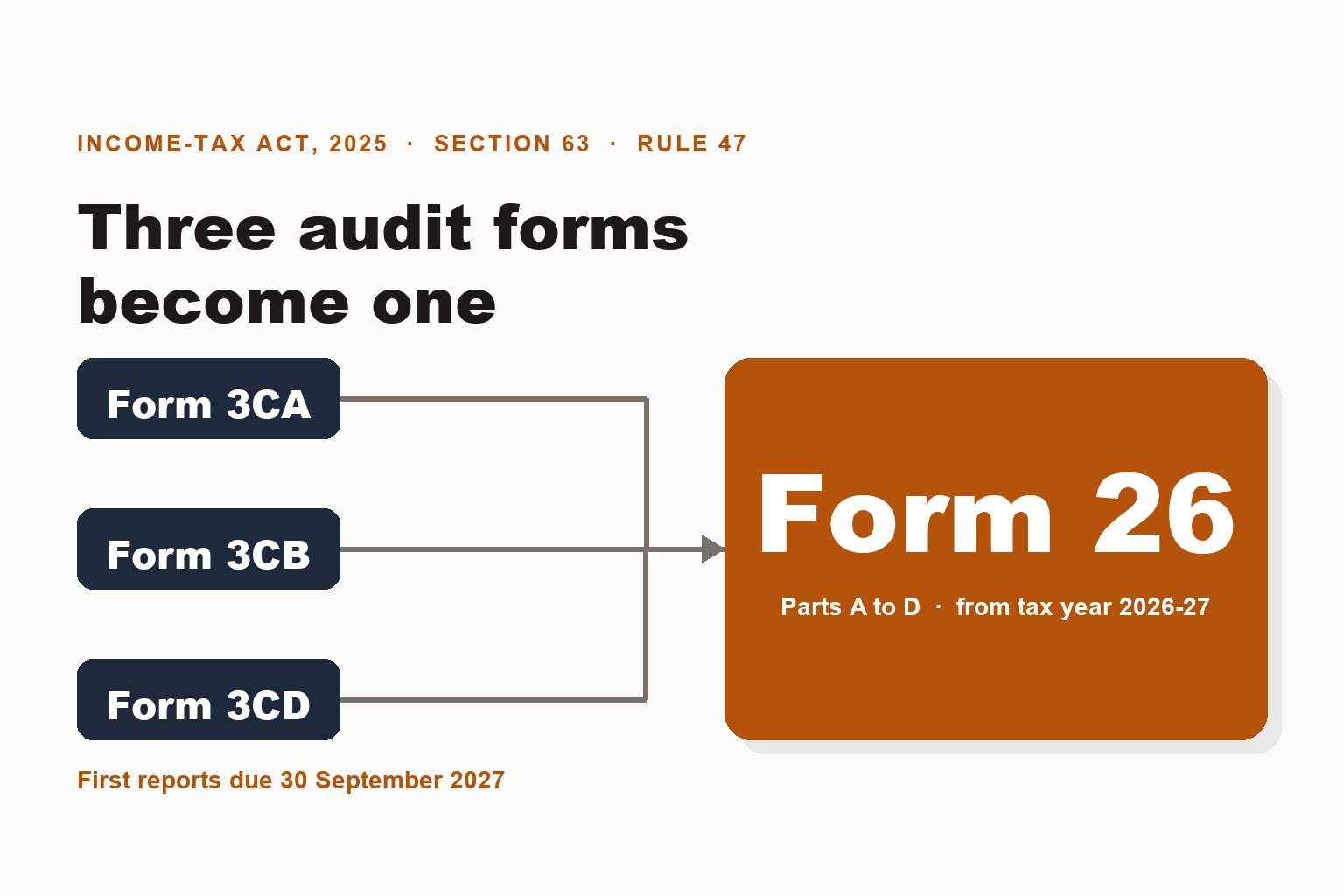

TL;DR: Under the Income-tax Act, 2025 the tax audit report is Form 26, prescribed by Rule 47 of the Income-tax Rules, 2026 for the audit required by Section 63. It replaces Forms 3CA, 3CB and 3CD with one form in four parts: Part A (particulars of the assessee), Part B (the statement of particulars, the old 3CD), Part C (the audit report where accounts are audited under another law, the old 3CA) and Part D (the audit report where they are not, the old 3CB). It applies to tax years commencing on or after 1 April 2026, so the first Form 26 reports are for tax year 2026-27 and fall due on 30 September 2027. It does not apply to the FY 2025-26 audit being finalised this September: that stays on Form 3CA/3CB with Form 3CD under the 1961 Act. The changes that matter for practice are structural: every clause is a mandatory Yes/No, a Yes opens a schedule, auditor qualifications must be categorised one of three ways with their profit impact stated, the form asks where the accounting data physically sits, and the whole thing is built to be validated against the return.
1. What Form 26 is
The Department’s FAQ describes Form 26 as “the prescribed Report of Audit of Accounts and Statement of Particulars required to be furnished under Section 63 of the Income-tax Act, 2025, in accordance with Rule 47 of the Income-tax Rules, 2026”. The 2026 Rules were notified in March 2026 and the form was published on the Department’s site on 26 March 2026, a week before the new Act commenced.
The mapping from the old framework is direct:
| Income-tax Act, 1961 | Income-tax Act, 2025 | |
|---|---|---|
| Audit provision | Section 44AB | Section 63 |
| Rule | Rule 6G, Income-tax Rules, 1962 | Rule 47, Income-tax Rules, 2026 |
| Forms | 3CA or 3CB, with 3CD | Form 26, Parts A to D |
| Year vocabulary | Previous year / assessment year | Tax year |
| Section references inside the form | 1961 Act | 2025 Act only (FAQ 7) |
That last row is easy to skate over. FAQ 7 says that all references in Form 26 “correspond exclusively to the Income-tax Act, 2025 and the Income-tax Rules, 2026”. A working paper that still says 40(a)(ia), 43B or 269SS will need translating before the numbers go in.
2. When it applies, and when it does not
FAQ 2: Form 26 is applicable for tax years commencing on or after 1 April 2026. FAQ 6: Forms 3CA, 3CB and 3CD “continue for tax audits for previous years relevant to assessment years up to 2026-27”, and “from tax year 2026-27, tax audit has to be furnished in Form No. 26”.
Two periods are therefore live in the same calendar year, with the same digits, and that is the whole source of the confusion:
| Accounts for | Called | Act | Audit form | Report due (ordinary case) |
|---|---|---|---|---|
| 1 April 2025 to 31 March 2026 | FY 2025-26 / AY 2026-27 | 1961 | 3CA/3CB + 3CD | 30 September 2026 |
| 1 April 2026 to 31 March 2027 | Tax year 2026-27 | 2025 | Form 26 | 30 September 2027 |
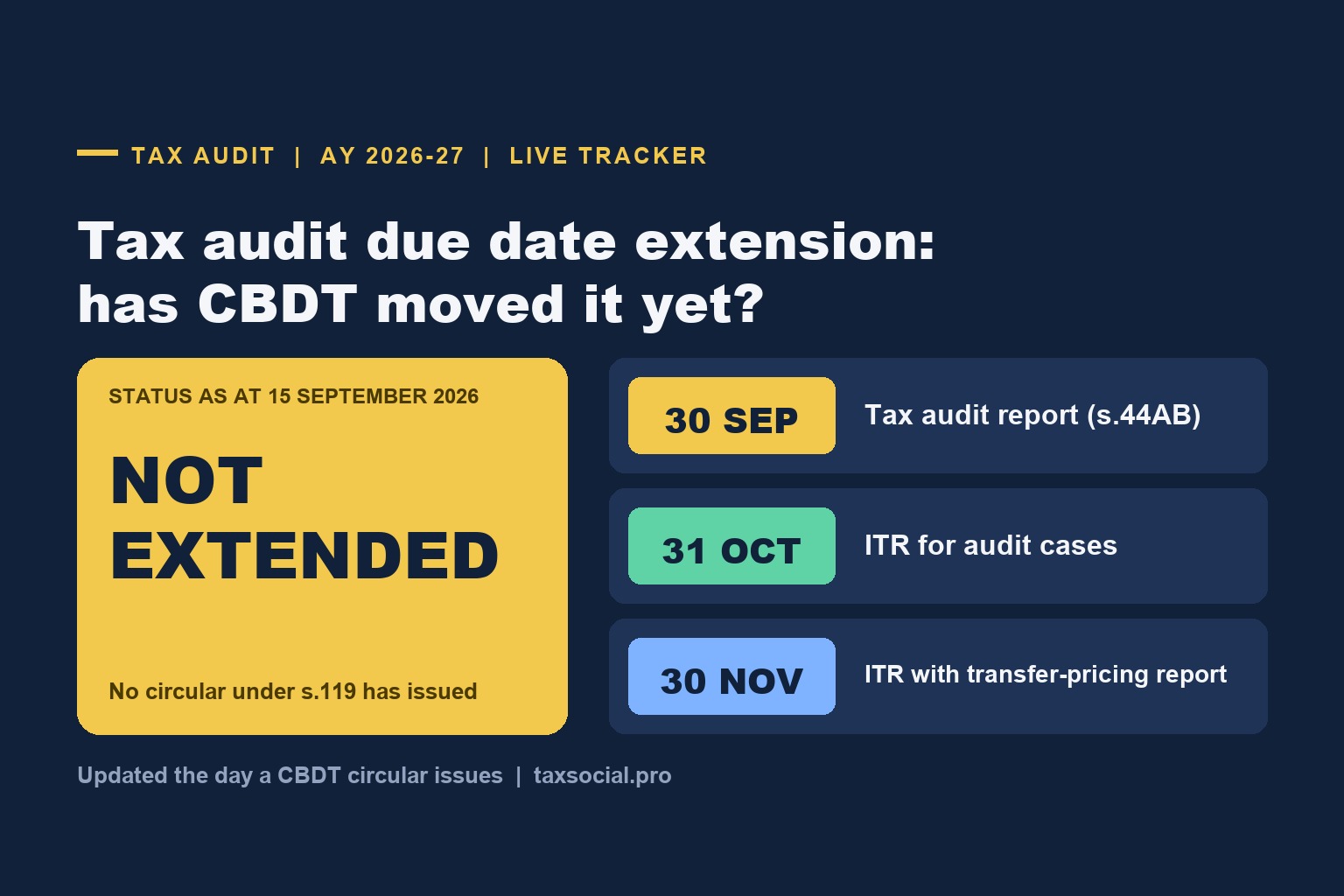
The due date comes from FAQ 5: Form 26 is furnished by the specified date, which is one month prior to the due date for the return under Section 263(1). Where the return date is 31 October, the report is due on 30 September; where the return date is 30 November (transfer-pricing cases), it is due on 31 October. The Department’s explainer adds “unless extended by the Board”, which is the same reservation the 1961 Act carried. Our note on AY 2026-27 versus tax year 2026-27 works through the two vocabularies for every other filing as well.
3. Who has to furnish it: Section 63
The thresholds have been carried across from Section 44AB with the same numbers. According to FAQ 3, Form 26 is required by a person carrying on business or profession whose accounts must be audited under Section 63, namely:
- Business: total sales, turnover or gross receipts exceeding Rs 1 crore, with the threshold rising to Rs 10 crore where cash receipts and cash payments each do not exceed 5% of total receipts and total payments respectively;
- Profession: gross receipts exceeding Rs 50 lakh;
- Presumptive cases under Section 58(2) or 61(2) (Table, Sl. Nos. 4 and 5) where the income declared is lower than the deemed income; and
- the opt-out case: a taxpayer who leaves a presumptive scheme within the five-year lock-in and whose income exceeds the basic exemption limit.
The renumbered presumptive provisions — Section 58 for the small business and profession rows, Section 61 for the specified-business rows — are covered in our Section 58 guide for tax year 2026-27. The point for audit is unchanged from the 1961 Act: turnover alone does not decide it; the presumptive election and the income declared do too.
4. The four parts
FAQ 8 sets out the structure. Part B applies in every case (FAQ 32); Parts C and D are alternatives.
| Part | Content | Old equivalent |
|---|---|---|
| A | Particulars of the assessee: name, address, PAN, status, tax year, residential status, contact details | The header of 3CD |
| B | Statement of particulars under Section 63, in eleven sub-parts (below), with schedules | Form 3CD |
| C | Audit report where the accounts are audited under any other law; the tax auditor relies on the statutory audit | Form 3CA |
| D | Audit report where the accounts are not audited under any other law; the accountant audits for Section 63 and gives the true-and-fair opinion | Form 3CB |
The Department’s explainer lists Part B’s sub-parts: (i) general information; (ii) books of account and method of accounting; (iii) receipts and income; (iv) expenses; (v) prior-period items; (vi) losses, depreciation and deductions; (vii) international taxation; (viii) other key parameters; (ix) TDS and TCS; (x) indirect taxation; and (xi) quantitative details. Part B runs to Clause 53, which is the quantitative-details clause (FAQ 28). The FAQ gives three specific correspondences: Clause 36 (depreciation and brought-forward losses) is the old Clause 18, Clause 43 is the remittances clause, and Clause 53 the quantitative clause. It does not publish a full old-to-new mapping, and neither does this article; the form has been redrawn, not renumbered.
5. What is actually new
Every clause is a Yes/No, and Yes opens a schedule
FAQ 17: each clause in Part B requires a mandatory Yes/No response. FAQ 15: schedules are required only where the corresponding clause is answered Yes. The common schedules are general information, accounting information, computation of receipt/income, computation of expenses, prior period, losses/depreciation/deductions, international taxation, TDS/TCS, GST, quantitative details and other key parameters. FAQ 16: every schedule referred to in Part B is part of the audit report and must be verified by the auditor. The practical consequence is that a “No” is now a positive representation by the auditor, on every clause, not a blank left for lack of information.
Qualifications have to be categorised, and costed
FAQ 35: any observation or qualification by the auditor must be categorised clause-wise into one of three heads — test-check basis applying materiality, based on management representation, or unable to verify. FAQ 36: paragraph 3 of Parts C and D requires the auditor to state the impact, if any, on the profit, loss or book profit of any observation, qualification, adverse remark, disclaimer or emphasis of matter in the statutory audit. The Department says openly that this is so qualifications can be analysed “in an automated/standardized way” and used in selecting cases for scrutiny. A qualification that used to sit in free text now has to be boxed and priced.
Where the books physically are
FAQ 18 ties the form to Rule 46 of the 2026 Rules: where books or documents are kept electronically they must remain accessible in India at all times and a daily backup must be maintained on India-located servers. Form 26 accordingly asks the auditor for the IP address and country of the server on which the accounting information is maintained and the address of the India-located backup server, and for the accounting software used. For a client on a foreign-hosted cloud accounting product this is a question to put now, not in August 2027.
Loans, deposits and specified sums by mode
FAQ 19: reporting covers all modes including journal entries, conversion of assets or liabilities and other non-cash modes, using prescribed mode codes. This is the same logic Notification 23/2025 brought into Clause 31 of Form 3CD for this year, carried into the new form.
TDS and TCS by transaction count
FAQ 38: the auditor must give the total number of transactions reported and not reported in the TDS/TCS statements as they stand after the latest correction statement, and the total amount of the unreported transactions. Reconciling the ledger to the quarterly statements at transaction level, rather than at total level, becomes part of the audit.
Depreciation without dates
FAQ 26: Clause 36 segregates assets used for less than 180 days from those used for 180 days or more without requiring specific dates of being put to use. The explainer calls this a “substantial reduction in compliance burden”; it removes the asset-wise date column that most of the old Clause 18 working consisted of.
Remittances, GST, ESI, MAT credit
FAQ 27: Clause 43 is restricted to remittances actually reported in Part D of Form 145 (the successor to Form 15CA) during the tax year and sits inside the international-taxation schedule, which also covers secondary adjustments and the interest-limitation rule (FAQ 21). FAQ 20: indirect-tax reporting has been rationalised, and total expenditure no longer has to be reconciled against the GST expenditure entries, which was the old Clause 44 exercise. The explainer’s tables add that ESI reporting is confined to disallowable amounts rather than employee-wise data, and that MAT credit is reported year-wise: entitlement, utilisation and carry-forward.
Items chargeable to tax but not through the profit and loss account
Among the changes the explainer lists across all the new forms is “separate identification of items chargeable to tax but not credited/debited to the profit and loss account”. Capital receipts and deemed income routed through reserves or the balance sheet get their own line, which means the balance-sheet movements have to be read for tax, not only the P&L.
Built to be matched with the return
FAQ 37 says the data in Form 26 has been aligned with the ITR so that it can be populated into the return, and so that mismatches that could trigger adjustments under Section 270(1) are reduced. The explainer is blunter: fields of the audit report are validated against the ITR, discrepancies are put to the taxpayer for revision, and system-driven discrepancies may trigger system-driven action “e.g. adjustment u/s 270(1)(a)”. The audit report and the return are one dataset from 2027.
6. Who signs, and how it is filed
FAQ 11: Form 26 must be signed by an Accountant as defined in Section 515(3)(b) of the 2025 Act, the successor to the Explanation to Section 288(2). FAQ 12: UDIN is mandatory and must be generated by the signing accountant and quoted in the form. FAQ 13: where the audit is in a firm’s name, the Firm Registration Number is required. The membership number, FRN and UDIN are structured fields in the form rather than a line in the signature block, which is what the Department means when it says auditor identification has been strengthened. The ICAI’s field-level UDIN validation, described in our note on UDIN for tax audits, is the other half of that.
The filing sequence in FAQ 14 is the familiar one: the assessee engages the accountant; the accountant fills Form 26 on the e-filing portal with membership number and FRN; UDIN is generated and quoted; the form is signed with the accountant’s DSC and uploaded; and the assessee electronically accepts the form, which is what completes the filing.
7. What to change before the first Form 26 season
The first Form 26 reports are not due until September 2027, but the tax year they cover started on 1 April 2026 and is already five months old. Some of what the form asks for cannot be reconstructed after the event.
- Rebuild the checklist from the form, not from 3CD. The FAQ gives three clause correspondences and no full map; the eleven sub-parts of Part B are the skeleton to build on.
- Translate every section reference. Working papers, client data-request lists and software templates that cite the 1961 Act have to be renumbered to the 2025 Act before the figures are entered (FAQ 7).
- Ask every client where the books are hosted. Software name, server IP and country, and the India-located daily backup under Rule 46. A client who cannot answer this in 2027 has a Form 26 problem and a Rule 46 problem.
- Move TDS/TCS reconciliation to transaction level during the year, so that the reported-versus-unreported counts in FAQ 38 are a report, not a project.
- Design the qualification register around the three categories in FAQ 35 and a profit-impact column for paragraph 3.
- Build the ITR reconciliation into the audit. If the Department will validate Form 26 against the return, the auditor should have done it first.
- Train staff before August 2027. The last fortnight of September is the wrong time to learn a form that has been redrawn rather than renumbered.
8. What not to do this September
Do not use Form 26, or a Form 26-shaped checklist, for the FY 2025-26 audit. The Department has said in terms that AY 2026-27 audits stay on Forms 3CA/3CB and 3CD, and the Form 3CD in use is the one amended by Notification 23/2025, with the MSME, Clause 31 and buyback changes. That report is due on 30 September 2026 and is covered clause by clause in our tax audit AY 2026-27 guide. The two seasons overlap in the calendar; they do not overlap in law.
9. Quick answers
Which section? Section 63 of the Income-tax Act, 2025, the successor to Section 44AB.
Which rule? Rule 47 of the Income-tax Rules, 2026, the successor to Rule 6G.
From when? Tax years commencing on or after 1 April 2026; the first is tax year 2026-27.
First due date? 30 September 2027 for ordinary cases, 31 October 2027 where the return is due on 30 November, subject to extension by the Board.
Does it apply to FY 2025-26? No. That audit is under the 1961 Act on Forms 3CA/3CB and 3CD, due 30 September 2026.
Do the thresholds change? No. Rs 1 crore and Rs 10 crore for business, Rs 50 lakh for profession, and the presumptive cases under Sections 58 and 61.
Who signs? An accountant under Section 515(3)(b), with UDIN, membership number and FRN.
Is Form 3CD abolished? For audits under the 2025 Act its content lives in Part B of Form 26. For AY 2026-27 and earlier it continues.
10. Sources
- Income Tax Department, “Form No. 26 — Frequently Asked Questions (FAQs)”, 38 FAQs on the audit report and statement of particulars under Section 63 read with Rule 47. FAQ numbers are cited in the text.
- Income Tax Department, “Form No. 26 (Erstwhile Form Nos. 3CA, 3CB & 3CD)”, explainer on purpose, structure, who files, process flow and the changes common to the new forms.
- Income-tax Act, 2025 — Section 3 (tax year), Section 63 (audit of accounts), Section 263(1) (return due dates), Section 515(3)(b) (accountant), Section 536 (repeal and savings).
- Income-tax Rules, 2026 — Rule 46 (electronic books, India-located backup) and Rule 47 (Form 26).
- Income-tax Act, 1961, Section 44AB and Income-tax Rules, 1962, Rule 6G, for the framework that continues to apply to AY 2026-27.
The Department’s FAQ and explainer are the only official commentary on Form 26 at the date of writing. Where the form itself, the e-filing utility or a later circular differs from them, the later document governs. Take advice from a Chartered Accountant on a specific position.



Comments (0)
No comments yet. Be the first to comment!