
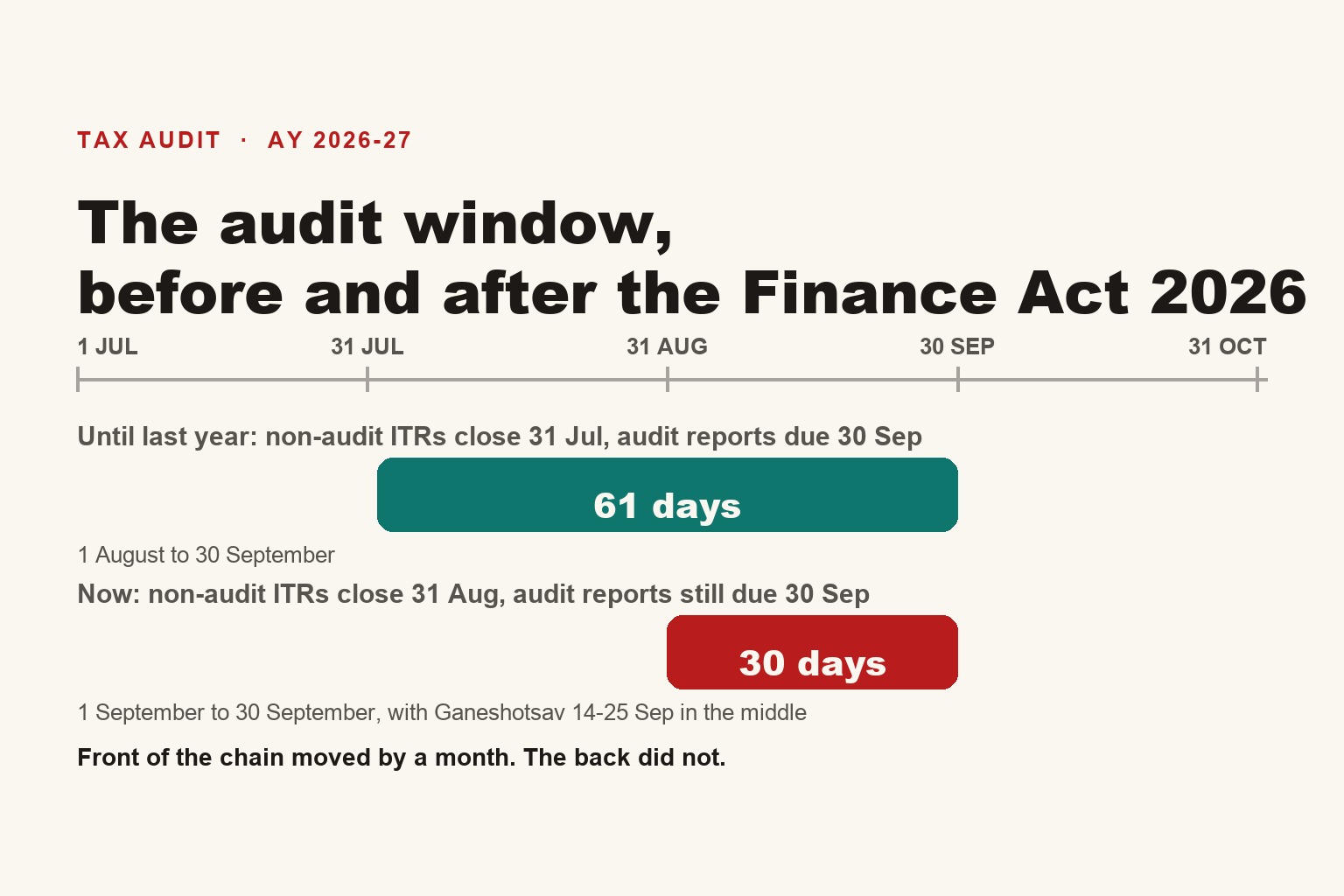

TL;DR: The Finance Act, 2026 rewrote the return due-date table so that a business or professional assessee whose accounts are not audited now files by 31 August instead of 31 July. It made that change in both the Income-tax Act, 1961 and the Income-tax Act, 2025, so it is permanent. It did not touch the tax audit report. The “specified date” under Section 44AB is still one month before the 31 October audit-case return date, which is 30 September 2026. The working gap between the end of the non-audit season and the audit deadline was 61 days. It is now 30. This article sets out the arithmetic, the calendar that sits inside those 30 days, what CBDT did in 2024 and 2025, what the profession has asked for so far, and the two-part fix. Position as at 7 September 2026: no extension has issued, and nothing below should be planned around.
1. What the Finance Act 2026 changed, and what it did not
Clause 5 of the Finance Act, 2026 substituted Explanation 2 to Section 139(1) of the 1961 Act with effect from 1 March 2026. The old Explanation had three dates. The new one has four, and the fourth is the one that matters here.
| Assessee | Return due before the Finance Act 2026 | Return due now |
|---|---|---|
| Assessee required to furnish a transfer-pricing report under Section 92E | 30 November | 30 November |
| Company; any assessee whose accounts are required to be audited under any law; partner of such a firm | 31 October | 31 October |
| Assessee with income from profits and gains of business or profession whose accounts are not required to be audited, and partners of such firms | 31 July | 31 August |
| Any other assessee | 31 July | 31 July |
| Tax audit report under Section 44AB (specified date) | 30 September | 30 September |
The same 31 August date was written into Section 263(1) of the Income-tax Act, 2025, so it carries forward into tax year 2026-27 and beyond. This is not a Section 119 extension that lapses. It is the statute’s own date. Our belated-return guide walks through the Gazette text and the one trap in it: the 31 August row turns on having business or professional income with accounts that are not required to be audited, not on which ITR form you file.
Now look at the last row. Section 44AB requires the audit report by the specified date, and Explanation (ii) to that section defines the specified date as one month prior to the due date for furnishing the return under Section 139(1). For an audit case the return date is 31 October, so the report is due 30 September. Section 63 of the 2025 Act says the same thing against Section 263(1). The Finance Act 2026 did not amend either provision. The audit calendar is exactly where it was.
2. The arithmetic: 61 days became 30
The statute has never fixed a “window” for tax audit work. In theory an audit for FY 2025-26 could have started on 1 April 2026. In practice it does not, and everyone who has worked a September knows why. The non-audit returns come first, because they are due first and because a client with a Rs 80 lakh turnover and no audit will not sit still while the firm opens a Form 3CD for someone else. The audit files open in earnest when the non-audit season closes.
| Non-audit season ends | Audit report due | Working window | |
|---|---|---|---|
| Up to AY 2025-26 (statute) | 31 July | 30 September | 1 August to 30 September: 61 days |
| AY 2026-27 (Finance Act 2026) | 31 August | 30 September | 1 September to 30 September: 30 days |
That is the honest measure. Not that Parliament took days away from the audit, but that it added a month to the front of the chain and left the back where it was, so the working window that every small and mid-sized practice actually uses fell by half. Nothing in the Finance Act 2026 speaks to the audit calendar at all. The 31 August date was inserted; the one-month chain from the audit-case return date was left as it was. That reads as a gap in the drafting, not a decision anyone made.
3. Why the non-audit date matters for audits: it is the same offices
The department’s calendar treats a freelancer’s ITR-3 and a trader’s tax audit as two different taxpayers with two different dates. They are. But they are not two different offices. The firm that files ITR-3 and ITR-4 for freelancers, doctors, small traders and partnership firms until midnight on 31 August is the firm that opens the audit working papers on 1 September. The articled assistants are the same. The partner who signs is the same. The work did not shrink when the date moved. The calendar did.
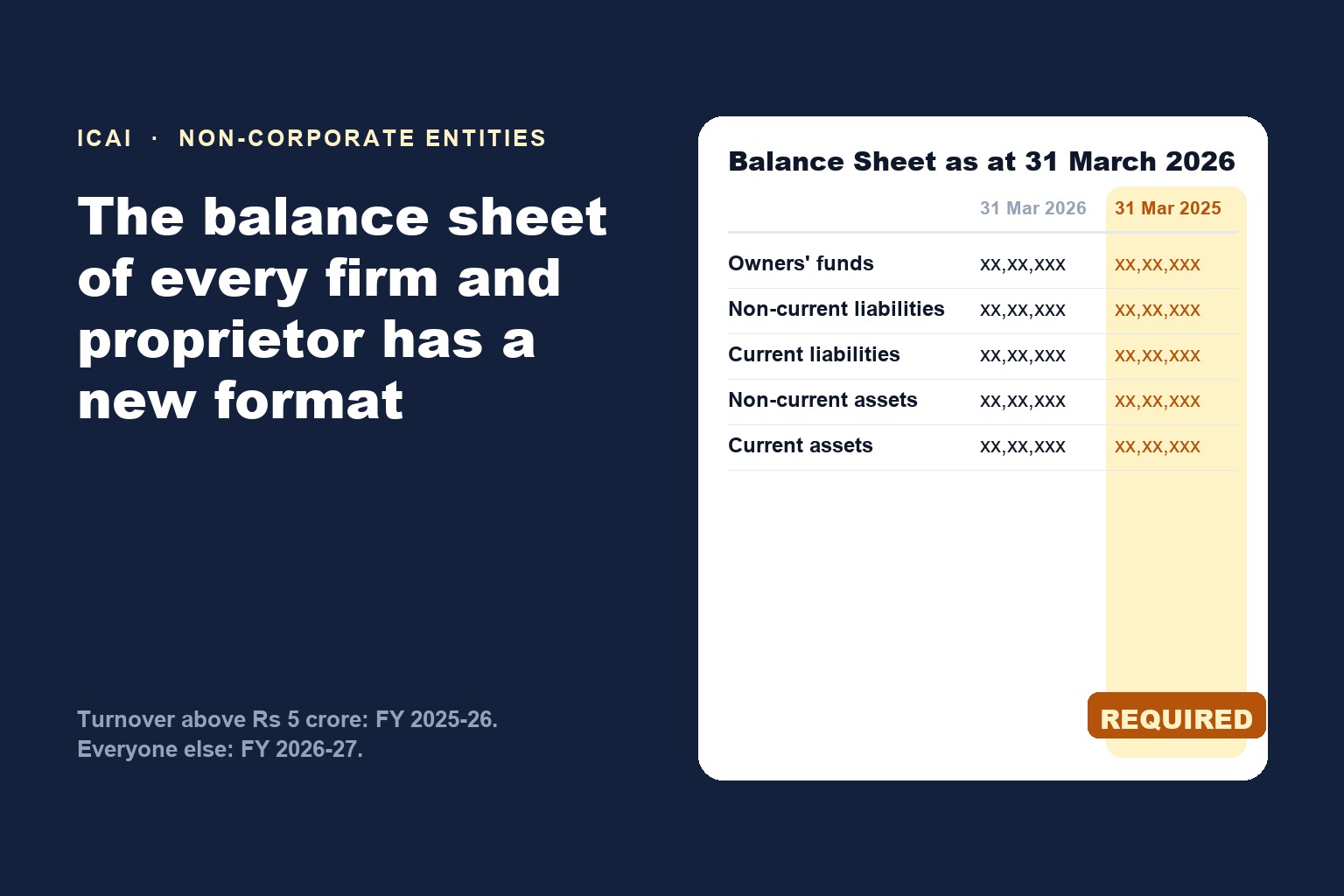
The Chartered Accountants Association, Jalandhar made the same point in its representation to the Finance Minister on 6 September 2026: the separate 31 August date for business taxpayers not liable to audit has produced “considerable overlap” of professional work in August and September. The Association also points to late ITR utilities this year (it cites ITR-3 on 18 June and ITR-6 on 4 August, with the online utilities following later) and to the ICAI’s detailed financial-statement format for non-corporate entities, which adds compilation and verification work to every audit file. Those are the Association’s figures and characterisation; the point that stands on its own is the calendar.
4. What else sits inside those 30 days
September is not an empty month with one deadline at the end of it. For a practice with GST, MCA and income-tax clients, the 30 days between 1 and 30 September 2026 look like this:
| Date | What falls due |
|---|---|
| 11 September | GSTR-1 for August 2026 (monthly filers) |
| 15 September | Advance tax, second instalment: 45 per cent cumulative. The first September instalment under the Income-tax Act, 2025 |
| 15 September | CCFS-2026 closes at MCA; every pending company filing that was waiting for the reduced fee has to be in |
| 20 September | GSTR-3B for August 2026 (monthly filers) |
| 30 September | DIR-3 KYC for every individual who held a DIN on 31 March 2026 (Rule 12A) |
| 30 September | Outer date for the FY 2025-26 AGM under Section 96(1) of the Companies Act (subject to the earlier-of test), and with it the board meetings and financial statements that precede an AGM |
| 30 September | Tax audit reports under Section 44AB; audit reports of trusts and institutions in Forms 10B and 10BB, which sit one month before the same 31 October return date |
And then the festival. Ganesh Chaturthi is 14 September 2026 and Anant Chaturdashi is 25 September 2026. The first day is a public holiday in Maharashtra and Goa. The other nine are not, and that is the point: anyone who has worked a September in Mumbai, Pune or Panaji knows those ten days are a working city running at half speed, with staff on leave in rotation, clients unreachable and every counter slow. That is a practitioner’s observation, not a statistic, but it is one every practitioner in those cities will recognise. Those ten days fall in the middle of the thirty.
5. What CBDT did in 2024 and 2025
The Board has extended the 30 September date in each of the last two years. The dates matter more than the fact.
| Year | Instrument | Issued | What it did |
|---|---|---|---|
| AY 2024-25 | Circular No. 10/2024 | 29 September 2024 | Specified date extended from 30 September to 7 October 2024, citing difficulties in electronic filing of audit reports |
| AY 2025-26 | Circular No. 6/2025 | 27 May 2025 | Return date for 31-July assessees extended to 15 September 2025 (a further one-day extension to 16 September was announced on 15 September) |
| AY 2025-26 | Circular No. 14/2025 | 25 September 2025 | Specified date extended from 30 September to 31 October 2025, after tax bar associations had moved High Courts |
| AY 2025-26 | Circular No. 15/2025 | 29 October 2025 | Audit report extended to 10 November 2025; audit-case return to 10 December 2025 |
Three things stand out.
First, the timing. Relief on 29 September for a 30 September deadline, and on 25 September for the same deadline a year later, arrives after the profession has already done the all-nighters. An extension issued five days before the date is not a plan anyone can staff around. It is a receipt for work already done under the old date.
Second, the reasons. The 2024 extension was for portal difficulties. The 2025 extensions followed a late ITR-utility season and litigation. Both were treated as one-off events. This year the reason is not an event. It is the statute. If the Board accepted that 31 July was unrealistic for the non-audit season, and Parliament then made 31 August the permanent date, the same logic says that an audit season which can only start on 1 September cannot end on 30 September.
Third, what 2025 actually proves. Last year the non-audit season ran to 16 September because the Board extended it. The audit report ended up due on 10 November. That is 55 days after the non-audit close. The Board did not design it that way, and it took two circulars and High Court petitions to get there, but that is where the calendar settled when the front of the chain moved. This year the front has moved again, by statute, to 31 August. Thirty days is not where it should settle.
6. The specified-date chain is anchored to the wrong link
The structural problem is simple to state. The audit report date is defined relative to the audit-case return date (31 October, less one month). It has no relationship at all to the non-audit return date. So when Parliament moved the non-audit date, the audit chain did not move, because nothing in the chain refers to it.
That worked when the non-audit season ended on 31 July, because a two-month gap to 30 September was built in by coincidence. It stopped working the moment the non-audit date became 31 August. The 2025 Act carries the same definition in Section 63, so the problem is not a 1961-Act leftover that will disappear on its own next year. It will be exactly the same in September 2027 for the first Form 26 season, and in every September after that, unless the definition is changed.
And from tax year 2026-27 the cost of missing it changes character. Under the 1961 Act a late report attracts a discretionary penalty under Section 271B, with reasonable cause as a defence. Under Section 428 of the 2025 Act a late tax audit report attracts a fee: Rs 75,000 where the delay is up to one month and Rs 1,50,000 beyond that, charged as a fee rather than a penalty, so the reasonable-cause route does not apply. That does not touch this year’s AY 2026-27 audit, which is under the 1961 Act. It is the strongest reason to fix the calendar before the first Form 26 season, because from next year a deadline that is unrealistic is also one that charges Rs 75,000 per client for being unrealistic.
7. The ask: two parts
Part one is for this year, and it is an exercise of the Board’s power under Section 119. Extend the specified date for AY 2026-27 from 30 September to 31 October 2026, extend the audit-case return date to 30 November 2026 so the one-month gap survives, and say in the circular itself whether the extension applies for the purposes of Section 234A, so that nobody spends October arguing about it. Do it in the first half of September, not on the 28th. The Jalandhar representation asks for 31 October or, in the alternative, for the audit report and the audit-case return to be synchronised at 31 October. Either is workable. A circular that arrives on time is worth more than one that arrives with an extra week.
Part two is for Parliament, and it is a one-line amendment to the Income-tax Act, 2025. Move the audit-case return date in Section 263(1) from 31 October to 30 November, and the transfer-pricing date from 30 November to 31 December. Section 63’s one-month rule then delivers an audit report date of 31 October on its own, and the audit season starts two months after the non-audit season ends, which is the gap the profession had until this year. No new definition is needed. Two consequences should be said out loud: the transfer-pricing accountant’s report under Section 172 hangs off the same one-month rule, so it moves with the return date to 30 November; and the Section 428 fees for both reports then run from the new dates. The revenue cost is a month’s delay in returns whose tax has largely been paid as advance tax, and the Board is better placed than we are to put a number on it. The alternative is what happens every September: representations, waiting, a circular in the last week, and a profession that burns out on schedule.
8. What to do in the meantime
Work to 30 September. Nothing in this article changes a due date, and a representation is not a circular. The AY 2026-27 checklist sets out the Form 3CD that applies, the Notification 23/2025 changes and the file discipline that gets a report out by the date. If a report is late, Section 271B allows a penalty of one-half per cent of turnover or Rs 1,50,000, whichever is less; it is discretionary, and Section 273B bars it where the assessee shows reasonable cause. A documented reason is a defence. A hoped-for extension is not.
If the Board does extend, the dates in the checklist article change and nothing else does. The extension tracker carries the current status, the update log and the circular the day it issues; this article will be updated the same day.
FAQ
Is the tax audit report for AY 2026-27 still due on 30 September 2026? Yes, as at 15 September 2026. No CBDT circular extending the specified date has issued. The live tracker is re-dated every time we check.
Did the Finance Act 2026 change the tax audit due date? No. It moved the return date for non-audit business and professional assessees from 31 July to 31 August, in both the 1961 Act and the 2025 Act. Section 44AB and Section 63 were not amended.
Why does the 31 August date affect audits? Because the same firms do both. The working window between the end of the non-audit season and the audit deadline fell from 61 days to 30.
What happened in 2025? The non-audit return date was extended to 15 September, then 16 September. The audit report date was extended to 31 October on 25 September 2025, then to 10 November on 29 October 2025. The audit-case return went to 10 December.
What has been asked for this year? The Chartered Accountants Association, Jalandhar wrote to the Finance Minister on 6 September 2026 asking for 31 October 2026, or for the audit report and audit-case return to be synchronised at 31 October.
What is the permanent fix? Move the audit-case return date in Section 263(1) of the 2025 Act to 30 November. Section 63 then puts the audit report at 31 October without any further amendment.
Is there a late fee for a late tax audit report? Not for AY 2026-27, which is under the 1961 Act (Section 271B penalty, discretionary, reasonable cause a defence). From tax year 2026-27, Section 428 of the 2025 Act charges a fee of Rs 75,000 for a delay up to one month and Rs 1,50,000 beyond that.
Sources
- The Finance Act, 2026 (Gazette of India, Extraordinary, Part II, Section 1, 30 March 2026), clause 5 substituting Explanation 2 to Section 139(1) of the Income-tax Act, 1961 with effect from 1 March 2026; the corresponding amendment to Section 263(1) of the Income-tax Act, 2025.
- Income-tax Act, 1961, Section 44AB and Explanation (ii); Sections 119, 234A, 271B, 273B. Income-tax Act, 2025, Sections 63, 172, 263(1) and 428.
- CBDT Circular No. 10/2024 dated 29 September 2024; Circular No. 6/2025 dated 27 May 2025; Circular No. 14/2025 dated 25 September 2025; Circular No. 15/2025 dated 29 October 2025.
- Chartered Accountants Association, Jalandhar, representation to the Union Finance Minister dated 6 September 2026.
- Companies Act, 2013, Section 96(1); Companies (Appointment and Qualification of Directors) Rules, 2014, Rule 12A.
This is an analysis and a position, written as at 7 September 2026. It describes the law and the dates as they stand; it does not change any of them. Take advice from a Chartered Accountant on a specific filing.



Comments (0)
No comments yet. Be the first to comment!