
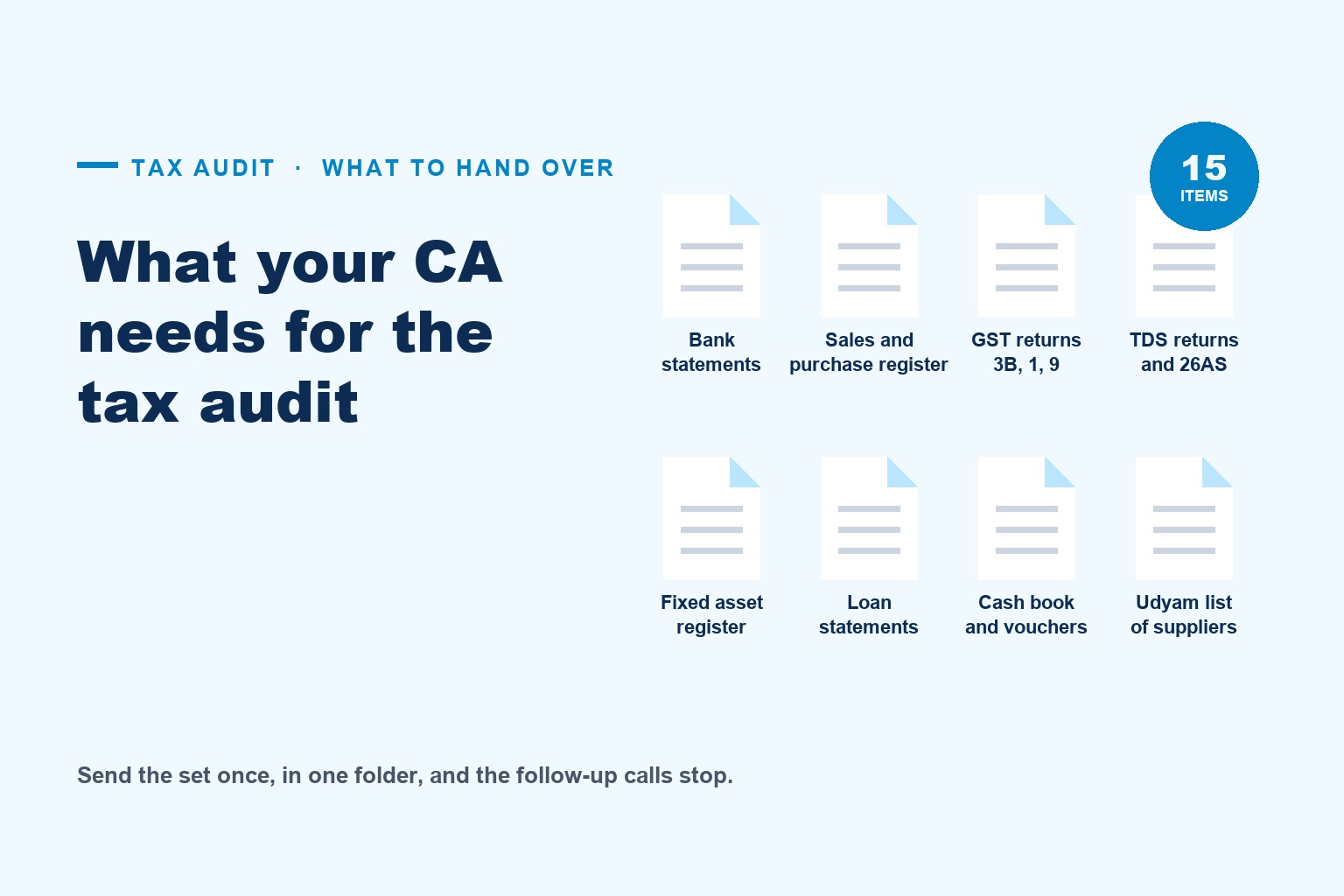

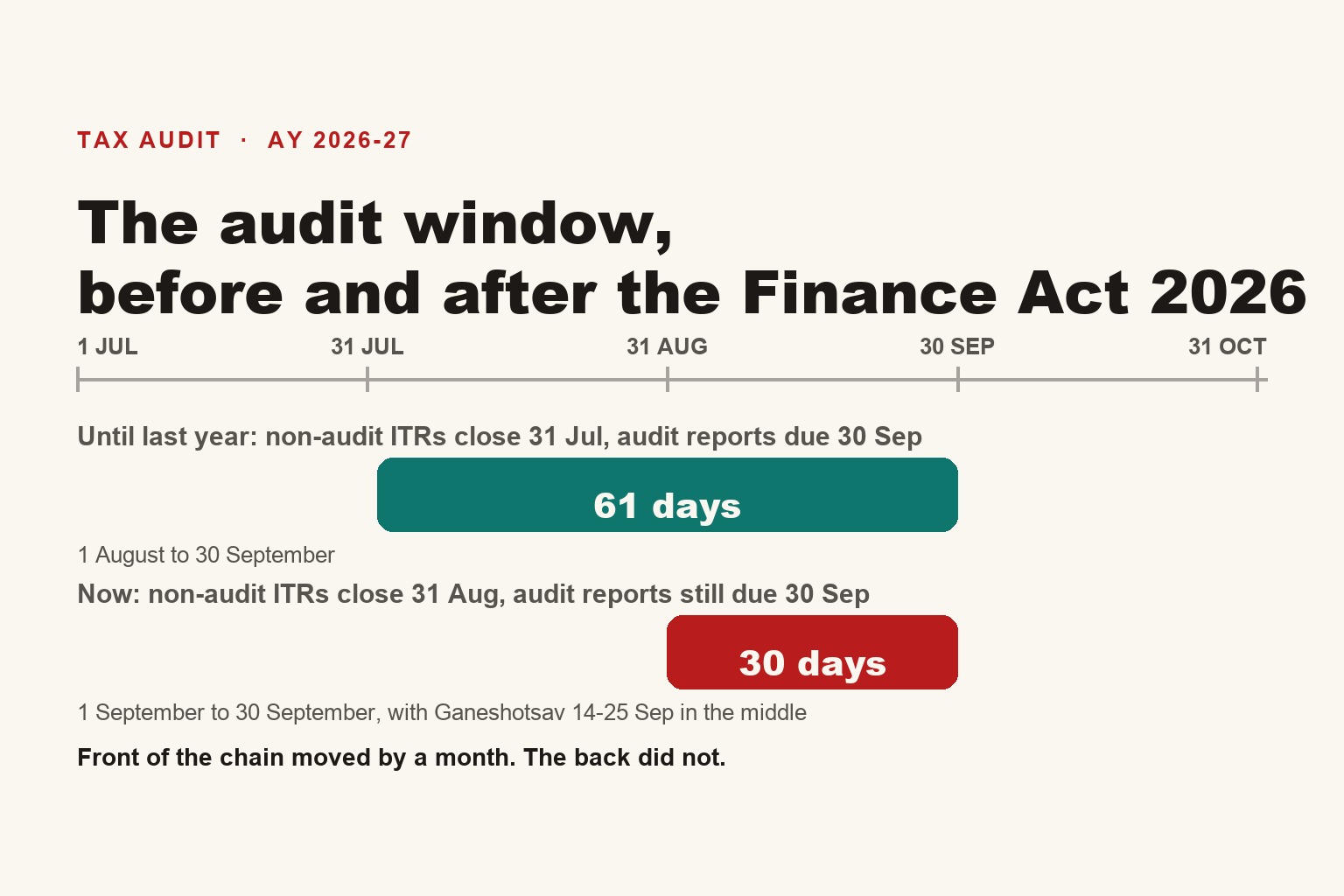
TL;DR: A tax audit under Section 44AB is built out of documents the auditor cannot create: your books, your bank statements, your GST and TDS returns, your registers of assets, loans, cash and suppliers. The report for AY 2026-27 (FY 2025-26) is due on 30 September 2026 (31 October where a Section 92E transfer-pricing report applies, with the return then due 30 November), and, as at 10 September, no extension has been notified. Below are the fifteen items a tax auditor needs, in the order they are used, with the Form 3CD clause each one answers, so that the request makes sense rather than feeling like an interrogation. Send the set once, in one folder, with a covering note of what is missing and why, and the follow-up calls stop. Every item that is late delays the audit by more than a day, because the clauses cross-check each other.
The fifteen items
| # | Document | What it feeds in Form 3CD | Format that saves time |
|---|---|---|---|
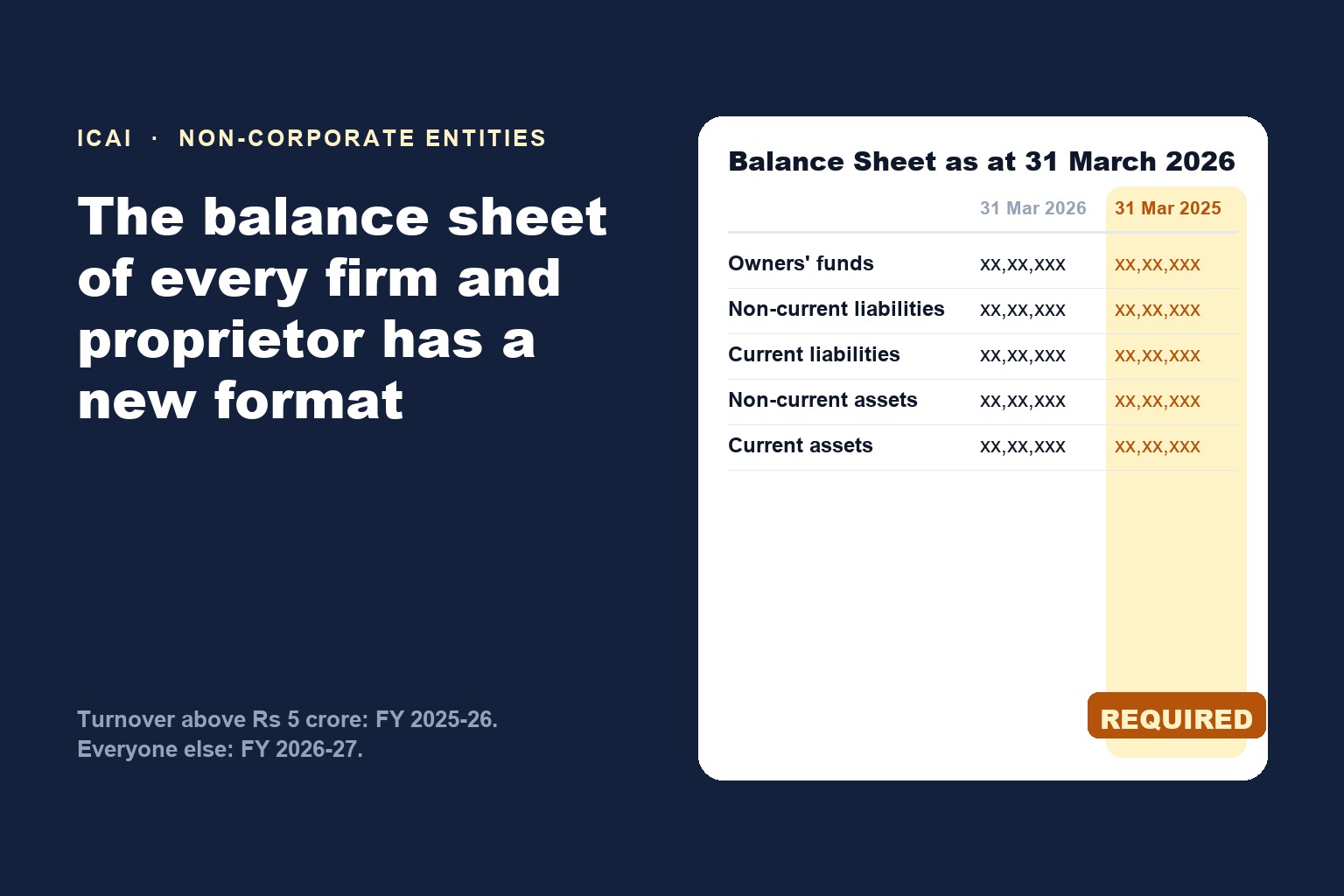
| 1 | Final trial balance, profit and loss account and balance sheet for FY 2025-26, with the previous year’s comparatives, and the accounting software backup or export | Everything: the audit is of these accounts. Clause 11 (books maintained), clause 13 (method of accounting), clause 40 (ratios) | Tally, Zoho or Busy backup plus PDF of the finals; the non-corporate financial-statement format now expected by ICAI, if it applies |
| 2 | All bank statements for 1 April 2025 to 31 March 2026, every account including closed ones and OD/CC accounts, with the bank reconciliation at 31 March | Cash-versus-digital test for the Rs 10 crore limit (clause 8), receipts and payments in cash, loan movements (clause 31), interest for clause 26 | Bank-issued PDF for every account; Excel export where the bank gives one |
| 3 | Sales register and purchase register with GSTIN of every party, and the sales and purchase returns | Turnover for the Section 44AB test (clause 8), quantitative details where applicable, clause 44 supplier classification, matching to GST returns | Excel with party name, GSTIN, invoice number, date, taxable value, tax |
| 4 | GST returns: GSTR-1 and GSTR-3B for every tax period (monthly, or quarterly under QRMP), GSTR-2B downloads, GSTR-9 and 9C for FY 2024-25, and the electronic credit and cash ledger | Turnover reconciliation with the books; input tax credit for clause 27; supplier registration status for clause 44; reverse-charge expenditure | Portal PDFs of 3B and 1 for every monthly or quarterly tax period; 2B as Excel for the year |
| 5 | TDS and TCS returns (Form 24Q, 26Q, 27Q, 27EQ for all four quarters), challans, and Form 26AS and the AIS for the year | Clause 34 (TDS/TCS compliance: deducted, deposited, late); clause 21 (expenses disallowable under Section 40(a) for TDS default); tax credits | TRACES justification reports and the filed return PDFs; 26AS from the portal |
| 6 | Fixed-asset register with additions and deletions during the year, invoices for additions, date put to use, and any asset sold or scrapped | Clause 18 (depreciation allowable, block-wise); capital expenditure for clause 44; disallowance of capital items in revenue heads | Excel block-wise: opening WDV, additions before and after 3 October (for the half-year rate), deletions, closing WDV |
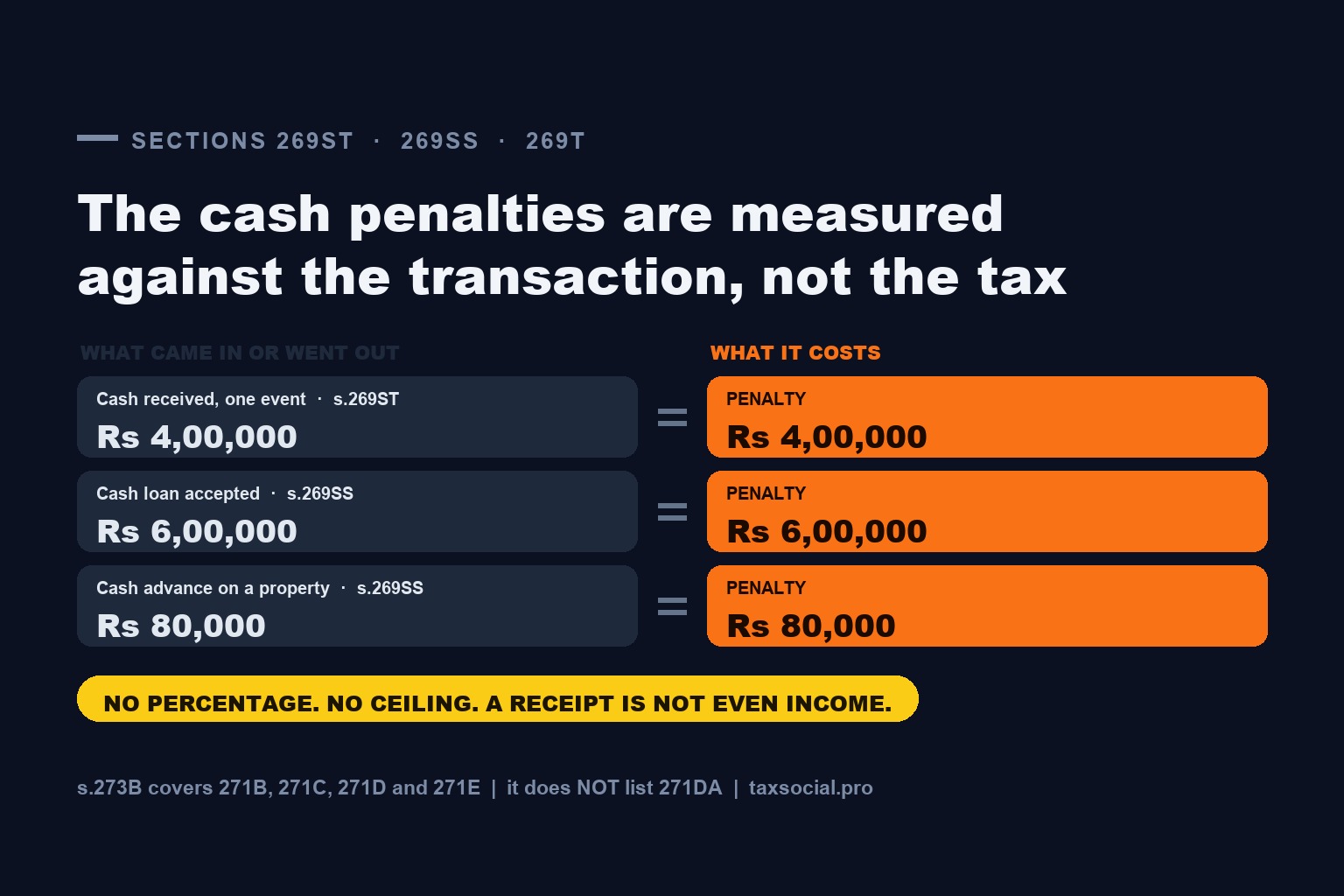
| 7 | Loans, deposits and advances schedule: every loan taken or repaid, from whom, mode (cheque, transfer, cash), with sanction letters, statements and interest certificates | Clause 31 (Sections 269SS and 269T: loans, deposits and specified advances relating to immovable property of Rs 20,000 or more, taken or repaid otherwise than by account-payee instrument or electronic mode, subject to the aggregate tests and the statutory exceptions); interest for clause 26; unsecured loans from directors or partners | Excel by lender: opening, taken, repaid, closing, mode, PAN |
| 8 | Cash book and the Rs 2 lakh schedule: every receipt and every payment of Rs 2 lakh or more from or to one person in a day, for one transaction or one event, made otherwise than by account-payee cheque, account-payee draft or electronic mode (a non-account-payee cheque counts) | Clause 31 (Section 269ST, the receipts and payments sub-clauses); the 5 per cent cash tests for the Rs 10 crore limit; Section 40A(3) cash payments above Rs 10,000 for clause 21 | Cash book export; a one-page schedule of receipts and payments that crossed the limits, or a statement that none did |
| 9 | Statutory dues schedule: GST, TDS, PF, ESI, professional tax, other levies: amount for the year, paid during the year, unpaid at 31 March and the date paid afterwards | Clause 26 (Section 43B: dues in clauses (a) to (g) are deductible on payment, with the relaxation for payment by the return due date; MSME dues under clause (h) only on actual payment within the MSMED time limit); clause 20 (employee contributions to PF and ESI, allowable only if deposited by the statutory due date under Section 36(1)(va)) | Month-wise Excel with due date and actual date of deposit; ECR and challans for PF and ESI |
| 10 | MSME supplier list: every supplier that is a micro or small enterprise, its Udyam number, the invoice dates, the agreed credit period, the date of payment, and any amount outstanding beyond the period at 31 March | Clause 22 (interest under the MSMED Act, and the Section 43B(h) disallowance of amounts not paid within the MSMED time limit: 15 days without an agreement, up to 45 with one) | Excel by supplier: Udyam number, invoice date, due date, paid date; obtain Udyam certificates where the status is unclear |
| 11 | Inventory valuation: closing stock statement at 31 March with quantity, rate, method (cost or NRV), and the physical verification record | Clause 14 (method of valuation, deviation from ICDS II); clause 35 quantitative details for traders and manufacturers | Item-wise Excel with the basis of cost; the auditor may ask for purchase invoices supporting the rate |
| 12 | Payroll register and employee-benefit records: salary register, Form 16 / 24Q reconciliation, bonus, gratuity and leave-encashment provisions and payments, and any ESOP or perquisite | Clause 20 (employee contributions); clause 26 (bonus, employer contributions to a gratuity or other welfare fund, and leave encashment under Section 43B); clause 21 (a provision for gratuity under Section 40A(7); TDS on salary); clause 44 (salaries as an item outside GST, excluded with a note) | Month-wise salary register; provision working papers |
| 13 | Related-party and partner or director schedule: remuneration, interest on capital, rent, loans, purchases and sales with related parties; for a firm, the partnership deed and any change in partners or profit-sharing during the year | Clause 9 (firm: partners, shares, changes); Section 40(b) limits on partner remuneration and interest for clause 21; specified-person payments under Section 40A(2) | Deed and supplementary deeds as PDF; a one-page schedule of related-party transactions |
| 14 | Supplier GSTIN master for clause 44: every supplier with GSTIN, registration type (regular, composition, unregistered), and whether what was bought is exempt from GST | Clause 44 (break-up of total expenditure by the supplier’s GST status) | The purchase register in item 3, plus a column for composition status and one for exempt supplies; Sachin’s clause 44 explainer shows how to build it from GSTR-2B |
| 15 | Previous year’s tax audit report, ITR and computation, any assessment or appeal orders, notices received during the year, and the signed management representation covering the clauses where the auditor relies on you (cash receipts, MSME status, related parties, contingent liabilities) | Continuity: clause 8 (which clause of 44AB applied last year), opening WDV, brought-forward losses and disallowances reversed on payment; the representation is what the auditor holds you to | Last year’s 3CD PDF and the ITR-V; the representation letter is drafted by the auditor for your signature |
Why the order matters
Items 1 to 5 establish the numbers: the accounts, the bank, the sales and purchases, and the two returns filed with the government during the year. The auditor reconciles turnover per books to GSTR-1 and GSTR-3B, and TDS per books to the TDS returns and Form 26AS, before anything else. A difference there is a question for you, and until it is answered the rest waits. Items 6 to 13 are the clause-specific schedules; each one turns into a clause of Form 3CD, and each one is faster if you prepare it in the format in the last column than if the auditor rebuilds it from the ledger. Items 14 and 15 close the report.
Two of the schedules generate most of the follow-up calls in a typical audit, so they are worth doing first. The MSME list (item 10) is new enough that most clients do not keep it during the year; it decides the Section 43B(h) disallowance, which is real money, and it needs the Udyam status of each supplier, which only the supplier can confirm. The cash schedule (item 8) decides which turnover limit applies to you and whether the Section 269ST reporting is triggered; the Rs 10 crore limit is available only where actual cash receipts and cash payments were each within 5 per cent, and the books and bank statements are what substantiate that. The tax audit limit hub sets out the cash tests.
What the auditor does with it
The report is Form 3CB (or Form 3CA where the accounts are also audited under another law, typically a company), with the statement of particulars in Form 3CD, filed on the income-tax portal by the auditor and accepted by you from your login. Vijay’s Form 3CD checklist for AY 2026-27 is the clause-by-clause working paper on the other side of this list, including the changes to clauses 21, 22, 31 and 36B that apply this year. Once the report is on file the return follows, due 31 October 2026, with the disallowances the report identifies carried into the computation.
If the list cannot be completed in time, the auditor reports on what is complete, with observations and qualifications where the evidence is missing; a revised report is allowed under Rule 6G(3) only where a later payment requires a Section 40 or Section 43B disallowance to be recalculated, so “file now, fix later” is not a plan. What cannot be done is furnishing nothing by 30 September: Section 271B allows a penalty of one-half per cent of turnover up to Rs 1,50,000, at the officer’s discretion, with the reasonable-cause defence in Section 273B, and Vijay’s Section 271B explainer prices that out. Whether a client’s own delay in producing documents amounts to reasonable cause is decided on the facts, and Section 273B puts the burden of proving it on the taxpayer; it is not a defence to plan around.
Three things clients push back on, and the answer
- “Why do you need every supplier’s GSTIN? You have the invoices.” Clause 44 classifies expenditure by the supplier’s registration status and the nature of the supply. A composition supplier’s bill of supply carries the prescribed declaration, and an exempt supply is usually visible on the document, but a supplier master with the status verified on the portal is what lets the auditor classify a year’s purchases in one pass. Sachin’s clause 44 piece explains the columns.
- “Why do you want Udyam numbers from my suppliers?” Section 43B(h) disallows amounts owed to a micro or small enterprise and not paid within the MSMED time limit; whether a supplier is one depends on its Udyam registration, and the disallowance is computed from your payment dates.
- “Why a schedule of cash receipts? I bank everything.” Then the schedule is one line saying so, and it is the line that supports the Rs 10 crore limit and the nil under Section 269ST. The auditor has to report it either way.
Next year’s list
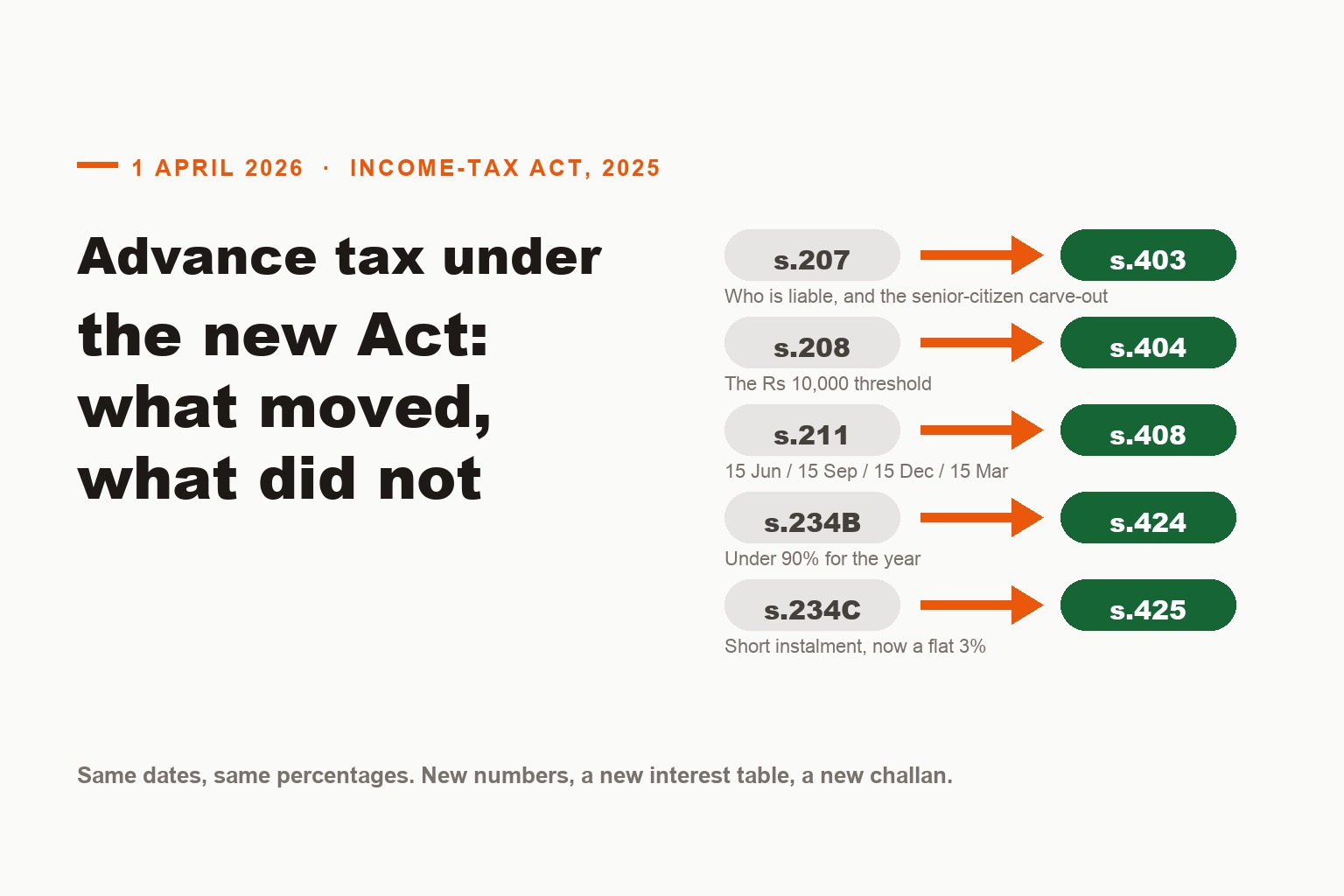
For tax year 2026-27, the audit moves to the Income-tax Act, 2025 (Section 63) and the report to Form 26, which merges Forms 3CA, 3CB and 3CD; the core records above stay relevant, but Form 26 rationalises the disclosures and adds schedules of its own, so next year’s list has to be checked against the new form; the clause numbers certainly change. Harsh’s piece on Form 26, the tax audit report under the 2025 Act has the mapping, and the ICAI’s format for non-corporate financial statements, covered in his Guidance Note explainer, becomes the shape of item 1 for every non-corporate entity from FY 2026-27.
Sources
- Income-tax Act, 1961 — Section 44AB (with Explanation (ii)), Section 44AA, Section 40(a), Section 40(b), Section 40A(2) and (3), Section 43B including clause (h), Section 269SS, Section 269T, Section 269ST, Section 271B, Section 273B; Income-tax Rules, 1962 — Rule 6G and Form 3CD (clauses 8, 9, 11, 13, 14, 18, 20, 21, 22, 26, 27, 31, 34, 35, 40 and 44).
- Income Tax Department — “Items reportable in the Tax Audit Report” (incometaxindia.gov.in), clause descriptions as amended by the Finance Act, 2026.
- Micro, Small and Medium Enterprises Development Act, 2006 — Sections 15 and 16.
Written as at 10 September 2026 for the AY 2026-27 tax audit under Form 3CD. Your auditor’s list may be longer for your business; this is the common core. Take advice from a Chartered Accountant on a specific case.


Comments (0)
No comments yet. Be the first to comment!