
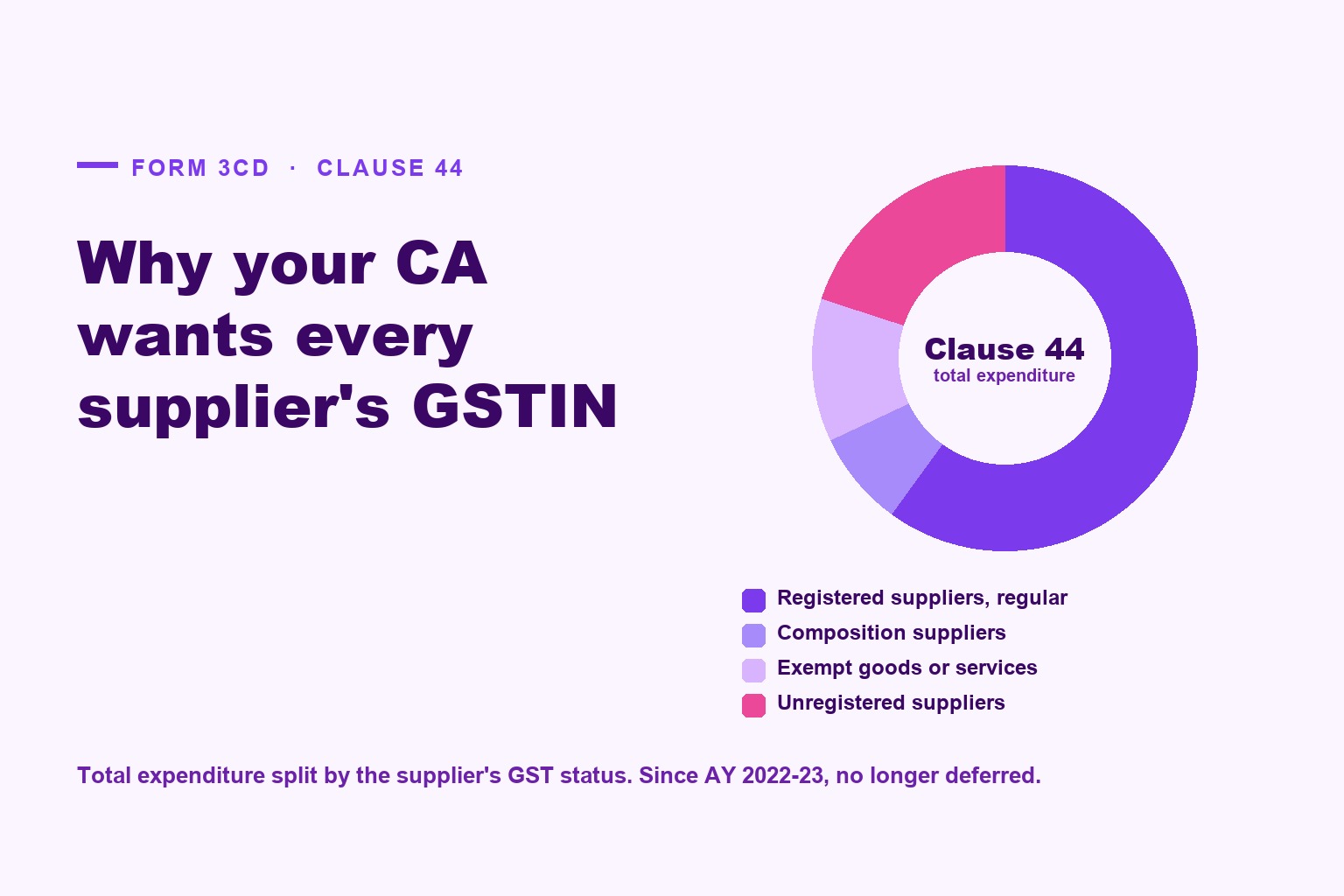

TL;DR: Clause 44 of Form 3CD, the statement of particulars in every tax audit under Section 44AB, requires the auditor to report your total expenditure for the year split by the GST status of the person you paid: expenditure on goods or services exempt from GST, expenditure with composition dealers, expenditure with other registered suppliers, the total paid to registered suppliers, and expenditure with suppliers who are not registered at all. To fill it, the auditor needs the GSTIN and registration type of every supplier, which is the list your CA has been asking for. The clause was added in 2018 and kept in abeyance by CBDT four times, until 31 March 2022; it has been live for every audit report furnished since, including the AY 2026-27 report due 30 September 2026. The reason it matters beyond the form: the department can lay the clause 44 figures against your GSTR-3B, GSTR-2B and GSTR-9, and an unregistered-supplier column that is out of line with your input-tax-credit claims is a question waiting to be asked.
1. What the clause actually asks
The clause is a single table. In the department’s own summary, it “seeks details of the total expenditure incurred during the year”, broken up between expenditure with entities registered under GST and expenditure with entities not registered. The columns:
| Column | What goes in it |
|---|---|
| (1) Sl. No. | Row number. |
| (2) Total amount of expenditure incurred during the year | All expenditure for the year that is within the scope of GST as a supply of goods or services, revenue and capital, that is the subject of the break-up. This is the control total. |
| (3) Relating to goods or services exempt from GST | Amounts paid to registered suppliers for exempt supplies: interest on a bank loan, exempt agricultural produce, health or education services, and the like. |
| (4) Relating to entities falling under composition scheme | Amounts paid to suppliers registered under the composition levy (Section 10 of the CGST Act), who charge no tax on the invoice and on whom you take no credit. |
| (5) Relating to other registered entities | Amounts paid to regular registered suppliers for taxable supplies: the bulk of a normal purchase register. |
| (6) Total payment to registered entities | Columns (3) + (4) + (5). |
| (7) Relating to entities not registered under GST | Amounts paid to unregistered suppliers: small vendors, individuals, landlords below the threshold, and items you paid tax on under reverse charge from an unregistered person. |
Column (2) equals column (6) plus column (7). Every rupee of expenditure that is a supply under GST has to land in one of the classes, which is why the exercise cannot be done by sampling and why it needs the supplier master, not just the ledger. What is not a supply at all (see section 4) is excluded from the total, with a reconciliation, rather than pushed into a column.
2. Why the auditor needs the GSTIN of every supplier
The classification is by the supplier, not by the expense head. “Repairs” is not a column; the electrician who is unregistered goes in (7), the registered maintenance contractor goes in (5), and the composition-dealer hardware shop goes in (4). Three facts about each supplier decide the column:
- Registered or not. A GSTIN on the invoice, or the absence of one. The portal’s search-taxpayer tool confirms a GSTIN and its status on the date.
- Regular or composition. A composition dealer is registered but may not charge tax; the portal shows “Composition” as the taxpayer type, and the invoice carries the words “composition taxable person, not eligible to collect tax on supplies”.
- Taxable or exempt supply. A registered supplier can make an exempt supply (a bank charging interest, a hospital); that expenditure goes to (3) even though the supplier is in (5) for its other invoices.
None of that is in the accounting ledger unless it was captured at the time of booking. Hence the request: a supplier-wise schedule with GSTIN, registration type, and the exempt or taxable nature of what was bought. Sachin’s explainer on input tax credit conditions under Sections 16 and 17(5) covers the same supplier data from the credit side.
3. How it got here: 2018, four deferrals, live since April 2022
Clause 44 (and clause 30C on GAAR) was inserted into Form 3CD by the notification of 20 July 2018, effective 20 August 2018. The profession objected that the data did not exist in most books and that the auditor could not certify a GST classification without a GST audit. CBDT kept the reporting under both clauses in abeyance: until 31 March 2019, then until 31 March 2020, then until 31 March 2021 (the April 2020 circular), then, by Circular No. 5 of 2021 dated 25 March 2021, until 31 March 2022. There was no fifth deferral. Every tax-audit report furnished on or after 1 April 2022, that is from AY 2022-23, carries a filled clause 44. This September’s AY 2026-27 report is the fifth year of it, which is why the request is no longer negotiable and why an auditor who was lenient in 2022 is not in 2026.
4. What is in “total expenditure”, and what is not
The form says “total amount of expenditure incurred during the year” and does not define it. The ICAI’s Guidance Note on Tax Audit is what auditors follow, and the working practice it settled is:
- The clause is about supplies. It classifies expenditure on goods and services by the GST status of the supplier, so it covers expenditure that is, or could be, a supply under the GST law. Transactions that are not a supply at all are outside it.
- Capital and revenue both count. A machine bought from a registered supplier is expenditure for this clause; the clause is not confined to the profit and loss account, so capital purchases that never touch the profit and loss account are added in.
- Purchases are expenditure. The purchase register is usually the largest component.
- Non-cash and non-procurement entries are not “incurred”. Depreciation and bad debts written off involve no supplier and are excluded. A provision is judged by what sits under it: a year-end provision for goods or services actually received from an identifiable supplier is expenditure to be classified; a general provision is not.
- Schedule III and other non-supply items are excluded, not parked in the unregistered column. Salaries and wages (services by an employee to the employer are not a supply under Schedule III of the CGST Act), statutory levies, taxes, and the like are outside the scope of the clause; the auditor excludes them from the total and documents the exclusion in the reconciliation. Reporting salaries as if they were purchases from an unregistered supplier is a mis-classification, not a conservative choice.
- Reverse-charge purchases. Expenditure on which you paid GST under reverse charge from an unregistered supplier is column (7); reverse charge on a registered supplier’s supply (a goods transport agency, an advocate) is column (5) or (3) according to the supply.
The control is a documented reconciliation: expenditure per the profit and loss account, plus capital expenditure on supplies that did not pass through it, less the non-supply and non-cash exclusions, equals column (2). That reconciliation is the second thing your auditor will ask for.
5. Building the data in a week
- Start from the purchase register and the vendor master, which is the complete population, and lay GSTR-2B for FY 2025-26 alongside it (monthly, or quarterly if you are a quarterly filer; note that 2B also carries import and ISD entries, which are not supplier invoices). Every invoice a registered supplier reported against your GSTIN is there with the supplier’s GSTIN and the taxable value. That is most of column (5), and the supplier list for it. Sachin’s note on GSTR-9 and GSTR-9C for FY 2025-26 uses the same 2B download for the annual return, so do both from one file.
- Match the purchase register to 2B. Registered-supplier invoices in the books that are not in 2B are still column (5) for clause 44 (the clause is about the supplier’s status, not about your credit), but they are also your Section 16 credit problem, so flag them.
- Tag composition suppliers. They do not appear in 2B for their supplies (they file CMP-08, not GSTR-1). Identify them from invoices and the portal’s taxpayer search, and total them for column (4).
- Tag exempt supplies from registered suppliers: bank interest and charges that are exempt, insurance premiums that are not, exempt services from hospitals or educational institutions, exempt goods. Column (3).
- Strip out what is not a supply (salaries, statutory levies, taxes, depreciation, bad debts, general provisions) into the exclusions list.
- Classify the remainder by verified status. What is left in the expense ledgers with no GSTIN is column (7) only once you have confirmed, from the invoice and the portal’s taxpayer search, that the supplier is in fact unregistered; a missing GSTIN in your ledger is a data gap, not a classification. Check the reverse-charge register against column (7); unregistered-supplier expenditure that should have carried reverse charge and did not is the finding you want to make before the department does.
- Reconcile: profit and loss expenditure, plus capital supplies outside it, less the exclusions, equals column (2); column (2) equals (6) plus (7).
6. Why the figures have to tie
Clause 44 is filed on the income-tax portal; GSTR-3B, GSTR-2B and GSTR-9 are on the GST portal; both departments share data. Three comparisons are obvious from the numbers alone. None of them is a direct reconciliation, because clause 44 and the GST returns differ in scope (imports, ISD credit, reverse charge, capital goods, credit notes, timing and valuation), so a variance is a reason to have a documented bridge ready, not proof of anything on its own:
- Column (5) against the inward supplies on which credit was claimed in GSTR-3B for the year. A large gap either way is the first thing a reviewing officer will ask about.
- Column (7) against the reverse-charge tax paid in GSTR-3B. Large unregistered-supplier expenditure with no reverse-charge liability invites a Section 9(4) question for the notified categories and a Section 9(3) question for the notified categories of supply.
- Column (4) against the nature of the supplier’s registration; credit claimed on a composition dealer’s invoice is credit that was never available.
The clause carries no penalty of its own; a wrong clause 44 is a wrong particular in the audit report, and the auditor signs it. The exposure is in what it points to under the GST law, and in an auditor who qualifies the report because the client would not supply the data.
7. Quick answers
My turnover is Rs 3 crore, all purchases from registered suppliers. Do I still need to fill it? Yes; the clause applies to every Form 3CD. Your column (7) may be small, but it exists (the office tea, the freelance designer).
Do salaries go in the unregistered column? No. Employee services are not a supply (Schedule III); salaries are excluded from the clause and shown in the reconciliation.
What about depreciation? Not expenditure incurred; excluded.
Is capital expenditure included? Yes; a machine bought from a registered supplier is column (5).
I paid reverse charge on a lawyer’s fee. The lawyer’s registration status decides the column; the reverse charge does not change it.
Can the auditor just write “not applicable”? Not since 1 April 2022. The abeyance ended with the AY 2021-22 reports.
Does this change under the 2025 Act? Tax year 2026-27 moves to Form 26 under Section 63; Harsh’s piece on Form 26, the tax audit report under the Income-tax Act, 2025 covers what carries over. FY 2025-26 stays on Form 3CD.
Sources
- Income-tax Rules, 1962 — Form No. 3CD, clause 44, as inserted by the Income-tax (8th Amendment) Rules, 2018 (G.S.R. 666(E), 20 July 2018).
- Income Tax Department — “Items reportable in the Tax Audit Report” (incometaxindia.gov.in, as amended by the Finance Act, 2026), clause 44 entry.
- CBDT Circular No. 5 of 2021 dated 25 March 2021 (reporting under clauses 30C and 44 in abeyance till 31 March 2022) and the earlier deferral circulars of 2018, 2019 and April 2020.
- ICAI Guidance Note on Tax Audit under Section 44AB of the Income-tax Act, 1961 (revised edition), chapter on clause 44.
- Central Goods and Services Tax Act, 2017 — Section 9(3) and (4), Section 10, Section 16, Section 2(47).
Written as at 10 September 2026 for the AY 2026-27 tax audit under Form 3CD. Take advice from your tax auditor on the basis of exclusions; the note in the audit report is what the department reads.



Comments (0)
No comments yet. Be the first to comment!