


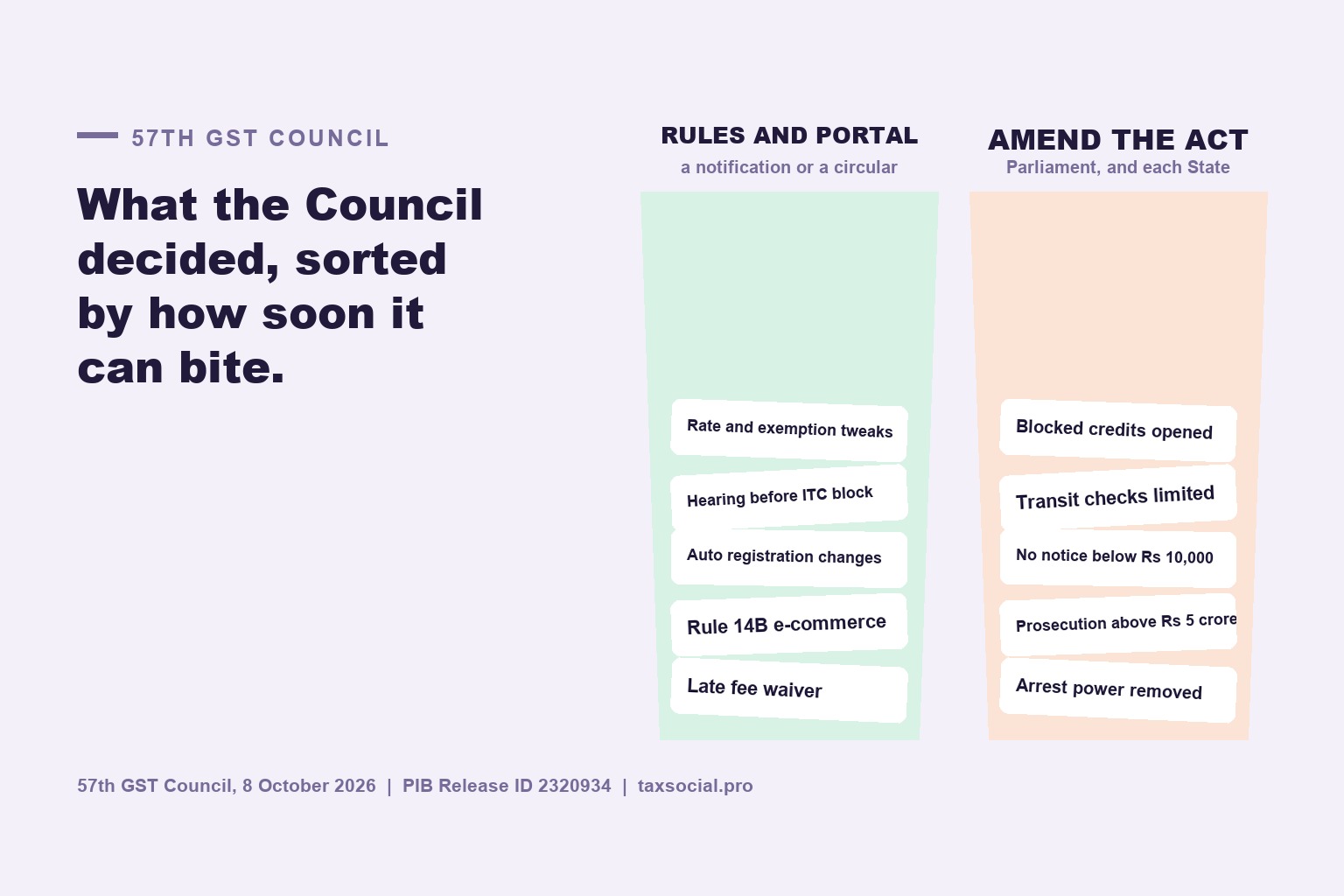
Update, 8 October 2026: the 57th GST Council has recommended amending section 17(5) to remove the block on, among other things, outdoor catering, health and life insurance, telecommunication towers, pipelines laid outside the factory, free samples, and goods destroyed or written off on expiry of shelf life as the law requires (PIB release of 8 October 2026). These are recommendations, not law. Section 17(5) and the "plant and machinery" Explanation are in the CGST Act, so the credit stays blocked, exactly as described below, until Parliament and the States amend their Acts. What was decided and when it can apply: ITC changes from the 57th GST Council.
TL;DR: Input tax credit is not something you are simply entitled to because you paid GST on a purchase. It is conditional, and the conditions are cumulative — miss any one of the six in Section 16(2) and the credit is not available, however genuine the transaction. On top of that sits a hard clock: for invoices belonging to FY 2025-26, credit must be taken by 30 November 2026, or by the date you furnish that year's annual return, whichever is earlier. And a separate list in Section 17(5) blocks credit permanently on certain purchases even when every Section 16 condition is satisfied. This guide walks all three, anchored to the CGST Act as currently in force.
1. The entitlement — Section 16(1)
Section 16(1) gives every registered person the right to take credit of input tax charged on any supply of goods or services used or intended to be used in the course or furtherance of business, and that amount is credited to the electronic credit ledger.
Two things are doing work in that sentence. First, you must be registered — an unregistered buyer has no ITC, full stop. Second, the purchase must be for business. Intended use counts, so credit is not denied merely because the input has not been consumed yet, but a purchase for personal use never qualifies.
2. The six conditions — Section 16(2)
Section 16(2) opens with a non-obstante clause: notwithstanding anything contained in this section, no registered person is entitled to credit unless all of the following hold.
| Clause | Condition | What it means in practice |
|---|---|---|
| 16(2)(a) | You possess a tax invoice or debit note issued by a registered supplier, or another prescribed tax-paying document | No document, no credit. A bank statement or a delivery challan is not a substitute. |
| 16(2)(aa) | The supplier has furnished the details of that invoice or debit note in the statement of outward supplies, and those details have been communicated to you under Section 37 | This is the clause behind GSTR-2B. If your supplier did not file, the invoice does not reach your 2B and the credit is not yours to take — regardless of what your books say. |
| 16(2)(b) | You have received the goods or services | An Explanation deems receipt where goods are delivered to a third party on your direction (bill-to / ship-to), and where services are provided to another person on your direction and account. |
| 16(2)(ba) | The credit communicated to you under Section 38 has not been restricted | Credit flagged as restricted in your statement cannot be availed while that restriction stands. |
| 16(2)(c) | The tax charged has actually been paid to the Government, in cash or by utilising admissible credit | Subject to Section 41. The clause that makes a buyer's credit depend on the supplier's conduct. |
| 16(2)(d) | You have furnished the return under Section 39 | Credit is claimed through the return; not filing means not claiming. |
The three provisos worth knowing
- Goods received in lots. Where goods against a single invoice arrive in lots or instalments, credit is taken on receipt of the last lot — not proportionately as each arrives.
- The 180-day rule. If you do not pay your supplier the value of the supply plus tax within 180 days of the invoice date, an amount equal to the ITC you availed must be paid by you along with interest under Section 50. This does not apply to reverse-charge supplies. In a business that stretches payables past six months, this is a live and frequently missed exposure.
- You can get it back. The third proviso restores the credit once you actually pay the supplier the value and tax. The reversal is a timing consequence, not a permanent loss.
3. The depreciation bar — Section 16(3)
If you have claimed depreciation on the tax component of the cost of capital goods or plant and machinery under the Income-tax Act, ITC on that tax component is not allowed. You choose one benefit or the other, not both. In practice this means deciding at capitalisation whether the GST goes into the asset's cost or into the credit ledger — and it is the kind of thing that surfaces years later in an audit if the fixed-asset register and the GST returns were maintained by different people.
4. The deadline — Section 16(4)
This is the provision that kills more credit than any other. A registered person is not entitled to take ITC on an invoice or debit note after:
the thirtieth day of November following the end of the financial year to which such invoice or debit note pertains, or furnishing of the relevant annual return, whichever is earlier.
The "30 November" wording was substituted for the older "due date of the September return" formulation by the Finance Act, 2022. So for the year now in play:
| Invoice belongs to | Last date to take ITC |
|---|---|
| FY 2025-26 | 30 November 2026 — or the date you furnish the FY 2025-26 annual return, if that is earlier |
| FY 2024-25 | 30 November 2025 — already closed |
Read the "whichever is earlier" limb carefully. It is not a formality. If you file your GSTR-9 for FY 2025-26 in, say, September 2026 because the work happened to be ready, you have shortened your own ITC window from 30 November to that September date. Any credit you discover afterwards is gone. If you have unreconciled purchase invoices outstanding, finish the reconciliation before you file the annual return, not after.
The retrospective relief in 16(5) and 16(6)
Two sub-sections were inserted with retrospective effect to relieve hardship caused by the time limit:
- Section 16(5) — notwithstanding 16(4), for invoices and debit notes pertaining to FY 2017-18, 2018-19, 2019-20 and 2020-21, credit may be taken in any Section 39 return filed up to 30 November 2021. This rescued a large volume of credit denied purely because the old September cut-off had passed.
- Section 16(6) — where a registration was cancelled and the cancellation was later revoked, credit that was not time-barred on the date of the cancellation order can still be taken: by the normal Section 16(4) date, or, for the period from cancellation to revocation, in a Section 39 return filed within thirty days of the revocation order — whichever is later. The statute says "later", not "earlier", and that word is the whole point of the relief.
Both are relief provisions for specific historical situations. Neither extends the ordinary deadline for a current year.
5. The blocked list — Section 17(5)
Section 17(5) starts with a non-obstante clause overriding Section 16(1). These are purchases on which credit is not available at all, no matter how clearly they are for business.
| Clause | Blocked | Main exceptions |
|---|---|---|
| (a) | Motor vehicles for transport of persons with approved seating capacity of not more than thirteen persons, including the driver | Further supply of such vehicles; transportation of passengers; driving training |
| (aa) | Vessels and aircraft | Further supply; passenger transport; navigation or flying training; transportation of goods |
| (ab) | General insurance, servicing, repair and maintenance of the vehicles, vessels and aircraft in (a) and (aa) | Available where the vehicle itself qualifies, or to manufacturers and insurers of them |
| (b)(i) | Food and beverages, outdoor catering, beauty treatment, health services, cosmetic and plastic surgery, leasing/renting/hiring of the vehicles in (a)/(aa), life insurance and health insurance | Where used to make an outward taxable supply of the same category, or as part of a composite or mixed supply — and where obligatory for the employer under any law (see below) |
| (b)(ii) | Membership of a club, health and fitness centre | Where obligatory for the employer under any law (see below) |
| (b)(iii) | Travel benefits to employees on vacation, such as leave or home travel concession | Where it is obligatory for the employer to provide it under any law in force |
| (c) | Works contract services for construction of immovable property (other than plant and machinery) | Where it is an input service for further supply of works contract service |
| (d) | Goods or services received for construction of immovable property (other than plant and machinery) on your own account | Blocked even when used in the course or furtherance of business |
| (e) | Goods or services on which tax was paid under the composition scheme (Section 10) | None |
| (f) | Goods or services received by a non-resident taxable person | Goods imported by him |
| (fa) | Goods or services used for CSR obligations under Section 135 of the Companies Act, 2013 | None |
| (g) | Goods or services used for personal consumption | None |
| (h) | Goods lost, stolen, destroyed, written off, or disposed of by way of gift or free samples | None |
| (i) | Tax paid under Section 74, in respect of any period up to FY 2023-24 | None |
The "obligatory for an employer" proviso covers all of clause (b)
This one is worth money and is routinely got wrong. The proviso allowing credit where it is obligatory for an employer to provide the goods or services under any law in force is printed immediately after sub-clause (iii), which makes it look as though it rescues only leave travel concession.
It does not. CBIC Circular No. 172/04/2022-GST clarifies that this proviso "is applicable to the whole of clause (b) of sub-section (5) of section 17". So where a statute obliges you to provide it, credit is available across clause (b) — the canteen you must run under the Factories Act being the standard example, alongside legally mandated employee insurance. The test is a genuine legal obligation, not company policy or a contractual perk.
The construction clauses deserve a second look
Clauses (c) and (d) are where the largest disputes sit. Explanation 1 defines "construction" to include reconstruction, renovation, additions, alterations and repairs — but only to the extent of capitalisation. So repair expenditure charged to the profit and loss account is not caught by the bar; the same work capitalised into the building is.
Explanation 2 then provides that, notwithstanding any judgment, decree or order of any court or tribunal, a reference to "plant or machinery" is to be construed, and always to have been construed, as a reference to "plant and machinery". That single-word substitution is deliberate and retrospective, and it closes the interpretation that had been read into clause (d) in favour of taxpayers constructing buildings let out on rent. Anyone relying on older commentary on this point should re-read it against the current text.
"Plant and machinery" itself is defined for the Chapter as apparatus, equipment and machinery fixed to earth by foundation or structural support, used for making outward supply — including that foundation and those structural supports, but excluding land, buildings and other civil structures, telecommunication towers, and pipelines laid outside factory premises.
6. A working checklist for FY 2025-26
- Reconcile your purchase register against GSTR-2B monthly, not annually. Clause (aa) means a supplier's non-filing becomes your problem, and the earlier you find it the more leverage you have to get it fixed.
- Chase suppliers who have not filed, before November. After 30 November 2026 there is no remedy for an FY 2025-26 invoice.
- Run a payables ageing for the 180-day rule and reverse where required, with interest, rather than waiting for it to be found.
- Check that GST on capitalised assets has not been claimed both as ITC and as part of depreciable cost.
- Tag blocked-credit purchases at entry — staff insurance, client entertainment, club memberships, building works — so they never enter the claim in the first place.
- Do not file GSTR-9 for FY 2025-26 until reconciliation is finished. Filing it early shortens your own deadline.
Sources
- Central Goods and Services Tax Act, 2017, Section 16 — eligibility and conditions for taking input tax credit, including sub-sections (1), (2)(a), (2)(aa), (2)(b) and its Explanation, (2)(ba), (2)(c), (2)(d), the three provisos, (3), (4), (5) and (6). Text as currently in force, from the CBIC tax repository.
- CGST Act, 2017, Section 17 — apportionment of credit and blocked credits, in particular sub-section (5) clauses (a) to (i), Explanation 1, Explanation 2, and the Chapter definition of "plant and machinery".
- CBIC Circular No. 172/04/2022-GST — clarifying that the proviso after sub-clause (iii) of Section 17(5)(b) applies to the whole of clause (b).
- Finance Act, 2022 — substitution of "thirtieth day of November" in Section 16(4), with effect from 1 October 2022.
- Finance (No. 2) Act, 2024 — insertion of Sections 16(5) and 16(6) with retrospective effect.
This article states the position under the CGST Act as in force on 26 August 2026. GST law changes frequently, by amendment Act, notification and circular, and state SGST Acts mirror but are separate; confirm the current text on the CBIC portal before acting. Nothing here is advice on your particular facts — for a specific credit position, especially one involving construction, capital goods or a disputed supplier default, consult a qualified GST practitioner.


Comments (0)
No comments yet. Be the first to comment!