
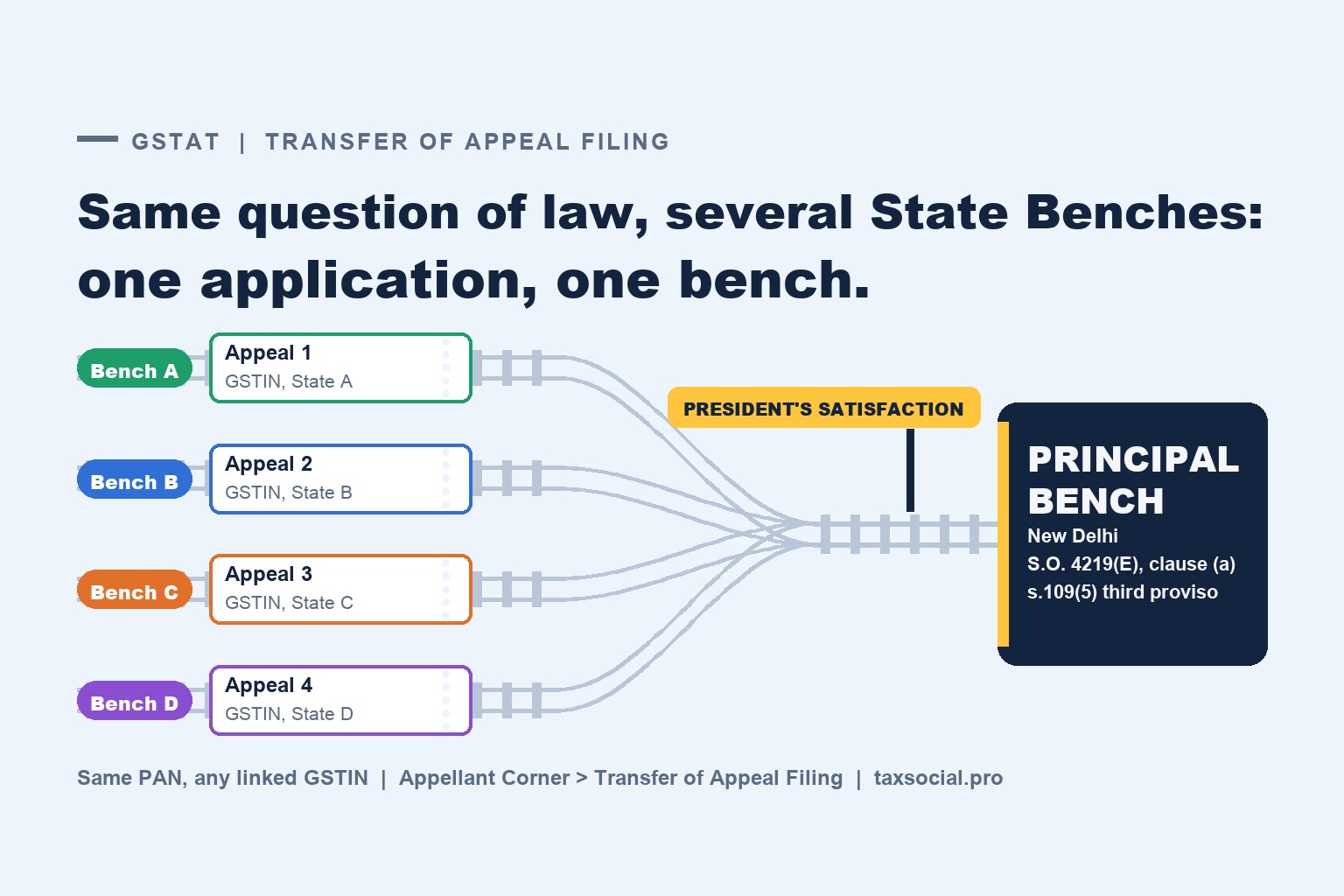

The GST Appellate Tribunal's portal now has a "Transfer of Appeal Filing" option in the Appellant Corner. A business whose GSTINs in different States sit under one PAN can see all its pending appeals in one list, pick the ones that raise the same question of law, and file a single application to have them heard together. The SOP does not cite any law. The legal basis is S.O. 4219(E) dated 17 September 2025, issued under the third proviso to section 109(5) of the CGST Act. It says that a case pending before two or more State Benches, where the President is satisfied that an identical question of law is involved, is to be heard only by the Principal Bench in New Delhi. So the application is a request, not a right. Filing it does not move anything until the President decides. If granted, your appeals end up in Delhi, not at a State Bench of your choosing. And the utility only sees appeals you have already filed, so it does nothing for limitation.
1. What GSTAT has released
GSTAT has published a Standard Operating Procedure for Transfer of Appeals. It is a ten-page walk-through of portal screens. The acknowledgement reproduced in it shows a transfer application filed on 16 September 2026, so the facility was working by mid-September. A second SOP on filing a reply as a respondent was released alongside it, and we cover that one separately.
The SOP states its purpose in two sentences. Where multiple appeals involving an identical question of law have been filed across different GSTAT Benches, and in particular where a taxpayer has several GSTINs under the same PAN and has appealed before several Benches, the taxpayer "may consolidate such matters through a single Transfer Appeal". Using any GSTIN linked to the PAN, the taxpayer logs in, views all such appeals, selects the ones that share the question of law, and creates one Transfer Appeal "for adjudication by an appropriate Bench".
That last phrase is the only place the SOP says where the appeals go, and it does not name the bench. The notification does.
2. The law behind it: S.O. 4219(E)
Section 109(5) of the CGST Act, as substituted by the Finance Act, 2023, sets out which appeals the Principal Bench hears and which go to State Benches. Its first proviso sends cases in which one of the issues relates to the place of supply to the Principal Bench only. Its third proviso lets the Government, on the GST Council's recommendation, notify other cases or classes of cases that only the Principal Bench will hear.
The Government used that power on 17 September 2025. S.O. 4219(E) (F. No. A-50/7/2025-GSTAT-DoR) notifies three classes of cases "in respect of which an appeal shall be heard only by the Principal Bench":
| Clause | What the notification covers | Why it matters here |
|---|---|---|
| (a) | Any case or class of cases "pending before two or more State Benches where the President is satisfied that an identical question of law is involved" | This is the clause the transfer utility serves. |
| (b) | Cases where one or more issues are covered under section 14 or 14A of the IGST Act | Broadly, the special place-of-supply and tax-collection rules for online information and database access or retrieval services, and for specified actionable claims, supplied from outside India. Each section has its own conditions. A case with an issue that actually falls within them goes to the Principal Bench anyway, with no transfer needed. |
| (c) | Cases where one or more issues are covered under section 20 of the CGST Act | Input Service Distributor distribution. Also Principal Bench from the outset. |
Section 109(6) supplies the machinery. Subject to sub-section (5), the President "shall, from time to time, by a general or special order, distribute the business of the Appellate Tribunal among the Benches and may transfer cases from one Bench to another".
Read together, the position is this. Once the President is satisfied that an identical question of law runs through appeals pending before two or more State Benches, those appeals become Principal Bench matters, and section 109(6) is the power under which they are moved. The portal utility is how a party asks for that satisfaction. It does not replace it.
The GSTAT (Procedure) Rules, 2025 add nothing on this point. The word "transfer" does not appear in them. Rule 123 lets the President issue directions where the rules are silent. The SOP does not say it was issued under that rule. It is best read as a description of the portal workflow, not as a prescribed procedure.
3. Four conditions you need to meet before the button is worth pressing
- The appeals must already be filed and pending. The utility lists appeals the PAN already has before GSTAT. It is not a way of filing an appeal at the Principal Bench, and it does not extend or pause the three-month limit in section 112(1) for any appeal you have not yet filed. Each appeal has to be filed, with its own pre-deposit under section 112(8), before the bench that has jurisdiction over it today.
- They must be before two or more State Benches. Clause (a) speaks of cases pending before "two or more State Benches". If all your appeals are before one State Bench, this clause does not apply. Ask that bench to hear them together instead.
- The question of law must be identical, not just similar. The SOP repeats the notification's word, "identical". Appeals that turn on the same legal point but on different facts can qualify. Appeals that share only a subject heading do not. "ITC on the same kind of expense" can be one question of law in one appeal and three different questions of fact in another.
- The President has to agree. Selecting cases and getting an acknowledgement is not a transfer. The acknowledgement in the SOP says the application "has been successfully filed", nothing more. Until an order is passed, each appeal stays where it is and you should keep preparing it there.
4. Who can use the portal utility
The SOP is written for an appellant. The option sits in the Appellant Corner, and it works off the PAN. You log in through any GSTIN linked to the PAN and see appeals filed under all of them. That suits the common case: a company registered in several States that received similar orders in each and appealed in each.
Clause (a) of the notification is not limited to one taxpayer's appeals. It speaks of "any case or class of cases". The portal utility, as the SOP describes it, only gathers appeals under one PAN. Grouping unrelated taxpayers' appeals on a common question is a matter for the President. The utility does not do it.
The SOP also says nothing about whether the department can use the utility, or whether the other side is given notice or heard before the President decides. Do not assume either way. Write the application so that it can be decided on the papers alone.
5. The 17 steps, grouped
The SOP runs to seventeen numbered steps. In practice there are five stages:
| Stage | SOP steps | What happens |
|---|---|---|
| Select | 1-6 | Log in to the GSTAT portal, go to Appellant Corner → Transfer of Appeal Filing. A page opens with the GSTIN. Click it to see the list of cases, tick the boxes in the last column against the appeals you want transferred, and click Save selected cases. |
| Verify parties | 7-9 | An application form opens with tabs. Verify the Appellant Details and Respondent Details. |
| Representative | 10-11 | Search for and select the representative, submit, then click Next. |
| Documents | 12-14 | The Upload Document section opens with a message listing what must be uploaded. Upload each document. A pop-up confirms each one. |
| Check and submit | 15-17 | Answer the final checklist Yes, No or NA, with a remark against every No or NA. Review the Final Preview, click Final Submit, and save the Acknowledgement Receipt, which carries a filing number, date, time, the filer's name and the place. |
The SOP does not reproduce the list of required documents, so read the message in step 12 carefully. Neither the SOP nor the notification says what material the President needs to be satisfied that the question of law is identical. A bundle of orders leaves that work to the reader, so we would add a short note of two or three pages that:
- frames the common question of law in one sentence;
- lists each selected appeal with its GSTAT number, bench, GSTIN, period and amount;
- points to the paragraph in each impugned order where the question is decided; and
- says plainly where the facts differ and why the differences do not change the question.
That is our recommendation, not a requirement in the SOP.
Fees. The SOP shows no payment step. The Procedure Rules' Schedule of Fees has no entry for a transfer application. Its catch-all for "application under any other provisions specifically not mentioned" is Rs 5,000. If the portal charges a fee, that is the most likely head. No fee is payable on an application by a departmental authority connected with the matter before GSTAT.
6. What the SOP and the notification do not tell you
Several practical consequences of a transfer are not addressed in either document. Do not assume an answer. Watch for directions on the portal or from the registry.
- Pre-deposit and stay. Each appeal was filed with the deposit under section 112(8) paid for it, and section 112(9) deems recovery of the balance stayed until the appeal is disposed of. Neither document mentions any further payment on transfer, but neither says expressly that none will be asked for. Check the portal before final submission.
- Numbers, records and orders. The SOP speaks of creating a single "Transfer Appeal". It does not say what happens afterwards to the original appeal numbers and records, how the appeals will be listed, or whether there will be one common order or separate orders.
- Issues that are not common. Clause (a) of the notification speaks of the case, not just the common issue. If an appeal raises the common question and also a GSTIN-specific one, such as a computation error or a limitation point, expect the whole appeal to move. Make sure your grounds on the local point do not get lost in the common argument.
- Larger benches. A transfer application is not, by itself, a reference to a larger bench. Rule 50 of the Procedure Rules provides for that reference where the members of a bench differ.
7. When not to use it
Consolidation sounds efficient, and often it is. You argue once, brief counsel once, and get one answer for every State, instead of one bench allowing the appeal and another dismissing it on the same point. But consider the costs before filing.
- One answer cuts both ways. If the Principal Bench decides the question against you, it decides it against you in every transferred appeal at once. Where one State Bench is already showing a favourable view, or the facts in one State are noticeably stronger, you may prefer to let that appeal go first.
- The hearing is in New Delhi. Rule 115(7) allows hearings in physical mode or, with the President's permission, in electronic mode. Virtual hearing is not automatic. Factor in travel and counsel in Delhi if it is refused.
- Uncertainty while it is pending. Nothing in the SOP says whether a pending application affects the listing of the appeals. Until a direction issues, treat every appeal as live where it is and comply with any hearing dates. If one of them is close to being heard, weigh whether the application is worth the uncertainty.
- "Identical" is contestable. If the department argues that the facts differ in each State, a weak application can be rejected with a finding that the questions are not the same. That finding will not help you later.
The strongest case for transfer is a pure question of law with no State-specific facts, appealed in three or more States, where none of the appeals has yet been heard on merits. For example: whether a particular inter-unit cross-charge attracts tax, or whether a credit is blocked under section 17(5), with identical contracts in every State.
8. If your issue is place of supply, IGST section 14 or 14A, or ISD, you may be at the wrong bench already
Three classes of case go to the Principal Bench from the start. These are place-of-supply issues (the first proviso to section 109(5)), IGST section 14 and 14A issues, and section 20 ISD issues (clauses (b) and (c) of S.O. 4219(E)). If one of these has been filed before a State Bench, the notification indicates that it belongs before the Principal Bench, but neither document prescribes how to correct it. The transfer utility is built for same-question appeals across benches, not for this. Seek directions from the registry or the bench promptly. For general background on the forum and the e-filing portal, see our GSTAT first-filer's roadmap.
9. Checklist before you file a transfer application
- List every pending GSTAT appeal under the PAN, with bench, period, amount and the question each one decides.
- Keep only those before two or more different State Benches that share an identical question of law.
- Think again about any that are already part-heard, or where the local facts are materially stronger, before including them.
- Check that none of them is a place-of-supply, IGST section 14/14A or ISD case filed at the wrong bench.
- Draft the short note described in section 5 and keep the impugned orders, appeal papers and pre-deposit proof ready to upload.
- File through Appellant Corner → Transfer of Appeal Filing, answer every checklist item, and save the acknowledgement.
- Until an order is passed, keep every appeal ready for hearing where it is.
Sources
- GSTAT, Standard Operating Procedure for Transfer of Appeals (portal SOP, sample acknowledgement dated 16 September 2026).
- Ministry of Finance (Department of Revenue), Notification S.O. 4219(E) dated 17 September 2025, F. No. A-50/7/2025-GSTAT-DoR, Gazette of India Extraordinary, Part II, Section 3(ii), No. 4102.
- Central Goods and Services Tax Act, 2017: section 109(5) and its provisos, section 109(6), section 112(1), (8) and (9).
- Goods and Services Tax Appellate Tribunal (Procedure) Rules, 2025, G.S.R. 256(E) dated 24 April 2025: rules 29, 50, 115, 119, 123 and the Schedule of Fees.
This article states the position as at 2 October 2026. The SOP describes portal screens that GSTAT can change without notice. Check the live portal and any later Presidential orders before relying on a particular step, and confirm the position on your own facts before advising.



Comments (0)
No comments yet. Be the first to comment!