
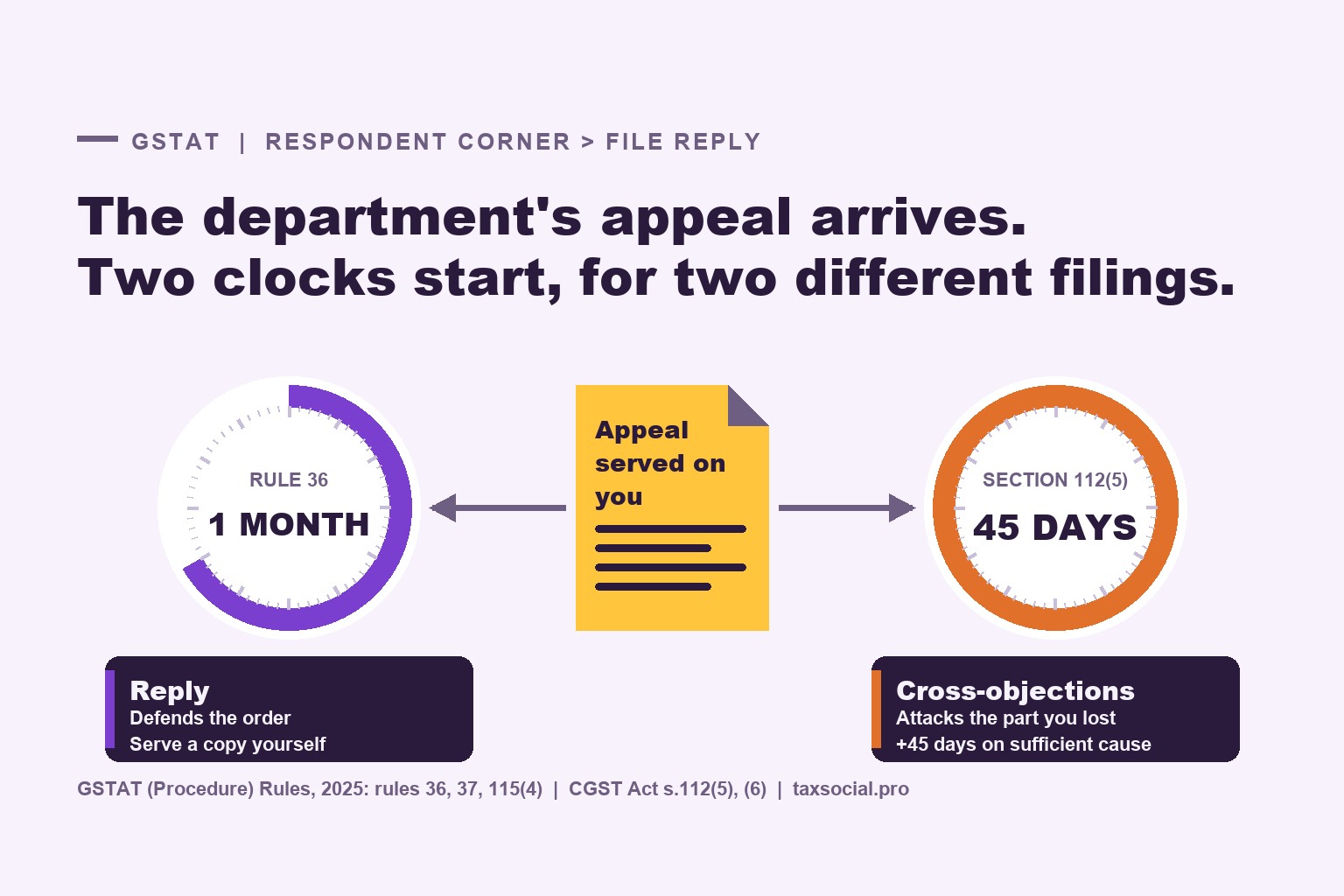

If the department has taken your GST order to the Appellate Tribunal, you are the respondent, and GSTAT's portal now lets you file your reply online through Respondent Corner → File Reply. The SOP shows the clicks but not the rules behind them. Three of those rules decide what you file. First, rule 36 of the GSTAT (Procedure) Rules, 2025 gives a respondent one month from receiving the appeal to file a reply, and requires you to serve a copy on the appellant yourself, "forthwith". Second, a reply only defends the order under appeal. If part of that order went against you, the reply cannot reverse it. That needs cross-objections under section 112(5) of the CGST Act, within 45 days of the notice. Third, the appellant does not get an automatic right of rejoinder. Under rule 37, a rejoinder is filed only if the Bench allows it, so your reply may well be the last written word before the hearing.
1. When you are the respondent
Rule 33 of the Procedure Rules settles who the respondent is. When a taxpayer appeals, the Commissioner concerned is the respondent. When the Commissioner appeals, "the other party", meaning the taxpayer, is the respondent.
The department's route to GSTAT is section 112(3) of the CGST Act. The Commissioner examines an order of the Appellate Authority or the Revisional Authority and, within six months of that order, directs an officer to apply to the Tribunal. Under section 112(4) the Tribunal treats that application as an appeal.
For a taxpayer, the usual trigger is an Appellate Authority order that went your way, wholly or partly, which the department has decided to challenge. Rule 34 requires a copy of the appeal and its documents to be provided to the respondent when it is filed. The date you receive it starts your clock.
Departmental officers will use the same Respondent Corner to reply to taxpayers' appeals. Most of what follows applies to them as well.
2. The rules behind the SOP
| Rule | What it says | What it means for you |
|---|---|---|
| 36(1) | Each respondent "may file his reply ... and copies of the documents, either in person or through an authorised representative ... within one month of the receipt thereof". A copy "shall be forthwith served on the applicant by the respondent". | One month from the day you received the appeal. Serving the copy is your job. |
| 36(2) | On being served, the applicant "shall specifically admit, deny, or rebut the facts stated by the respondent". | Facts you put on record in the reply have to be dealt with by the other side. Use that. |
| 37 | Where the respondent states additional facts, "the Bench may allow" the petitioner to file a rejoinder within one month, or such time as the Bench specifies or extends. | A rejoinder needs the Bench's permission. It is not automatic. |
| 115(4) | All replies and documents "shall be signed, verified and uploaded electronically on the GSTAT portal". | This is why the SOP requires e-signing. Paper is not the route. |
| 29 | Interlocutory applications include "extension of time prayed for in pending matters", supported by an affidavit. | The route if you need more time. The Schedule of Fees lists Rs 5,000 for an interlocutory application (applications by the department pay none). |
Two points on rule 36.
"May": a reply is optional. You can choose to argue only at the hearing. Unless the issue is a pure question of law already fully argued in the order under appeal, that is rarely wise. The Bench reads the appeal memo before the hearing, and if there is no reply on record, only one side's account has been read.
No stated consequence: rule 36 does not say what happens if you miss the month. It does not bar a late reply, and it does not set out a procedure for one either. Rule 29 provides for an interlocutory application seeking "extension of time" in a pending matter, supported by an affidavit. If you are running late, our advice is to move one promptly, and to ask the Registry how the reply should be tendered, rather than uploading it late and hoping it is taken on record.
A GSTAT committee that met in May and June 2026 is reported to have recommended longer timelines for respondents' replies, among other amendments to the Procedure Rules. As far as we can find, nothing has been notified. Until an amendment is published, plan on one month.
3. Reply or cross-objection? Decide this first
This is the decision that matters most. The SOP does not mention it.
| Reply (rule 36) | Cross-objections (section 112(5)) | |
|---|---|---|
| Purpose | Defends the order. Answers the appellant's grounds. | Attacks the part of the same order that went against you, even if you did not appeal it yourself. |
| Time | One month from receipt of the appeal | 45 days from receipt of the notice of appeal. Under section 112(6) the Tribunal can allow a late filing within a further 45 days if there was sufficient cause. |
| Status | A pleading in the appeal | Registered and numbered, and the rules on appeals apply to it "so far as may be" (rule 35). Under section 112(5) it is disposed of as if it were an appeal. |
| Portal route in the SOP | Respondent Corner → File Reply | Not covered by this SOP |
A worked example. The adjudication order confirmed tax on three issues. The Appellate Authority dropped the demand on two of them and upheld it on the third. The department appeals against the two issues it lost.
Your reply can defend the Appellate Authority's findings on those two issues. It cannot ask the Tribunal to set aside the third issue, because that issue is not in the department's appeal. To challenge it, you file your own appeal under section 112(1), within three months of the date the Appellate Authority's order was communicated to you, with pre-deposit. Or, once the department's appeal reaches you, you file cross-objections within 45 days. If neither is filed in time, or admitted late on sufficient cause within the extra periods section 112(6) allows (three months for an appeal, 45 days for cross-objections), the third issue stays decided against you, whatever the Tribunal says on the other two.
The two filings also run on different clocks: one month for the reply, 45 days for cross-objections. If you need both, start both on the day the appeal arrives.
4. The portal steps
- Log in to the GSTAT portal and go to Respondent Corner → File Reply.
- Select "Search by Case No." and enter the security code, case type, case number, location (the bench) and case year. Take these from the appeal papers served on you. Getting the bench wrong is the most likely reason for "no record found".
- Search. The case appears in a list. Click Click to Upload in the right-most column.
- A new upload window opens.
- Select your name from the drop-down. The other details fill in automatically. In the upload section, choose one of the e-sign utilities offered. Select the document type (Reply). A pop-up lists the mandatory requirements for the upload. Read it before choosing the file, then upload.
- Check the Submit Document List. A message confirms the upload, and the document appears in the list with the party name and document type. You can view or delete it from here, so check it before you submit. The SOP does not say what can be corrected after submission.
- Click Submit. A confirmation appears with a Print Receipt option. Print or save the receipt and keep it with the file.
5. What the SOP leaves for you to do
- Serve the copy. Rule 36(1) puts service on the respondent, "forthwith". The SOP shows no portal step for it. Send the reply and documents to the appellant by a route you can prove, such as email to the appearing officer and the address in the appeal papers. Keep the proof with the portal receipt.
- Get the signature right. If you file through an authorised representative, the authorisation or vakalatnama must be on record and the right person must e-sign. A reply signed by someone without authority is a defect that the other side will point out at the hearing.
- Prepare the file for the portal. The pop-up in step 5 states the mandatory upload requirements, including what format and size the portal currently accepts. Check it early, and build a clean, paginated, indexed document in advance rather than scanning a stack of papers at the last minute.
6. What a good reply contains
The rules do not prescribe a format for a reply. The structure below works because it follows the appeal memo, which is what the Bench will have in front of it.
- Preliminary objections. For example: the department's application was filed beyond the six months allowed by section 112(3); the review order directing the appeal is not on record; the appeal raises grounds the review order did not authorise; or the issue is a place-of-supply question that belongs to the Principal Bench. Put these first, briefly.
- Para-wise response to the grounds. Take each ground in the appeal memo in order and say whether it is admitted or denied, and why, citing the paragraph of the impugned order that answers it. Remember rule 36(2): the appellant then has to admit, deny or rebut what you state.
- Additional facts. Facts the appeal memo leaves out but the impugned order relied on. Keep it short. Stating new facts is what opens the door to a rejoinder under rule 37.
- Documents. Ordinarily, only those already on the record below, indexed and paginated. Rule 45 says parties are not entitled to produce additional evidence before the Tribunal. It may allow it, for reasons recorded, where it needs the evidence to pass orders, for sufficient cause, or where the authority below did not give a sufficient opportunity. If you need fresh evidence, ask for leave under rule 45 and explain why. Do not slip it into the reply.
- Prayer. That the appeal be dismissed and the order upheld. Any challenge to the part you lost belongs in cross-objections, not here.
7. Respondent's checklist
- Note the date you received the appeal. Diary one month for the reply and 45 days for cross-objections.
- Read the appeal against the impugned order and decide whether the reply alone is enough or cross-objections are needed as well.
- Check limitation and authority on the department's side: the date of the review direction, the date of filing, and the grounds authorised.
- Draft the reply with preliminary objections, a para-wise response, additional facts and an index, and get it signed by the right person.
- File through Respondent Corner → File Reply, save the receipt, and serve the reply and documents on the appellant forthwith, as rule 36(1) requires. We suggest the same day. Keep proof of service.
- If you are late, consider an interlocutory application under rule 29 for extension of time, supported by an affidavit.
- Watch for a rejoinder. If the Bench allows one, you will have something more to answer at the hearing.
If you are the appellant and the respondent's reply has just arrived, the same rules apply from the other side. Rule 36(2) requires you to deal with the facts it states, and you need the Bench's leave for a rejoinder. Businesses with same-issue appeals in several States should also read our piece on transferring them to the Principal Bench together.
Sources
- GSTAT, Reply Filing — Standard Operating Procedure (portal SOP).
- Goods and Services Tax Appellate Tribunal (Procedure) Rules, 2025, G.S.R. 256(E) dated 24 April 2025: rules 29, 33, 34, 35, 36, 37, 115(4), 119 and the Schedule of Fees.
- Central Goods and Services Tax Act, 2017: section 112(1), (3), (4), (5) and (6).
This article states the position as at 2 October 2026. The SOP describes portal screens that GSTAT can change without notice, and amendments to the Procedure Rules have been recommended but not, as far as we can find, notified. Check the live portal and the current rules before relying on a particular step or time limit, and confirm the position on your own facts before advising.



Comments (0)
No comments yet. Be the first to comment!