

Time of supply answers one question: which month's return does the tax belong in? Section 12 of the CGST Act answers it for goods, Section 13 for services, and Section 14 overrides both when the rate changes, though for goods most suppliers stay on the invoice date even then. For goods, it is broadly the invoice date or the date the invoice was due, because advances for goods have not been taxed since November 2017 for anyone outside composition. For services, it is the earlier of the invoice and the payment if the invoice goes out on time, and the date the service was provided if it does not. That makes advances for services taxable and a late services invoice the most common way to put tax in the wrong month. Getting the time of supply wrong rarely changes how much tax you pay. It changes when the tax was due, and interest under Section 50 runs from that date.
1. Why the date matters
Section 12(1) and Section 13(1) say the same thing in almost the same words: the liability to pay tax "shall arise at the time of supply". The tax for a supply goes into the return for the tax period in which its time of supply falls, and is due with that return.
That is why the question is almost never "is tax payable?" and almost always "in which month?". If you put a supply into October's GSTR-3B when its time of supply fell in September, the tax is the same. But it was due with September's return, and Section 50(1) charges interest "for the period for which the tax or any part thereof remains unpaid", calculated "from the day succeeding the day on which such tax was due to be paid". The notified rate is 18 per cent a year.
One point people miss. The proviso to Section 50(1) limits interest to the part paid in cash, but only for supplies "made during a tax period and declared in the return for the said period" and filed late. A supply that belonged in September and was reported in October's return was not declared in the return for its own period. Do not assume the cash-only relief covers it.
2. Goods: Section 12
Section 12(2) makes the time of supply of goods the earlier of two dates:
"(a) the date of issue of invoice by the supplier or the last date on which he is required, under section 31, to issue the invoice with respect to the supply; or (b) the date on which the supplier receives the payment with respect to the supply"
Clause (b) has been switched off for most suppliers since 15 November 2017. Notification No. 66/2017 – Central Tax, issued under Section 148, notifies "the registered person who did not opt for the composition levy" as a class that pays tax on outward supplies of goods "at the time of supply as specified in clause (a) of sub-section (2) of section 12". So a regular taxpayer receiving an advance for goods does not pay tax on the advance. The tax arises at the invoice, or at the date the invoice should have been issued.
Two groups sit outside that notification and still have clause (b) in full:
- Composition taxpayers. The class is defined as persons who did not opt for composition. A composition dealer receiving an advance for goods is, on the text, still within Section 12(2)(b).
- Suppliers of specified actionable claims, which Section 2(102A) defines as actionable claims involved in betting, casinos, gambling, horse racing, lottery and online money gaming. Notification No. 50/2023 – Central Tax carved them out of the class with effect from 1 October 2023.
"The last date on which he is required to issue the invoice" does real work. For goods, Section 31(1) requires the invoice "before or at the time of" removal, where the supply involves movement, or delivery in any other case. If goods leave your warehouse on 29 September and the invoice is dated 2 October, the time of supply is still 29 September. That was the last date the invoice could lawfully have been issued, and it is earlier than 2 October. Back-dating is not the issue here. Dating the invoice after the removal is.
Continuous supply of goods (defined in Section 2(32)) works through the invoice rule in Section 31(4): where there are successive statements of account or successive payments, the invoice is due "before or at the time each such statement is issued or, as the case may be, each such payment is received". The time of supply follows that invoice date.
3. Services: Section 13
Section 13(2) has three clauses, and which one applies depends on whether the invoice was issued in time:
"(a) the date of issue of invoice by the supplier, if the invoice is issued within the period prescribed under section 31 or the date of receipt of payment, whichever is earlier; or (b) the date of provision of service, if the invoice is not issued within the period prescribed under section 31 or the date of receipt of payment, whichever is earlier; or (c) the date on which the recipient shows the receipt of services in his books of account, in a case where the provisions of clause (a) or clause (b) do not apply"
The period prescribed is in Rule 47: thirty days from the date of supply of the service, or forty-five days where the supplier is an insurer, a banking company or a financial institution including an NBFC. Rule 47 also lets those suppliers (and telecom operators), when supplying to their own distinct persons under Section 25, issue the invoice when they record it in their books or before the end of the quarter.
Three consequences follow, and between them they cover most of the errors that turn up in practice.
- Advances for services are taxable. Notification 66/2017 covers goods only. There is no equivalent for services, so receipt of payment remains a live limb, and an advance creates a time of supply on the date it is received. The Explanation to Section 13(2) limits this to the amount received: the supply "shall be deemed to have been made to the extent it is covered by the invoice or, as the case may be, the payment". Section 31(3)(d) requires a receipt voucher for the advance. If the supply then does not happen, Section 31(3)(e) allows a refund voucher. Where the rate or the nature of supply cannot be determined at the time of the advance, the proviso to Rule 50 says to pay at 18 per cent and treat it as inter-State.
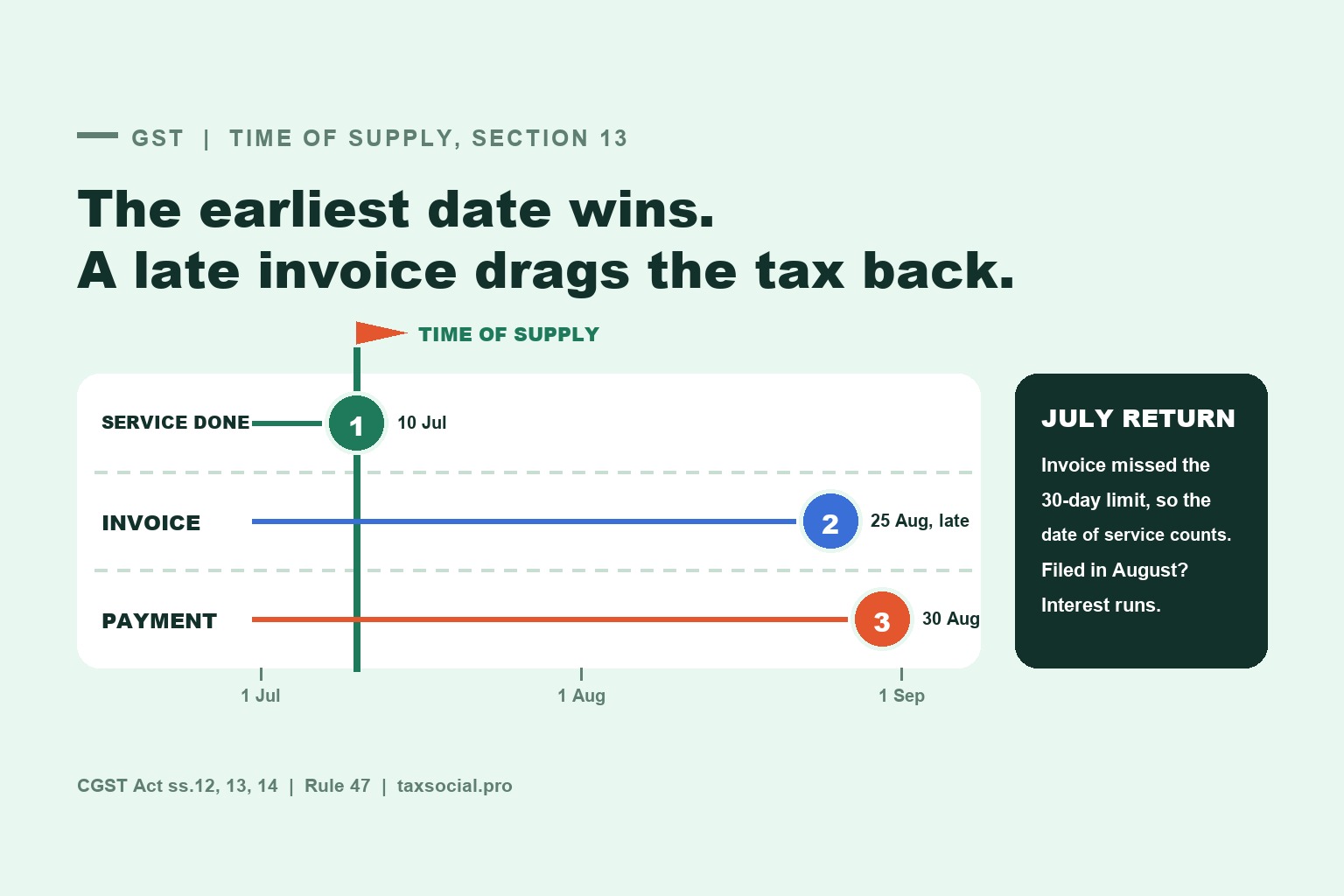
- A late invoice moves the date backwards, not forwards. If the invoice goes out after the thirty days, clause (a) stops applying and clause (b) takes over. The time of supply becomes the date the service was provided (or the payment date, if earlier). A firm that finishes an assignment on 10 July and raises the invoice on 25 August has a July time of supply, not an August one.
- Continuous supply of services (a contract for more than three months with periodic payment obligations, Section 2(33)) has its own invoice rule in Section 31(5). Where the due date of payment is ascertainable from the contract, the invoice is due on or before that date. Where payment is linked to an event, it is due on or before the event. Where the due date is not ascertainable from the contract, the invoice is due before or at the time payment is received. Once the invoice is due, an invoice issued on time sets the time of supply. CBIC applied this reasoning to annuity payments under hybrid annuity road contracts in Circular No. 221/15/2024-GST.
4. "Date of receipt of payment" means the earlier entry
Both sections define the payment date the same way. For goods, Explanation 2 to Section 12(2) says it "shall be the date on which the payment is entered in his books of account or the date on which the payment is credited to his bank account, whichever is earlier". The Explanation to Section 13(2) uses the same words for services.
So a supplier who records a receivable as received on 30 September, on the strength of a cheque in hand, has a 30 September payment date even if the bank credits it on 3 October. The reverse is also true. A bank credit on 28 September that the accounts team posts on 5 October has a 28 September payment date. Whichever happens first counts.
The ₹1,000 option. Both sections let a supplier who receives up to ₹1,000 more than the invoice amount choose the date of issue of an invoice for that excess as its time of supply. It exists so that small over-payments do not each need an immediate return entry.
5. Four worked examples (monthly filer)
| Facts | Time of supply | Return |
|---|---|---|
| Consultancy completed 20 August. Invoice 5 September (within 30 days). Paid 10 October. | 5 September: invoice issued in time, and earlier than payment (s.13(2)(a)) | September |
| Assignment completed 10 July. Invoice 25 August (outside 30 days). Paid 30 August. | 10 July: invoice late, so the date of provision of service, which is earlier than payment (s.13(2)(b)) | July. Reporting it in August is a month late, with interest |
| Advance of ₹2 lakh for an audit engagement received 15 September. Work and invoice in October. | 15 September for the ₹2 lakh. The balance follows the October invoice | September (advance), October (balance) |
| Regular taxpayer receives an advance for goods 15 September. Goods removed and invoiced 3 October. | 3 October. Advances for goods are not taxed (Notification 66/2017) | October |
Example 2 is where interest usually comes from. The tax belonged in July's return. If it goes into August's return instead, interest runs for the month in between, whether or not the client has paid.
6. When the rate changes: Section 14
Section 14 begins "Notwithstanding anything contained in section 12 or section 13", so it overrides the ordinary rules whenever a supply straddles a change in rate. It is written as six situations, three where the goods or services were supplied before the change and three where they were supplied after. They all follow one rule: look at three events, namely supply, invoice and payment. If two of them fall on the same side of the change, that side's rate applies.
| Supply | Invoice | Payment | Time of supply (s.14) | Rate |
|---|---|---|---|---|
| Before | After | After | Earlier of invoice and payment | New |
| Before | Before | After | Invoice date | Old |
| Before | After | Before | Payment date | Old |
| After | Before | After | Payment date | New |
| After | Before | Before | Earlier of invoice and payment | Old |
| After | After | Before | Invoice date | New |
Section 14 was put to heavy use on 22 September 2025, when the GST 2.0 rate changes took effect. For services, any contract that ran across that date needs this table, not Section 13, to decide which rate applied.
Goods are different for most suppliers. Notification 66/2017 requires a regular (non-composition) supplier of goods to pay tax at the Section 12(2)(a) time, the invoice limb, "including in the situations attracting the provisions of section 14". Read with the notification, the payment-date rows of the table do not operate in the ordinary way for those suppliers. An advance received before the change does not, by itself, lock in the old rate on goods. The invoice date is the anchor. Composition taxpayers and suppliers of specified actionable claims are outside the notification. Where a large goods contract had advances straddling a rate change, take advice on the specific row before settling the rate.
The four-working-day proviso. For Section 14, the payment date is normally the earlier of the books entry and the bank credit, as in the Explanation to the section. But the proviso overrides that where it matters most: "the date of receipt of payment shall be the date of credit in the bank account if such credit in the bank account is after four working days from the date of change in the rate of tax". A cheque recorded in the books before the change but credited more than four working days after it is treated as received on the credit date.
7. Reverse charge has its own dates
Where the recipient pays the tax under reverse charge, the supplier's invoice and payment rules above do not apply. Sections 12(3) and 13(3) set the recipient's time of supply instead.
- Goods (s.12(3)): the earliest of the date of receipt of the goods, the date of payment (the earlier of the recipient's books entry and the bank debit), and "the date immediately following thirty days from the date of issue of invoice" by the supplier.
- Services (s.13(3)): the earlier of the date of payment (books or bank debit, whichever is earlier) and the date immediately following sixty days from the supplier's invoice, "in cases where invoice is required to be issued by the supplier".
- Services from an unregistered supplier (s.13(3)(c), from 1 November 2024): where the recipient has to issue the invoice itself under Section 31(3)(f), the time of supply is "the date of issue of invoice by the recipient". Rule 47A gives the recipient thirty days from receipt of the supply to issue that self-invoice.
- Imported services from an associated enterprise: the second proviso to Section 13(3) makes it the date of entry in the recipient's books or the date of payment, whichever is earlier. The sixty-day limb does not apply.
Goods have no equivalent of the services self-invoice limb. A recipient buying goods under reverse charge from an unregistered supplier, such as metal scrap, takes the earliest of receipt and payment, and the thirty-day date where the seller has issued an invoice or other document. If none of these produces a date, the proviso to Section 12(3) uses the date of entry in the recipient's books. The self-invoice the recipient issues under Rule 47A is a separate obligation and does not change the goods time of supply. Our reverse charge guide covers who pays under reverse charge and what the self-invoice has to contain.
8. Two things that are no longer in the sections
Vouchers. Section 12(4) and Section 13(4) used to fix the time of supply of vouchers: the date of issue if the supply was identifiable then, otherwise the date of redemption. Both were omitted with effect from 1 October 2025 by Sections 122 and 123 of the Finance Act, 2025, brought into force by Notification No. 16/2025 – Central Tax. Older guides, and many still circulating, quote them as current law. Sections 12(5) and 13(5) still refer to "sub-section (4)". That is a drafting leftover in the statute, not a sign that the voucher rule survives.
The 2024 change to reverse charge services. Before 1 November 2024, Section 13(3)(b) applied the sixty-day rule to every reverse charge service and there was no self-invoice limb. Section 117 of the Finance (No. 2) Act, 2024 confined the sixty days to cases where the supplier issues the invoice and inserted clause (c). An older commentary that applies sixty days to purchases from unregistered suppliers is out of date.
The Finance Act, 2026 amended Sections 15, 34, 54 and 101A of the CGST Act. It did not touch Sections 12, 13, 14 or 31. The text described here is the text in force in October 2026. The same rules apply to IGST through Section 20 of the IGST Act.
9. The residual rules
- If none of the rules produce a date, Sections 12(5) and 13(5) fall back to the date on which the periodical return has to be filed, or, where no return is due, the date on which tax is paid.
- Interest, late fee or penalty charged to your customer for paying late is part of the value of the supply. Sections 12(6) and 13(6) make its time of supply "the date on which the supplier receives such addition in value". You pay tax on late-payment interest when you collect it, not when you charge it.
10. A month-end checklist
- Services completed this month but not yet invoiced: diary the thirtieth day (forty-fifth for banks, insurers and NBFCs). After that, the time of supply goes back to the completion date.
- Advances received for services: tax in this month's return, receipt voucher issued, adjusted against the invoice later.
- Advances received for goods: no tax unless you are a composition taxpayer or supply specified actionable claims.
- Goods removed before the invoice date: the removal date governs.
- Receipts: take the earlier of the books entry and the bank credit.
- Reverse charge: track the supplier's invoice date (thirty days for goods, sixty for services) and your own self-invoice date for unregistered suppliers.
- Contracts spanning a rate change: for services, apply the two-out-of-three rule in Section 14 and the four-working-day proviso to cheques. For goods from a regular supplier, start from the invoice date (Notification 66/2017).
Sources
- Central Goods and Services Tax Act, 2017: Sections 2(32), 2(33), 12, 13, 14, 31 and 50, current text on the CBIC tax information portal.
- Finance Act, 2025, Sections 122 and 123 (omission of Sections 12(4) and 13(4)), in force from 1 October 2025 by Notification No. 16/2025 – Central Tax dated 17 September 2025.
- Finance (No. 2) Act, 2024, Section 117 (Section 13(3)), in force from 1 November 2024 by Notification No. 17/2024 – Central Tax.
- Notification No. 66/2017 – Central Tax dated 15 November 2017, as amended by Notification No. 50/2023 – Central Tax.
- CGST Rules, 2017: Rules 47, 47A and 50.
- Integrated Goods and Services Tax Act, 2017: Section 20.
- Circular No. 221/15/2024-GST dated 26 June 2024.
This article states the law as at 4 October 2026. Check for later amendments and confirm the position on your own facts before advising.




Comments (0)
No comments yet. Be the first to comment!