

Updated 9 October 2026: checked against the Council's official press release (PIB, 8 October, 7:03 pm). The release adds outdoor catering to the credits being unblocked, extends the capital-goods refund to zero-rated supplies as well as inverted duty, and describes the "same line of business" change as limited credit for restaurants, hotels up to Rs 7,500 and gyms. Corrected below.
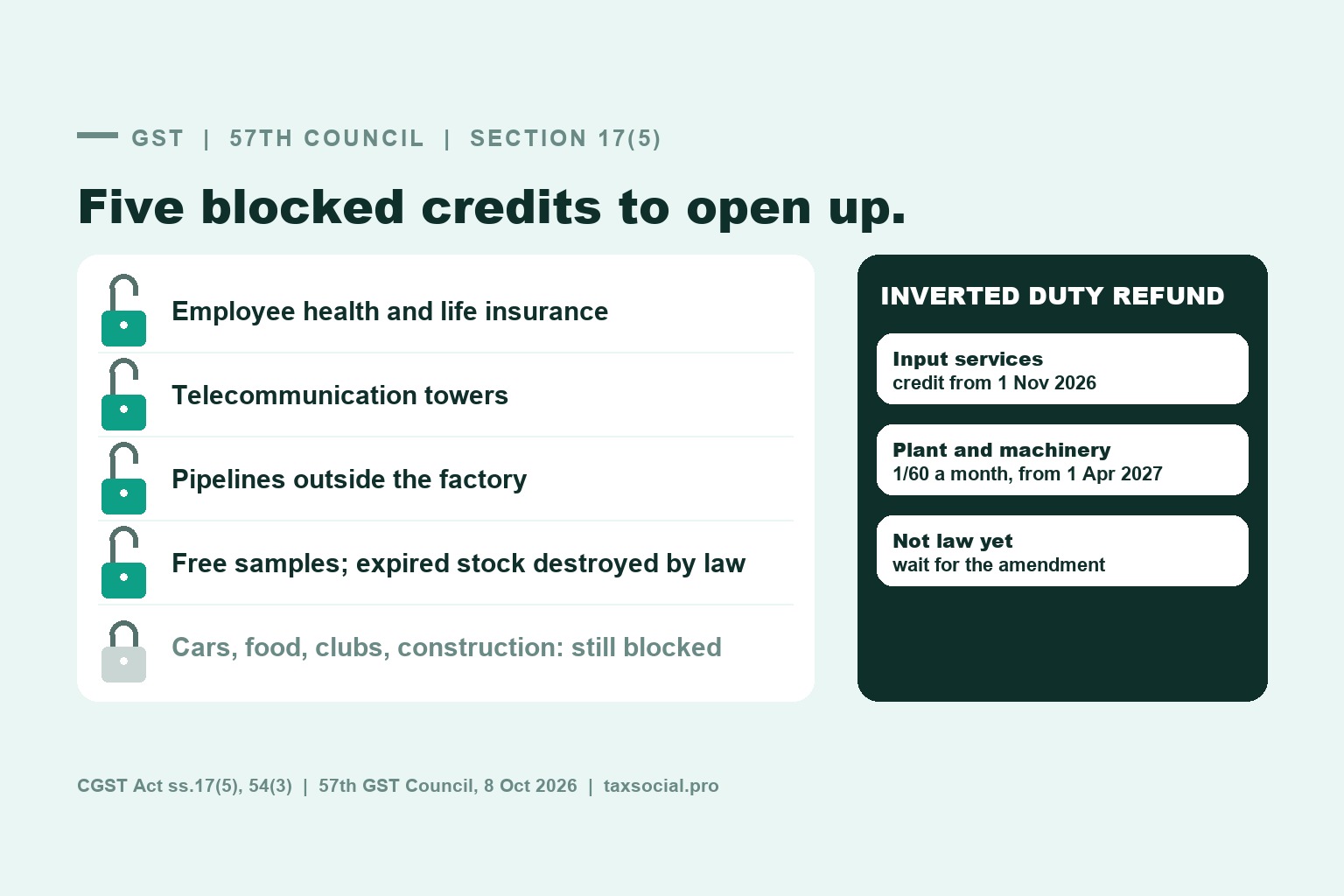
The 57th GST Council (8 October 2026) recommended amending section 17(5) to remove the block on input tax credit for, among other things, outdoor catering, health and life insurance, telecommunication towers, pipelines laid outside the factory, free samples, and goods destroyed or written off on expiry of shelf life as the law requires. It also recommended refunds of accumulated credit on input services (inverted duty, for credit availed on or after 1 November 2026) and on capital goods (inverted duty and zero-rated supplies, spread over 60 months, for credit availed on or after 1 April 2027). The wider eligibility cannot be claimed until the amendment takes effect. Credit already allowed today under the existing exceptions in section 17(5) (onward supply of the same category, composite supply, or a legal obligation on the employer) remains claimable as before. Both the blocks and the refund limit are in the CGST Act. Credit claimed early has to be reversed, and interest is generally charged if it has also been used.
1. The credit changes
The release (item 9) recommends amending section 17(5) "to remove the restrictions on availment of ITC inter-alia on the supplies of outdoor catering, health and life insurance, telecommunication towers, pipelines laid outside factory premises, free samples, goods destroyed or written off on expiry of shelf life as required by law". "Inter-alia" means the amending text may cover more; the list below is what has been named.
| Item | Where it is blocked today | Recommended |
|---|---|---|
| Outdoor catering | Section 17(5)(b)(i), subject to the same-category / composite-supply proviso and the obligatory-by-law proviso | Restriction to be removed |
| Health insurance and life insurance | Section 17(5)(b)(i), unless the employer is obliged by law to provide it, or uses it to make an outward supply of the same category | Restriction to be removed |
| Telecommunication towers | Excluded from "plant and machinery" by the Explanation to section 17, so caught by section 17(5)(c) and (d) as immovable property | Restriction to be removed |
| Pipelines laid outside the factory premises | Same exclusion from "plant and machinery" | Restriction to be removed |
| Free samples | Section 17(5)(h): "disposed of by way of gift or free samples" | Restriction to be removed |
| Stock written off after expiry of shelf life, where the law requires it to be destroyed | Section 17(5)(h): "destroyed, written off" | Restriction to be removed, only where the law requires destruction |
Employee insurance, and outdoor catering
Today, life and health insurance sit in section 17(5)(b)(i), alongside food and beverages, beauty treatment and health services. Credit comes back only through the provisos: where the service is used to make an outward taxable supply of the same category, or as an element of a taxable composite or mixed supply (an insurer, for instance), or where "it is obligatory for an employer to provide the same to its employees under any law for the time being in force". CBIC Circular 172/04/2022-GST confirms the second proviso covers all of clause (b). So a factory that must insure its workers under a labour law can claim credit. An IT company that buys a group mediclaim policy as a perk cannot.
The recommendation removes that distinction for employee insurance. For a company buying group health and term cover for a large workforce, the GST on the premium becomes creditable instead of a cost. The release speaks of "health and life insurance" without the word "employees"; the scope will be in the amending text. Outdoor catering sits in the same clause today, so an employer's event catering or a staff canteen run by an outside caterer is the obvious beneficiary. What the announcement does not settle is whether the new text will cover insurance for employees' family members, top-up policies or key-person cover. That will be in the amending text.
Towers and pipelines
These were never blocked by name. They are blocked because the Explanation to section 17 defines "plant and machinery" as equipment fixed to earth, including foundations, but excludes "(ii) telecommunication towers; and (iii) pipelines laid outside the factory premises". Section 17(5)(c) and (d) block credit on works contracts and own-account construction of immovable property "other than plant and machinery". So once a tower or pipeline is found to be immovable property, the plant-and-machinery carve-out cannot rescue it. The release recommends amending section 17(5) to remove the restriction for towers and pipelines outside the factory; the amending text will show whether that is done by deleting the two exclusions from the definition or another way. This is the change telecom operators and tower companies have litigated for years.
Free samples and expired stock
Section 17(5)(h) blocks credit on goods "lost, stolen, destroyed, written off or disposed of by way of gift or free samples". Two parts of that are to go: free samples, which matter to pharma and FMCG companies, and goods written off once their shelf life has expired, where a law requires them to be destroyed (food safety and drug rules being the usual cases). Lost and stolen goods, and gifts, stay blocked on what has been announced.
2. The refund changes
Section 54(3) allows a refund of unutilised credit in two cases. One is zero-rated supplies made without payment of tax. The other is where credit accumulates "on account of rate of tax on inputs being higher than the rate of tax on output supplies": the inverted duty structure. "Inputs" means goods. So today the refund formula in Rule 89(5) counts only credit on inputs. Credit on input services and capital goods piles up in the ledger even when the inversion is real.
- Input services: to be included in the inverted duty refund, for credit availed on or after 1 November 2026.
- Capital goods: accumulated credit on capital goods to become refundable for both inverted duty and zero-rated supplies (exports and SEZ supplies), "spread over 60 months", for credit availed on or after 1 April 2027. The briefing described this as one-sixtieth of the credit for each month.
Because the dates turn on when credit is availed, credit taken on input services before 1 November 2026 stays outside, on what has been announced.
One point decides how fast this arrives. Section 54(3)(ii) speaks of credit accumulated because the tax on "inputs" is higher than on the output, and the Act defines "input" as goods other than capital goods. A rule cannot enlarge that. So both changes need the CGST Act amended first, and the refund rules rewritten after. The release confirms the route: an amendment to "clause (ii) of proviso to section 54(3)" and to the CGST Rules. A 1 November 2026 date for input services therefore means credit availed from that date will count once the law changes. It does not mean you can file for it in November.
3. Other credit decisions
- Limited credit in the same line of business for restaurant and outdoor catering services, hotel accommodation up to Rs 7,500 per unit per day, and gym and fitness services, "in the same manner as is currently available for passenger transportation services, tour operator services and renting of motor vehicles services" (release, part C2, item 4). These are concessional-rate entries where credit is restricted, so a business that buys the service and supplies it on, a caterer subcontracting to another caterer for instance, bears tax twice. Passenger transport already has this treatment; the three named services are being added. It comes by rate notification.
- Second-hand vehicle dealers under the margin scheme may take credit on other inputs and input services (spares, repairs, technology, rent, marketing); the bar applies only to tax on the vehicles bought.
- Circulars promised on credit for banks and NBFCs that opt for section 17(4), on the Input Service Distributor mechanism, and on credit for demonstration vehicles in certain situations.
- A hearing before credit is blocked under rule 86A.
- Genuine buyers and supplier default. At the briefing it was said that a Committee of Officers is to examine whether a buyer who has a valid invoice, received the goods and paid the supplier in full should keep the credit when the supplier does not pay the tax. Its report is due in three months. This is not in the written release, and it is not a decision. Section 16(2)(c) still makes the buyer's credit depend on the tax having actually been paid to the Government.
4. When can you claim?
- The section 17(5) changes need an Act amendment. The blocks are written into the CGST Act, and into every SGST Act and the UTGST Act, so Parliament and each State have to amend them. A CGST amendment alone does not make the State-tax part creditable. Until then, the credit is blocked. Credit taken early must be reversed. Interest under section 50(3) is charged where the wrongly availed credit has also been utilised, and a penalty may follow depending on the facts.
- The refund dates are announced dates, not yet law. Both refund changes need section 54(3) amended, then the rules. Do not include input-service credit in an RFD-01 until both are in force.
- Keep the records now. Separate insurance, outdoor catering, tower and pipeline credit, sample stock and expiry write-offs in your books from October 2026. If the amendment works by reference to credit availed after a date, you will want clean figures from that date.
5. What did not change
- Motor vehicles, food and beverages, club membership, leave travel, works contract and own-account construction stay blocked, subject to the exceptions already in the Act (vehicles used for onward supply, passenger transport or driving training; same-category or composite supplies; benefits an employer is obliged by law to provide).
- The section 16 conditions, including the 30 November time limit in section 16(4), are untouched. A credit that becomes available still has to be claimed in time.
- Our full guide to the current section 16 conditions and section 17(5) is here: GST input tax credit: section 16 conditions and section 17(5) blocked credits.
Source: Recommendations of the 57th Meeting of the GST Council, Press Information Bureau, 8 October 2026 (Release ID 2320934), items 8, 9, 14 and 16 and part C; the Finance Minister's press briefing the same evening, where noted. First published on 8 October from the briefing; checked against the release and corrected on 9 October.


Comments (0)
No comments yet. Be the first to comment!