
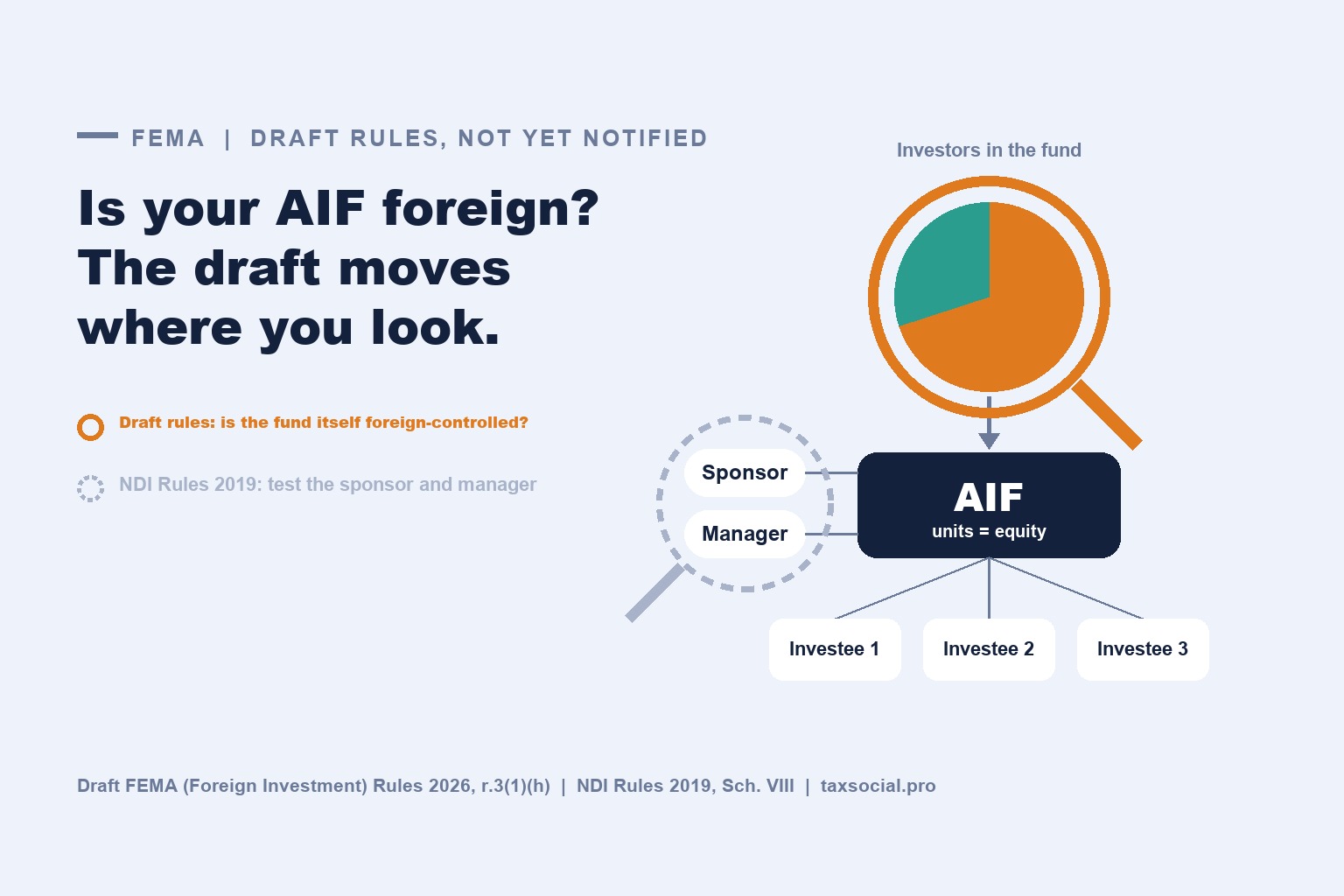

This is a draft, not the law. On 21 July 2026 the RBI published the draft Foreign Exchange Management (Foreign Investment) Rules, 2026. Once notified by the Central Government, they would replace the Non-Debt Instruments (NDI) Rules, 2019. Comments closed on 31 August 2026. As at 7 October 2026 the final rules have not been notified, so the NDI Rules still apply. For alternative investment funds, the biggest change is in how a fund's downstream investments are classified. Today, whether an AIF's investment in an Indian company counts as foreign depends on who owns and controls its sponsor, manager or investment manager. The draft drops that test. Instead it asks whether the AIF itself is a "Foreign Controlled Entity", and leaves "ownership and control" to be decided by sectoral regulators or, failing them, by "SEBI AIF regulations". If that wording is finalised, an Indian-managed fund with mostly foreign money could be treated as foreign.
1. Where this stands
- 21 July 2026: RBI Press Release 2026-2027/726. It explains that the Union Budget 2026-27 announced a comprehensive review of the NDI Rules, the Central Government set up a committee, and the RBI prepared the draft "in consultation with the Central Government and other stakeholders". It says: "The Rules will be finalized after wider public consultations."
- 31 August 2026: the comment window closed.
- Now: no final notification. The draft is framed as a Ministry of Finance (Department of Economic Affairs) notification under section 46 of FEMA, which is the Central Government's rule-making power, and it would come into force "on the date of their publication in the Official Gazette". So it would take effect on the day it is published, with no lead time.
The draft says it supersedes the NDI Rules "except as respects things done or omitted to be done before such supersession". That preserves acts already done. But the draft has no express grandfathering or transition provision for structures that continue past that date: an existing fund's holdings, its future downstream investments, or the compliance that follows from them. Do not assume an existing structure is insulated until the final text says so.
2. The rule today: look at the sponsor and the manager
Schedule VIII of the NDI Rules, 2019 deals with foreign investment in "Investment Vehicles", meaning AIFs, REITs and InvITs. Paragraph 4 is the rule that matters:
"Investment made by an Investment Vehicle into an Indian entity shall be reckoned as indirect foreign investment for the investee Indian entity if the Sponsor or the Manager or the Investment Manager (i) is not owned and not controlled by resident Indian citizens or (ii) is owned or controlled by persons resident outside India."
A proviso lets SEBI decide foreign ownership and control where the sponsor or manager is not a company or LLP. An Explanation adds that "control" of the AIF "should be in the hands of 'sponsors' and 'managers or investment managers'", and that where they are individuals, they must be resident Indian citizens for the fund's downstream investment to count as domestic.
The result is the market's familiar structure. How much foreign money is in the fund's corpus does not matter. An AIF raising 80% of its commitments from offshore LPs, run by an Indian-owned and controlled sponsor and manager, invests as a domestic investor. Its investment is not indirect foreign investment in the hands of its portfolio companies, so it does not count towards their foreign-investment limits. Paragraph 5 adds one restriction: a Category III AIF that has received foreign investment may make portfolio investments only in securities a foreign portfolio investor could buy.
3. What the draft says instead
The draft has no Schedule VIII, and no sponsor-and-manager test anywhere in the rules. AIFs come in through three definitions:
- AIFs are named as eligible investee entities. Rule 3(1)(b)(iii) covers "an investment vehicle registered with the SEBI", expressly including REITs, InvITs, AIFs, venture capital funds, and mutual funds or ETFs "which invest more than fifty per cent in equity". Foreign investment in AIFs was already permitted under Schedule VIII. The change is that AIFs now sit in the same list as companies and LLPs.
- Units are "equity". Rule 3(1)(d)(ii) defines equity to include a "Unit of an investment vehicle as per the respective SEBI regulations". So when a foreign LP holds units, that is "foreign investment in equity" under the new rules. An undrawn commitment is not itself a unit; when it becomes one depends on the fund's unit-issue mechanics and the SEBI rules.
- The "Foreign Controlled Entity". Rule 3(1)(h) defines an FCE as "a resident company or an LLP or an investment vehicle which is owned or controlled by a person resident outside India". The test is applied to the fund, not to its sponsor or manager. The definition then hands the test itself to someone else:
"... where 'Ownership and Control' shall be governed by the applicable provisions stipulated by the respective sectoral regulators in consultation with the central Government. In the absence of any such stipulations, the ownership and control in the entities shall be determined in accordance with the applicable Indian laws under which such entity is incorporated (the Companies Act, 2013 for Indian companies or LLP Act, 2009 for an Indian LLP or SEBI AIF regulations for AIFs etc.)"
(The "LLP Act, 2009" is the draft's own slip: the statute is the Limited Liability Partnership Act, 2008.)
An investment by an FCE is, under rule 3(1)(e), foreign investment made "indirectly". So whether an AIF's investment in an Indian company is foreign would depend on whether the AIF is an FCE, and that depends on a test the rules do not set out.
4. Why this is the open question
This is the point the creative going round is making with its question about SEBI. It is a fair question, and the draft does not answer it.
- There is a gap where the old test was. The SEBI (Alternative Investment Funds) Regulations, 2012 regulate who may be a sponsor or manager and what a fund may do, and they deal with a change in control of an AIF, its sponsor or its manager, which needs SEBI's prior approval. But they do not contain a full FEMA-style test of whether a fund is owned or controlled from outside India, and their limited control provisions do not answer the draft's FCE question. Commentators reviewing the draft, including Cyril Amarchand Mangaldas, make the same point. Until SEBI (with the Central Government) or the final rules fill the gap, the test the draft relies on has not been spelt out.
- "Owned" could start to look at the LPs. One possible reading of "owned by a person resident outside India", applied to an AIF, is that it asks who holds the units. On that reading, a fund whose corpus is mainly foreign could be an FCE even with an Indian sponsor and manager, which would reverse the result under paragraph 4 today. It is only one reading. AIFs can be trusts, companies or LLPs, and the draft gives no single ownership test across those forms, and no threshold.
- The 10% voting limb. Rule 3(1)(e) defines "control" to include management rights, shareholders' agreements or "voting agreements that entitle them to ten per cent. or more of voting rights". On its face that definition applies to the indirect route through another foreign entity, while the FCE definition has its own regulator-led test. Which one governs an AIF's LP advisory committee rights or side letters is a drafting question the final text needs to settle.
5. What softens the impact
Two provisions in the draft cut the other way, and the creative does not mention them.
- FCE conditions apply only where the FDI policy says so. The first proviso to rule 8(1)(a): "foreign investment by an FCE shall comply with the applicable conditions only for sectors which are specifically prescribed in the foreign investment policy (Annexure-II) for such purpose." So even if an AIF becomes an FCE, its investments face entry-route, cap and condition rules only in the sectors the policy names for FCE investment. The full downstream rulebook would not apply across the board. The draft does not yet identify those sectors. Annexure-II is simply the Government's FDI Policy "as amended from time to time", so the answer depends on the policy in force if and when the rules are notified.
- Pricing follows SEBI. Rule 8(2)(a) prices foreign investment in "an investment vehicle" by "the relevant SEBI Regulations", so a unit issue to a foreign LP needs no separate FEMA valuation certificate under rule 8(2)(a). Any SEBI or fund-document valuation requirements still apply.
Two further changes matter to funds. Rule 7 keeps the swap route: an investment vehicle may issue units to a foreign investor against equity of an SPV it is acquiring, which is the familiar InvIT and REIT asset-acquisition structure. And the paragraph 5 restriction on Category III AIFs does not appear in the main text of the draft. Whether it comes back through the RBI's Annexure-III regulations is not known.
6. The other changes in the draft, briefly
- One "equity" concept replaces "equity instruments" and "capital instruments": instruments classified as equity under the accounting standards, units of investment vehicles, and participating interests in oil fields or mines.
- FDI and FPI by a 10% line in a company or LLP. Under rule 8(1)(d), portfolio investment on a recognised stock exchange in India that takes a foreign investor to 10% or more of a company's equity "may be reclassified to FDI".
- Non-repatriation investment (typically NRIs and OCIs) is freed from the rule 8 conditions, except that it is still barred from prohibited sectors.
- Who does what: the RBI administers the rules and sets payment and reporting requirements, and the Department for Promotion of Industry and Internal Trade (DPIIT) interprets the FDI policy (rule 4).
- Onus is on the foreign investor and the investee, or on the transferor and transferee (rule 9).
- Bonus and rights issues that leave foreign shareholding unchanged are outside the entry-route and cap conditions, and rights issues are outside pricing.
7. What to do while it is a draft
- Until notification, nothing changes. AIF downstream investments today are still tested under Schedule VIII paragraph 4, on the sponsor, manager and investment manager.
- Know your fund's foreign-LP percentage, and who controls it. The FCE test is ownership or control. If the final rules look at unitholding, the foreign share of the corpus becomes one input, and control is a separate route in. Funds raising offshore money now should model the possible outcomes.
- Portfolio companies in sectors with caps or conditions (insurance, defence, broadcasting, multi-brand retail and others) should know which of their AIF investors could become FCEs. A cap breach is the investee's problem too.
- Review LP side letters and advisory committee rights against the 10% voting limb, so you are not surprised if the final text applies it to funds.
- Watch three things: the final rules in the Gazette, whatever SEBI notifies on fund-level ownership and control (with the Central Government), and the revised FDI Policy in Annexure-II naming the FCE sectors. We will update this article when any of them appears.
Sources
- RBI Press Release 2026-2027/726, "Rationalisation of Foreign Exchange Management (Non-Debt Instruments) Rules, 2019 – Draft Rules for Comments", 21 July 2026.
- Draft Foreign Exchange Management (Foreign Investment) Rules, 2026, as placed on the RBI website on 21 July 2026: rules 1-9 and Annexures I-III.
- Foreign Exchange Management (Non-debt Instruments) Rules, 2019, G.S.R. 795(E) dated 17 October 2019, Schedule VIII.
- Commentary used only for how the draft has been received: Cyril Amarchand Mangaldas, "Hits and misses" (August 2026); KPMG Flash News (24 July 2026).




Comments (0)
No comments yet. Be the first to comment!