

Updated 9 October 2026: rebuilt from the Council's official press release (PIB, 8 October, 7:03 pm), which was not out when this page was first published from the Finance Minister's briefing. The release is longer than the briefing. It adds a late fee waiver, rule 14B for e-commerce sellers, automatic registration amendments and cancellations, a return-matching overhaul from April 2027, and a set of specific rate and exemption changes. It also confirms which items need the Act amended. Corrected throughout.
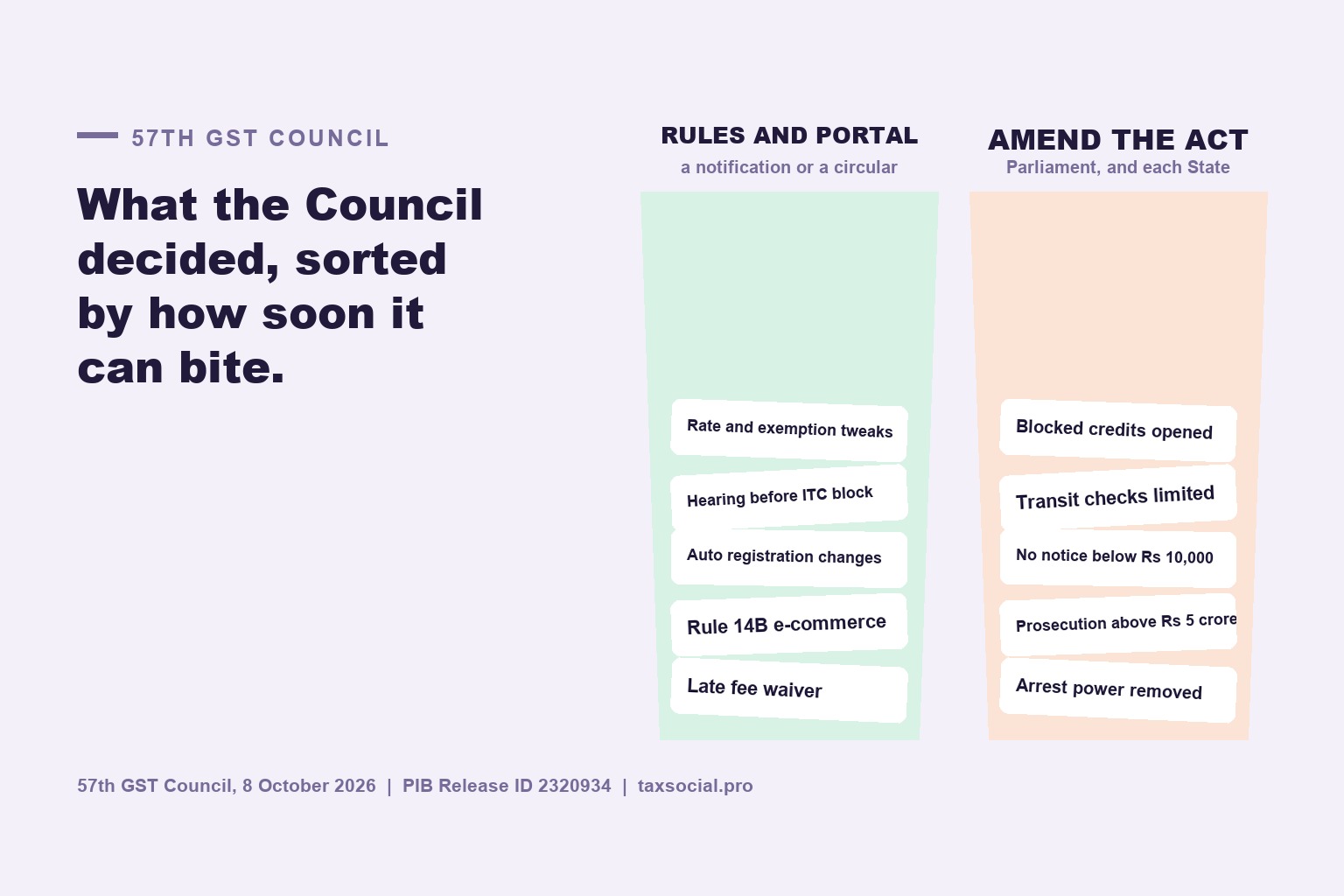
The 57th GST Council met on 8 October 2026 at Bharat Mandapam, New Delhi. There was no general rate revision; the release calls the meeting's focus "process reforms primarily covering registration, returns, refund and adjudication", plus clarifications and some specific rate and exemption changes. The headline recommendations are to remove the power of arrest, raise the prosecution threshold to Rs 5 crore, cut the general penalty to Rs 10,000, put a Rs 10,000 floor on notices, unblock credit on outdoor catering, insurance, towers, pipelines, free samples and expired stock, allow refunds on input services and capital goods, and automate refunds. Recommendations are not law. The release itself says they take effect only through "circulars/ notifications/ law amendments which alone shall have the force of law". This page lists the decisions and sorts them by what each needs.
1. Status
| Item | Position |
|---|---|
| Meeting | 57th GST Council, Thursday 8 October 2026, Bharat Mandapam, New Delhi, chaired by the Union Finance Minister. Rescheduled twice: from 12 September, then from 7 October. |
| Source for this page | "Recommendations of the 57th Meeting of the GST Council", PIB, 8 October 2026, 7:03 pm (Release ID 2320934). Points from the Finance Minister's briefing are marked as such. |
| Rates | No general rate revision. Specific changes and clarifications in part C of the release (section 3 below). At the briefing, the Finance Minister said rate matters will now go to one dedicated meeting a year. |
| Legal effect today | None until the circulars, notifications and Act amendments issue. |
2. The process decisions, and what each needs
| Decision | Current law | Route in the release |
|---|---|---|
| Arrest power withdrawn completely | Section 69 | Omit section 69 (Act) |
| Prosecution threshold Rs 1 crore to Rs 5 crore; offences in section 132(1)(c), (e), (h) narrowed, clause (i) omitted; punishments rationalised | Section 132 | Act |
| No show cause notice below Rs 10,000 (all taxes and cess together); pending sub-Rs 10,000 notices and appeals decided as if the floor applied | No floor today | Sections 73, 74, 74A (Act) |
| Penalty deemed a "charge" on voluntary full payment; 5% penalty in non-fraud cases paid within 30/60 days of the order; Rs 10,000 minimum penalty in non-fraud cases removed | Sections 73, 74A | Act |
| General penalty Rs 25,000 to Rs 10,000 | Section 125 | Act |
| Pre-deposit capped at Rs 40 crore (20 + 20) for penalty-only appeals | Sections 107(6), 112(8) provisos | Act |
| Common guidelines on notices, orders, fraud allegations and personal hearings | Varies | Circular |
| Interception only on specific intelligence with Joint Commissioner's authorisation; only where supplier or recipient is in the State (none in transit States unless there is no e-way bill or document); no confiscation in transit | Sections 68, 129, 130 | Act |
| Hearing before credit is blocked | Rule 86A | Rule |
| Credit unblocked "inter-alia" on outdoor catering, health and life insurance, telecom towers, pipelines outside the factory, free samples, goods destroyed or written off on expiry as required by law | Section 17(5) | Act |
| Refund of accumulated credit on input services (inverted duty, credit from 1 Nov 2026) and capital goods (inverted duty and zero-rated, over 60 months, credit from 1 Apr 2027) | Section 54(3)(i) for zero-rated supplies; first proviso to section 54(3), clause (ii), for inverted duty | Act and rules |
| Refund automation: cash-ledger refunds sanctioned automatically; acknowledgement in 10 days with deemed acknowledgement; 90% provisional refund automatic; phase 2 full automation for zero-rated | Section 54, rules 90, 91 | Act and rules |
| RFD-01 in system-readable form; 1.5x cap in rule 89(4)(C) removed; Rs 1,000 refund floor counted across all taxes; interest on pre-deposit refunds in section 115 | Rules 89, section 54(14), 115 | Act, rules, circular |
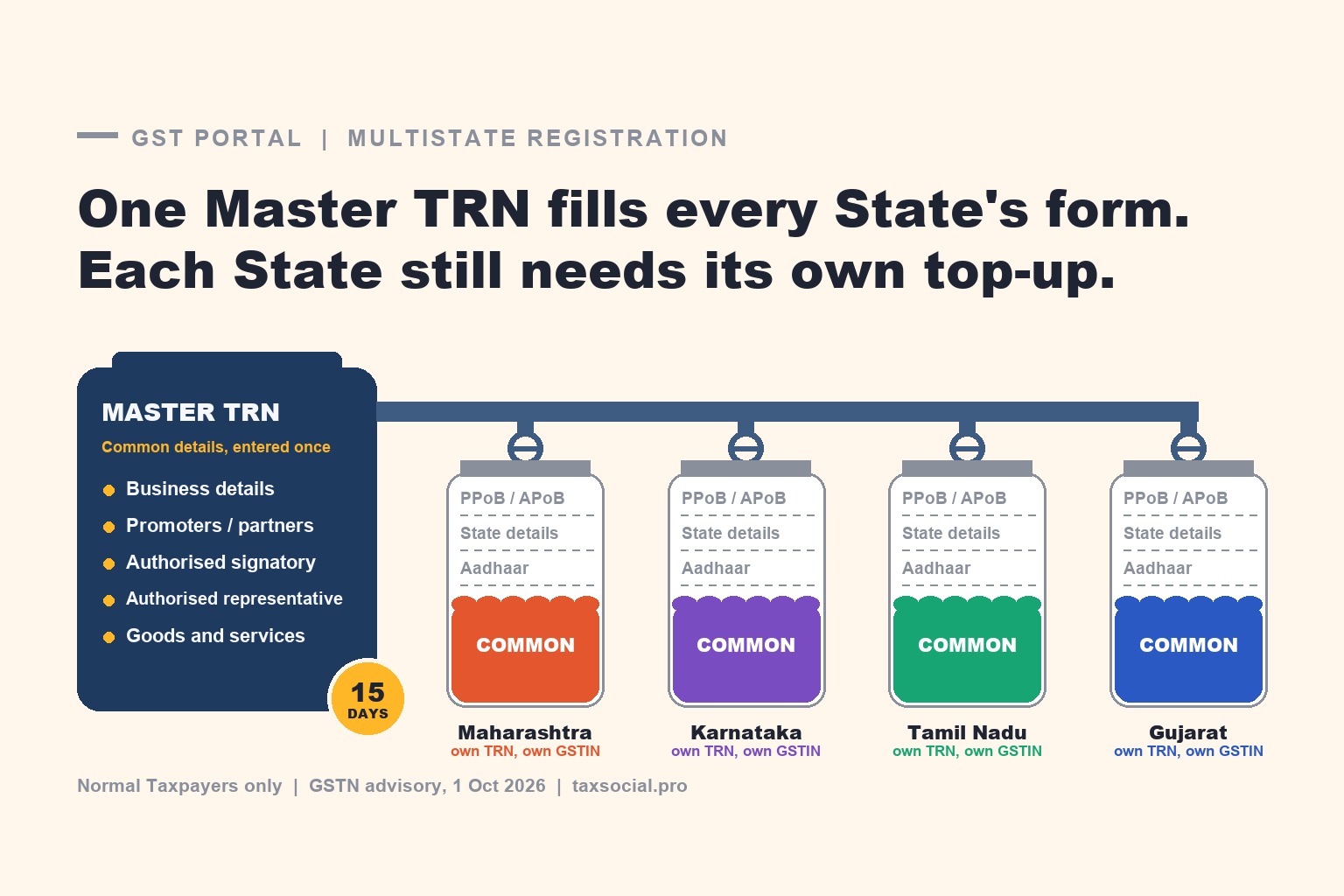
| Registration: documents circular and FAQs, REG-01 drop-downs, portal interface | Rules 8, 9 | Circular, form, portal |
| Registration amendments accepted automatically except principal place of business (all, for rule 14A registrants) | Rule 19 | Rule |
| Cancellation applications accepted automatically once returns and dues are clear (two phases); system-based cancellation and revocation for non-filing | Rules 20 to 23, Act | Act and rules |
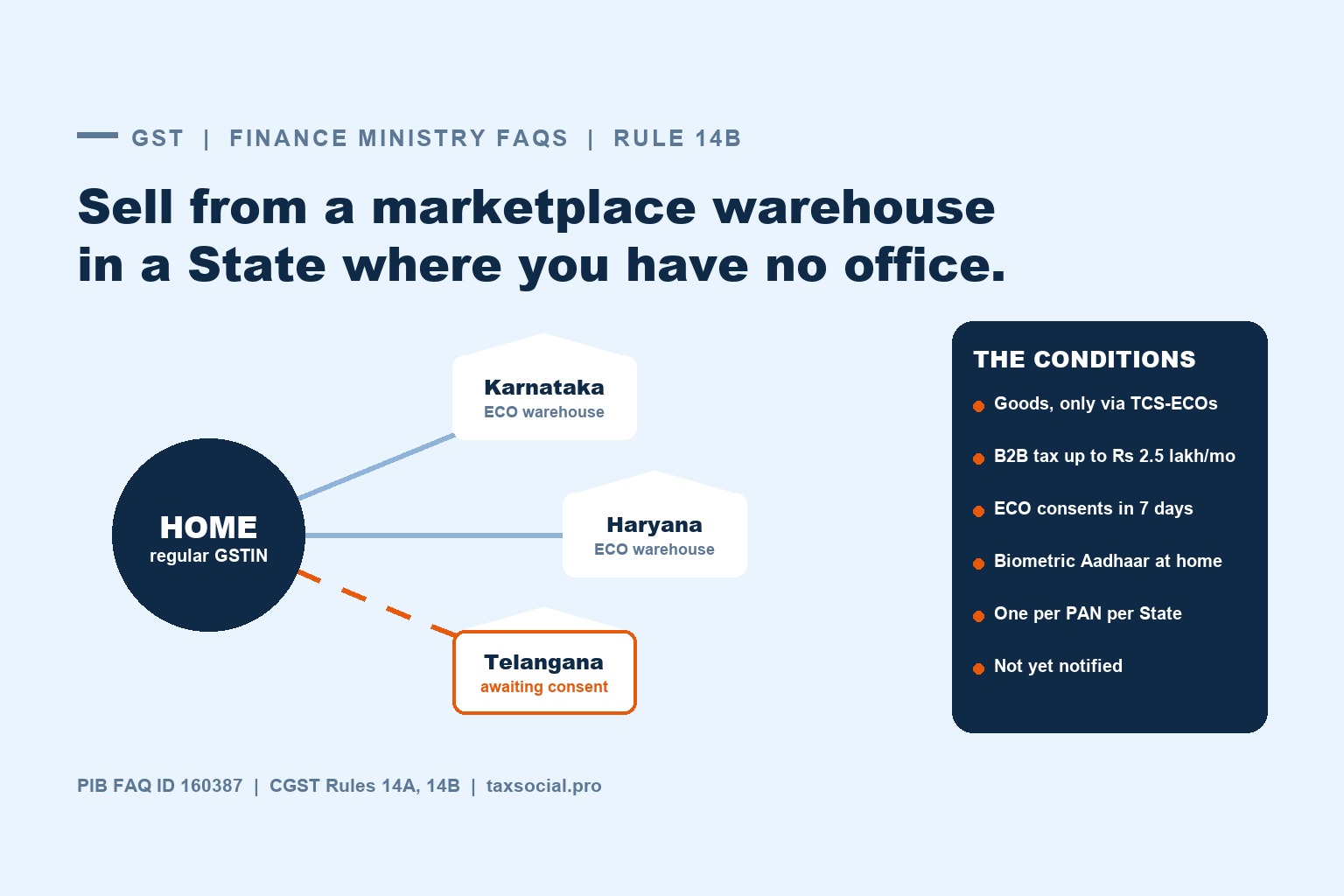
| Rule 14B: small e-commerce sellers of goods (credit passed on up to Rs 2.5 lakh a month) may register in a State with no presence by declaring the operator's warehouse as principal place of business; automatic grant | No such route | Rule |
| Return matching: GSTR-1/1A/IFF enhancements, new rules 86C and 86D statements, rule 61(1A) and (1B) corrections, IMS rule 60(6A), DRC-03 invoice details; from the April 2027 return, after public consultation | Rules 60, 61 | Rules, forms, circular |
| Late fee waived on a section 39(1) return filed by the end of the month it was due, turnover up to Rs 5 crore | Late fee under section 47 (caps under Notification 76/2018 as amended) | Waiver by notification under section 128 |
| ARQP: optional annual return with quarterly payment, turnover up to Rs 5 crore, B2C only | Section 39 | Concept note approved in principle; Act amendment to follow |
| Export of services through an Indian supplier's own foreign office or branch | IGST s.2(6)(v) | Omit s.2(6)(v) (IGST Act) |
| Services on goods made physically available by a foreign recipient: place of supply to be the recipient's location | IGST s.13(3)(a) | Omit s.13(3)(a) (IGST Act) |
| Supply to an overseas buyer delivered in an SEZ/FTWZ deemed a supply to the SEZ/FTWZ | IGST s.16(1) | Explanation (IGST Act) |
| Transfer of title in IPR, temporary or permanent, treated uniformly as a supply of services | Schedule II | Act |
| Sections 16, 37 and 39 aligned with the section 16(4) credit time limit; ECO liability under section 9(5) clarified; validation of notices covering multiple years | Act | Act |
| E-invoicing extended to reverse-charge purchases from unregistered persons and to import of services, turnover Rs 5 crore and above | Rule 48 | Notification |
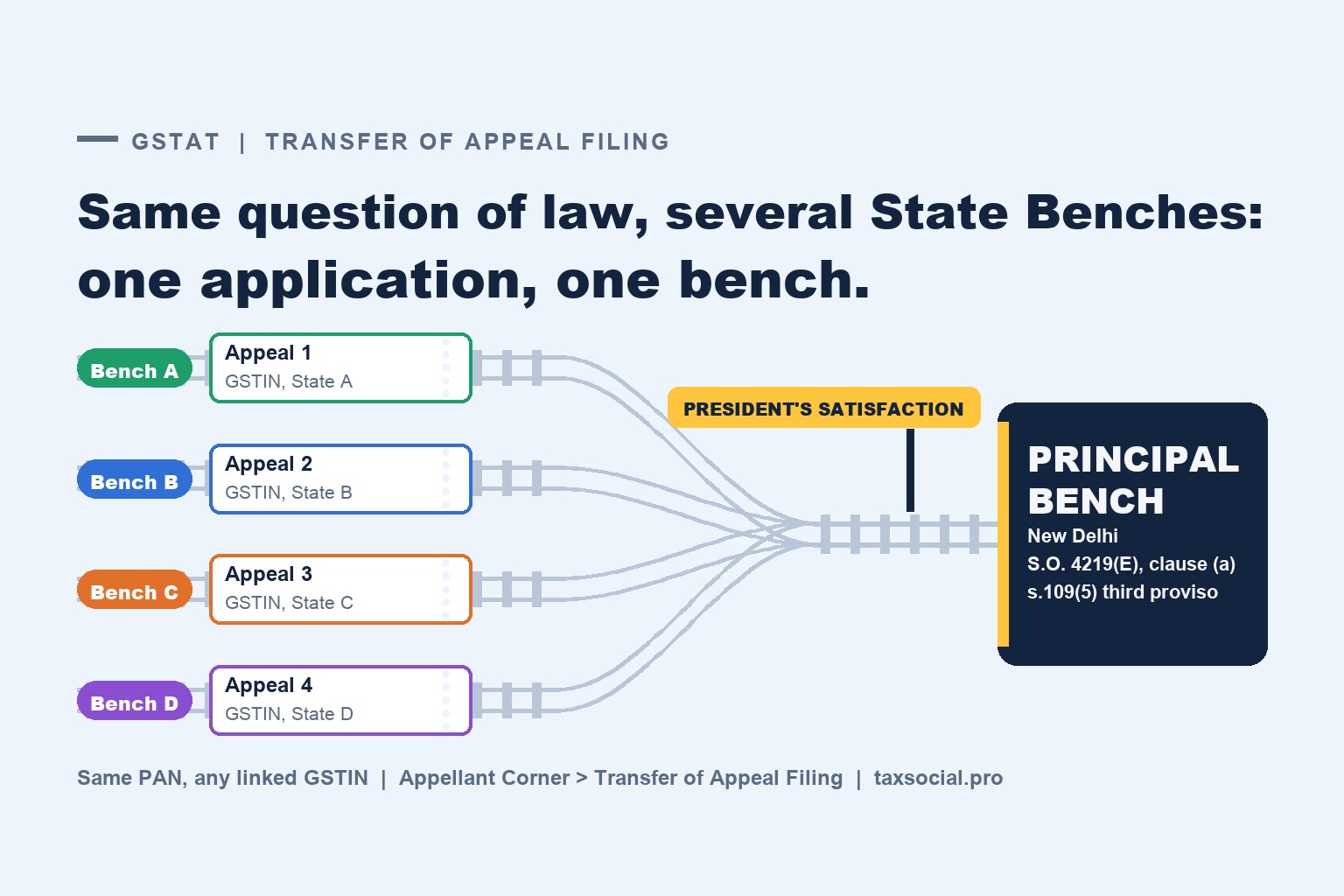
| GSTAT provisions aligned with the Tribunals Reforms Act, 2026 | Act, GSTAT rules | Act and rules |
| Rule 96(10) omitted with effect from 23 October 2017, following the Supreme Court's decision | Rule 96(10) | Rule |
3. Rate and exemption changes in the release
Part C of the release lists specific changes and clarifications. The ones most likely to matter:
- Waste and scrap: plastics, e-waste, tyres and used cooking oil under reverse charge when supplied by an unregistered person to a registered person, and TDS of 2% on B2B supplies of the same.
- Same-line credit: limited credit for restaurants and outdoor catering, hotels up to Rs 7,500 per unit per day, and gyms, as already allowed for passenger transport, tour operators and vehicle renting.
- EV passenger transport and rental with operator: option of 5% with restricted credit where charging cost is included.
- Delivery through e-commerce operators: brought under section 9(5) where the delivery person is not liable to register, at 5% without credit; GTA exemption for transport to unregistered persons excluded where the goods were ordered through an ECO.
- Exemptions: seat-sharing passenger transport by helicopter from or to airports and helipads in the north-eastern States, Sikkim and Bagdogra in West Bengal; storage of seeds for sowing; coffee curing; the Seamen's Provident Fund Organisation; import of services by Indian establishments of foreign shipping lines from related persons without consideration; the toll right granted to TOT concessionaires.
- Clarifications: sublimation paper under heading 4809; all toys under heading 9503 covered by the toy entries; seaweed-based bio-stimulants as fertilisers under 3101; isabgol seeds at nil; retreaded tractor tyres aligned with new ones; second-hand vehicle dealers under the margin scheme can take credit on other inputs; R&D exemption by self-certification; fund transfer pricing in banks treated as "interest".
4. The numbers the Council put on the table
At the briefing, the meeting was framed around how GST has done since the two-rate structure came in a year ago. As reported:
- Monthly taxable supplies up 25.8%, from Rs 40.19 lakh crore to Rs 50.58 lakh crore.
- Effective tax rate on domestic supplies down from 14.55% to 13.13%.
- GST revenue up 11% in 2026-27, and 14.7% higher in June to August 2026 than a year earlier.
- About 61% of registrations already granted through the automated route.
Its argument from those numbers: businesses deal with registrations, returns and refunds far more often than with rate changes, so the friction is in procedure, not in rates. And because the system now matches sellers' and buyers' invoices and can pick out fake credit, enforcement can rely on detection rather than on the threat of arrest. That reasoning explains why this meeting spent its time on process rather than rates.
5. What the Council did not do
- No general rate revision. The changes in section 3 are targeted.
- No decision on credit lost through supplier default. At the briefing it was said that a Committee of Officers will report in three months; the written release does not mention it. Until the law changes, section 16(2)(c) still ties the buyer's credit to the supplier paying the tax.
- No change on corporate guarantee valuation under rule 28(2), despite pre-meeting reports.
- Search, seizure and summons powers in sections 67 and 70 are not mentioned. The arrest power goes; the investigative powers stay.
6. The four pieces you will want in detail
- Enforcement: arrest, prosecution, penalty, notices and transit checks. What the law says today, section by section, and why none of it applies to cases already under way.
- Credit and refunds: blocked credits opened and refunds on services and capital goods. Why claiming any of it now would be a mistake.
- Small businesses: ARQP, rule 14B for e-commerce sellers, registration and refunds.
- Late fee: no late fee on a GSTR-3B filed within the month, turnover up to Rs 5 crore. Who qualifies and what it saves.
7. What happens next
- Circulars and notifications for the rule-level and rate items: registration documents, rule 19 amendments, rule 14B, rule 86A, the late fee waiver, the rate and exemption notifications, and the notices circular. These usually follow within weeks of a Council meeting, but there is no fixed date. The release says FAQs are being issued.
- Amendments to the CGST and IGST Acts for arrest, prosecution, notices and penalties, transit checks, blocked credits, refunds, the export changes and IPR. They can come in any Bill, and each needs a commencement notification.
- SGST and UTGST amendments in each State and for the Union territories, on their own timetables.
- Public consultation on the return-matching mechanism, meant to apply from the April 2027 return.
- ARQP: the scheme itself, built on the concept note.
8. What we got right, and wrong, in our preview
Our preview listed five reported agenda items. Credit on insurance was recommended (vehicles were not). Registration changes came through as automatic amendments and cancellations and the new rule 14B, rather than the uniform procedure reported. Credit for buyers whose supplier did not pay the tax was not decided; a committee was mentioned at the briefing. Corporate guarantee valuation was not in the release. The preview did not foresee the arrest and prosecution package, which turned out to be the headline.
Source: Recommendations of the 57th Meeting of the GST Council, Press Information Bureau, 8 October 2026 (Release ID 2320934); the Finance Minister's press briefing the same evening, where noted. First published on 8 October from the briefing; rebuilt from the release on 9 October.




Comments (0)
No comments yet. Be the first to comment!