
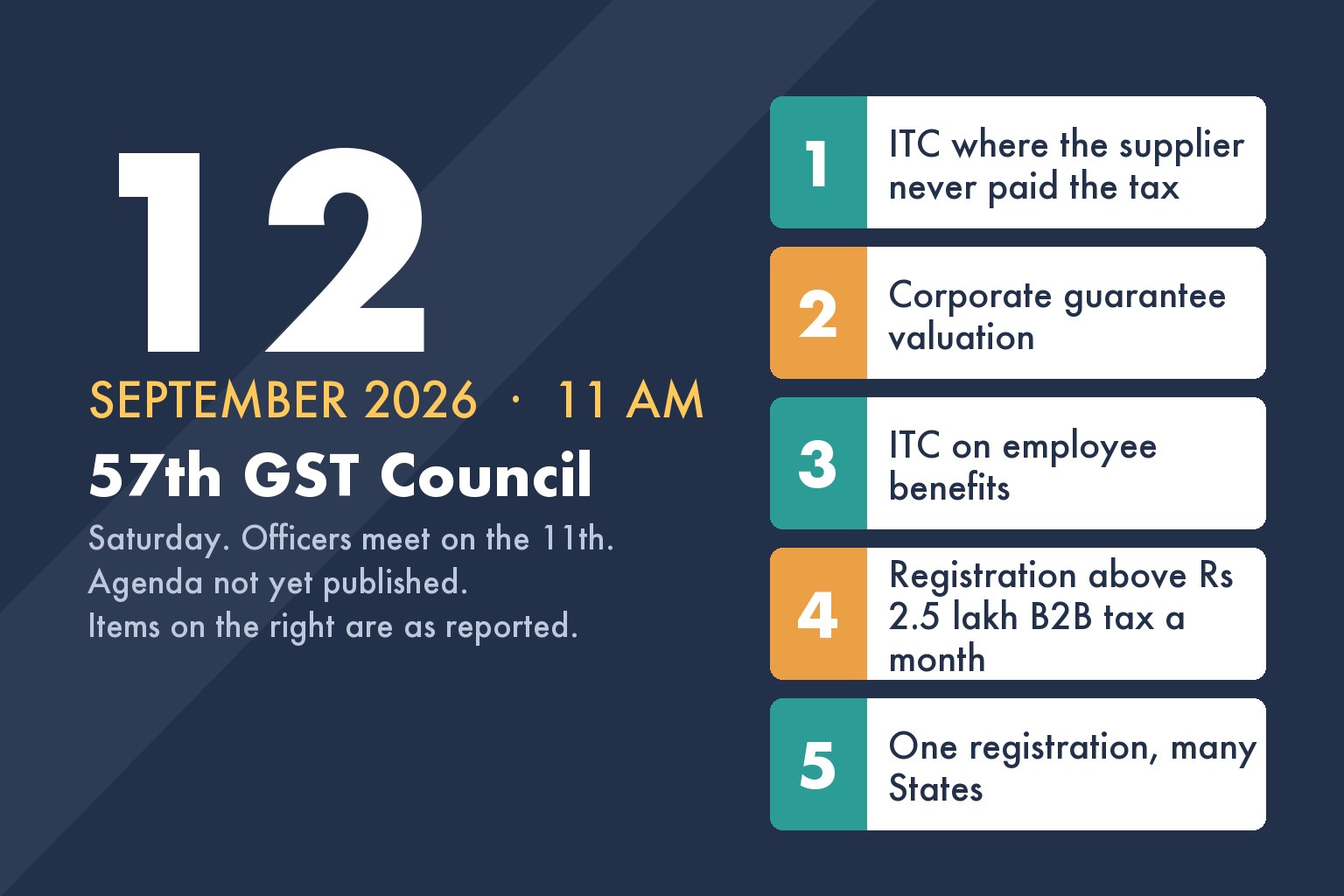

TL;DR. Updated 13 September 2026: the 57th GST Council did not meet on 12 September. The Council Secretariat rescheduled it to Wednesday 7 October 2026 in New Delhi, with the officers' meeting on 5 and 6 October, because India hosted the BRICS Leaders' Summit in the capital on 12 and 13 September; the change was reported on 6 September from the Secretariat's office memorandum. The original memorandum of late August had fixed 12 September. The agenda has still not been published. Five items are reported, all of them things practitioners have been asking about for years. This piece gives you the current law on each so that on the evening of the 12th you can read the press release against something solid, and it tells you which items could take effect within weeks and which cannot.
1. Status as on 13 September 2026
| Item | Position | Source |
|---|---|---|
| 57th GST Council meeting | Wednesday 7 October 2026, New Delhi (rescheduled from Saturday 12 September) | GST Council Secretariat office memorandum rescheduling the meeting, reported 6 September 2026; original memorandum reported 29 August 2026 |
| Officers' meeting | Monday 5 and Tuesday 6 October 2026, New Delhi (rescheduled from 11 September) | Same rescheduling memorandum |
| Reason for the change | BRICS Leaders' Summit in New Delhi, 12 and 13 September 2026 | Press reports of 6 September citing the Finance Ministry |
| Venue and agenda | "To be communicated in due course" | Same memorandum |
| Previous meeting | 56th, held 3 and 4 September 2025 | gstcouncil.gov.in |
| Everything in sections 3 to 7 below | Reported by media citing unnamed officials. Not confirmed by the Council. | Press reports of 29 August to 2 September 2026 |
If you are reading this after 7 October, the press release on gstcouncil.gov.in supersedes every "reported" line below, and the notifications that follow it supersede the press release. Effective dates live in notifications, never in press releases.
2. Fast track or slow track: what the Council can change and how quickly
Under Article 279A the Council recommends. What happens next depends on where the provision sits.
- Rates, exemptions and the CGST Rules change by notification, usually within days or weeks of the meeting. Rule 28(2) on corporate guarantees and Rules 8, 9, 9A and 14A on registration are in this bucket. So are circulars, which the CBIC can issue the same week.
- Anything in the CGST Act itself needs Parliament, and then each State's legislature for the SGST mirror. Section 16(2)(c), section 17(5)(b), section 22 and section 25 are in this bucket. The usual vehicle is the next Finance Bill, which means a Council decision in September has typically become law the following year, with the effective date set separately.
Keep that split in mind while reading the five items. Two of them could reach you before Diwali. Three would need an amending Act first, whether that is the next Finance Bill, a standalone amendment Bill, or an Ordinance while Parliament is not sitting, and then the State mirrors.
3. Reported item 1: credit for the buyer when the supplier pocketed the tax
The law today. Section 16(2)(c) of the CGST Act makes your credit conditional on the tax charged in respect of the supply having "been actually paid to the Government, either in cash or through utilisation of input tax credit admissible in respect of the said supply", subject to section 41. Read with section 16(2)(aa), which requires the invoice to have been furnished by the supplier and communicated to you, and section 16(2)(ba), which requires that the credit communicated under section 38 has not been restricted, the buyer carries the risk of the supplier's default. If your supplier filed GSTR-1 (so the invoice sits in your GSTR-2B) but never filed GSTR-3B or paid, the department's position is that your credit fails at 16(2)(c), and a demand follows: under section 73 or 74 for periods up to FY 2023-24, and under section 74A from FY 2024-25. Some High Courts have read the clause against the department where the buyer was bona fide and the supplier was traceable, but the section has not changed and the notices have not stopped.
What is reported. A proposal to allow the credit where the recipient can show that the full invoice value, including the GST component, was paid to the supplier through banking channels.
Track. Slow. The condition is in the Act. Unless the Council chooses to do it through a circular on the sequence of recovery (supplier first, recipient only in exceptional cases), which would change enforcement but not the law, this needs an amendment to section 16 and a mirror amendment in every State.
Do not claim, or re-claim, credit on the strength of a report. If you have reversed credit under 16(2)(c) and want to preserve your position, the proof of full payment through banking channels is the document to have in the file now, whatever the Council does.
4. Reported item 2: corporate guarantees between group companies
The law today. A corporate guarantee given by one company to a bank or financial institution on behalf of a related company is a supply of service, and Rule 28(2) of the CGST Rules, inserted with effect from 26 October 2023 and amended retrospectively from that date in July 2024, fixes its value at one per cent of the amount guaranteed per annum, or the actual consideration, whichever is higher. Where the recipient is eligible for full input tax credit, the value declared in the invoice is deemed to be the value. The sub-rule applies to a guarantee issued or renewed on or after 26 October 2023; an older guarantee still running is valued under Rule 28 as it stood when it was given. Circular 225/19/2024-GST of 11 July 2024 settled the field questions: the supply was taxable even before the sub-rule existed, with valuation under the old Rule 28; the value is on the amount guaranteed, not the loan actually disbursed, and the recipient can take credit regardless of disbursement; a bank taking over the loan does not trigger fresh GST unless the guarantee is fresh or renewed; co-guarantors pay on their proportionate share of the one per cent; domestic intra-group guarantees are taxed under forward charge with an invoice from the guarantor. Circular 204/16/2023-GST of 27 October 2023 did the same for the personal guarantee of a director, where no consideration can be paid under RBI norms and the value is nil.
One court has already moved. On 14 August 2026 the Gujarat High Court in Torrent Power Ltd v Union of India upheld the levy and the validity of Rule 28(2), but read down the words "whichever is higher" as arbitrary and held that the one per cent measure cannot be applied to periods before 26 October 2023. That binds the department in Gujarat, is persuasive elsewhere, and is the kind of judgment that sends a valuation rule back to the Council. If your guarantor is assessed in Gujarat, take advice before the next invoice; everywhere else, the sub-rule reads as written until a notification or your own High Court says otherwise.
What is reported. A "simpler and more predictable" mechanism for intra-group guarantees, which most read as a lighter valuation or a clearer exemption where the recipient has full credit and the exercise is revenue-neutral.
Track. Fast. Rule 28(2) is a rule and the rest is circular. A change here could be notified within weeks and could even be made retrospective, as the July 2024 amendment was.
Do not stop invoicing and paying on guarantees issued or renewed since 26 October 2023. Outside Gujarat the one per cent per annum rule stands until a notification says otherwise, and interest under section 50 does not wait for the Council.
5. Reported item 3: credit on what you give employees
The law today. Section 17(5)(b) blocks credit on food and beverages, outdoor catering, beauty treatment, health services, cosmetic and plastic surgery, leasing, renting or hiring of the motor vehicles, vessels and aircraft that clause (a) covers, life insurance and health insurance, membership of a club or health and fitness centre, and travel benefits extended to employees on vacation such as leave or home travel concession. The proviso at the end of the clause restores the credit "where it is obligatory for an employer to provide the same to its employees under any law for the time being in force". Circular 172/04/2022-GST confirmed that the proviso applies to the whole of clause (b), not only to the travel benefits it sits next to. So group health insurance bought because a statutory order requires it carries credit; the same policy bought because it is good practice does not. A car leased for an employee is an inward leasing service and sits under clause (b)(i): blocked unless the vehicle is one clause (a) does not cover, unless the leasing is used to make an onward supply of the same category, or unless the proviso applies because a law obliges the employer to provide it.
What is reported. Relaxation of the block for vehicles provided to employees and for group health and life insurance policies bought by employers.
Track. Slow. Section 17(5) is in the Act. A circular can clarify the proviso; it cannot enlarge it.
Do not take credit on group mediclaim or employee vehicles in the September GSTR-3B on the basis of a report. If the Council recommends the change, the effective date will be in the amending Act, and it is unlikely to be retrospective.
6. Reported item 4: registration for businesses above the Rs 2.5 lakh a month line
The law today. Registration is granted under Rule 9: within seven working days of the application where nothing is flagged, and within thirty days where the officer requires physical verification of the premises, where Aadhaar authentication was not done, or where the applicant is flagged on risk parameters. From 1 November 2025 two things sit alongside it. Rule 9A allows the portal to grant registration electronically within three working days on the basis of data analysis and risk parameters, and Rule 14A, inserted by Notification 18/2025-Central Tax of 31 October 2025, gives an optional simplified registration to an applicant whose output tax liability on supplies to registered persons does not exceed Rs 2.5 lakh a month, on Aadhaar authentication, again within three working days, with one such registration per State per PAN and a withdrawal route through Form REG-32 once the business outgrows the limit.
The Rs 2.5 lakh line is drawn on the applicant's total monthly output tax on supplies to registered persons, across CGST, SGST or UTGST, IGST and cess, which is the same thing as the credit it passes on to its buyers, and the press reports describe it that way. It was drawn so that the small, low-risk applicant could be registered by the system. The applicant above the line still goes through Rule 9, and the reported complaint is that Central and State formations do not follow one procedure for that applicant, so identical applications get different treatment depending on which formation draws them.
What is reported. A uniform, simplified procedure for applicants above the Rs 2.5 lakh line, and automation of the registration cancellation process.
Track. Fast. This is rules and instructions. The 56th Council's registration reform went from recommendation on 3 September 2025 to notification on 31 October and effect on 1 November 2025.
Do not hold back a registration application to wait for a better procedure. Rule 14A already exists for the applicant under the line, and Rule 9A already lets the portal clear a low-risk application above it in three working days.
7. Reported item 5: one small business, several States
The law today. Section 22 requires registration in every State or Union territory from which a person makes a taxable supply once the threshold is crossed, and section 25(1) requires the application in each such State. A trader supplying from warehouses in three States holds three registrations, files three sets of returns, and moves stock between them on tax invoices as distinct persons under section 25(4). Nothing in the Act or the Rules lets a small business consolidate that.
What is reported. A simplified registration mechanism for eligible small businesses operating in more than one State.
Track. Depends entirely on the design. A single national registration would need the Act. A lighter procedure for obtaining the second and third State registrations, or a common return facility, could be done in the Rules.
8. What to do between now and 7 October
- File and pay as the law stands. The September and October due dates do not move because the Council is meeting; the postponement does not change a single return date either. Nothing on this list is retrospective relief you can bank on.
- Keep the 16(2)(c) file. For every supplier whose credit is in dispute, keep bank proof of full payment including tax, the invoice, the e-way bill where there was one, and the GSTR-2B extract showing the invoice. If relief comes, that is the evidence it will turn on.
- Keep paying on corporate guarantees issued or renewed since 26 October 2023 at one per cent per annum of the amount guaranteed, or the actual consideration if higher, with the invoice value deemed where the recipient has full credit. Guarantors assessed in Gujarat should take advice on Torrent Power first.
- Do not touch section 17(5)(b) in the September return.
- Read the press release, then wait for the notification. The press release will say "the Council recommended". The notification will say "with effect from". Only the second one changes your return.
9. After the meeting
The Council's recommendations are published as a press release on gstcouncil.gov.in and by the Press Information Bureau, usually the same evening. Rate and rule changes then arrive as Central Tax and Central Tax (Rate) notifications, and the State notifications follow. This article carries the date it was written at the top and will be updated once the press release is out, with the reported items replaced by what was actually decided and the track each one is on.
Sources
- GST Council Secretariat office memorandum fixing the 57th meeting for 12 September 2026 and the Officers' Meeting for 11 September 2026, as reported on 29 August 2026; and the rescheduling memorandum moving the meeting to 7 October 2026 and the officers' meeting to 5 and 6 October, as reported on 6 September 2026.
- CGST Act, 2017: sections 16(2)(aa), (ba) and (c), 17(5)(b) and its proviso, 22, 25, 41, 73, 74 and 74A.
- CGST Rules, 2017: Rule 9, Rule 9A and Rule 14A (Notification No. 18/2025-Central Tax dated 31 October 2025, effective 1 November 2025); Rule 28(2) (Notification No. 52/2023-Central Tax dated 26 October 2023, amended by Notification No. 12/2024-Central Tax dated 10 July 2024).
- Circular No. 225/19/2024-GST dated 11 July 2024 and Circular No. 204/16/2023-GST dated 27 October 2023 on corporate and personal guarantees.
- Circular No. 172/04/2022-GST, paragraph 3, on the proviso to section 17(5)(b).
- Torrent Power Ltd v Union of India, Gujarat High Court, 14 August 2026 (SCA 12175 of 2024 and connected matters), on Rule 28(2).
- Article 279A of the Constitution on the GST Council.
- Press reports of 29 August to 2 September 2026 on the expected agenda, all citing unnamed officials.
This article, first published on 3 September 2026 and updated on 13 September for the rescheduled date, states the CGST Act and Rules as in force on 3 September 2026 and describes press reports of an agenda the Council has not published. Nothing in it is a prediction of what the Council will recommend, and nothing in it changes what you owe in the September return. Decisions on a disputed credit or on a guarantee arrangement should be taken on your own documents with a practising professional.



Comments (0)
No comments yet. Be the first to comment!