
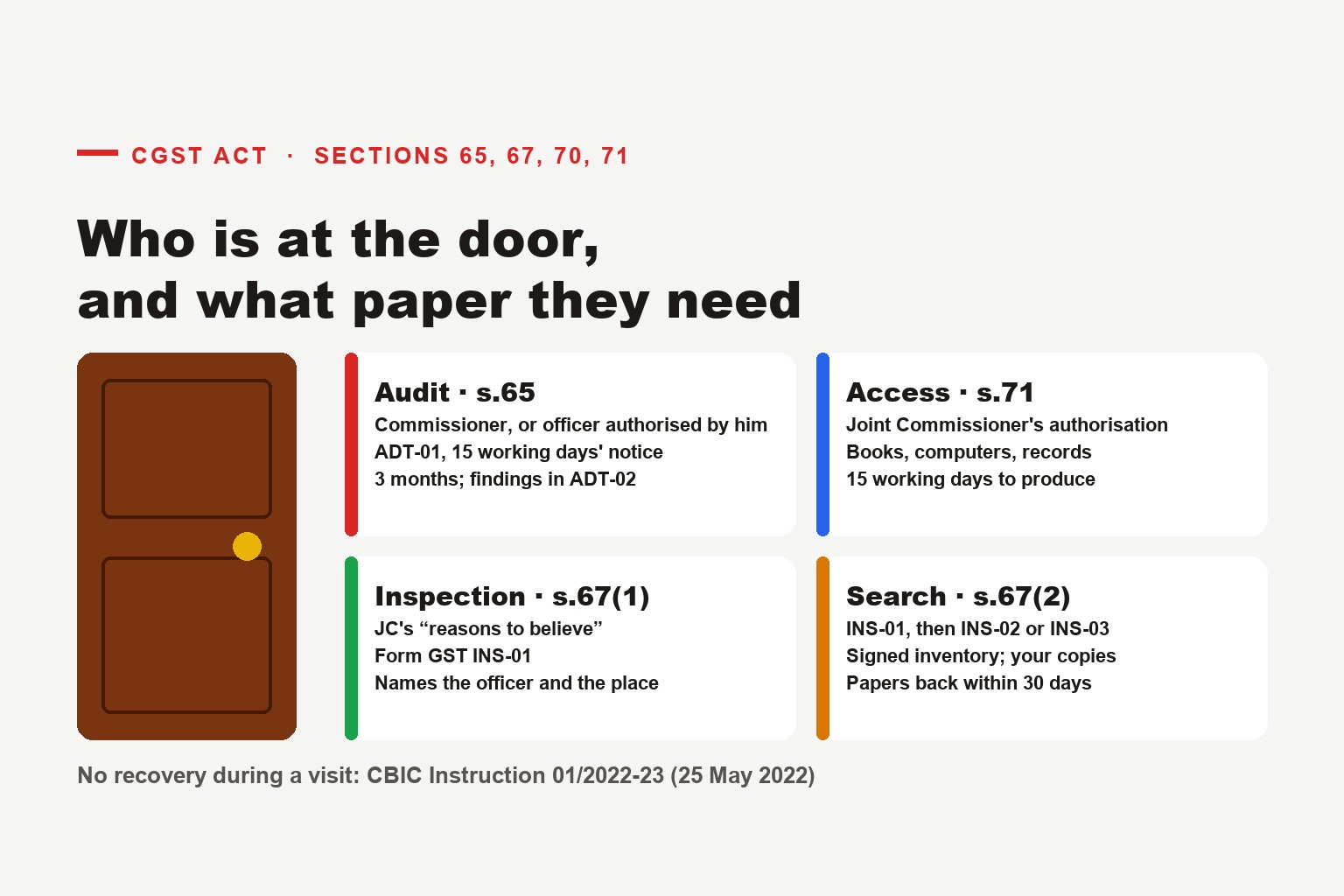

TL;DR: The CGST Act lets an officer come to your place of business in four different capacities, and each one needs a different piece of paper and a different rank behind it. An audit under section 65 is undertaken by the Commissioner or an officer the Commissioner has authorised by a general or specific order, and needs at least 15 working days' notice in Form ADT-01. An access visit under section 71 needs a written authorisation from an officer not below Joint Commissioner, and gives you 15 working days to produce the listed records. An inspection under section 67(1) and a search and seizure under section 67(2) both need a Joint Commissioner's "reasons to believe" and an authorisation in Form GST INS-01 naming the place; a search adds, where anything is actually seized, a seizure order (INS-02) or a prohibition order (INS-03) and a signed inventory, and a 30-day clock to return what is not relied upon. A summons under section 70 is not a visit at all: it is an order to attend, and since 1 November 2024 you may attend through an authorised representative if the officer permits. Two things no visit permits: recovery of tax on the spot (the Board's Instruction 01/2022-23 says "there may not be any circumstance necessitating 'recovery' of tax dues during the course of search or inspection or investigation proceedings"), and arrest without the safeguards the Supreme Court spelt out in Radhika Agarwal (February 2025). Ask for the paper, read the section on it, sign nothing you have not read, and pay nothing during the visit.
1. Four doors, one building
| Visit | Section | Who must authorise it | The paper to ask for | Your time limit |
|---|---|---|---|---|
| Audit by tax authorities | 65 | The Commissioner, or an officer the Commissioner authorises by general or specific order | Notice in Form GST ADT-01, at least 15 working days before the audit | Audit to finish in 3 months from commencement (extendable by 6); findings in ADT-02 within 30 days of conclusion |
| Access to business premises | 71 | Proper officer not below Joint Commissioner | Written authorisation of the officer visiting | Listed records within 15 working days of demand |
| Inspection | 67(1) | Proper officer not below Joint Commissioner, with "reasons to believe" | Form GST INS-01 naming the officer and the place | None fixed; the authorisation defines the scope |
| Search and seizure | 67(2) | Proper officer not below Joint Commissioner, with "reasons to believe" | Form GST INS-01; INS-02 (seizure) or INS-03 (prohibition); signed inventory | Documents not relied on back within 30 days of the notice; seized goods back if no notice in 6 months (+6) |
| Special audit | 66 | Assistant Commissioner or above, with the Commissioner's prior approval | Written direction naming the nominated CA or cost accountant | Report in 90 days (+90) |
| Summons (not a visit) | 70 | Proper officer; Superintendents need prior written permission of a DC/AC (Instruction 03/2022-23) | The summons itself, with a DIN | Attend on the date, in person or by representative as directed |
State GST officers have the same powers under their State Acts. Section 6 of the CGST Act lets State and Union-territory officers be authorised as proper officers under the central Act, and the State Acts do the reverse for central officers, each subject to the notified conditions; the Directorate General of GST Intelligence's officers act as central-tax officers under these same sections within the jurisdiction assigned to them. Whoever is at the door, the section number on the paper tells you which set of rules applies, and everything below follows from that number.
2. Audit under section 65: the scheduled visit
Section 65(1): "The Commissioner or any officer authorised by him, by way of a general or a specific order, may undertake audit of any registered person for such period, at such frequency and in such manner as may be prescribed." The audit may be "at the place of business of the registered person or in their office" (65(2)), and "the registered person shall be informed by way of a notice not less than fifteen working days prior to the conduct of audit" (65(3)); the rules put that notice in Form GST ADT-01. So a section 65 audit never begins with a knock: if officers are at the premises with no ADT-01 served fifteen working days earlier, they are not there under section 65, and you may say so.
The clock: three months from "commencement of audit", which the Explanation to 65(4) defines as "the date on which the records and other documents, called for by the tax authorities, are made available by the registered person or the actual institution of audit at the place of business, whichever is later"; the Commissioner may extend by up to six months for reasons recorded. Your duty during it is in 65(5): "to afford him the necessary facility to verify the books of account or other documents as he may require" and "to furnish such information as he may require and render assistance for timely completion of the audit". At the end, 65(6): "within thirty days, inform the registered person ... about the findings, his rights and obligations and the reasons for such findings" (Form ADT-02). Anything the audit turns up is then pursued through a show-cause notice under section 73 or 74, or section 74A for periods from financial year 2024-25 (65(7)); the audit report is not itself a demand.
Section 66 is the special audit: at any stage of "scrutiny, inquiry, investigation or any other proceedings", an officer not below Assistant Commissioner who thinks "the value has not been correctly declared or the credit availed is not within the normal limits" may, "with the prior approval of the Commissioner", direct you in writing to have your records audited by a chartered accountant or cost accountant the Commissioner nominates. Ninety days for the report, extendable by ninety; the Commissioner pays the auditor (66(5)); and you must be heard on any material from it before it is used against you (66(4)).
3. Access under section 71: the working visit
Section 71(1) is the provision most routine visits are actually made under: "Any officer under this Act, authorised by the proper officer not below the rank of Joint Commissioner, shall have access to any place of business of a registered person to inspect books of account, documents, computers, computer programs, computer software whether installed in a computer or otherwise and such other things as he may require and which may be available at such place, for the purposes of carrying out any audit, scrutiny, verification and checks as may be necessary to safeguard the interest of revenue." Two conditions in that sentence: the visiting officer must hold an authorisation from a Joint Commissioner or above, and the purpose is inspection of what is "available at such place", for audit, scrutiny, verification or checks. It is not a search: section 71 gives no power to break open anything, seize anything, or go anywhere but a "place of business of a registered person".
What you must produce is a closed list, in 71(2): the records you maintain and have declared to the proper officer; "trial balance or its equivalent"; "statements of annual financial accounts, duly audited, wherever required"; the cost audit report under section 148 of the Companies Act, if any; "the income-tax audit report, if any, under section 44AB of the Income-tax Act, 1961" (for tax year 2026-27 onward that report is filed under the Income-tax Act, 2025, but the CGST text still says 44AB; produce whichever applies to the year); and "any other relevant record". The time: "within a period not exceeding fifteen working days from the day when such demand is made, or such further period as may be allowed". A demand for the trial balance "now, today" is not what the sub-section says.
4. Inspection under section 67(1): the unannounced visit
This is the first of the two visits that can happen without warning. Section 67(1) allows it only where "the proper officer, not below the rank of Joint Commissioner, has reasons to believe that" one of two things is true. For a taxable person: that they have "suppressed any transaction relating to supply of goods or services or both or the stock of goods in hand, or has claimed input tax credit in excess of his entitlement under this Act or has indulged in contravention of any of the provisions of this Act or the rules made thereunder to evade tax". For a transporter, warehouse or godown operator: that they are "keeping goods which have escaped payment of tax" or keeping accounts or goods "in such a manner as is likely to cause evasion". On that belief the Joint Commissioner "may authorise in writing any other officer of central tax to inspect any places of business" of that person.
Rule 139(1) puts the authorisation in Form GST INS-01. It names the officer authorised and the place, and it is the first thing to ask to see. The Board's own search instruction of 2 February 2021 (Instruction 01/2020-21) says that no search may be carried out on your premises under a warrant issued for another person's premises, so an INS-01 that names someone else does not cover you; the same logic applies to an inspection. "Reasons to believe" is a legal standard, not a formality: the High Courts have read it as an honest belief on material actually seen, distinguishing it from suspicion, and the reasons, though they need not be shown to you at the door, can be tested later in adjudication.
5. Search and seizure under section 67(2): the visit with consequences
Section 67(2) needs a second "reasons to believe", formed "either pursuant to an inspection carried out under sub-section (1) or otherwise": that "any goods liable to confiscation or any documents or books or things, which in his opinion shall be useful for or relevant to any proceedings under this Act, are secreted in any place". The Joint Commissioner may then authorise a search and seizure (INS-01 again) or conduct it personally. What follows is a sequence the Act and the rules script closely:
- Seizure order in Form GST INS-02 (Rule 139(2)); where goods cannot practically be moved, a prohibition order in INS-03 that you "shall not remove, part with, or otherwise deal with the goods except with the previous permission of such officer" (first proviso to 67(2); Rule 139(4)). The officer may leave seized goods in your custody on the same terms (Rule 139(3)).
- Inventory of everything seized, "containing, inter alia, description, quantity or unit, make, mark or model", which the officer must "get ... signed by the person from whom such goods or documents or books or things are seized" (Rule 139(5)). Read it before you sign it; it is the record.
- Force: the authorised officer "shall have the power to seal or break open the door of any premises or to break open any almirah, electronic devices, box, receptacle" where "access ... is denied" (67(4)). Denying access does not stop the search; it changes how it happens.
- Copies: you are "entitled to make copies thereof or take extracts therefrom in the presence of an authorised officer", unless the proper officer thinks that would "prejudicially affect the investigation" (67(5)). The 2021 instruction says a request for copies made during the search may be noted in the panchnama along with the time and place for taking them, and requires the authorised officer to sign every page of the panchnama and its annexures.
- Return: documents "which have not been relied upon for the issue of notice ... shall be returned to such person within a period not exceeding thirty days of the issue of the said notice" (67(3)); seized goods must be returned if "no notice in respect thereof is given within six months of the seizure", extendable once by six months on sufficient cause (67(7)). The exception is goods the Government has notified as perishable, hazardous, fast-depreciating or hard to store: those may be disposed of soon after seizure, against an inventory prepared in the prescribed manner (67(8) and (9)).
- Release: seized goods may be released provisionally on a bond in INS-04 for their value plus a bank guarantee for the tax, interest and penalty (67(6); Rule 140), or on payment of those amounts; perishable or hazardous goods are released in INS-05 on payment of the lower of market price and the tax, interest and penalty (Rule 141).
- Test purchase: the Commissioner may have someone buy goods or services from you "to check the issue of tax invoices or bills of supply", and on return of the goods you must refund the price against cancellation of the invoice (67(12)).
Section 67(10) applies the Code of Criminal Procedure's search-and-seizure provisions "so far as may be", with the Commissioner standing in for the Magistrate in section 165(5) of the Code; since the 2023 Sanhita replaced the Code, read the reference with it. The 2021 instruction adds the department's own conduct rules: the officer issuing a search authorisation must record valid and justifiable reasons in the file; a lady officer must be part of the team when a residence is searched; and the Document Identification Number rules apply. Under Circulars 122 and 128 of 2019 a search authorisation, summons, arrest memo or inspection notice issued outside the portal must carry a DIN, and one without it is treated as never issued, subject to the circulars' own exceptions; since Circular 249/06/2025, a communication generated on the GST common portal carrying a verifiable Reference Number is valid without a DIN. A document with neither is one to query on the spot. One thing the section does not say clearly is whether cash is a "thing" that can be seized: High Courts have differed, and the Supreme Court declined to interfere with the Kerala High Court's view that cash which is not stock-in-trade cannot be seized under section 67(2). If cash is taken, get it on the inventory and take the point in writing the same week.
6. Summons under section 70: not a visit, but the same rules of engagement
Section 70(1) gives the proper officer the power "to summon any person whose attendance he considers necessary either to give evidence or to produce a document or any other thing in any inquiry", with the powers of a civil court, and 70(2) makes the inquiry a "judicial proceeding" for the offences of giving false evidence. The Finance (No. 2) Act, 2024 added sub-section (1A), in force from 1 November 2024: "All persons summoned under sub-section (1) shall be bound to attend, either in person or by an authorised representative, as such officer may direct, and the person so appearing shall state the truth during examination or make statements or produce such documents and other things as may be required." So a representative can attend if the summons or the officer permits; and whoever attends is bound to tell the truth.
The Board's summons guidelines (Instruction 03/2022-23, 17 August 2022) are what you hold the officer to: a Superintendent may issue a summons only "after obtaining prior written permission from an officer not below the rank of Deputy/Assistant Commissioner" with reasons recorded (oral permission in urgent cases, reduced to writing afterwards); the summons should name the person or enterprise being inquired into unless that would compromise the investigation; "issuance of summons may be avoided to call upon statutory documents which are digitally/online available in the GST portal"; "senior management officials such as CMD/MD/CEO/CFO ... should not generally be issued summons in the first instance"; the issuing officer must be present at the appointed time or tell you in advance; and only after about three unanswered summons is a complaint to the Magistrate contemplated. The March 2024 investigation guidelines (Instruction 01/2023-24) add that for a listed company, public sector undertaking or government body the field formation "should first issue an official letter, instead of summons", that interpretation disputes and "big industrial houses and major multinational corporations" need the zonal Principal Chief Commissioner's prior approval, and that where more than one office is looking at the same taxpayer, "only one investigating office should undertake investigation on all the subject matters" if feasible.
7. Money, and arrest
Nothing in sections 65, 67 or 71 is a recovery provision. Instruction 01/2022-23 of 25 May 2022, issued after complaints that officers were pressing taxpayers to pay during searches, put it in the Board's own words: "there may not be any circumstance necessitating 'recovery' of tax dues during the course of search or inspection or investigation proceedings". A taxpayer who wants to pay may do so voluntarily through Form DRC-03; an officer who obtains a payment by pressure is to be inquired into. The Supreme Court went further in Radhika Agarwal v Union of India (27 February 2025): it upheld sections 69 and 70, but held that the safeguards of the criminal procedure code apply to GST arrests, that the grounds of arrest must be given in writing before the person is produced before the Magistrate, that the Commissioner must record the material on which he is satisfied that a non-bailable offence under section 132(5) is made out, and that the threat of arrest may not be used to make a person pay; someone who paid under threat, force or coercion is entitled to go to court and seek a refund (paragraph 68). Section 69 itself limits arrest to offences under section 132(1)(a) to (d) that are punishable under 132(1)(i) or (ii) or 132(2), on the Commissioner's reasons to believe, with production before a Magistrate within 24 hours for cognizable offences.
8. What you can and cannot refuse
| You may | You may not |
|---|---|
| Ask to see the authorisation (ADT-01, the section 71 authorisation, INS-01) and note the officer's name, designation, the authorising officer's rank and the DIN or portal Reference Number | Refuse access to a place named in a valid INS-01; section 67(4) answers a locked door |
| Decline a section 65 audit that has not been noticed in ADT-01 fifteen working days earlier, and say why in writing | Withhold the section 71(2) records once demanded; the time you have is fifteen working days, not "never" |
| Ask for copies or extracts of seized documents, and have the request recorded in the panchnama | Remove, part with or deal with goods under an INS-03 order without the officer's permission |
| Decline to pay anything on the day; ask for the show-cause notice and reply to it | Refuse a section 70 summons; attend, in person or through a representative "as such officer may direct", and tell the truth |
| Read the inventory and panchnama before signing, and write your objections on it | Give a statement you have not read; it is recorded in a "judicial proceeding" |
| Have your CA or advocate present during a section 65 or 71 visit; insist on the section 66 hearing before special-audit material is used | Delay a search until counsel arrives; the officers are not required to wait |
9. The one-page sheet for the front desk
- Ask for the paper and photograph it. Section number, form number, authorising officer's rank, the DIN (or the portal Reference Number), the place named. If any is missing, say so politely and note the time.
- Call the proprietor or director and the CA. Do not sign anything before they are on the phone.
- Do not obstruct. Section 67(4) and section 72 (police and other officers "shall assist the proper officers") mean obstruction only makes the visit worse.
- Keep your own record. Who came, when, what was looked at, what was taken, what was said. A second copy of the panchnama, signed by the officer.
- No payment, no undertaking to pay, no DRC-03 on the day. "We will reply to the notice" is a complete answer.
- Diary the dates: 15 working days for section 71 records; 30 days for return of documents not relied on; six months for goods.
Related: what an officer can ask about your registration is in our note on biometric Aadhaar authentication for GST registration; the audit that is not a departmental visit, the reconciliation in Form GSTR-9C, is in GSTR-9 and GSTR-9C for FY 2025-26; and the three audits compared is in tax audit vs statutory audit vs GST audit.
Sources
- Central Goods and Services Tax Act, 2017: sections 6, 65, 66, 67, 69, 70 (including sub-section (1A) inserted by the Finance (No. 2) Act, 2024, section 135, in force 1 November 2024 by Notification 17/2024-Central Tax), 71, 72, 73, 74, 74A and 132.
- Central Goods and Services Tax Rules, 2017: rules 101, 139, 140 and 141; Forms GST ADT-01, ADT-02, INS-01 to INS-05, DRC-03.
- CBIC: Instruction No. 01/2020-21 [GST-Investigation] dated 2 February 2021 (search procedure); Instruction No. 01/2022-23 [GST-Investigation] dated 25 May 2022 (no recovery during search, inspection or investigation); Instruction No. 03/2022-23 [GST-Investigation] dated 17 August 2022 (summons); Instruction No. 01/2023-24-GST (Inv.) dated 30 March 2024 (investigations and ease of doing business); Circular No. 122/41/2019-GST dated 5 November 2019 and Circular No. 128/47/2019-GST dated 23 December 2019 (Document Identification Number), as modified by Circular No. 249/06/2025-GST (portal communications with a verifiable Reference Number need no DIN).
- Radhika Agarwal v Union of India, Supreme Court, 27 February 2025, 2025 INSC 272 (three-judge Bench), paragraphs 47, 56, 57 and 60 and the discussion of coerced payment.
This article states the provisions and the Board's instructions as they stood on 14 September 2026. Instructions bind the department's officers, not the courts, and a visit is a fact-specific event; if one is under way, call a practising professional, not this page.

Comments (0)
No comments yet. Be the first to comment!