
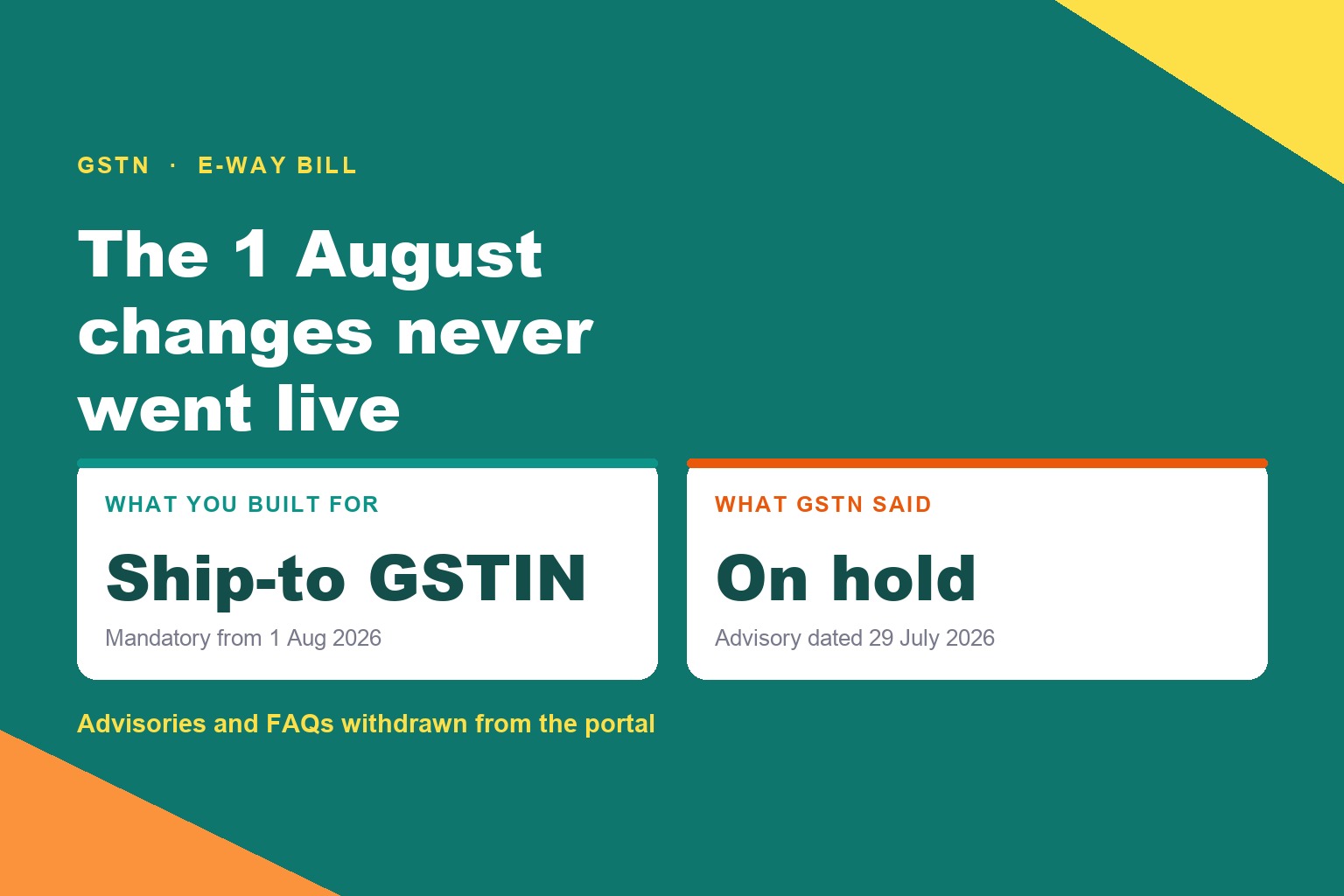

TL;DR: If your ERP team spent June and July building for the 1 August 2026 e-way bill changes, stop before you deploy. On 29 July 2026 — two days before go-live — GSTN issued an advisory keeping the whole package "on hold until further notice", and said that no changes are required to be implemented in the production environment. It also said the related advisories and the FAQs would be withdrawn from the GST Portal, which they since have been. So the mandatory Ship-to GSTIN, the new ExpShipDtls GSTIN field and the voluntary e-way bill closure facility are all not implemented in production and not required by the GSTN system, no new date has been announced, and the official write-up you were working from is no longer where you left it. This article is the record: what was in the package, what applies right now, and why the build work should be parked rather than binned.
1. What GSTN actually said on 29 July
The advisory is short, and worth reading in the original register rather than through a summary. Its title is "Advisory on Keeping on Hold the Proposed e-Way Bill Enhancements", dated 29 July 2026, and it makes four statements:
- It refers back to GSTN advisories dated 9 June 2026 and 17 June 2026 on proposed enhancements to the e-way bill system, with a scheduled implementation date of 1 August 2026, and to detailed FAQs issued on 2 July 2026.
- It states that implementation of those enhancements has been kept on hold until further notice.
- It advises all stakeholders that no changes are required to be implemented in the production environment pursuant to those advisories, until further communication.
- It states that all related advisories, along with the FAQs, shall also be withdrawn from the GST Portal.
That last line is the one with a practical sting, and it is why this article reproduces the deferred requirements in detail below. The specification your integration was written against is no longer published. If you did not keep a local copy, you now have a compliance change parked in your backlog with no official document behind it.
As at the end of August 2026, the position is unchanged. The GST Portal's News and Updates list runs: the July 2026 revenue release on 1 August, this hold advisory on 29 July, and the AATO timeline advisory on 1 July. GSTN has not announced a revised production implementation date.
2. What was in the deferred package
Two distinct things were bundled together, which is part of why the deferral matters more than it first appears. One was a data change with hard validations attached. The other was a genuinely useful facility that trade had asked for.
2.1 Mandatory Ship-to GSTIN
In a Bill-to / Ship-to transaction the buyer and the delivery location are different persons. Today the e-way bill captures the ship-to name, address and state, but not necessarily the ship-to party's GSTIN. The change would have made that GSTIN a required data element wherever ship-to details are present and an e-way bill is needed:
- In the Generate IRN and e-Way Bill together flow, the e-invoice schema field
ShipDtls.Gstinwould become conditionally mandatory — required wherever ship-to legal name and address are supplied and an e-way bill is to be generated. - In the e-Way Bill by IRN flow, a new field
Gstinwas added underExpShipDtlsand made mandatory. An optionalTrdNmfield for trade name was added alongside it. - Where the ship-to party has no GSTIN — an unregistered consignee, or a scenario where GSTIN does not apply — the literal value
URPwas to be entered.
The validations were the sharp part. A GSTIN entered in the ship-to field would be checked for validity, and — the rule most likely to break existing master data — the ship-to GSTIN could not be the same as the bill-to GSTIN. The stated reasoning is that in a genuine Bill-to / Ship-to transaction the two parties are expected to be distinct persons. Plenty of ERP systems populate both from the same customer record by default.
The advisory published indicative error codes, released in the sandbox:
| Flow | Validation | Error code |
|---|---|---|
| Generate IRN + EWB together | Ship-to GSTIN mandatory if ship details are provided | 5002 |
| Bill-to and Ship-to GSTIN must not be the same | 2323 | |
| Ship-to state code must match the GSTIN state code | 2325 | |
| Ship-to PIN code must belong to the ship-to state | 3039 | |
| e-Way Bill by IRN | GSTIN in ExpShipDtls is mandatory | 5001 |
| For B2B and SEZ, ship details given at IRN generation cannot be replaced | 2324 | |
| Ship-to state code must match the GSTIN state code | 4074 | |
| Ship-to PIN code must belong to the ship-to state | 3039 |
Two asymmetries in the design are worth remembering for whenever this returns. For export e-way bills, ship details including GSTIN supplied at IRN generation may be replaced when the e-way bill is later generated using the IRN, and URP may be used where no domestic registered ship-to GSTIN applies. For B2B and SEZ, ship details supplied at IRN generation cannot be replaced — though where no GSTIN was supplied at IRN stage, it could be supplied at the e-way bill stage. For old IRNs generated with the same GSTIN in both bill-to and ship-to, the e-way bill by IRN API would simply generate a regular e-way bill.
2.2 Voluntary closure of an e-way bill
The second half of the package was the one taxpayers had actually asked for. An e-way bill currently has no "delivered" state — it runs to the end of its validity and then lapses, which leaves no positive system record that the movement completed. The facility would have allowed closure after delivery, EWB-wise or date-wise, by any of the supplier, recipient, transporter, or the driver or authorised person whose mobile number was captured for the purpose.
Mechanically: suppliers, recipients and transporters would close through the portal after login; the driver route was mobile-number based, showing the active e-way bills tied to that number. The mobile number could be given at generation and updated later during vehicle updation, consolidated EWB operations or validity extension. For API users, a closure API required just three fields — e-way bill number, closure date and remarks.
Three honest limitations were disclosed up front, and they tell you the module was shipping in a first iteration. There was no API provision to capture the driver's mobile number (portal only). There was no API to retrieve closed e-way bills. And a separate "Closed" status was only proposed for "due course" — during stabilisation the existing Active / Cancelled / Discarded framework would continue, and actions such as update transporter, extend validity and vehicle updation would remain available even after closure, with restrictions to follow later.
3. So what do you do with the work already done?
Do not deploy to production. The advisory is explicit that no production change is required. Pushing a mandatory ship-to GSTIN validation into your own outbound flow now would reject documents that GSTN will happily accept, which is a self-inflicted wound.
Do not throw the work away either. Nothing in the advisory says the enhancements are abandoned — the phrase is "kept on hold until further notice". The direction of travel across the last several years of e-invoicing and e-way bill design has been consistently towards more granular party-level data, and a deferral driven by readiness concerns is not a reversal of intent.
What is worth doing in the meantime:
- Keep your copy of the specification. The advisories and FAQs have been pulled from the portal. If your integration partner, GSP or ASP holds the June specification and the July FAQs, get a copy into your own document store now rather than when the change is revived.
- Fix the master data anyway. The one change with real lead time is data, not code: ship-to GSTINs that are missing, invalid, or identical to the bill-to GSTIN. Cleaning that up has no downside, does not depend on any go-live date, and is the part that will bite hardest when validations 5002 and 2323 eventually switch on.
- Park the code behind a flag. Keep the sandbox-tested build; do not merge it into the live path. Whenever a fresh date is announced, the gap between announcement and enforcement may be short.
- Watch the portal, not the commentary. Because the source documents were withdrawn, secondary write-ups dated June and July still describe the change as live from 1 August. Several are still circulating. The GST Portal's News and Updates page is the only thing worth trusting on the current status.
4. What actually is in force right now
With the e-way bill package on hold, the operative changes from this quarter are narrower than the noise suggests.
AATO amendment timeline. By advisory dated 1 July 2026, GSTN revised the window for amending Aggregate Annual Turnover for FY 2025-26. The facility, historically available during May, ran from 1 to 31 July 2026, with jurisdictional officer review from 1 to 15 August 2026. Both windows have now closed. The change accompanies a system upgrade that automatically updates AATO as subsequent returns are filed after the amendment window. If your AATO drives an e-invoicing threshold determination, check that the figure now showing on the portal is the one you expect.
Nothing else has moved on the e-invoicing or e-way bill side. Existing e-way bill and e-invoice processes continue unchanged.
5. July 2026 collections
GSTN published the July 2026 revenue figures on 1 August. They are marked provisional and may vary on finalisation. As on 31 July 2026:
| Measure | Jul 2026 (Rs crore) | Growth over Jul 2025 |
|---|---|---|
| Gross GST revenue | 2,11,205 | 15.4% |
| — of which domestic | 1,44,695 | 10.1% |
| — of which imports | 66,511 | 28.8% |
| Total refunds | 29,968 | 13.1% |
| Net GST revenue | 1,81,237 | 15.8% |
A note on the arithmetic, because someone will check it: the domestic and import components add to Rs 2,11,206 crore against a published gross total of Rs 2,11,205 crore. That one-crore difference is in the source table itself, not a transcription slip here — the components are rounded. Gross less refunds does reconcile exactly to the net figure.
The composition is more interesting than the headline. Domestic gross revenue grew 10.1% while the import leg grew 28.8% — import IGST alone went from Rs 51,626 crore to Rs 66,511 crore year on year. On the financial year to date, gross collections stand at Rs 8,42,905 crore (up 10.1%) and net at Rs 7,21,457 crore (up 9.2%), where the year-to-date domestic net figure has grown only 2.5% against a customs net growth of 32.7%. A month of strong headline growth carried substantially by the import side is not the same story as broad-based domestic buoyancy, and it is worth keeping that distinction in mind when the number is quoted at you.
6. What to watch next
The 57th meeting of the GST Council is reported to be scheduled for 12 September 2026 in New Delhi, with an officers' meeting the previous day. That reporting, which appeared on 29 August 2026, cites an official memorandum rather than a published Council press release, and — this matters — the agenda is expressly described as not yet finalised. Items said to be likely include the operationalisation and functioning of the GST Appellate Tribunal, input tax credit norms, the revenue position of the States and the Centre, and carrying forward procedural relaxations around registration and audit from the previous meeting.
Treat all of that as expectation, not decision. A Council discussion or recommendation does not itself change the law: depending on the subject, a change has to be carried into effect by a notification under an enabling provision, an amendment to the Rules, or legislation. And on the e-way bill package specifically — a Council meeting or a press report is not an implementation notice. If it is revived with a fresh date, confirm that date from an official GSTN communication before you deploy anything.
7. A short checklist
- Confirm nothing was deployed to production on 1 August in anticipation of the change. If it was, check for rejected or blocked documents in the first week of August.
- Secure a copy of the 9 June and 17 June advisories and the 2 July FAQs from your GSP, ASP or IRP — they are no longer on the portal.
- Run a data quality report: ship-to records with no GSTIN, with an invalid GSTIN, or with a GSTIN identical to the bill-to party.
- Keep the sandbox-tested build behind a feature flag; do not merge to the live path.
- Verify your AATO for FY 2025-26 on the portal now that the amendment and review windows have closed.
- Check the GST Portal News and Updates page before acting on any commentary dated June or July 2026.
Sources
- GSTN, "Advisory on Keeping on Hold the Proposed e-Way Bill Enhancements", 29 July 2026 — GST Portal, News and Updates. The operative advisory.
- GSTN, "Advisory on e-Invoice API and e-Way Bill by IRN API changes for mandatory capture of Ship-to GSTIN and Voluntary Closure of e-Way Bill", 17 June 2026 — the deferred specification, since withdrawn from the portal. Field names, error codes and closure mechanics in section 2 above are taken from it.
- GSTN, "Advisory on Revision of Timeline for Amendment of Aggregate Annual Turnover (AATO), 2026", 1 July 2026 — GST Portal, News and Updates.
- GSTN, monthly GST revenue report for July 2026, published 1 August 2026 — figures as on 31 July 2026, expressly provisional.
- 57th GST Council meeting — date and expected agenda as reported on 29 August 2026 citing an official memorandum; agenda not finalised at the time of writing.
This article states the position as at 30 August 2026. GSTN advisories can be issued, revised or withdrawn at short notice — as this episode demonstrates — and a deferred change may be revived with limited lead time. Confirm the current status on the GST Portal before making any system or filing decision. Nothing here is a substitute for advice on your own facts.



Comments (0)
No comments yet. Be the first to comment!