
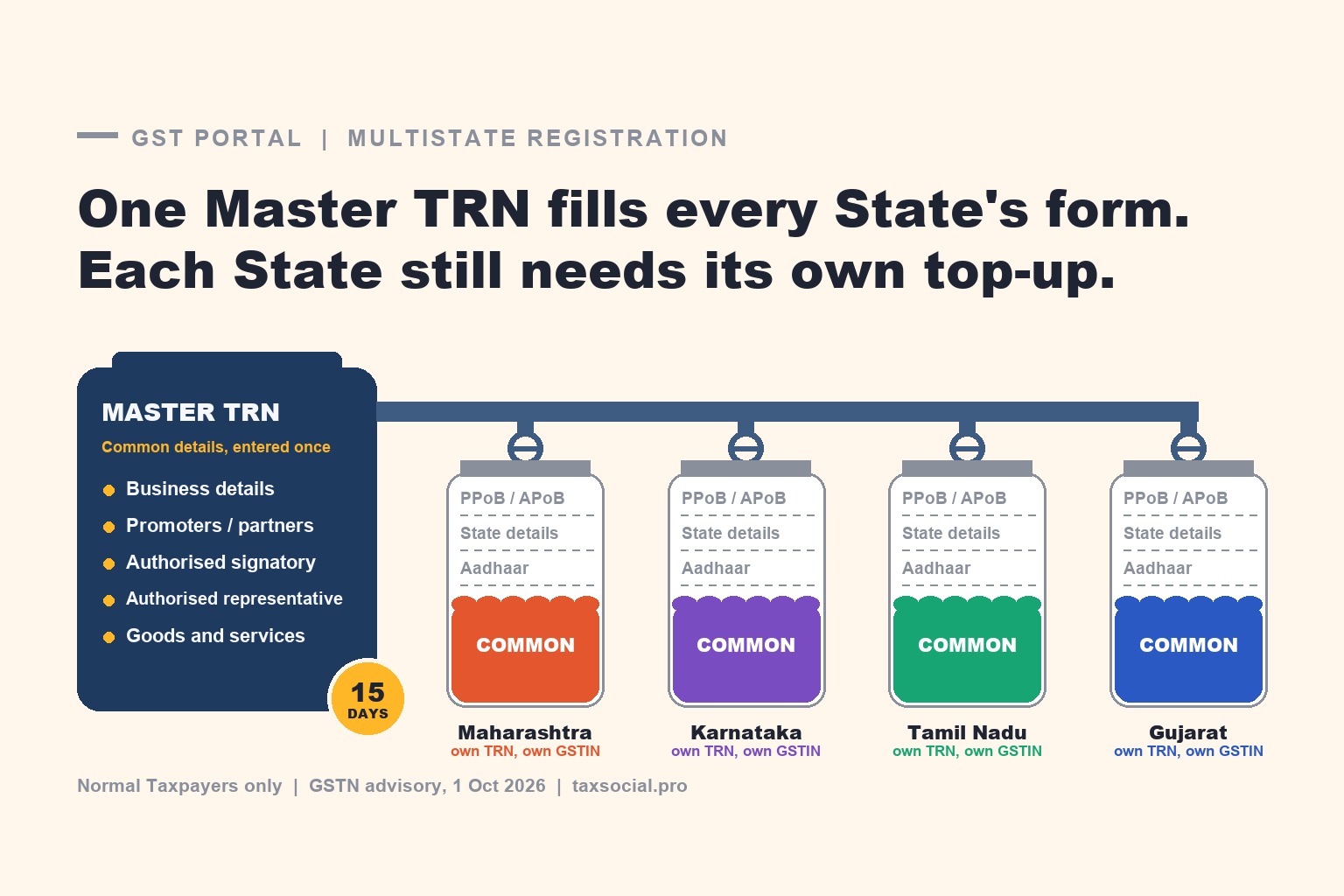

Since 1 October 2026 the GST Portal has a "Multistate Registration" tab. A Normal Taxpayer who needs GST registration in more than one State or Union territory under the same PAN can select all of them together, get one Master TRN, and enter the Common Registration Information once: business details, promoters or partners, authorised signatory, authorised representative, and goods and services. The Master TRN must be submitted within 15 days. The portal then creates a separate TRN for each State, with the common details pre-filled and editable, and you complete the rest in each one: principal and additional places of business, State-specific information and Aadhaar authentication. The data entry gets shorter. Nothing else changes. You still get a separate GSTIN in each State, each application is still verified on its own, and each registration is still a distinct person with its own returns. The decision that matters is the list of States you tick on the first screen, and that is the one decision the portal cannot make for you.
1. What GSTN announced
GSTN issued an advisory on 1 October 2026 titled "Advisory on 'Multistate Registration' Facility for GST Registration", under the Registration module, backed by a creative headed "One PAN, Multiple States, One Smarter Start". Unlike the REG-01 changes of 1 September, which went out only as creatives, this one is a numbered entry in the portal's advisory feed. The advisory runs to five short paragraphs. The ones that matter:
"Taxpayers seeking GST registration in more than one State/UT under the same PAN can use this functionality. Currently, the functionality is available only for Normal Taxpayers."
"Using the Master TRN, the applicant can provide the Common Registration Information (CRI), comprising details such as Business Details, Promoter/Partner details, Authorised signatory, Authorised representative, and Goods and Services. The Master TRN is required to be submitted within 15 days."
"In the respective individual TRN, the common information already provided through the CRI is auto populated and remains editable. Further, the applicant is required to provide the remaining information such as Principal Place of Business (PPoB), Additional Place of Business (APoB), State-specific Information, and Aadhaar authentication."
One point about its legal status before going further. This is a change to how the portal works. No notification has been issued, the CGST Act and Rules are not amended, and REG-01 is not changed. A portal facility can be modified or withdrawn without anything being notified, and the law behind each application is exactly what it was on 30 September.
2. The flow, step by step
- Select the States. From the "Multistate Registration" tab on the portal homepage, select every State or UT in which you want registration.
- One Master TRN is generated for the selected States. TRN is the Temporary Reference Number. In an ordinary application, Rule 8(3) issues it once your PAN, mobile number and e-mail are verified.
- Fill and submit the CRI against the Master TRN, within 15 days. This is the common block: Business Details, Promoter/Partner details, Authorised Signatory, Authorised Representative, and Goods and Services.
- Individual TRNs are generated, one per selected State. Each opens with the CRI already filled in. You can edit it, and you add the State-specific parts: principal place of business, additional places of business, State-specific information, and Aadhaar authentication.
Step 4 is where the work actually gets done. Each individual TRN is, for every practical purpose, an ordinary application for registration in that State. The facility saves you typing the common block four or five times over. It does not merge four or five applications into one.
3. What it does not change
It is easy to read "one Master TRN" as "one registration". The statute says otherwise, and the advisory does not suggest anything different.
- One GSTIN per State, as before. Section 25(2) of the CGST Act grants "a single registration in a State or Union territory" (with separate registrations for multiple places of business inside a State available under Rule 11). There is no all-India registration under GST, and the Master TRN does not create one.
- Each registration is a distinct person. Section 25(4) treats a person holding more than one registration, in one State or several, as distinct persons "in respect of each such registration". Supplies between your own GSTINs remain supplies, with the valuation and invoicing that follows.
- Each application is verified on its own. Each State's application is verified on its own under Rule 9: approval within seven working days of submission, or within thirty days where the proviso to Rule 9(1) brings in physical verification, any query in REG-03 and reply in REG-04, and rejection in REG-05. The exception is an application the portal picks out under Rule 9A on data analysis and risk parameters, which is granted electronically within three working days. That too happens one application at a time. The advisory says nothing about the State applications being linked, and nothing in the rules links them. Plan on the basis that one State can be approved while another is still answering a query.
- Each GSTIN carries its own compliance. Returns, the annual return, bank details under Rule 10A and every later amendment work GSTIN by GSTIN. Rule 10A wants bank details within thirty days of grant, or before the first GSTR-1 or IFF if that comes earlier. That clock runs separately for each State.
4. How this differs from the 1 September auto-population
The portal now has two different ways to avoid retyping your details, and they are easy to confuse. We covered the first one on 19 September.
| REG-01 auto-population (1 Sep 2026) | Multistate Registration (1 Oct 2026) | |
|---|---|---|
| Starting point | An existing active GSTIN under the same PAN | A fresh set of applications in several States, chosen together |
| How many applications | One | One per selected State or UT, all from one Master TRN |
| What is carried | "Some of the fields" in the Business Details and Promoter/Partner tabs | The CRI: Business Details, Promoter/Partner, Authorised Signatory, Authorised Representative, Goods and Services |
| Consent step | OTP to the Primary Authorised Signatory of the existing GSTIN; relevant promoters and partners are notified | None described in the advisory |
| How GSTN announced it | Creatives only, no advisory | Advisory dated 1 Oct 2026 |
| Who can use it | Applicants with an active GSTIN under the same PAN | "Only for Normal Taxpayers" |
One thing the advisory does not answer: can a business that already holds a GSTIN use the Multistate tab to expand into several new States in one go, or is it meant only for first-time applicants? It describes its users only as "taxpayers seeking GST registration in more than one State/UT under the same PAN". Check the live portal before advising a client either way.
5. The State list is the real decision
The facility makes applying easier. It does nothing to the question of whether you need to apply, and that question still has the same answer as before.
Liability is State by State. Section 22(1) makes a supplier liable to register "in the State or Union territory ... from where he makes a taxable supply" once aggregate turnover crosses the threshold, and aggregate turnover is computed on an all-India basis for the PAN. Section 24 adds compulsory registration in specified cases, including persons making inter-State taxable supplies. That is subject to exemptions: Notification No. 10/2017 – Integrated Tax, for instance, exempts persons making inter-State taxable supplies of services whose all-India aggregate turnover stays within the threshold, on its conditions. Section 25(1) then requires an application "in every such State or Union territory in which he is so liable", within thirty days of becoming liable. The test is where you supply from. Having customers in a State does not, on its own, make you liable to register there. A business that sells into Karnataka from a Maharashtra warehouse is not liable to register in Karnataka just because the buyers are there. A business that opens a godown in Karnataka is in a different position.
Each extra GSTIN is a standing compliance cost. An unnecessary registration means returns to file in that State, nil or not. It means an annual return where applicable, and supplies between your own GSTINs to invoice and value. And since 1 April 2025, where an office receives input-service invoices for or on behalf of distinct persons, Section 20(1) requires that office to register as an Input Service Distributor and distribute the credit. More GSTINs under one PAN make that more likely, so assess it alongside the State list. Ticking a State because ticking is now free is the wrong instinct. Registration is free. Running a GSTIN is not.
The State is the hardest particular to fix later. Rule 8(1) has the applicant declare the PAN and the "State or Union territory" in Part A of REG-01. The Explanation to Rule 9(2) then excludes the PAN, State, mobile number and e-mail in Part A from the "clarification" an applicant can give in reply to a query. A wrong State cannot be corrected through the verification process. The advisory does not say whether States can be added to or dropped from a Master TRN once it has been generated. Settle the list before you start, and do not tick a State "just in case".
And every State you select needs an actual principal place of business in that State, with the address and documents to support it, because that is part of each individual TRN. If you cannot yet name premises in a State, you are not ready to apply there, Master TRN or not.
6. Common is not always identical: review the CRI State by State
The advisory says the common information arrives in each individual TRN "auto populated and remains editable". That last word does real work. The CRI is common to the group of applications. Your facts may not be common to every State, and three fields deserve a second look in each one.
- Authorised signatory. One signatory across all States is common in a small business. In a larger one, the person who signs for the Gujarat plant may not be the person who signs for the Tamil Nadu branch. Each GSTIN's authorised signatory is the person who receives that registration's OTPs and notices, so get it right per State.
- Goods and services. A trading warehouse in one State and a service office in another will not have the same HSN and SAC list. Accepting the common list unedited leaves each registration describing a business it does not run in that State.
- Business details that are really State-specific. In REG-01, the Business Details tab is where an applicant ordinarily gives facts like the date of commencement of business, the date on which liability arises and the reason for obtaining registration. For an expansion, those dates are rarely the same in every State. Treat any date that came through the common block as a default to check, not an answer.
One field should stay consistent. If composition is under consideration, Section 10(2) does not let one registration under a PAN opt for composition unless every registration under that PAN does. The common block is a sensible place to make that choice once, as long as it is the right choice for all the States you have selected.
The general point is the one we made about the September auto-population. Pre-filled is not verified. Every particular in each application is still the applicant's declaration, verified when it is submitted. A wrong particular entered once in the CRI does not stay in one application. It turns up in every State you selected.
7. Two clocks, and the parts you still do once per State
The 15-day limit in the advisory applies to the Master TRN, which is to say the CRI. It is not the statutory deadline, and it is not the only time limit in the process.
- The statutory clock is Section 25(1): thirty days from the date you become liable in a State. If liability arises in different States on different dates, the thirty days run separately for each State, from that State's own date. Putting them on one Master TRN does not extend any of them.
- The individual TRNs each still need their own place-of-business details, State-specific information and Aadhaar authentication before they are submitted. The advisory does not say how long an individual TRN stays open once generated. Do not let the CRI's 15 days give the impression that everything after it can wait.
- The date of submission of each State's application is still set by Rule 8(4A) where Aadhaar authentication is opted for: the date of authentication, or fifteen days from the Part B submission, whichever is earlier. That date starts the Rule 9 verification period, so it is set State by State.
Aadhaar, and the biometric step, are per application. The advisory lists Aadhaar authentication among the things completed in each individual TRN, not in the CRI. That matters more since 8 September. The Delhi High Court's interim direction told authorities across the country not to allow any GST registration without biometric-based Aadhaar authentication. Under Rule 8(4A), biometric authentication takes place at a Facilitation Centre notified by the Commissioner. Neither the advisory nor the rule says whether one biometric capture can be used for applications in several States, or whether each State needs its own visit. Do not assume either answer. Confirm it on the live portal or with the Facilitation Centre before you quote a client a timeline for going live in five States in the same week.
8. Who cannot use it
The advisory limits the facility to Normal Taxpayers, so everything outside that category still goes through its own route. That covers casual taxable persons and non-resident taxable persons, both of whom have the advance-deposit step under Rule 8(6) read with Section 27(2), tax deductors and collectors under Sections 51 and 52, and the overseas online service suppliers that Rule 8(1) carves out. It also covers Input Service Distributors. The proviso to Rule 8(1) requires an ISD to "make a separate application for registration as such Input Service Distributor". A group that needs ISD registration alongside its State registrations should plan for it as a separate exercise.
The advisory is also silent on the Rule 14A simplified-registration option, which sits in Part B of REG-01. That option is open only to a Rule 8 applicant whose own assessment is that output tax on supplies to registered persons will not exceed ₹2.5 lakh a month, and it comes with its own Aadhaar condition. Whether it is offered inside each individual TRN is something to check on the live form. Remember too that Rule 14A(3) bars a second Rule 14A registration in the same State on the same PAN. Our 19 September piece explains that bar.
9. Before you generate the Master TRN
- Confirm liability in each State on the Section 22 and 24 tests: where you will supply from, not where your customers are.
- Confirm actual premises in each State and have the place-of-business documents ready for every one of them.
- Fix the State list now. The State is a Part A particular that a reply to a query cannot correct.
- Decide signatories per State before the common block suggests one signatory for all of them.
- Draft the goods and services list per State, not one list for the whole business.
- Set a 15-day reminder for the CRI, and a separate plan for completing each State's TRN.
- Treat Aadhaar authentication as a step in every State application, and confirm whether one biometric capture can serve several of them before you promise dates.
- Diary Rule 10A for each new GSTIN. Bank details are due within thirty days of grant or before the first GSTR-1/IFF, whichever comes earlier.
- Plan separately for any ISD, casual or other non-normal registration.
Sources
- GSTN, "Advisory on 'Multistate Registration' Facility for GST Registration", dated 1 October 2026 (Registration module), and the accompanying GSTN creative "One PAN, Multiple States, One Smarter Start".
- Central Goods and Services Tax Act, 2017: Sections 10(2), 20(1), 22(1), 24, 25(1), 25(2), 25(4) and 27(2).
- CGST Rules, 2017: Rules 8(1), 8(3), 8(4A), 8(6), 9, 9A, 10A, 11 and 14A. Rules 9A and 14A were inserted by Notification No. 18/2025 – Central Tax with effect from 1 November 2025.
- Notification No. 10/2017 – Integrated Tax (exemption from registration for specified inter-State suppliers of services).
This article states the position as at 3 October 2026 and describes portal functionality that GSTN can change without notification. Check how the live portal behaves before relying on any particular step, and confirm the position on your own facts before advising.



Comments (0)
No comments yet. Be the first to comment!