
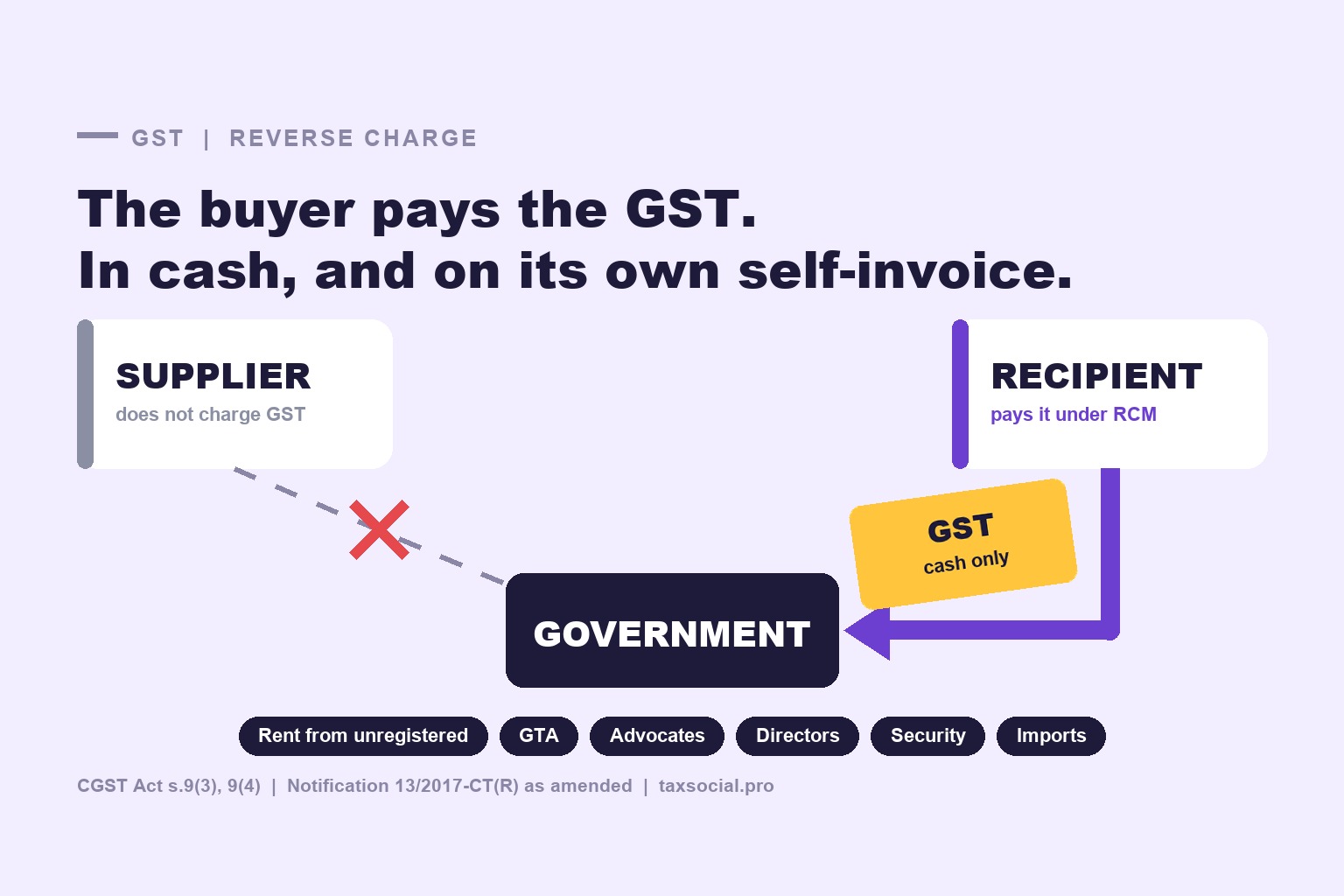

Under reverse charge, the person who receives the supply pays the GST, not the person who makes it. The CGST Act provides for it in two places. Section 9(3) covers notified categories of goods and services, and Section 9(4) covers notified supplies received from unregistered suppliers. A third, related rule, Section 9(5), makes e-commerce operators pay on certain services supplied through them, but that is a separate liability, not reverse charge as the Act defines it. The list is longer than most people remember. It now includes commercial rent paid to an unregistered landlord (since 10 October 2024) and metal scrap bought from unregistered sellers, and January 2025 took composition taxpayers out of the rent entry and body corporates out of the sponsorship entry. The list is the easy part, though. Money is lost in the mechanics: reverse charge tax must be paid in cash, a purchase on the list from an unregistered supplier needs a self-invoice within thirty days. For services, that self-invoice date can fix the time of supply, and for any such purchase it decides how long you have to claim the credit.
1. What reverse charge is, in the statute
Section 2(98) of the CGST Act defines reverse charge as "the liability to pay tax by the recipient of supply of goods or services or both instead of the supplier", under Section 9(3) or 9(4) of the CGST Act or Section 5(3) or 5(4) of the IGST Act. Two routes produce it, and a third rule sits next to them:
- Section 9(3): notified categories. The Government notifies categories of supply "the tax on which shall be paid on reverse charge basis by the recipient", and "all the provisions of this Act shall apply to such recipient as if he is the person liable for paying the tax". Services are notified in Notification No. 13/2017 – Central Tax (Rate), goods in No. 4/2017 – Central Tax (Rate), and imported services in No. 10/2017 – Integrated Tax (Rate).
- Section 9(4): supplies from unregistered suppliers. This applies only to a notified class of registered recipients and notified categories of supply. It is not a general tax on every purchase from an unregistered supplier, which is what it was for a short time in 2017. Today its main use is Notification No. 07/2019 – Central Tax (Rate), which applies to promoters of residential and commercial real estate projects under the specified construction entries. Where less than 80 per cent of the inputs and input services for the project come from registered suppliers, the promoter pays tax on the shortfall. Promoters also pay on cement and capital goods bought from unregistered persons. Whether a particular project falls in those entries is a question to settle on its own facts.
- Section 9(5): e-commerce operators (related, but not reverse charge). The operator is made liable to pay the tax on notified services supplied through it "as if he is the supplier liable for paying the tax". Section 2(98) does not include Section 9(5) in "reverse charge", so the recipient-side mechanics below (self-invoice, cash payment by the recipient) do not apply to it. The services covered include passenger transport, accommodation and housekeeping. Since 22 September 2025 the list also includes local delivery services, unless the person supplying through the operator is itself liable to register.
2. The services list as it stands in October 2026
Notification 13/2017 – Central Tax (Rate) has been amended more than a dozen times. The table below is rebuilt from the original and every amendment. None was issued in the GST 2.0 package of September 2025 or in 2026.
| Service | Supplier | Recipient who pays |
|---|---|---|
| Goods transport agency (GTA), by road, where the GTA has not opted for forward charge | GTA | Factory, society, co-operative society, registered person, body corporate, partnership firm or AOP, casual taxable person |
| Legal services, directly or indirectly | Individual advocate (including a senior advocate) or firm of advocates | Business entity |
| Arbitral tribunal services | Arbitral tribunal | Business entity |
| Sponsorship | Any person other than a body corporate (from 16 January 2025) | Body corporate or partnership firm |
| Services of government or a local authority, with exclusions (renting of immovable property, postal services, Railways services, transport of goods or passengers and others) | Central or State Government, UT, local authority | Business entity |
| Renting of immovable property by government | Government, excluding the Ministry of Railways | Registered person |
| Renting of a residential dwelling | Any person | Registered person |
| Renting of any immovable property other than a residential dwelling (from 10 October 2024) | Unregistered person | Registered person, other than one who has opted for composition (from 16 January 2025) |
| Transfer of development rights or FSI; long-term lease of land for a project | Any person | Promoter |
| Director's services | Director | The company or body corporate |
| Insurance agent | Insurance agent | Insurer |
| Recovery agent | Recovery agent | Bank, financial institution or NBFC |
| Direct selling agents | Individual DSA (not a body corporate, firm or LLP) | Bank or NBFC |
| Business facilitator; agent of a business correspondent | Business facilitator; BC agent | Banking company; business correspondent |
| Music composer, photographer, artist (copyright); author (with an option to pay forward) | The creator | Music company or producer; publisher |
| Security services (supply of security personnel) | Any person other than a body corporate | Registered person, excluding composition taxpayers and TDS-only government registrants |
| Renting of a motor vehicle for passengers, with fuel, subject to the conditions in the entry | Person other than a body corporate | Body corporate |
| Lending of securities under SEBI's scheme | Lender | Borrower |
One small entry is left out of the table: services of members of RBI's Overseeing Committee. Read the recipient column every time. Most of the entries name a particular kind of recipient, and if you are not that kind of recipient, the entry does not apply to you.
Imported services. Entry 1 of Notification 10/2017 – Integrated Tax (Rate) puts IGST on any service supplied by a person in a non-taxable territory to a person in the taxable territory, other than a non-taxable online recipient, under reverse charge. This now matters to a wider group. Since 30 March 2026, intermediary services received from overseas have their place of supply in India, as we explained in May.
3. Three changes most lists have missed
Commercial rent from an unregistered landlord (entry 5AB). Since 10 October 2024, a registered business that rents an office, shop or warehouse from an unregistered landlord pays GST on the rent itself under reverse charge. The entry was inserted by Notification No. 09/2024. A corrigendum of 22 October 2024 corrected its wording from "any property" to "any immovable property". From 16 January 2025, Notification No. 07/2025 excluded composition taxpayers as recipients. Circular No. 245/02/2025-GST regularised, on an "as is where is" basis, the period from 10 October 2024 to 15 January 2025 for composition taxpayers. One detail to watch: the IGST mirror notification of the same date (07/2025 – Integrated Tax (Rate)) changed only the sponsorship entry. On its text, the composition carve-out was not repeated for inter-State renting.
Metal scrap from unregistered sellers. Notification No. 06/2024 added entry 8 to the goods list from 10 October 2024. A registered person buying metal scrap of Chapters 72 to 81 from an unregistered person pays the tax under reverse charge.
Sponsorship by a body corporate. Since 16 January 2025, sponsorship supplied by a body corporate is out of reverse charge. The body corporate charges GST on its invoice in the ordinary way. Reverse charge still applies when the sponsor's counterparty is an individual, a firm or another non-corporate person and the recipient is a body corporate or firm.
4. GTA after GST 2.0
Goods transport agencies have a choice, and the choice decides who pays. Under Notification 11/2017 – Central Tax (Rate), serial 9(iii), as amended:
- If the GTA does not opt to pay tax itself, the rate is 5 per cent (2.5 per cent CGST plus 2.5 per cent SGST) without input tax credit to the GTA. Where the recipient is in the list in the table above, the recipient pays it under reverse charge.
- If the GTA opts for forward charge, it charges either 5 per cent without credit, or, since 22 September 2025, 18 per cent with credit. Notification No. 15/2025 changed the CGST figure from 6 to 9, which took this option from 12 to 18 per cent.
The option is exercised by a declaration filed between 1 January and 31 March of the financial year before the one it is to apply to. Once exercised, it continues for future years until the GTA files a declaration to revert. A recipient should keep the GTA's declaration on its invoice. Without it, the default is that the recipient pays.
5. The goods list
Notification 4/2017 – Central Tax (Rate), as amended, puts the following goods under reverse charge, with a registered person as the recipient in each case except lottery:
- Cashew nuts (not shelled or peeled), bidi wrapper leaves, tobacco leaves and raw cotton, supplied by an agriculturist.
- Silk yarn, supplied by a person who manufactures it from raw silk or silk worm cocoons.
- Peppermint and mint oils, supplied by an unregistered person.
- Lottery, supplied by a State Government, UT or local authority, where the lottery distributor or selling agent pays.
- Used vehicles, seized and confiscated goods, old and used goods, and waste and scrap, supplied by government (excluding the Railways) or a local authority.
- Priority Sector Lending Certificates.
- Metal scrap of Chapters 72 to 81, supplied by an unregistered person (from 10 October 2024).
6. Mechanics: where the money is lost
Cash only
Reverse charge tax cannot be paid out of the electronic credit ledger. There is no single sentence in the Act that says so. It follows from two definitions. Section 49(4) lets the credit ledger pay "output tax", and Section 2(82) defines output tax to exclude "tax payable by him on reverse charge basis". CBIC's Circular No. 211/5/2024-GST states the result directly: the recipient must "pay the tax in cash on the same under RCM". A business with a large credit balance still needs cash for its reverse charge liability every month.
The credit comes back, but not automatically
Tax paid under reverse charge is "input tax" under Section 2(62)(b) and (c). The recipient can take credit on it in the same return, if the supply is used in the course of business and is not blocked by Section 17(5). Two conditions are easy to miss:
- The tax must have been paid first. For a purchase from an unregistered supplier, Rule 36(1)(b) allows credit on the self-invoice "subject to the payment of tax".
- The 180-day payment rule does not apply. The second proviso to Section 16(2), which reverses credit if the supplier is not paid within 180 days, is expressly limited to "supplies other than the supplies on which tax is payable on reverse charge basis".
For a fully taxable business, reverse charge is therefore a cash-flow cost, not a final cost. For a composition taxpayer, an exempt business, or anyone whose credit is blocked under Section 17(5), it is a real cost, because the credit never comes back.
The self-invoice, and its thirty days
When the supplier is unregistered, there is no supplier's tax invoice to rely on. This applies to goods and services alike. Section 31(3)(f) requires the recipient to issue an invoice for goods or services received from a supplier who is not registered. The words "within the period as may be prescribed" were added from 1 November 2024. The same amendment added an Explanation that a supplier registered only for TDS under Section 51 counts as unregistered. Rule 47A sets the period at thirty days from the date of receipt of the supply. Section 31(3)(g) separately requires a payment voucher when the recipient pays the supplier.
Where the supplier is registered, the supplier issues the invoice and the recipient pays the tax on it. No self-invoice is needed. Whether a self-invoice is needed therefore depends on the supplier's registration, not on the entry. Many advocates, directors and individual security agencies are not registered, and for them the recipient issues the self-invoice.
The time of supply
Section 13(3) sets the reverse charge time of supply for services as the earlier of the date of payment (the books entry or the bank debit, whichever comes first) and, depending on who issues the invoice, either:
- the day after sixty days from the supplier's invoice, where the supplier issues the invoice; or
- the date of the self-invoice, where the recipient issues it (inserted from 1 November 2024).
For goods, Section 12(3) takes the earliest of receipt of the goods, payment, and the day after thirty days from the supplier's invoice. Imported services from an associated enterprise abroad take the earlier of the books entry and payment. Our time of supply guide takes these through month by month.
How long you have to claim the credit
Section 16(4) shuts the door on credit after 30 November following the end of the financial year "to which such invoice or debit note pertains", or the date of the annual return if that is earlier. Which year does a reverse charge supply pertain to? For purchases from unregistered suppliers, Circular 211/5/2024 says the financial year in which the recipient issued the self-invoice. That helps a business that discovers a missed reverse charge liability late and corrects it. But the same paragraph adds that a self-invoice issued after the time of supply means "interest on such delayed payment of tax", and possible penal action under Section 122. Rule 47A's thirty days now gives that late issue a fixed date to be measured against.
Registration, turnover and composition
- Registration. Section 24(iii) makes registration compulsory, whatever the turnover, for "persons who are required to pay tax under reverse charge". In practice, most entries name a registered person or a body corporate as the recipient, so a small unregistered business is usually outside them. The entries that name a "business entity" are the ones to check on their own facts.
- Turnover. Section 2(6) excludes from aggregate turnover "the value of inward supplies on which tax is payable by a person on reverse charge basis". Reverse charge purchases do not push you towards a threshold.
- Composition taxpayers pay reverse charge tax on inward supplies where an entry applies to them, without credit. Since 16 January 2025 they are out of the commercial rent entry, and the security services entry has always excluded them.
7. A worked example
A registered private limited company rents a warehouse from an unregistered individual for ₹1,00,000 a month and pays on the 5th of each month for that month. It also engages a GST-registered firm of advocates for a tax appeal, billed at ₹2,00,000 on 12 September.
- Rent (entry 5AB). The landlord is unregistered, so the company issues a self-invoice within thirty days of receiving each month's service and pays 18 per cent, ₹18,000, in cash. The time of supply is the earlier of the payment date and the self-invoice date. Credit of ₹18,000 is available in the same return if the warehouse is used for taxable business and Section 17(5) does not block it, and the clock for that credit runs from the financial year of the self-invoice.
- Legal fees (entry 2). The advocates' firm is registered, so it issues its own invoice without charging GST. The company, as a business entity, pays 18 per cent, ₹36,000, in cash. The time of supply is the earlier of payment and the day after sixty days from the firm's invoice. No self-invoice is needed. If the firm were unregistered, the company would issue a self-invoice within thirty days and the self-invoice date would come into the time of supply instead.
Net effect for a fully taxable company: ₹54,000 of cash out, ₹54,000 of credit back, provided both are reported in the right month.
8. A checklist
- Map recurring payments to the list: rent, GTA freight, legal fees, directors' sitting fees, security, sponsorship, foreign vendors.
- For every unregistered landlord or supplier on the list, put a thirty-day self-invoice step into the payables cycle.
- Keep the GTA's declaration on file if it is charging tax itself. Otherwise you pay.
- Budget cash for reverse charge separately from the credit balance.
- Check the recipient column before applying an entry, especially after the January 2025 carve-outs.
- Claim the credit in the same return as the payment, and before the Section 16(4) date counted from the self-invoice year.
Sources
- Central Goods and Services Tax Act, 2017: Sections 2(6), 2(62), 2(82), 2(98), 9(3), 9(4), 9(5), 12(3), 13(3), 16(2), 16(4), 24, 31(3)(f) and (g), and 49(4). Integrated Goods and Services Tax Act, 2017: Section 5(3) to (5).
- Notification No. 13/2017 – Central Tax (Rate), as amended up to Notification No. 07/2025 – Central Tax (Rate), including Notification No. 09/2024 and its corrigendum of 22 October 2024.
- Notification No. 4/2017 – Central Tax (Rate), as amended, including Notification No. 06/2024.
- Notification No. 11/2017 – Central Tax (Rate), serial 9(iii), as amended by Notifications No. 03/2022 and 15/2025; Notification No. 17/2025 – Central Tax (Rate).
- Notification No. 07/2019 – Central Tax (Rate) (promoters, under Section 9(4)).
- Notification No. 10/2017 – Integrated Tax (Rate), as amended up to Notification No. 07/2025 – Integrated Tax (Rate).
- CGST Rules, 2017: Rules 36(1)(b) and 47A.
- Circular No. 211/5/2024-GST dated 26 June 2024; Circular No. 245/02/2025-GST dated 28 January 2025.
This article states the law as at 4 October 2026. Rate notifications change often, so check for later amendments and confirm the position on your own facts before advising.




Comments (0)
No comments yet. Be the first to comment!