

Updated 9 October 2026: checked line by line against the Council's official press release (PIB, 8 October, 7:03 pm), which was not out when this was first published. The release adds detail the briefing did not: the transit-check limits will be written into sections 68, 129 and 130 of the Act, the Rs 10,000 notice floor goes into sections 73, 74 and 74A and counts CGST, SGST, IGST and cess together, and several offences in section 132 are narrowed or dropped. Corrected below.
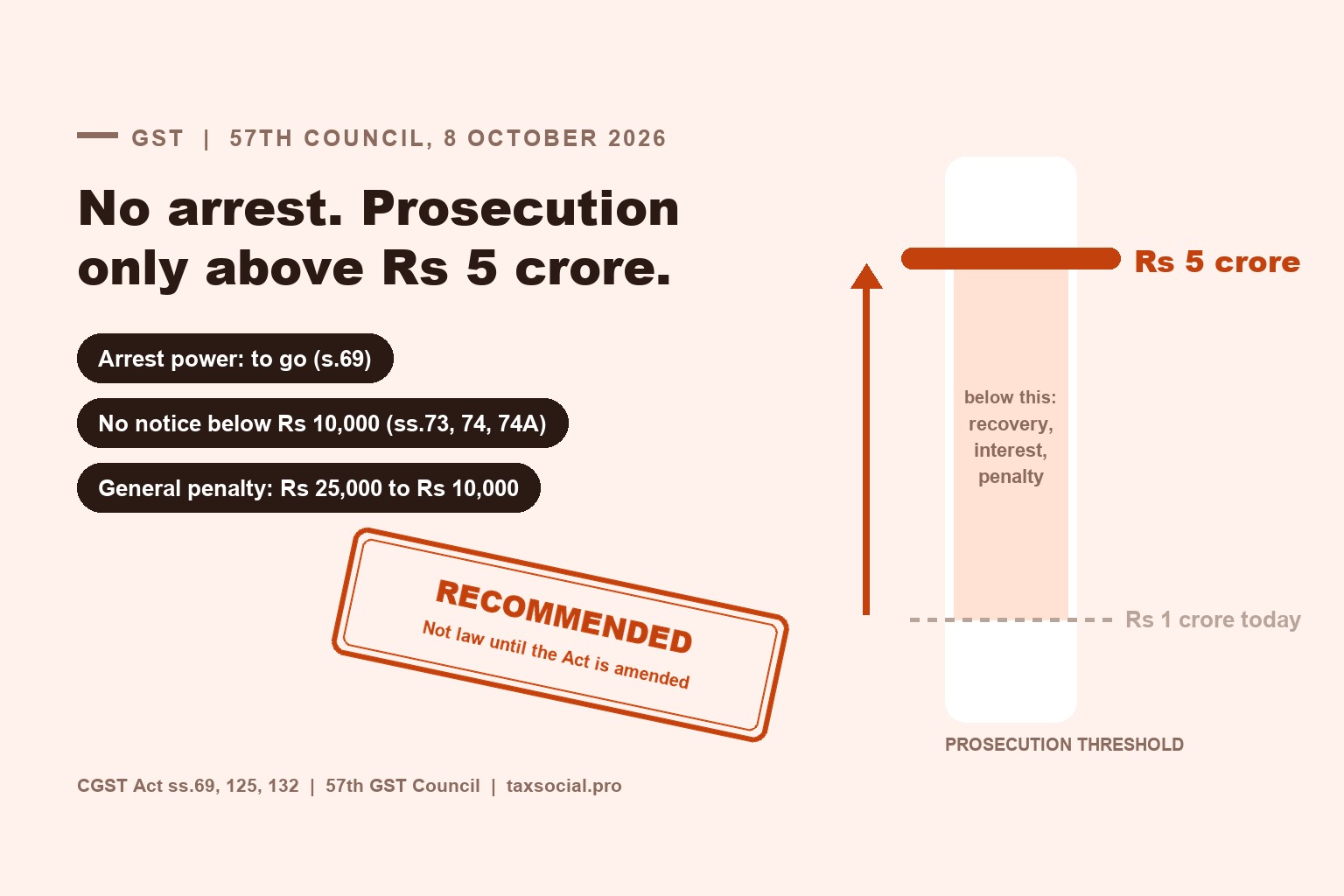
The GST Council has recommended taking the power of arrest out of GST entirely, by omitting section 69 of the CGST Act. At its 57th meeting on 8 October 2026 it also recommended raising the monetary threshold for prosecution from Rs 1 crore to Rs 5 crore, narrowing several offences in section 132, cutting the general penalty under section 125 from Rs 25,000 to Rs 10,000, and putting a Rs 10,000 floor on show cause notices. Vehicles are to be intercepted only on specific intelligence with a Joint Commissioner's authorisation, and only in the State where the supplier or recipient is. None of it is law yet. Every one of these changes is an amendment to the CGST Act, and to each State's SGST Act. Until they are passed and brought into force, the existing provisions apply in full, including to investigations already under way.
1. What the Council recommended
From the official release, item 11 (arrest and prosecution), items 7.2 to 7.4 (notices and penalties) and item 12 (e-way bills):
Arrest and prosecution
- "Complete withdrawal of arrest powers under GST by omission of section 69."
- Prosecution threshold raised from Rs 1 crore to Rs 5 crore.
- Offences narrowed: the offence in clause (i) of section 132(1), lettered (a) to (l), omitted (dealing with a supply of services known to be in contravention of the Act); the words "evades tax" deleted from clause (e); the words "or in any other manner deals with" deleted from clause (h); clause (c) to cover only fraudulent availment of credit without receipt of goods or services, or without an invoice or bill.
- Punishments "rationalised" for the various offences. The Finance Minister said at the briefing that the minimum punishment goes, leaving a fine, imprisonment or both to the court's discretion; the written release says only "rationalizing the amount of punishment".
Notices, penalties and appeals
- No show cause notice below Rs 10,000, measured on the tax involved, "CGST + SGST + IGST + Cess" together, by amending sections 73, 74 and 74A. Notices and appeals below Rs 10,000 still pending when the change comes into force are to be decided "as if the said threshold of Rs. 10,000/- had been in force when the notice was issued". So, once the amendment is in force, pending notices and appeals below Rs 10,000 are to be decided as if the floor had applied when the notice was issued. How that plays out procedurally will depend on the amending text.
- Penalty treated as a "charge" where the full tax is paid voluntarily, with interest and penalty, within the specified time.
- Penalty of 5% in non-fraud cases where tax and interest are paid within 30 days of the order under section 73, or 60 days under section 74A.
- The Rs 10,000 minimum penalty in non-fraud cases removed.
- General penalty under section 125 cut from Rs 25,000 to Rs 10,000.
- Pre-deposit capped at Rs 40 crore (Rs 20 crore CGST and Rs 20 crore SGST/UTGST) for appeals to the Appellate Authority and the Tribunal where the order is penalty-only, with no tax demand, by amending sections 107(6) and 112(8).
- A circular with common guidelines on the quality and timeliness of notices and orders, invoking fraud or suppression "only based on merits in each case", and natural justice, including personal hearings.
- A hearing before credit is blocked: rule 86A to be amended so a taxpayer can object to the blocking of credit and be heard before the officer decides.
Goods in transit
- A conveyance can be intercepted only on specific intelligence, with authorisation from an officer not below Joint Commissioner.
- Inspection, detention or seizure only where the supplier or the recipient is located or registered in the State making the interception. "No interception in the transit States."
- The exception: where no e-way bill has been generated, or the vehicle carries nothing showing the origin or destination of the goods, the goods can be inspected, detained or seized anywhere.
- No confiscation under section 130 of goods or conveyances in transit.
- All of this by amending sections 68, 129 and 130 of the Act.
The Council's stated reasoning, given at the briefing: the system now matches sellers' and buyers' invoices and can pick out fake credit, so enforcement can rely on detection instead of on the threat of arrest.
2. The law today, section by section
Section 69: the power to arrest
Section 69(1) lets the Commissioner, where he "has reasons to believe" that a person has committed an offence in clauses (a) to (d) of section 132(1) punishable under clause (i) or (ii) of that sub-section, or under section 132(2), authorise an officer to arrest that person. In practice, that is:
- supplying without an invoice to evade tax (132(1)(a));
- issuing invoices without supply, leading to wrongful credit or refund (132(1)(b));
- availing credit on such invoices, or fraudulently without any invoice (132(1)(c));
- collecting tax and not paying it for more than three months (132(1)(d)),
where the amount exceeds Rs 2 crore (clause (ii)) or Rs 5 crore (clause (i)), or the person is a repeat offender under section 132(2). Section 132(5) makes these offences, where above Rs 5 crore, cognizable and non-bailable. Everything else is non-cognizable and bailable under section 132(4).
Section 132: the prosecution ladder
| Amount (tax evaded, credit wrongly availed or utilised, or refund wrongly taken) | Punishment today |
|---|---|
| Above Rs 5 crore | Imprisonment up to 5 years and fine (clause (i)) |
| Above Rs 2 crore, up to Rs 5 crore | Imprisonment up to 3 years and fine (clause (ii)) |
| Above Rs 1 crore, up to Rs 2 crore, only for the fake-invoice offence in clause (b) | Imprisonment up to 1 year and fine (clause (iii)) |
| Falsifying records or furnishing false information (clause (f)) | Imprisonment up to 6 months, or fine, or both (clause (iv)) |
Two more features matter. Section 132(3) sets a minimum of six months for clauses (i) to (iii) and for repeat offences, "in the absence of special and adequate reasons to the contrary to be recorded in the judgment". And section 132(6) bars any prosecution without the Commissioner's previous sanction.
A note on lettering: section 132(1) lists the offences as clauses (a) to (l), and the punishments as clauses (i) to (iv) at the end. The offence the release omits is clause (i) in the first list; the punishment bands below are the second list. The "Rs 1 crore" the Finance Minister referred to is the floor in punishment clause (iii), which since 1 October 2023 applies only to fake invoicing. A Rs 5 crore threshold for the money-based offences would leave punishment clause (i), the most serious band, as their only route to prosecution. Clause (f), falsifying records or furnishing false information, is punished separately under clause (iv) with no money threshold at all. Whether that offence is changed too is for the amending text to show.
Section 125: the general penalty
Section 125 today: any person who contravenes the Act or the rules, "for which no penalty is separately provided", is liable to a penalty that "may extend to twenty-five thousand rupees". It is a ceiling, not a fixed charge, and it is the penalty officers reach for on procedural lapses with no penalty of their own. The recommendation cuts the ceiling to Rs 10,000.
Sections 68, 129 and 130: goods in transit
Section 68(3) lets the proper officer intercept a conveyance "at any place" and require the person in charge to produce the prescribed documents and devices, and to allow the goods to be inspected. The Act sets no condition of specific intelligence, no senior officer's approval and no limit to particular States. Sections 129 and 130 then allow detention, seizure and confiscation. The release puts all three changes into the Act itself, so the transit limits come with the same Act amendment as everything else in this article, not earlier by rules.
3. When will it take effect?
Not on 8 October, and not by notification. The Council's recommendations take effect only when the law is changed:
- Sections 68, 69, 73, 74, 74A, 107, 112, 125, 129, 130 and 132 are all in the CGST Act. Changing them needs an amendment passed by Parliament, in a Finance Bill or a separate CGST amendment bill, and it applies from whatever date the amending Act provides, often a date the Government notifies. The release itself says the recommendations "would be given effect through the relevant circulars/ notifications/ law amendments which alone shall have the force of law".
- Each State has the same provisions in its own SGST Act, and the Union territories have the UTGST Act. Each has to be amended separately, so the Central change and the State changes can take effect on different dates. Until a State amends its Act, the powers under that State's law survive.
- Until then, these sections apply as they stand today, including to investigations, summons, interceptions and arrests in cases already under way. The circular on notices and the rule 86A hearing can come sooner, since they need no Act amendment.
What happens to cases already pending when the amendment arrives depends on the transition wording in the amending Act. A taxpayer facing a section 132 complaint today should not assume the new thresholds will apply to it.
4. What it does not change
- Tax and interest remain payable. Demands under sections 73 and 74 (periods up to 2023-24) and section 74A (from 2024-25) stay. What changes is the floor for issuing a notice and the size of the penalty in non-fraud cases.
- Fake invoicing remains an offence. Above the new threshold it remains prosecutable. What happens below it will depend on the amending text.
- Search, seizure and summons powers in sections 67 and 70 are not mentioned in the release. The arrest power goes; the investigative powers stay.
5. What to do now
- If you are under investigation, nothing in this recommendation helps you today. Treat a summons or arrest authorisation under the current law, and take advice on bail and compounding under section 138 as you would have done last week. Compounding is not open to everyone: it is barred for a person accused under section 132(1)(b) (fake invoices), among other exclusions, and the tax, interest and penalty must be paid first.
- If you have pending notices, watch the amending Act's transition clause before deciding whether to contest or settle. For a notice under Rs 10,000 (all taxes together), the release says pending cases will be decided as if the floor already applied, but only once the amendment is in force. Do not ignore a due date in the meantime.
- If you advise clients, do not tell anyone "arrest has been abolished". It has been recommended. Arrest is still in the Act.
Source: Recommendations of the 57th Meeting of the GST Council, Press Information Bureau, 8 October 2026 (Release ID 2320934), items 7, 11, 12 and 14; the Finance Minister's press briefing the same evening, where noted. First published on 8 October from the briefing; checked against the release and corrected on 9 October.



Comments (0)
No comments yet. Be the first to comment!