
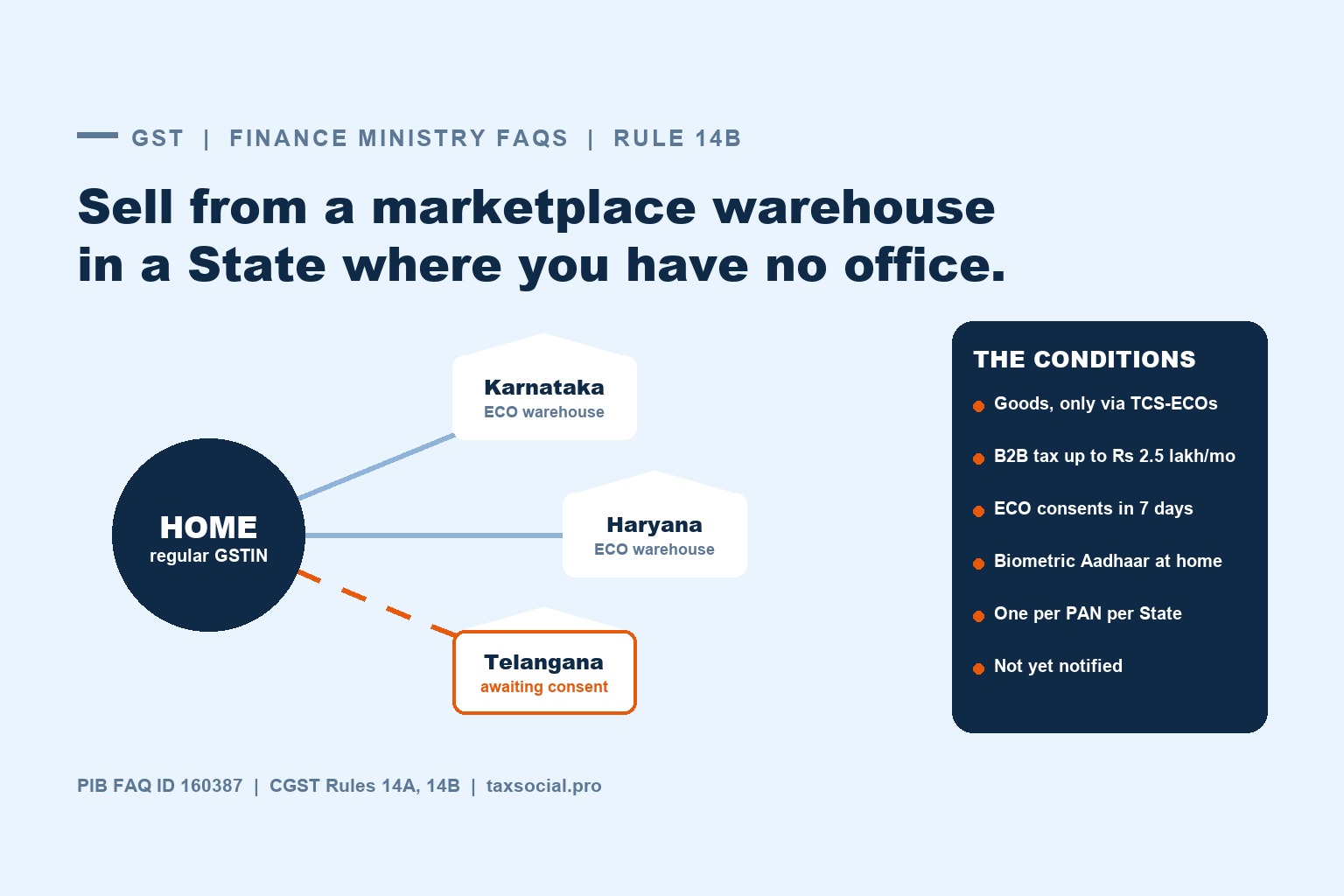

On 9 October 2026 the Finance Ministry published 14 FAQs on the simplified GST registration scheme for e-commerce sellers, the new rule 14B recommended by the 57th GST Council. A small seller of goods can register in a State where it has no premises by declaring an e-commerce operator's warehouse there as its principal place of business. The conditions:
- sales only through e-commerce operators that collect tax at source;
- output tax on supplies to registered buyers of not more than Rs 2.5 lakh a month;
- the operator's consent within 7 working days;
- a regular registration in your home State;
- biometric Aadhaar authentication and physical verification there.
The FAQs fill in much more than the Council's release did, and some of it is stricter than the "automatic registration" headlines suggest. Rule 14B is not yet notified. The FAQs are attached to this article, and the full text is on pib.gov.in (FAQ ID 160387).
1. The problem it solves
GST registration is State by State. A seller in Pune whose goods sit in a marketplace's fulfilment centre in Bengaluru is supplying from Karnataka and needs a Karnataka registration. For that it must declare a principal place of business in Karnataka and prove it with documents. A small seller has nothing there to declare, so in practice either it never sells from other States' warehouses, or it pays someone to provide an address. Rule 14B lets the marketplace's warehouse be that address.
2. Who qualifies (FAQs 1, 2 and 13)
- Goods only, through e-commerce operators only. The seller must intend to supply only through operators that are required to collect tax at source under section 52. A rule 14B registration cannot be used for any sale outside the platforms. A business that also sells offline from that State is not eligible.
- Rs 2.5 lakh a month on B2B supplies. The seller's output tax (CGST, SGST/UTGST and IGST together) on supplies to registered persons must not exceed Rs 2.5 lakh a month. Supplies to its own registrations on the same PAN are excluded from the count. Supplies to consumers do not count at all. FAQ 1 puts the same test as intending to pass on credit of less than Rs 2.5 lakh a month, excluding stock transfers.
- No physical presence in that State. The scheme is for States where you have no premises of your own.
- One per State. Only one rule 14B registration per PAN in each State or Union territory.
- A regular home-State registration. FAQ 3: you must have a registration in your home State that is not under rule 14B and not under rule 14A.
That last point matters for the smallest sellers. Many registered through the rule 14A automatic route, which has the same Rs 2.5 lakh monthly cap (rule 14A's test also counts compensation cess). FAQ 7: a person registered in the home State only under rule 14A must first apply to withdraw from rule 14A, in FORM GST REG-32, before applying under rule 14B anywhere else. Under rule 14A as it stands, withdrawal is conditional on the return history and takes effect by an order in REG-33, so allow time for it.
3. How the application works (FAQs 3, 4 and 6)
- Apply in REG-01 on the portal for the new State, opting for rule 14B. Give the GSTIN you hold on the same PAN in your home State. Give the address of the operator's warehouse to be declared as the principal place of business, and of any other warehouses of the operator in that State to be declared as additional places of business.
- The operator decides within 7 working days. The application goes to the operator for consent. If it does not consent, the application is deemed rejected.
- Home-State verification. Once the operator consents, the application goes to the jurisdictional officer in your home State for biometric Aadhaar authentication, a photograph, verification of original documents and physical verification of the home-State principal place of business, unless these have already been done.
- Grant or rejection by the portal. If verification succeeds, registration is granted electronically. If it fails, the application is rejected electronically.
So "automatic" means no officer in the new State and no premises to show there. It does not mean no verification. The checks move to the home State, and they include biometric Aadhaar authentication, which is mandatory under the scheme (FAQ 1).
4. What the certificate shows, and display (FAQs 5 and 14)
The registration certificate shows the operator's warehouses declared as principal and additional places of business in that State, and the address of your principal place of business in the home State. You do not have to display the certificate or GSTIN on a name board at the operator's warehouse.
5. Your obligations (FAQs 9 and 10)
- Books at home. Keep the books of account and records, including electronic data, for every rule 14B registration at your principal place of business in the home State. Produce them when the proper officer of the State where you hold the rule 14B registration asks.
- Changing the warehouse. To change the declared warehouse address, file REG-14. The operator's consent is needed again, and the address stands amended once it consents. Other changes stand amended on filing REG-14 under rule 19.
- If the operator withdraws consent, you must file REG-14 within 30 days of its intimation to change the principal or additional place of business.
6. The operator's obligations (FAQ 11)
- Decide on each consent request within 7 working days.
- Appoint an authorised representative in each State or Union territory to arrange and provide information that tax authorities need about sellers registered under the scheme.
- Intimate any withdrawal of consent on the portal.
This is the part that will decide how widely the scheme is used. Nothing in the FAQs obliges an operator to consent. Sellers should expect large marketplaces to set their own conditions before they let their warehouses be used this way.
7. Cancellation and withdrawal (FAQs 8 and 12)
- You can withdraw from rule 14B in FORM GST REG-32.
- The rule 14B registration is deemed cancelled by the portal, and communicated in FORM GST REG-38, if the operator withdraws consent and you do not amend within 30 days, or if your home-State registration is cancelled.
8. How it fits with what already exists
| Rule 14A (in force since 1 Nov 2025) | Rule 14B (recommended, FAQs of 9 Oct 2026) | |
|---|---|---|
| Who | Any applicant whose output tax (including cess) on supplies to registered persons is up to Rs 2.5 lakh a month | Sellers of goods only through TCS-collecting e-commerce operators, Rs 2.5 lakh monthly cap on B2B output tax, in a State with no premises |
| Place of business | The applicant's declared principal place of business under the ordinary rules (owned, rented or with consent) | The operator's warehouse, with its consent |
| Verification | Aadhaar authentication; grant within 3 working days | Operator consent, then biometric Aadhaar and physical verification in the home State |
| Home-State registration needed | No | Yes, a regular one (not rule 14A) |
| Withdrawal | REG-32 | REG-32 |
If you sell through several channels, or from your own premises in several States, the route remains regular registration in each State. Our article on GST Multistate Registration and the Master TRN covers applying in several States at once.
9. What is not settled
- When. Rule 14B has to be inserted in the CGST Rules by notification, and REG-01 changed. The FAQs give no date.
- "Certain conditions". The Council's release said registration will be granted automatically "subject to certain conditions". The FAQs list the main ones, but the rule may add more.
- Stock transfers. Moving stock from your home-State registration to the rule 14B registration is a deemed supply between distinct persons under Schedule I. GST is payable on it where the goods are taxable. The FAQs exclude such transfers from the Rs 2.5 lakh test; they do not exempt them from tax.
The rest of the 57th Council's registration changes are in our small business article and the full list in our roundup.
Source: "Frequently Asked Questions (FAQs) on simplified registration schemes for ECO sellers", Ministry of Finance, Press Information Bureau, 9 October 2026, 4:29 pm (FAQ ID 160387), text attached; Recommendations of the 57th Meeting of the GST Council, PIB, 8 October 2026 (Release ID 2320934), item 4; CGST Rules 14A, 19 and 25.


Comments (0)
No comments yet. Be the first to comment!