

Updated 9 October 2026: checked against the Council's official press release (PIB, 8 October, 7:03 pm), which was not out when this was first published. Corrected below: the e-commerce route is a new rule 14B with a Rs 2.5 lakh-a-month credit limit; the registration changes are about amendments and cancellations, not a new three-day route; the refund changes need section 54 amended; and the release adds a late fee waiver for returns filed within the month they fall due.
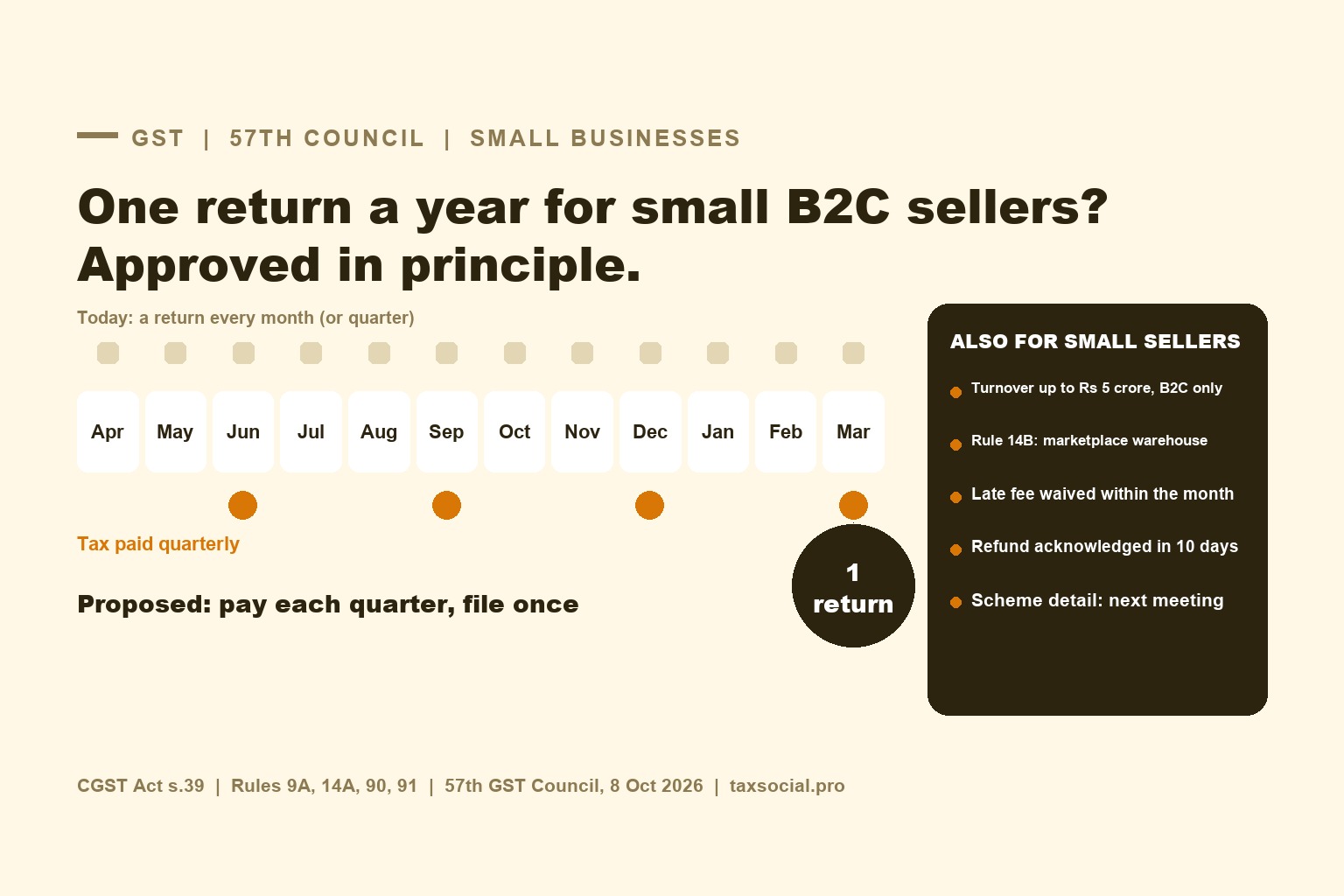
For small businesses, the 57th GST Council (8 October 2026) did five things. It approved, in principle, a concept note for an optional Annual Return Quarterly Payment (ARQP) scheme for businesses with turnover up to Rs 5 crore that supply only to unregistered buyers. It recommended waiving the late fee on a GSTR-3B filed late but within the same month, for turnover up to Rs 5 crore. It recommended a new rule 14B letting small sellers on e-commerce platforms register in another State by declaring the platform's warehouse there as their principal place of business. It recommended automatic acceptance of most registration amendments and of cancellation applications. And it recommended faster, system-run refunds. None of this is in force yet. Some needs only rules and circulars; the late fee waiver needs only a notification; ARQP and the refund changes need the Act amended.
1. Annual Return Quarterly Payment (ARQP): approved only in principle
The release (item 17): the Council "approved in-principle a concept note for an optional Annual Return Quarterly Payment (ARQP) scheme for taxpayers having an aggregate turnover equal to or less than Rs. 5 Crore in the preceding financial year and engaged exclusively in supplies to unregistered persons (B2C supplies)". As the names say, one return a year and tax paid quarterly. What was approved is a concept note, not a scheme. At the briefing, the Finance Minister said the detailed framework and the required amendments will come back to the Council at its next meeting.
What that means in practice:
- Nothing changes for your October, November or December returns. You file as you do now: GSTR-1 and GSTR-3B monthly, or quarterly under QRMP with monthly payment, until the scheme is notified.
- "Engaged exclusively in supplies to unregistered persons" is the hard condition. A single B2B invoice, for example to a registered business customer who asks for a GSTIN on the bill, may take you out of the scheme. The scheme rules will have to say how strictly that is applied.
- Why it needs the Act amended. Section 39(1) of the CGST Act requires a return "for every calendar month or part thereof". Its proviso lets the Government notify a class of taxpayers who file "for every quarter or part thereof", which is how QRMP works. Neither covers a once-a-year return for a regular taxpayer; the annual periodic return in section 39(2) is only for composition taxpayers. So the scheme requires section 39 to be amended, in the CGST Act and in each State's Act, before any rules or forms can follow. The Council itself said the "required amendments" will come with the framework.
How it compares with what exists today
| Monthly filing | QRMP | Composition | Proposed annual option | |
|---|---|---|---|---|
| Who | Default for every regular taxpayer | Aggregate turnover up to Rs 5 crore, optional | Turnover up to the composition limit; restricted categories; no inter-State outward supplies | Turnover up to Rs 5 crore, supplies only to consumers |
| Returns | GSTR-1 and GSTR-3B every month | GSTR-1 and GSTR-3B every quarter | CMP-08 statement every quarter, GSTR-4 once a year | One return a year |
| Tax payment | Monthly | Monthly (PMT-06 in the first two months of each quarter) | Quarterly, at a fixed rate on turnover | Quarterly |
| Input tax credit | Yes | Yes | No | Not yet stated |
The comparison shows what is new. Composition already gives quarterly payment and an annual return, but at the cost of input tax credit, a fixed rate on turnover and a bar on inter-State supplies. The proposed option would give the same filing rhythm to a regular taxpayer. Whether it keeps input tax credit, and how quarterly payment would be computed, are exactly the details the Council has left for its next meeting.
Who is likely to fit
- Retail shops, restaurants, salons, gyms and coaching centres, where customers are individuals and almost nobody asks for a tax invoice with their GSTIN.
- Small online sellers who sell only to consumers, though e-commerce sellers will need to watch how the scheme treats tax collected at source by the marketplace under section 52.
- Not a fit: anyone who supplies to registered businesses, even occasionally, unless the final scheme allows a small B2B tolerance.
2. Late fee waived if you file within the month
The release (item 15): the Council "recommended waiver of late fee on delayed filing of return under section 39(1) of the CGST Act, 2017, for taxpayers with an annual turnover up to Rs. 5 crore in the preceding financial year, if the said delayed return is filed by the end of the month in which it was due". The section 39(1) return for a monthly filer is GSTR-3B, due on the 20th. So a GSTR-3B due on 20 November and filed by 30 November would carry no late fee. We cover this in detail in our article on the late fee waiver.
Unlike most of this list, it needs no Act amendment. Late fees are already reduced by notification under section 128, and this would be another such notification. Interest under section 50 on tax paid late is not waived.
3. E-commerce sellers: a new rule 14B
Today, a seller who wants to keep stock in a marketplace's fulfilment centre in another State has to register in that State and declare a principal place of business there. That place need not be owned; premises held under a rent agreement or with the owner's consent can be declared. But the seller still needs a principal place of business in the State that it can document, and most small sellers have nothing there to declare.
The release (item 4) recommends inserting rule 14B in the CGST Rules for small suppliers who:
- supply goods through e-commerce operators;
- in States or Union territories where they have no physical presence;
- and intend to pass on input tax credit of not more than Rs 2.5 lakh a month, not counting stock transfers between their own registrations.
Such a seller can declare the operator's warehouse in that State as its principal place of business, and registration "will be granted automatically by the system, subject to certain conditions". At the briefing it was added that the operator's consent will be needed, the seller must have a physical presence in at least one State, and the registration is limited to supplies made through the platform. Those conditions will be in the rule itself.
Update, 9 October: the Finance Ministry's FAQs on the scheme, published the next day, show it is stricter than "automatic" suggests. The operator must consent within 7 working days or the application is deemed rejected. Biometric Aadhaar authentication and physical verification happen in the home State. A regular, non-rule 14A registration in the home State is required. And only one rule 14B registration is allowed per PAN in each State. Details in our article on the rule 14B FAQs.
The Rs 2.5 lakh limit mirrors rule 14A, so this is the same idea extended to e-commerce sellers in States where they have no premises. Before the meeting, PTI reported an estimate that around 9.5 lakh small sellers could benefit. Until rule 14B is notified, a seller wanting to use a warehouse in another State needs a normal registration there. Our article on GST Multistate Registration and the Master TRN explains the current route for applying in several States at once.
4. Registration: amendments and cancellations go automatic
The release confirms that automatic registration without officer intervention already runs under rule 14A for applicants who do not intend to pass on credit of more than Rs 2.5 lakh a month. That was the 56th meeting's reform, in force since 1 November 2025. Rule 9A separately lets the portal grant registration within three working days to applicants it identifies on data analysis and risk parameters. Nothing in the 57th release changes either route. What it does change:
- Applications: a circular listing the documents and information needed for registration, with FAQs; REG-01 to get drop-down boxes for the prescribed documents; a simpler portal interface. The aim is fewer queries and rejections in the cases that still go to an officer.
- Amendments: rule 19 to be amended so that changes to all registration particulars are accepted automatically on the portal, except the principal place of business. For rule 14A registrants, even the principal place of business is accepted automatically.
- Cancellation on your own application: in phase 1, REG-16 applications accepted automatically once all returns are filed and dues paid, where you never passed on credit above Rs 2.5 lakh in any month, or where you did but have filed the final return (GSTR-10) in time. In phase 2, all applications accepted automatically on the same conditions, with GSTR-10 details furnished in REG-16 itself. This needs amendments to the Act and the rules.
- Cancellation by the officer: some grounds in rule 21 to be dropped, and a system-based cancellation, and revocation once the default is cured, for not filing returns or not furnishing bank account details.
5. Faster refunds
The release (item 6) recommends amending section 54 and the rules for system-based processing of refunds of excess cash-ledger balance, zero-rated supplies and inverted duty, in two phases.
| Step | Today | Phase 1 |
|---|---|---|
| Refund of excess balance in the electronic cash ledger | RFD-01, then the officer processes it | Full claim sanctioned automatically by the system, without officer intervention |
| Acknowledgement (RFD-02) or deficiency memo, for other refunds | Within 15 days of filing (rule 90(2)) | Within 10 days; if the officer does not act, the system deems it acknowledged |
| Provisional refund of 90% for zero-rated supplies and inverted duty | Order (RFD-04) by the proper officer within 7 days of acknowledgement, on the system's risk evaluation (rule 91(2)); section 54(6) provides for it on zero-rated supplies, and inverted duty claims have been given the same treatment under CBIC instructions since October 2025 | Sanctioned automatically by the system, without officer intervention, on its risk evaluation |
In phase 2, acknowledgement itself becomes automatic after the system verifies the application, and for zero-rated supplies the full refund is sanctioned automatically, after adjusting dues, on risk evaluation. At the briefing, the Finance Minister described the provisional order as issuing within three working days; the release gives no number of days.
Other refund changes in the release:
- RFD-01 to capture details in a system-readable format, with no scanned documents for zero-rated and inverted duty claims.
- The cap in rule 89(4)(C) limiting zero-rated turnover of goods to 1.5 times the value of like goods supplied domestically to be removed.
- The Rs 1,000 minimum refund in section 54(14) to apply to CGST, SGST/UTGST and IGST taken together.
- Interest on refunds of pre-deposits made for appeals to get its own provision in section 115, with a clarifying circular.
Because the release routes these through section 54, the automation is not a rules-only change. The deadlines in rules 90 and 91 can move by notification, but automatic sanction without an officer needs the Act changed. The system can still refuse provisional treatment on risk grounds, and rule 91(1) still denies it to anyone prosecuted, in the five years before the tax period, for an offence with tax evaded above Rs 2.5 crore.
6. What to do now
- B2C businesses under Rs 5 crore: do not change your filing calendar. Do check whether all your sales really are to unregistered customers. That will decide eligibility when the scheme arrives.
- Turnover up to Rs 5 crore: until the late fee waiver is notified, the late fee still runs from the day after the due date. File on time.
- E-commerce sellers: list the States where you would use a marketplace warehouse, check that your credit passed on to buyers there would stay under Rs 2.5 lakh a month, and ask your marketplace whether it will give consent.
- New registrations: complete Aadhaar authentication at the application stage. It is required for the rule 14A route, and without it rule 9 sends the application to physical verification.
- Refund claimants: file complete applications. A deficiency memo restarts the clock, and faster deadlines do not help an application that comes back for a missing document.
Source: Recommendations of the 57th Meeting of the GST Council, Press Information Bureau, 8 October 2026 (Release ID 2320934), items 1 to 4, 6, 15 and 17; the Finance Minister's press briefing the same evening, where noted. First published on 8 October from the briefing; checked against the release and corrected on 9 October.


Comments (0)
No comments yet. Be the first to comment!