
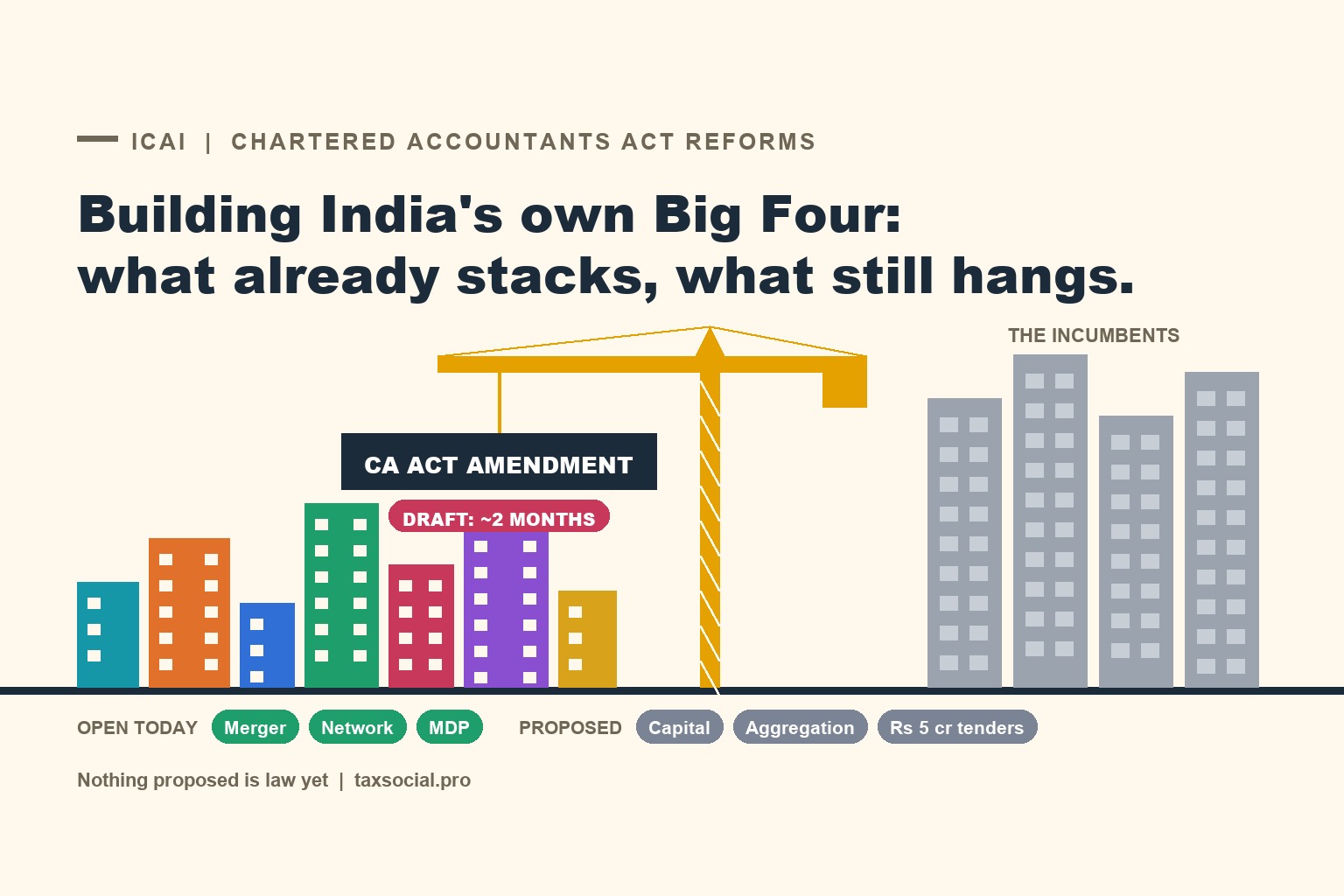

In the third week of September 2026, ICAI said it is preparing amendments to the Chartered Accountants Act, 1949 to help Indian firms grow large enough to compete with the global Big Four. According to reports, its Vice-President said the Central Council would take the proposal up shortly and that a first draft would be ready in about two months. It has not been published, and nothing in it is law. A change to the Act needs the Ministry of Corporate Affairs and then Parliament. Two other things are moving faster. On 22 July 2026 the Finance Ministry's Department of Expenditure advised ministries that consultancy tenders were demanding turnover and staff far beyond what the work needs, which has shut smaller firms out. ICAI has since asked for assignments of about Rs 5 crore to be reserved for MSMEs and smaller firms. Meanwhile, most of the routes to scale are already open. Firms can merge under ICAI's 2024 guidelines and form networks. Subject to registration with ICAI and conditions for each profession, they can form a multi-disciplinary partnership (MDP) with company secretaries, cost accountants, engineers, architects and actuaries who do not hold a certificate of practice. They cannot yet do so with advocates, because the Bar Council's rules do not allow it.
1. What has actually been said
Three sets of reports came out in quick succession.
20 September 2026: ICAI's reform package. Reports that day quoted ICAI Vice-President Mangesh P Kinare: the proposal "is going to be taken up by the ICAI Central Council shortly and the first draft of the proposal will be ready within two months". The items reported as being under consideration were:
- formal recognition of aggregation structures, so that firms that come together are treated as one for eligibility purposes;
- allowing capital infusion into CA firms;
- amending the CA Act for "measured deregulation" of non-assurance services, giving more room in consultancy and advisory work;
- revising the networking guidelines so that networks can include company secretaries, cost accountants, advocates, engineers, architects and actuaries;
- revisiting the 2006 guidelines on corporate form of practice;
- a digital platform, "CA Setu", to connect firms looking for mergers, networks, LLP aggregation, referrals and specialists; and
- government support: removing obstacles to government consulting work, infrastructure support, and tax incentives for aggregation.
The same reports gave ICAI's figures for February to August 2026: about 1,000 firm mergers approved, 10 networks formed and 18 management consultancy companies registered.
22 September 2026: government consulting. The headline that prompted this piece reported that ICAI was seeking a bigger role for smaller firms in government consulting as part of the same push.
1 October 2026: the Rs 5 crore request. Reports said that after ICAI's Committee for Aggregation of CA Firms met the Secretary, Department of Expenditure, ICAI asked the Finance Ministry to reserve consultancy assignments of about Rs 5 crore for MSMEs and smaller professional firms. ICAI argued that evaluation should look at the number of partners, capital, employees and, above all, the firm's experience, not size alone. The Ministry is reported to have asked ICAI for more details.
The background is a broader government push for home-grown accounting and consulting firms. In September 2025 the Ministry of Corporate Affairs put out a paper for comments on Indian multi-disciplinary firms. It raised the advertising restrictions on CAs, company secretaries and lawyers, the limits on MDPs, and the "majority of partners" condition in section 141(1) of the Companies Act, 2013.
2. The part that is moving now: consulting tenders
For most small and mid-sized firms, procurement will matter long before any change to the CA Act.
As reported, the Department of Expenditure's Procurement Policy Division issued an office memorandum on 22 July 2026 after reviewing consultancy tenders. It found three problems:
- turnover requirements of five to ten times the expected cost of the assignment, which it said "prima facie, appears high";
- minimum staff strength "far exceeding the actual manpower required" for the project; and
- evaluation that weighted the firm's past experience over the qualifications and experience of the key personnel actually proposed for the job.
The memorandum is advice to procuring departments. It is not a rule that strikes down existing tenders, and each department still frames its own eligibility conditions. But it gives a bidder something concrete to cite.
When a tender for a modest assignment demands turnover running into hundreds of crores, or a headcount the job plainly does not need, raise it in the pre-bid queries. Refer to the 22 July 2026 memorandum and ask for the condition to be brought in line with the assignment's value. Departments are more likely to relax a condition before bids close than to defend it afterwards.
ICAI's request for a Rs 5 crore reservation would go further, by setting aside a category of work rather than relaxing the entry bar for all of it. It has not been accepted. Treat it as a request under consideration.
3. What the rules already allow
Much of the reform talk is about removing limits. It helps to know where the limits actually are today, because several of the structures being discussed are already permitted.
Mergers
ICAI's Merger and Demerger of CA Firms Guidelines, 2024 were approved by the Council on 2 and 3 July 2024 and replaced the earlier rules. A merger needs ICAI's approval. The reported figure of about a thousand approved mergers in six months shows the route is being used. A merger gives a two- or three-partner firm more partners and more resources at once. Whether the merged firm can count its predecessors' turnover and experience for a particular tender or bank-audit empanelment depends on that scheme's own eligibility terms, so check them before relying on it.
Networks
Separate firms can form a network under ICAI's networking guidelines and present a combined profile while remaining separate firms. The reform package proposes widening networks to take in other professionals as well.
Multi-disciplinary partnerships
This is the most misunderstood point. Section 2(2) of the CA Act already treats a member as "in practice" when practising "in partnership with members of such other recognised professions as may be prescribed". ICAI's Guidelines for Formation of Multi-disciplinary Partnership, in force since 8 July 2021, set out the professions prescribed under Regulation 53B of the Chartered Accountants Regulations, 1988:
| Profession | Can a CA firm take them in as partners today? |
|---|---|
| Company Secretary | Yes, a member of the Institute of Company Secretaries of India |
| Cost Accountant | Yes, a member of the Institute of Cost Accountants of India |
| Engineer | Yes, if a member of the Institution of Engineers, or an engineer from a university or institution established or recognised by law |
| Architect | Yes, a member of the Indian Institute of Architects |
| Actuary | Only a member of the Institute of Actuaries of India who does not hold a certificate of practice. An actuary who holds one cannot be admitted. |
| Advocate | No, not in practice. Regulation 53B permits it, but ICAI's own guidelines note that the Bar Council of India Rules bar an advocate from any partnership or remuneration-sharing arrangement with a non-advocate. "Unless the Bar Council of India Rules, 1975 are amended", an MDP cannot take in an advocate. |
Registration of an MDP with ICAI is mandatory. The firm needs an approved name carrying the suffix "multi-disciplinary partnership firm of chartered accountants in practice", and its registration number carries "MDP". No other profession is admitted: ICAI's guidelines give management graduates, registered valuers, insolvency professionals and IT professionals as examples of people who cannot be partners.
So the "CA plus lawyer" firm that the reform talk often has in mind depends on the Bar Council as much as on ICAI or Parliament. An amendment to the CA Act alone will not create it.
The audit constraint that stays
An MDP that wants to do company audits faces a constraint in the Companies Act, not the CA Act. Section 141(1) allows a firm to be appointed auditor in its firm name only if a majority of its partners practising in India are chartered accountants. Section 141(2) says only partners who are chartered accountants may act and sign for the firm.
ICAI's MDP guidelines apply that majority test on both the number of partners and their share of profits, and warn that the CA partners face disciplinary action if an MDP without a CA majority takes a company audit. Grow the consulting side with non-CA partners, and the firm can lose its eligibility for statutory audits unless the CA majority is kept on both measures. The MCA's 2025 paper asked whether this condition should be reviewed. Until the Companies Act is amended, it applies.
4. What is new in the proposals, and what to watch
Set against what already exists, the reported proposals are new in four respects:
- Outside capital. Today's rules control who can be a partner. The reported proposal for "capital infusion" does not yet say whether it means outside equity, other financing, control rights or something else. Whatever form it takes, who can put money in, on what terms and with what limits on non-CA control is the real structural change, and the one most likely to raise independence questions for audit work.
- Non-assurance services. "Measured deregulation" has not been defined. The draft will show whether it means wider permitted services, lighter rules on how they are marketed, or a separate entity for advisory work. Until then, it is a label.
- Recognition of aggregation. If tender and empanelment rules count an aggregated structure's combined credentials, small firms gain without having to merge outright. This needs procurement rules to change as well as ICAI's.
- Wider networks. Letting networks include other professionals would bring MDP-style collaboration to firms that do not want to share profits.
Watch for three things over the next few months:
- the ICAI draft and whether it is put out for members' comments;
- any Bill to amend the CA Act, which would show which parts the government has accepted; and
- any Department of Expenditure decision on reserving smaller assignments, together with whether departments actually revise their tender templates after the July memorandum.
5. What a small or mid-sized firm can do now
- Look at the eligibility criteria in the tenders you have been ruled out of. Where turnover or headcount is out of proportion to the job, use pre-bid queries and cite the 22 July 2026 memorandum.
- Put key personnel forward. If evaluation shifts towards the people proposed for the job, a firm with a strong partner and a credentialled team can compete on that basis. Keep a CV bank and assignment record ready to submit.
- Consider merging or networking before the reforms arrive, not after. Both routes exist today. Firms that have already combined will be first to benefit from any recognition of aggregation.
- Use the MDP route where it fits. A company secretary or cost accountant partner is possible today, after registration with ICAI. Keep the CA majority, by number and by profit share, if you do company audits.
- Do not plan on outside capital or on advocate partners yet. The first depends on a draft no one has seen. The second depends on the Bar Council.
Sources
- ICAI, Guidelines for Formation of Multi-disciplinary Partnership (MDP) as per the Chartered Accountants Act, 1949, in force 8 July 2021.
- ICAI, ICAI (Merger and Demerger of CA Firms) Guidelines, 2024 (icai.org announcement).
- Chartered Accountants Act, 1949, section 2(2); Chartered Accountants Regulations, 1988, Regulation 53B; Companies Act, 2013, section 141(1) and (2).
- News reports of 20 September 2026 (ICAI reform proposals, statements of the ICAI Vice-President), 22 September 2026 (government consulting), 15 and 17 August 2026 (Department of Expenditure office memorandum of 22 July 2026) and 1 October 2026 (ICAI's Rs 5 crore reservation request). The ICAI draft and the office memorandum were not available to us. Where this article relies on reports, it says so.
This article states the position as at 2 October 2026. The proposals described are proposals: none has been notified or enacted. Check the current ICAI guidelines and the specific tender document before acting.


Comments (0)
No comments yet. Be the first to comment!