
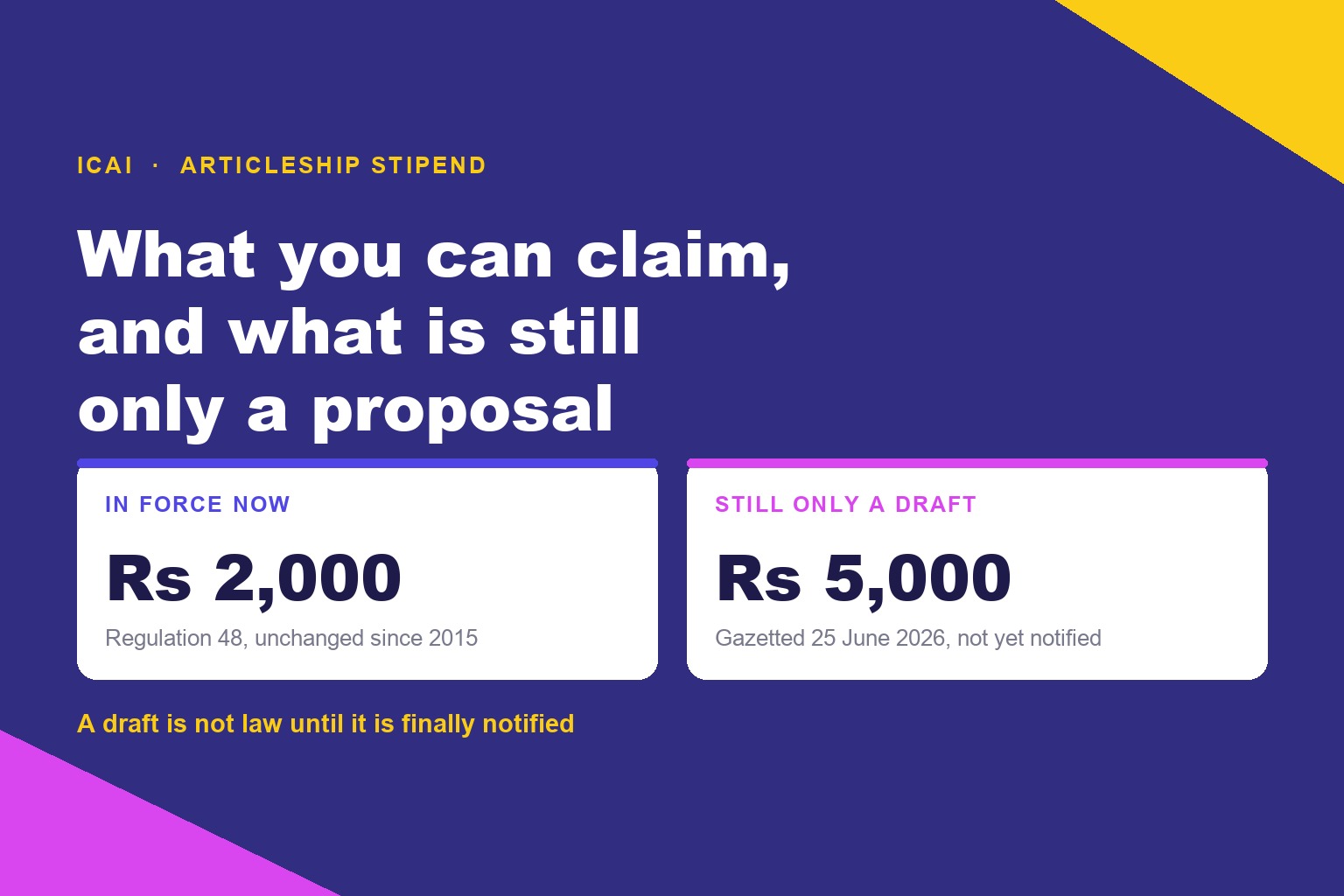

TL;DR: If you are an articled assistant right now, the minimum your principal must legally pay you is still the Regulation 48 table set in 2015 — Rs 2,000 rising to Rs 3,000 a month in cities of 20 lakh people or more, and less elsewhere. ICAI has published a draft amendment that would lift that to Rs 5,000 in the first year and Rs 6,000 in the second. It was gazetted on 25 June 2026 and the comment window closed on 5 August 2026 — but a draft is not law. The higher rates become payable only when the final notification is published in the Official Gazette, which has not yet happened. A lot of coverage is blurring those two things. This piece keeps them apart.
1. What you are entitled to today
Regulation 48 of the Chartered Accountants Regulations, 1988 obliges every principal engaging an articled assistant to pay a minimum monthly stipend, at rates that depend on where the assistant actually serves. These figures were doubled by ICAI Notification No. 1-CA(7)/167/2014 dated 23 January 2015, and they have not moved since.
| Where you serve | First year | Second year | Remaining period |
|---|---|---|---|
| Cities/towns with population of 20 lakh and above | Rs 2,000 | Rs 2,500 | Rs 3,000 |
| Population 4 lakh and above but under 20 lakh | Rs 1,500 | Rs 2,000 | Rs 2,500 |
| Population under 4 lakh | Rs 1,000 | Rs 1,500 | Rs 2,000 |
Two things to be clear about. This is a floor, not a going rate — a great many firms pay well above it, and in metros the market rate for a decent article bears little relation to these numbers. But it is the floor a principal cannot go below, and if you are being paid less than the row that applies to you, you are being underpaid as a matter of regulation, not of opinion.
The other thing: eleven years is a long time for a statutory minimum to sit still. Rs 2,000 in January 2015 does not buy what it did. That gap is precisely what the draft amendment is meant to close.
2. The awkward bit: a three-year table for two-year training
Read the table again and you will notice it has columns for a first year, a second year and a remaining period of training. That structure was written when articleship ran for three years.
Under the New Scheme of Education and Training, practical training is two years. So for anyone registered under the new scheme, the third column has nothing left to apply to — you serve a first year and a second year, and then you are done. In practice that means a new-scheme article in a large city tops out at the Rs 2,500 second-year rate rather than ever reaching Rs 3,000.
That mismatch is one of the reasons the amendment is drafted the way it is: the proposed table has only two rows, for year one and year two, and abandons the "remaining period" column entirely.
3. What ICAI has proposed
The draft Chartered Accountants (Amendment) Regulations, 2026 were published in the Gazette of India on 25 June 2026 for public comment, with in-principle approval from the Ministry of Corporate Affairs. The proposed Regulation 48 table:
| Where you serve | First year | Second year |
|---|---|---|
| Cities/towns with population of 20 lakh and above | Rs 5,000 | Rs 6,000 |
| Population 5 lakh and above but under 20 lakh | Rs 4,000 | Rs 5,000 |
| Population under 5 lakh | Rs 3,000 | Rs 4,000 |
In the top band that is a 150% increase on the first-year floor and 140% on the second. In the smallest towns the first-year minimum triples, from Rs 1,000 to Rs 3,000.
Notice that the population bands themselves move. The middle band currently starts at 4 lakh; the draft starts it at 5 lakh. So a town of, say, 4.5 lakh people sits in the middle band today and would drop to the lowest band under the new structure. For an article there the minimum still rises — Rs 1,500 to Rs 3,000 — but not by as much as the headline suggests. Anyone comparing the two tables row by row will get this wrong unless they read the population column as carefully as the money column.
The status, stated plainly
The draft says the amendment comes into force from the date of its final publication in the Official Gazette. The consultation closed on 5 August 2026. As at the date of this article, the final notification has not been issued.
Which means: a principal paying Rs 2,000 to a first-year article in Mumbai today is complying with the law. Frustrating if you are the article, but accurate. Do not go into a conversation with your principal citing Rs 5,000 as your entitlement — it is not, yet.
If you started before 2023
The draft carries a transitional provision: a candidate registered as an articled assistant for a period of three years, on or before the commencement of the Chartered Accountants (Amendment) Regulations, 2023, continues to be paid at the rates in force before the amendment. Old-scheme three-year articles stay on the old table, including its third-column rate. The increase is aimed at the two-year New Scheme cohort.
4. How the stipend must actually be paid
Regulation 48(2) is specific about the mechanics, and it is worth knowing because it is quietly protective. The stipend must be paid either:
- by a crossed account payee cheque, every month, against a stamped receipt from the articled assistant; or
- by depositing it into the articled assistant's bank account.
Cash is not a listed mode. If you are being handed notes each month with nothing on paper, that is not how the regulation contemplates it being done, and it leaves you with no record if the amount is ever disputed. Insist on the bank transfer — it is the norm now anyway, and it creates the evidence trail.
5. Three explanations that decide your actual number
Attached to Regulation 48 are three explanations that quietly determine what lands in your account:
- Excess leave is unpaid. No stipend is payable for leave taken beyond your entitlement. Track your leave balance; it converts directly into money.
- Time with a previous principal counts. If you transfer, the period served under an earlier principal is taken into account in working out which year's rate applies (nothing before 1 July 1973 counts, a limit of purely historical interest now). So a transfer at month fourteen does not reset you to first-year rates — you carry your second-year entitlement across. Some principals get this wrong, occasionally in their own favour.
- Population follows the last published Census. Not the current estimate, not the metropolitan-area figure, not the district. It is the city or town of your normal place of service, per the last published Census Report of India.
6. Industrial training is a different, much higher number
If you go the industrial training route in the later part of your training, the economics change completely. ICAI revised the empanelment criteria for organisations imparting industrial training under Regulation 51(2)(b) with effect from 1 January 2026. Under those criteria the minimum stipend is Rs 15,000 per month — as mutually agreed, but not below that — for a training period of 9 to 12 months.
That is five to seven times the current Regulation 48 floor, and comfortably above even the proposed rates. Many empanelled organisations pay well beyond the minimum. If the stipend is a material factor in your circumstances, industrial training is worth planning for early rather than discovering late.
7. If you are being paid less than the minimum
- Work out your correct row. Population band of your normal place of service, and which year of training you are in — counting service under any previous principal.
- Check the payment mode. Bank transfer or crossed account payee cheque against a stamped receipt. Keep the statements.
- Raise it with your principal first. In a surprising number of cases the firm is working off a stale figure or has simply not revisited the table since a transfer.
- If it is not resolved, the route is a written complaint to ICAI. Payment of the minimum stipend is a regulatory obligation on the principal, not a matter of negotiation.
- Watch for the final notification. When the 2026 amendment is gazetted, the new floor applies from that date — not retrospectively, and not from the draft date.
Sources
- The Chartered Accountants Regulations, 1988, Regulation 48 — "Stipend to articled assistants": the rate table by population and year of training, the payment modes in sub-regulation (2), and Explanations 1 to 3 on excess leave, service under a previous principal, and Census-based population.
- ICAI Notification No. 1-CA(7)/167/2014 dated 23 January 2015 — doubling the Regulation 48 stipend rates; the rates currently in force.
- Draft Chartered Accountants (Amendment) Regulations, 2026 — published in the Gazette of India on 25 June 2026 for public comment (window closed 5 August 2026), with in-principle approval of the Ministry of Corporate Affairs. Proposes the two-year stipend table above and preserves existing rates for pre-2023 three-year registrants. Comes into force only on final publication in the Official Gazette.
- ICAI, revised eligibility criteria for empanelment of organisations imparting industrial training under Regulation 51(2)(b), effective 1 January 2026 — minimum stipend Rs 15,000 per month, training period 9 to 12 months.
This article states the position as at 28 August 2026, when the Chartered Accountants (Amendment) Regulations, 2026 remained in draft. Once the final notification is published in the Official Gazette the rates in section 3 become the applicable minimum from that date. Confirm the current position on the ICAI website before relying on any figure here, and for a dispute about your own training or stipend, take it up through ICAI's official channels.


Comments (0)
No comments yet. Be the first to comment!