
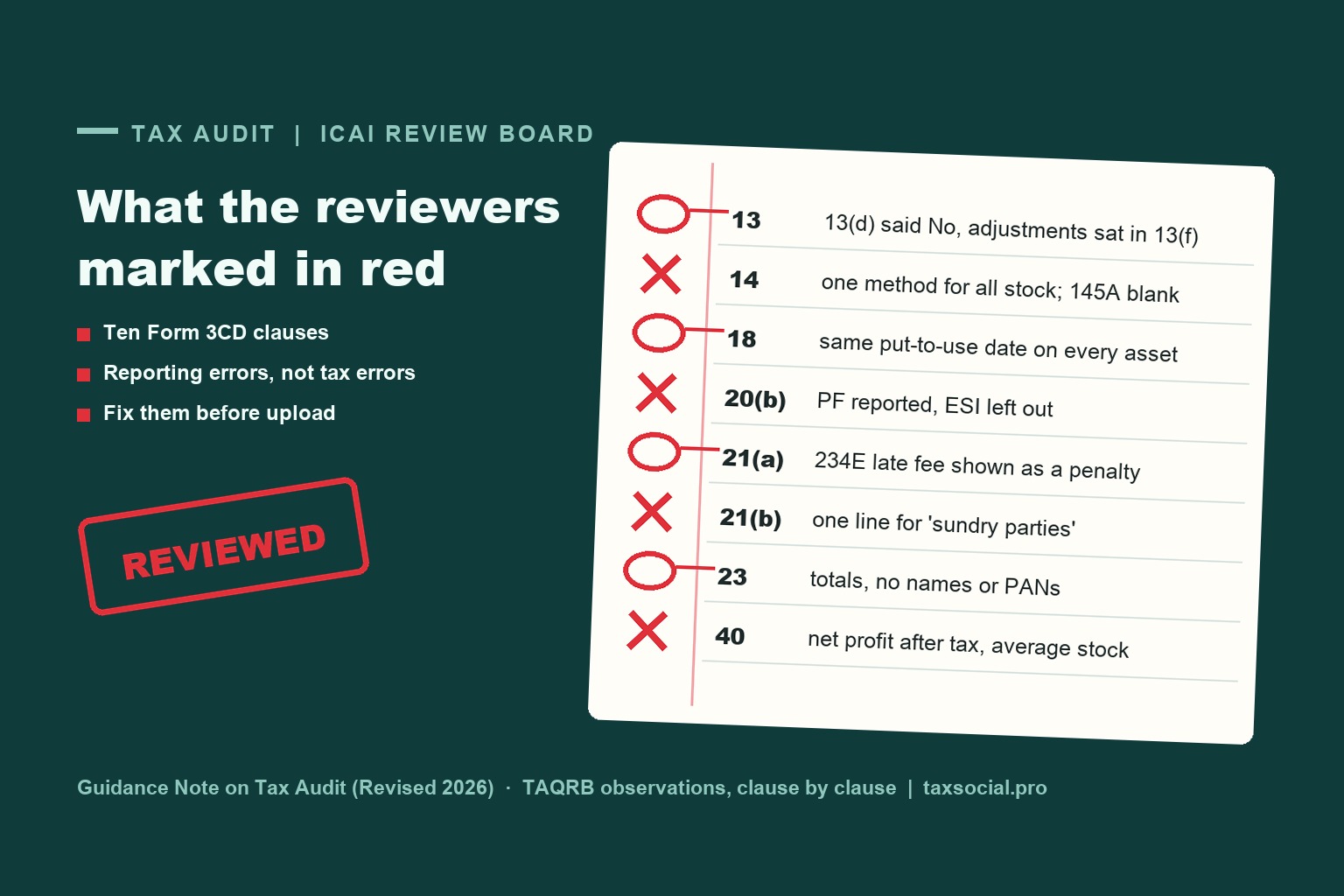

The list is real, and it is ICAI's own. The table of "mistakes in tax audit identified by TAQRB" going round this week is a close copy of the boxes ICAI printed under each clause in its Guidance Note on Tax Audit under Section 44AB (Revised 2026). Those boxes condense the Taxation Audits Quality Review Board's 2022 study of reports it had reviewed. What the table leaves out is the part you need: the rule behind each observation, and ICAI's own caution that the observations are illustrative and add no reporting requirement of their own. They are mostly reporting defects rather than wrong views of the law, though several carry a computation consequence (depreciation, employee contributions, section 40(a)). They come in three kinds. Figures are consolidated where the form asks for them item by item. Figures don't tie back to the audited financial statements. Or something sits in an annexure while the utility row that should carry it is left blank or wrong. All three can be fixed before upload, and the list below goes clause by clause.
1. Where the list comes from, and what it is not
The Taxation Audits Quality Review Board is an ICAI body set up in 2018 to review reports that chartered accountants certify under the tax laws, tax audit reports included. Its own activity reports describe a three-tier review: a Technical Reviewer goes through the report first, then a Taxation Audits Quality Review Group, then the Board. The outcome it describes is an advisory to the member. The Guidance Note adds the harder edge: where the Board finds material or serious non-compliance, appropriate action, including a reference for disciplinary proceedings, may follow.
In June 2022 the Board published a Study on Compliances in Reporting in Tax Audit Report. It goes clause by clause, quotes what the Guidance Note required, and then records what reviewers actually found. The Revised 2026 edition of the Guidance Note, the eleventh (its foreword is dated 31 July 2026), took a condensed version of those findings and printed it in italics under the relevant clauses. That is the text the viral table reproduces, clause for clause.
Read the Guidance Note's own disclaimer before treating the list as a rulebook. ICAI says the observations are "purely illustrative and informational". It says they do not form part of the Guidance Note, are not exhaustive, and should not be read as prescribing any reporting requirement beyond the Act, the Rules and the Guidance Note itself. So the list tells you where reviewers have found errors. It does not tell you what the correct entry is. That comes from the Guidance Note's text, which is what the rest of this piece works from.
One timing note. This is the last edition of the Guidance Note under the 1961 Act. The Guidance Note says so itself: from tax year 2026-27 tax audit runs under section 63 of the Income-tax Act, 2025, and the report is Form 26, not 3CA/3CB/3CD. The reports being signed this month, for FY 2025-26, are still on Form 3CD, and the amended clause list applies. The habits below carry straight across to Form 26, which was built to be matched against the return.
2. Clause 13: the Yes/No that switches off the next row
What reviewers found. Three things. First, ICDS adjustments were identified and written up under clause 13(f), but clause 13(d) was answered "No", so nothing got reported in 13(e). Second, the ICDS disclosures were left out altogether. Third, the inventory valuation reported did not line up with what the ICDS requires.
The rule. Clause 13(d) asks whether any adjustment to profit is needed to comply with the ICDS notified under section 145(2). In the e-filing utility that answer is a gate. "Yes" opens 13(e), the table of increase, decrease and net effect for each ICDS. "No" closes it. Clause 13(f) is a different thing: it is where the disclosures the ICDS require are made, and it lists eight of the ten standards. ICDS VI (foreign exchange) and ICDS VIII (securities) are not in it. For ICDS V (tangible fixed assets), the TAQRB study points out that the disclosure mirrors clause 18, and a cross-reference to clause 18 is enough.
The fix. If any number moves between book profit and ICDS-compliant profit, the answer to 13(d) is "Yes" and the number goes in 13(e). Writing it into 13(f) as a narrative doesn't take the place of the 13(e) entry. And fill 13(f) for every listed ICDS that applies to the assessee. A blank 13(f) was one of the most common observations.
There is a quieter wording point from the 2022 study that is still worth knowing. ICDS II values inventory at "cost or net realisable value, whichever is lower". AS 2 says "the lower of cost and net realisable value". The disclosure in 13(f) should use the ICDS language, even if the utility's drop-down pushes you towards the AS wording. The study suggested making sure at least the hard copy issued to the auditee says it correctly.
3. Clause 14: one method per category, and the section 145A line
What reviewers found. A single valuation method was given for "inventory" instead of one for each category. Deviations from section 145A were not disclosed. And methods were described wrongly, in some cases using the ICDS formulation where clause 14(a) wanted the method actually used in the books.
The rule. Clause 14(a) asks for the method of valuing closing stock employed in the previous year. The Guidance Note reads "closing stock" as all items of inventory: raw material, work-in-progress, finished goods, stores, consumables, loose tools. So the method has to be given for each. Clause 14(b) asks for any deviation from the method prescribed by section 145A and its effect on profit. Section 145A lets you keep the books on your regular method. For tax purposes, though, purchases, sales and inventory are to be adjusted to include any tax, duty, cess or fee actually paid or incurred to bring the goods to their location and condition, and inventory is to be valued in line with ICDS.
The fix. Most businesses keep their books on the GST-exclusive method, because the input tax credit is recoverable, and AS 2 does not permit the inclusive method anyway. Keeping the books that way is not non-compliance with section 145A. The Guidance Note is explicit that the section does not require the books to change; it requires an adjustment when income is computed, and the effect of that adjustment is to state the figures on the inclusive method. It also notes that the gross profit comes out the same either way. The TAQRB observation is narrower: where the books are on the exclusive method, the difference from the section 145A method and its effect "remained to be reported" in clause 14(b). So report the difference and its effect, which in the ordinary case is nil, instead of leaving the row blank on the assumption that nobody will ask. ICAI's Technical Guide on ICDS suggests a memorandum working to show that the result is tax-neutral.
4. Clause 18: the dates are not decoration
What reviewers found. Additions and deletions in the depreciation chart did not match the audited financial statements. Exchange-fluctuation adjustments were shown in the uploaded annexure but not in the utility's own column. Every asset in a block carried the same purchase date and the same put-to-use date. Sales had identical dates across a block. And in some reports additions were bunched into one amount per half-year instead of being dated asset by asset.
The rule. Clause 18(d) wants additions and deductions "with dates", and for additions the date the asset was put to use. There is a reason those dates matter. Under the second proviso to section 32(1), an asset put to use for less than 180 days in the year gets half the normal depreciation. The put-to-use date decides which side of that line each addition falls. The utility has a separate column for adjustments on account of exchange rate changes under section 43A. An adjustment reported only in a PDF annexure is, as the study put it, a reported difference that "is not tenable".
The fix. Keep a reconciliation between the tax depreciation chart and the fixed asset schedule in the accounts. The Guidance Note suggests preparing one for your own file. Take put-to-use dates from evidence such as installation reports, power connection records or production records, not from the purchase invoice. Where evidence is thin, the Guidance Note allows a management representation, and the working papers should show that you took one. Anything the utility has a column for goes in that column.
5. Clause 20(b): the ESI line, and whose "due date" it is
What reviewers found. Provident fund was reported, but ESI was not, even where the annual report showed regular ESI contributions. And the due dates reported were wrong.
The rule. Clause 20(b) covers employees' contributions received for any fund under section 36(1)(va): PF, ESI, superannuation or any other employee welfare fund. The "due date" is the date by which the employer must credit the contribution under the law governing that fund, per Explanation 1 to section 36(1)(va). It is not the return due date. Explanation 2, inserted by the Finance Act 2021, says section 43B does not apply to this due date and is deemed never to have applied. The Supreme Court confirmed the position in Checkmate Services in October 2022: employees' contributions are held in trust, and a deposit after the fund's due date is not saved by paying before the return is filed.
There is one change from the older Guidance Note that is easy to miss. The 2014 edition said the EPF manual's five-day grace period could be used in working out the due date. The Revised 2026 text no longer says that. It says an extension granted by the respective authority is to be considered. If your working template still adds five days, fix it.
The fix. List every fund that recovers money from employees' pay and report each one. For each month, compare the actual deposit date with the fund's own due date, and report both. Keep the employer's contribution out of this clause. That is a section 43B item and belongs in clause 26.
6. Clause 21(a): the rows exist to be kept apart
What reviewers found. Three things. Club entrance fees and subscriptions were lumped in with charges for club services and facilities. Penalties for breaking a law were lumped in with "any other penalty or fine". And the late filing fee under section 234E for TDS statements was reported as a penalty.
The rule. Clause 21(a) is a table of separately numbered rows, and the separation is the whole point:
| Row | What goes there |
|---|---|
| (iv) | Expenditure at clubs being entrance fees and subscriptions |
| (v) | Expenditure at clubs being cost for club services and facilities used |
| (vi) | Expenditure for a purpose that is an offence or prohibited by law, or by way of penalty or fine for violation of any law, in India or outside |
| (via) | Expenditure by way of any other penalty or fine not covered above |
| (vii) | Expenditure to compound an offence, in India or outside |
| (viii) | Expenditure on a benefit or perquisite whose acceptance breaks the law, rules or guidelines governing the recipient |
| (ix) | Expenditure to settle proceedings for a contravention under a law the Central Government has notified |
The rows were reworked to line up with Explanation 3 to section 37(1). The 2024 amendment (Notification 27/2024) reworded rows (vi) and (vii), turning (vii) into a compounding row, and added (viii). The 2025 amendment (Notification 23/2025) added (ix). A template built before those amendments has the old rows.
On section 234E, the TAQRB study relied on the Income Tax Department's own tutorial material, which states that the ₹200-a-day charge "is not penalty but it is a late filing fee". A fee is not a penalty or fine, so it does not belong in rows (vi) or (via). That is a point about where it is reported. It is not a view on whether it is deductible, and the Guidance Note is explicit that the tax auditor reports these items without expressing an opinion on allowability.
The fix. Split the club ledger into fees and subscriptions on one side and usage charges on the other. Split the penalty ledger into penalties for breaking a law and everything else. Keep the section 234E fee out of the penalty rows; any other charge labelled a "late fee" has to be classified on the statute that levies it. Where the assessee argues a charge is partly compensatory rather than penal, the Guidance Note says to bifurcate it on a reasonable basis. If the auditor and the assessee disagree, report both stands in the observations paragraph.
7. Clause 21(b): payee by payee, with the real date
What reviewers found. Year-end provisions for "various expenses" of "sundry parties" were reported as one line with a made-up date. Payments were grouped by expense head instead of by payee. Resident and non-resident payees ended up in each other's sub-clause. And addresses were incomplete.
The rule. Clause 21(b) is split by the kind of payee, because the consequence differs. Sub-clause (i) is for payments to non-residents: where tax was deductible under Chapter XVII-B and was not deducted, or not paid in time, section 40(a)(i) disallows the whole sum. Sub-clause (ii) is for payments to residents, where in the same situation section 40(a)(ia) disallows 30%. Within each, the form asks for the date, amount and nature of the payment, the payee's name, address and PAN, and the tax deducted and deposited.
The fix. Break every provision down to its payees before reporting it. A provision for audit fees, legal fees and contract charges is three or more payees, each with its own TDS position. For a provision, use the actual date it was credited in the books, which is the TAQRB point about dummy dates. For a payment, use the actual payment date. Check residential status from the vendor master, not from the ledger name. A reporting slip here costs twice. If a resident's payment is filed under the non-resident sub-clause, the figure it implies is 100% disallowance where the law allows 30%, and the reverse understates it. And whatever this clause reports, the department can compare against the return's own computation, which is how a 3CD entry turns into an adjustment at processing.
8. Clause 21(g): contingent means contingent
What reviewers found. Provisions made in the books were reported here as though they were contingent liabilities.
The rule. Clause 21(g) asks for particulars of any liability of a contingent nature debited to the profit and loss account. The Guidance Note text is short: "only" contingent liabilities that have been debited. That rules out two things. A provision in the accounting sense is a recognised liability, not a contingent one. And the contingent liabilities listed in the notes to accounts were never debited to profit and loss, which is why they are in the notes. Neither belongs in 21(g) just because it was labelled "provision" or "contingent".
The fix. Look for items actually charged to profit and loss where the obligation is still contingent: a disputed claim debited in full, or a liability that depends on an outcome that has not happened yet. The Guidance Note suggests going back to last year's contingent items to see whether any were charged this year and whether they are still contingent. Where the details simply aren't available, say so in a note instead of listing provisions to fill the space.
9. Clause 23: names, PANs, and transactions, not totals
What reviewers found. The name and PAN of persons covered by section 40A(2)(b) were missing. Amounts did not reconcile with the annual report. And consolidated amounts were given instead of transaction-wise details for each specified person.
The rule. Clause 23 asks for particulars of payments to persons specified in section 40A(2)(b): relatives, directors, partners, members, persons with a substantial interest, and the chains that run from them. The utility wants each person identified and the transactions with that person reported.
The fix. Start from a list of specified persons signed off by the assessee. The Guidance Note accepts reliance on that list, with a disclosure that you relied on it. Then reconcile the payments to the related-party disclosure in the financial statements. Expect the two lists to overlap without matching exactly, because section 40A(2)(b) and the accounting standard on related parties are not drafted alike. What matters is that the difference can be explained, not that it exists.
10. Clause 25: section 41, whether or not it went through profit and loss
What reviewers found. Amounts chargeable under section 41, visible in the annual report, were not reported.
The rule. Clause 25 asks for any profit chargeable under section 41 and how it was computed. The typical case is a trading liability that was deducted in an earlier year and has since been remitted or has ceased. The Guidance Note has said for years, and the TAQRB observation repeats, that this is reported whether or not the amount was credited to profit and loss.
The fix. Look for balances written back straight to reserves, creditor balances settled for less than their book value, and liabilities that were waived. They are exactly the items that never pass through profit and loss and so never reach the tax computation unless someone reports them here.
11. Clause 40: seven observations on one small table
Clause 40 is a five-row ratio table, and it drew more observations than any other clause:
- Left blank for service businesses. The Guidance Note says a service provider furnishes only row 1 (total turnover) and row 3 (net profit/turnover). The rows that don't apply should say "Not applicable", not be left empty.
- Scrap sales left out of turnover. Scrap and wastage proceeds form part of turnover even when credited to miscellaneous income.
- Net profit after tax. The Guidance Note is specific: it is net profit before tax.
- Average stock. The stock-in-trade/turnover ratio uses closing stock, and only finished goods. Not raw material, not work-in-progress, not stores and spares.
- Material consumed without stores. Material consumed includes stores, spare parts and loose tools as well as raw material.
- Ratio 5 missing for manufacturers. Material consumed/finished goods produced is required for a manufacturer. The Guidance Note gives the formula for finished goods produced.
- Preceding-year figures that don't match. The preceding-year column should come from last year's audit report. The Revised 2026 text also allows reinstated figures to make the ratios comparable. If they differ, say why in the observations paragraph, which is para 3 of Form 3CA or para 5 of Form 3CB. If the preceding year was not audited, leave the column empty and disclose that.
The Guidance Note also asks that the components behind each ratio be stated, or referenced to the financial statements, and that the numerator and denominator be consistent. Any significant deviation goes in the same observations paragraph.
12. The three habits that clear most of the list
Read across the ten clauses and the same three failures keep coming back.
- Consolidation where the form wants detail. Payee-wise in 21(b), transaction-wise in 23, asset-wise dates in 18, category-wise methods in 14, row-wise in 21(a). If the utility gives you a row per item, a single total is an error even when the total is right.
- Figures that don't tie to the audited accounts. Additions in 18, amounts in 23, ESI in 20(b), section 41 items in 25. A reviewer's first test is to put Form 3CD next to the annual report, so run that test yourself first.
- Annexure versus utility. Exchange differences in 18, ICDS adjustments in 13(f) instead of 13(e). The structured data in the utility is what gets read and matched. An annexure that says the right thing doesn't cure a blank or wrong row.
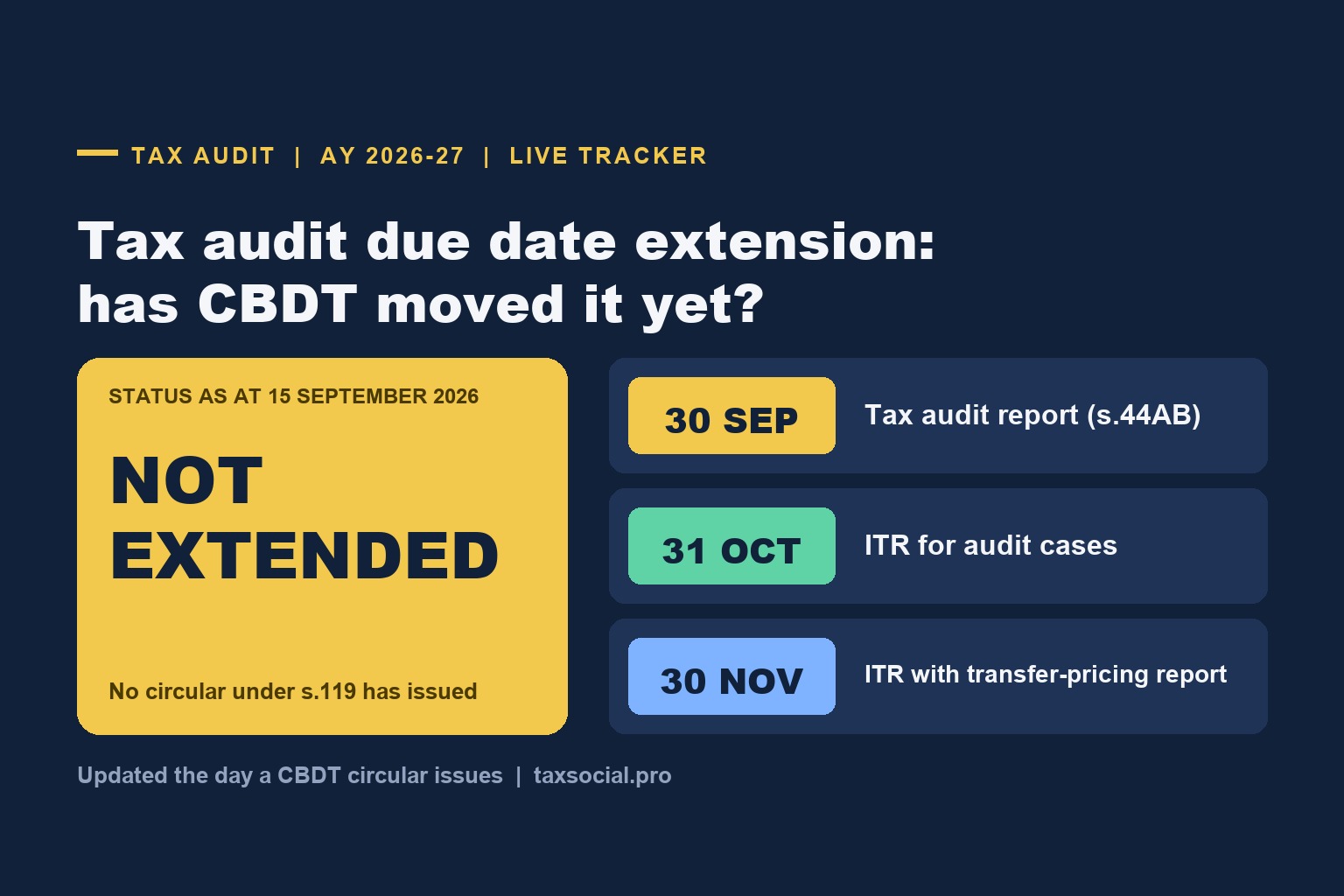
None of this needs a view on a contested point of law. It needs a second pass over the uploaded utility, row by row, against the signed financial statements, before the 30 September 2026 due date for FY 2025-26 (check the extension tracker for any change to that date). If you are also worried about where the turnover figure itself came from, that is a different and more serious problem, covered in five ways turnover gets computed wrong.
Quick answers
Is TAQRB the same as the Income Tax Department?
No. TAQRB is a board of ICAI, the regulator of chartered accountants. It reviews the auditor's reporting for compliance with the Act, the Rules and ICAI's guidance. What the department does with a Form 3CD is a separate matter.
Does a TAQRB observation change what the law requires?
No. ICAI's disclaimer says in terms that the observations are illustrative, not authoritative, and prescribe nothing beyond the Act, the Rules and the Guidance Note. They show where reviewers found reports falling short of requirements that already existed.
We have already uploaded. Can we revise the report to fix one of these?
Not as a matter of course. Rule 6G(3) expressly allows a revised report where a payment made after the audit report requires the section 40 or 43B disallowance to be recomputed, and only before the end of the relevant assessment year. Beyond that, the Guidance Note says a tax audit report should not normally be revised, and recognises revision only in exceptional situations such as revised accounts, a retrospective change in the law or a change in interpretation. A revised report must say it is revised, refer to the earlier one and give the reasons. Neither route is a general way to tidy up reporting after upload. Our Form 3CD checklist covers it.
Do these observations apply to Form 26 next year?
The clauses are renumbered and restructured in Form 26, so the observations don't map across one for one. The three habits in section 12 do. If anything, Form 26's Yes/No structure makes them more important.
Sources
- ICAI, Guidance Note on Tax Audit under Section 44AB of the Income-tax Act, 1961 (Revised 2026), eleventh edition: the TAQRB disclaimer before the Form 3CD particulars; para 14.1 (TAQRB and disciplinary reference); paras 5.6 and 5.13(xii) (scrap in turnover); and the clause paragraphs for clauses 13, 14, 18, 20, 21(a), 21(b), 21(g), 23, 25 and 40, including paras 32.4-32.5 and 75.1-75.8.
- Taxation Audits Quality Review Board, ICAI, Study on Compliances in Reporting in Tax Audit Report (first edition, June 2022).
- Taxation Audits Quality Review Board, Activity Report 2024-25: the three-tier review and advisories.
- Income-tax Act, 1961: sections 32(1) second proviso, 36(1)(va) with Explanations 1 and 2, 37(1) Explanation 3, 40(a)(i), 40(a)(ia), 40A(2)(b), 41, 43A, 145(2), 145A and 234E; Rule 6G and Form 3CD.
- Checkmate Services (P.) Ltd. v. CIT, Supreme Court, 12 October 2022, on employees' contributions and section 43B.
This article describes reporting in Form 3CD for FY 2025-26 (AY 2026-27) under the Income-tax Act, 1961, as the Guidance Note on Tax Audit (Revised 2026) describes it. Quoted observations are ICAI's. The explanations around them are ours, and where they go beyond the Guidance Note's text we say so. Nothing here is advice on a particular engagement.



Comments (0)
No comments yet. Be the first to comment!