
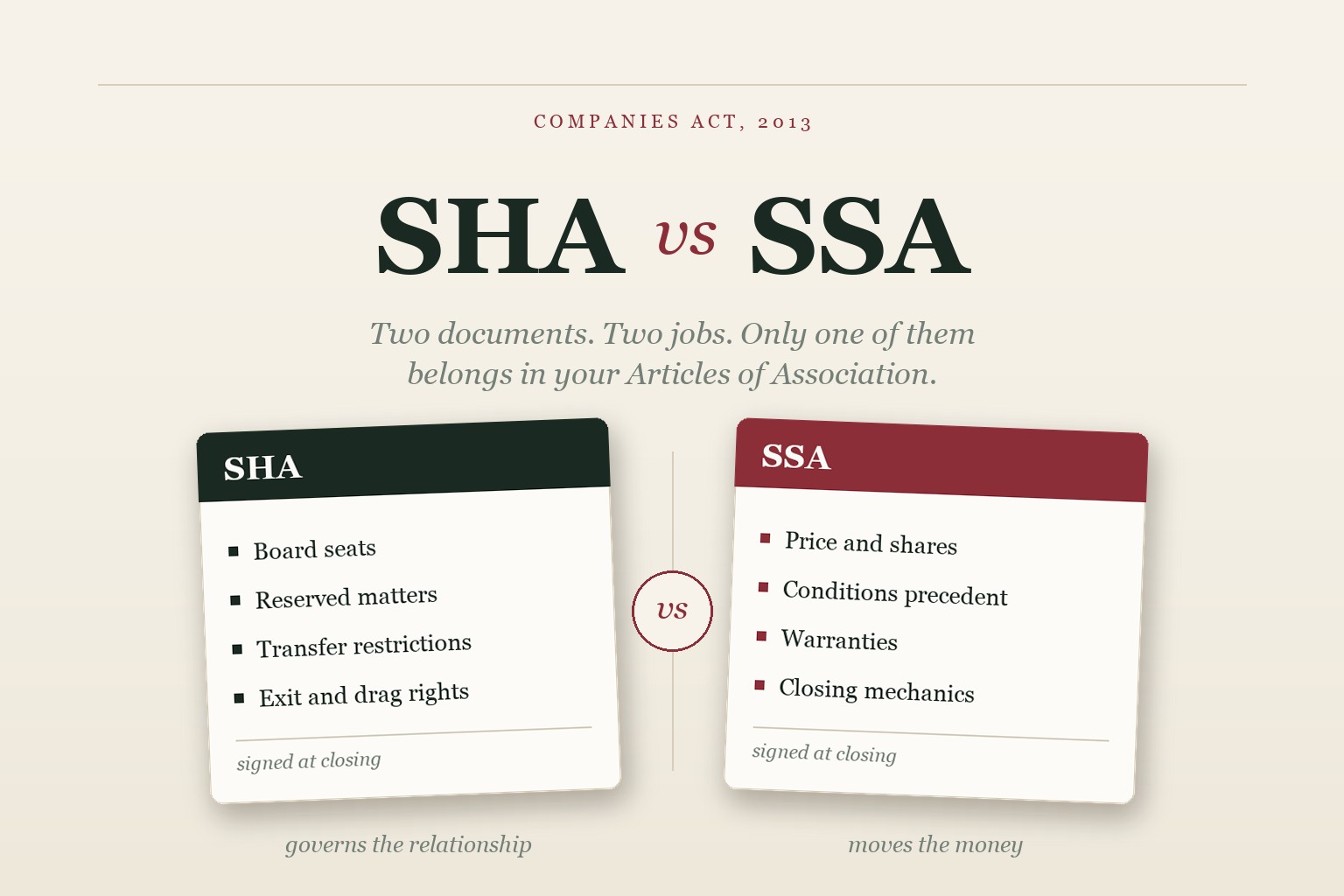

TL;DR: A Share Subscription Agreement (SSA) is the contract under which an investor pays money and the company issues new shares. It is a one-time transactional document and it is largely spent once the money is in and the shares are allotted. A Shareholders Agreement (SHA) governs what happens afterwards — board seats, veto rights, transfer restrictions, exit. Both are usually signed on the same day, and founders reasonably treat them as one bundle. The part that gets missed is more important than the distinction itself: under section 6 of the Companies Act, 2013 and the line of authority beginning with V.B. Rangaraj, a right agreed in an SHA but never carried into the Articles of Association may not bind the company at all. You can win a contract claim and still lose the thing you were trying to protect.
1. The two documents in one line each
SSA — the transaction. It records the price, the number of shares, what the investor is being told about the business, the conditions that must be satisfied before money moves, and the mechanics of closing. Its obligations are largely discharged once allotment happens and the consideration is paid.
SHA — the relationship. It records how the company will be run once the investor is on the cap table: who appoints directors, which decisions cannot be taken without the investor's consent, what happens if someone wants to sell, and what happens on an exit. It continues to operate for the life of the investment.
One buys the shares. The other decides what owning them means.
2. Side by side
| Parameter | Share Subscription Agreement | Shareholders Agreement |
|---|---|---|
| What it is | A transactional contract for the issue and allotment of new shares | A governance contract regulating the ongoing relationship between shareholders |
| Parties | The company as issuer and the subscribing investor or investors | All or the key existing shareholders, the incoming investor, and usually the company as a confirming party |
| When it bites | Between signing and closing, and on the warranties afterwards | From closing onwards, for as long as the investment lasts |
| Core content | Price and number of shares, conditions precedent and subsequent, representations and warranties, use of proceeds, indemnity, closing deliverables | Board composition, reserved and affirmative-vote matters, information rights, transfer restrictions, pre-emption, tag-along and drag-along, anti-dilution, exit and IPO obligations, deadlock and dispute resolution |
| Money | Yes — this is the document the consideration flows under | No. It allocates control, not cash |
| Relationship to the Articles | Does not amend the articles. It triggers an allotment and the filings that follow | Should be mirrored into the articles. If it is not, enforceability against the company becomes the problem described below |
| Filings it drives | PAS-3 on allotment, MGT-14 for the enabling special resolution, and FC-GPR where the investor is non-resident | None by itself — unless the articles are amended to reflect it, which is itself a special resolution and an MGT-14 |
| Effect of a breach | Usually goes to whether the transaction closes at all, or to an indemnity or damages claim on the warranties | Goes to governance — specific performance, injunction, damages between the shareholders, and in some cases an oppression and mismanagement petition |
3. Why both are signed on the same day
A round typically runs: term sheet, then due diligence, then the SSA and SHA executed together, then the conditions precedent are satisfied, then the board and members pass the enabling resolutions, then money comes in, then shares are allotted, then the filings go out.
The SHA is signed at the same time as the SSA but is written to come alive at closing, because there is no point conferring board seats and veto rights on somebody who has not yet paid. Where the two documents disagree, one of them will contain a clause saying which prevails. Read that clause. In a badly assembled set it is either missing or points both ways.
4. The problem that decides whether any of it works
Here is the part that separates a document that protects you from one that reads as though it does.
Section 6 sits above both
Section 6 of the Companies Act, 2013 provides that the Act overrides the memorandum, the articles, any agreement and any resolution, to the extent that they are repugnant to it. No amount of drafting agreement between commercially sophisticated parties makes an arrangement work if the Act says otherwise. This is the outer boundary of everything below.
A clause outside the articles may not bind the company
In V.B. Rangaraj v. V.B. Gopalakrishnan (AIR 1992 SC 453), shareholders of a private company had agreed among themselves that each branch of the family would hold an equal number of shares, and that a member wishing to sell would first offer to his own branch. That restriction was not in the articles. The Supreme Court held that a restriction on transfer which does not find a place in the articles does not bind the company; the articles govern.
Read that against how funding documents are actually put together and the risk is obvious. Pre-emption, transfer restrictions, drag and tag, the requirement that the board not act on a share transfer without following a process — these are the clauses most likely to be tested, and they are exactly the clauses that need the company to act or refrain from acting. If they live only in an SHA, the company is not obliged by them in the way the parties assumed.
The private company already restricts transfer — that is what it is
Under section 2(68), a private company is one whose articles restrict the right to transfer its shares. So a private company's articles necessarily contain a transfer restriction already. The question is never whether there is a restriction; it is whether the restriction in the articles is the one the parties negotiated in the SHA, or some default clause carried over from an incorporation template that nobody has looked at since.
The public company position, and where Messer Holdings fits
Section 58(2) provides that the securities of a public company are freely transferable. Its proviso then says that any contract or arrangement between two or more persons in respect of transfer of securities shall be enforceable as a contract.
That proviso did not appear from nowhere. In Messer Holdings Ltd v. Shyam Madanmohan Ruia (Bombay High Court, 1 September 2010), the court upheld a right of first refusal agreed between shareholders of a public company, holding that such an inter-se arrangement did not offend the free-transferability requirement then in section 111A of the 1956 Act. The 2013 Act carried that position into the statute.
The practical effect is a split worth holding in your head:
- Between the shareholders, an inter-se arrangement on transfer is enforceable as a contract. You can sue the shareholder who breached it.
- Against the company — to make the board decline to register a transfer, or to make a rights mechanism operate as a matter of corporate law rather than as a claim for damages — the article-level position is what does the work.
So the answer is not "the SHA is worthless". It is that an SHA gives you a claim against a person, while the articles give you an outcome. In most disputes the founder wanted the outcome.
5. Getting the SHA into the articles
The fix is unglamorous and routinely deferred until it is too late.
- Amend the articles under section 14, by special resolution, to carry across the clauses that need to operate against the company — transfer restrictions and pre-emption, the board-composition mechanism, the reserved matters, and any consent requirement the investor is relying on.
- File MGT-14 within 30 days of passing the special resolution. The thirty-day obligation is in section 117(1); section 117(3)(a) is what brings special resolutions within its scope. Note that the exemption private companies enjoy is from filing board resolutions under section 179(3); it does not extend to special resolutions.
- Consider entrenchment under section 5(3), which makes specified provisions alterable only on conditions more restrictive than a special resolution. Section 5(4) sets the price of doing it by amendment: in a private company an entrenchment provision added by amendment requires the agreement of all the members; in a public company, a special resolution. Notice of entrenchment goes to the Registrar in the prescribed form.
Do this at closing, as a condition subsequent with a real deadline, not "when we get to it". The moment the relationship is under strain is the moment you will not be able to pass a special resolution.
6. What an SSA actually sets in motion
The SSA itself is a private contract, but the allotment it produces runs through a fixed statutory chain. Miss a step and the defect sits on the cap table permanently.
The enabling route
A fresh issue to a specific investor is a preferential allotment under section 62(1)(c), authorised by a special resolution, with the price supported by a registered valuer's report. Rule 13 of the Companies (Share Capital and Debentures) Rules, 2014 requires the offer to be made in accordance with section 42 — so the private placement machinery applies whether or not anyone calls the deal a private placement.
File MGT-14 within 30 days of passing that special resolution. This one is easy to file late, because it is mentally filed under "the funding round" and the round is not finished yet. It is not pegged to allotment or to closing — the thirty days in section 117(1) run from the date the resolution is passed, and section 117(3)(a) is what brings special resolutions within that section at all. If closing slips by six weeks, the MGT-14 deadline does not move with it.
The section 42 machinery
- PAS-4. The offer goes out as a private placement offer-cum-application letter to identified persons.
- The 200-person ceiling. An offer may not be made to more than 200 persons in the aggregate in a financial year, excluding the categories the section carves out.
- No cash. Subscription money must come through cheque, demand draft or another banking channel, from the subscriber's own account.
- A separate bank account. The money sits in a separate account with a scheduled bank and cannot be used for anything except allotment or repayment.
- Allot within 60 days of receipt of the application money. If the company cannot, it must repay within 15 days of the expiry of those 60 days. Miss the repayment window too and the money carries interest at 12% per annum, running from the expiry of the sixtieth day — not from the end of the repayment window.
- PAS-3 within 15 days of allotment. And note section 42(4): the company cannot utilise the money raised until allotment is made and the return of allotment has been filed. Founders who treat the funds as available the moment they land in the account are operating outside the section.
After allotment
- Share certificates within two months of allotment, under section 56(4)(b).
- Register of members updated under section 88.
- Stamp duty on the issue of securities, and on the agreements themselves. The rate and the collection mechanism differ between demat and physical holdings and between states — check the applicable position rather than assuming.
7. If the investor is not resident in India
A foreign subscriber adds a second, parallel compliance track under the FEMA (Non-debt Instruments) Rules, 2019, and it runs on its own clock:
- Form FC-GPR within 30 days of the issue of equity instruments to a person resident outside India, filed on the RBI's FIRMS portal through the Single Master Form.
- Pricing. The issue cannot be at less than the fair value worked out under an internationally accepted pricing methodology, certified as prescribed. This sits alongside the registered valuer's report required by the Companies Act — they are two separate requirements, and one certificate does not automatically satisfy the other.
- Sector conditions. Entry route, sectoral caps and any conditions attached to the sector have to be cleared before the money is taken, not after.
One drafting trap worth flagging: FEMA speaks of the issue of equity instruments while the Companies Act speaks of allotment, and a set of documents that assumes the two dates are always the same can produce a late FC-GPR without anyone noticing.
8. Five ways this goes wrong in practice
- The articles are never amended. The SHA is signed, everyone moves on, and the incorporation-template articles remain the company's constitution. The problem surfaces years later, in a transfer dispute, when the clause everyone relied on turns out not to bind the company.
- The money is spent before PAS-3 is filed. Section 42(4) prohibits it. It is a common and entirely avoidable defect, and it is visible on the face of the bank statement.
- The 60-day allotment window is missed because a condition precedent slipped. The consequence is repayment within 15 days, not an extension — and 12% interest from the sixtieth day if even that is missed.
- The valuation report is dated after the resolution, or covers a different instrument from the one actually issued. The price under section 62(1)(c) has to be supported by the valuation, which means the sequence matters as much as the document.
- SSA and SHA contradict each other on the same point — most often on reserved matters or on what happens to unvested founder shares on exit — and no priority clause resolves it.
Frequently asked
Do we need both documents?
If a new investor is putting money in for new shares, you need the SSA — that is the contract the money moves under. The SHA is needed the moment the investor expects any say in how the company is run, which is essentially always. A round done on an SSA alone leaves governance to the articles as they stand.
Is the SHA filed with the ROC?
The agreement itself is not filed. What reaches the Registrar is the consequence of acting on it — the special resolution amending the articles, in MGT-14, and the amended articles themselves. That is another reason the mirroring step matters: it is the only part of the SHA that becomes a matter of public record and binds the company.
Can the articles and the SHA simply say the same thing?
They can, and for the clauses that need to operate against the company they should. Where they cannot be identical — commercial terms between shareholders that have no place in a public constitutional document — keep the SHA clause and accept that its remedy lies against the counterparty rather than against the company.
We are a private company. Does section 58(2) help us?
Section 58(2) is about the free transferability of a public company's securities. A private company is defined by the restriction on transfer in its articles, so the analysis starts from the articles, and V.B. Rangaraj is the case to keep in mind rather than Messer Holdings.
What if the investor subscribes to convertible instruments rather than equity?
The commercial documents look similar, but the statutory chain is not the same one described here, and for a non-resident investor the FEMA treatment of the instrument decides a great deal. Take that specific instrument to a professional rather than reasoning by analogy from an equity round.
Sources
- Companies Act, 2013 — section 6 (Act to override memorandum, articles, agreement and resolutions).
- Section 2(68) — definition of a private company and the restriction on transfer in its articles.
- Section 58(2) and its proviso — free transferability of a public company's securities; inter-se contracts enforceable as contracts.
- V.B. Rangaraj v. V.B. Gopalakrishnan, AIR 1992 SC 453 — a transfer restriction not in the articles does not bind the company.
- Messer Holdings Ltd v. Shyam Madanmohan Ruia, Bombay High Court, 1 September 2010 — right of first refusal between shareholders upheld.
- Sections 5(3) to (5) and 14 — entrenchment, and alteration of articles by special resolution.
- Section 42 — private placement: PAS-4, the 200-person ceiling, banking channels, the separate bank account, allotment within 60 days, the bar on utilising money before the return of allotment, and PAS-3 within 15 days.
- Section 62(1)(c) with Rule 13, Companies (Share Capital and Debentures) Rules, 2014 — preferential allotment, special resolution and registered valuer's report.
- Section 117(1) read with section 117(3)(a) — special resolutions filed in MGT-14 within thirty days of passing.
- Sections 56(4) and 88 — share certificates and the register of members.
- FEMA (Non-debt Instruments) Rules, 2019 and the RBI reporting framework — Form FC-GPR on the FIRMS portal.
This article states the position under the Companies Act, 2013 and the FEMA (Non-debt Instruments) Rules, 2019 as in force on 28 August 2026. It describes the framework, not the enforceability of any particular clause on your facts — that turns on the drafting, the class of company and the conduct of the parties. Stamp duty rates are deliberately not stated here because they vary by instrument, by state and by mode of holding. A funding round is not a document-template exercise; have the SSA, the SHA and the amended articles reviewed together by a qualified professional before you sign.




Comments (0)
No comments yet. Be the first to comment!