
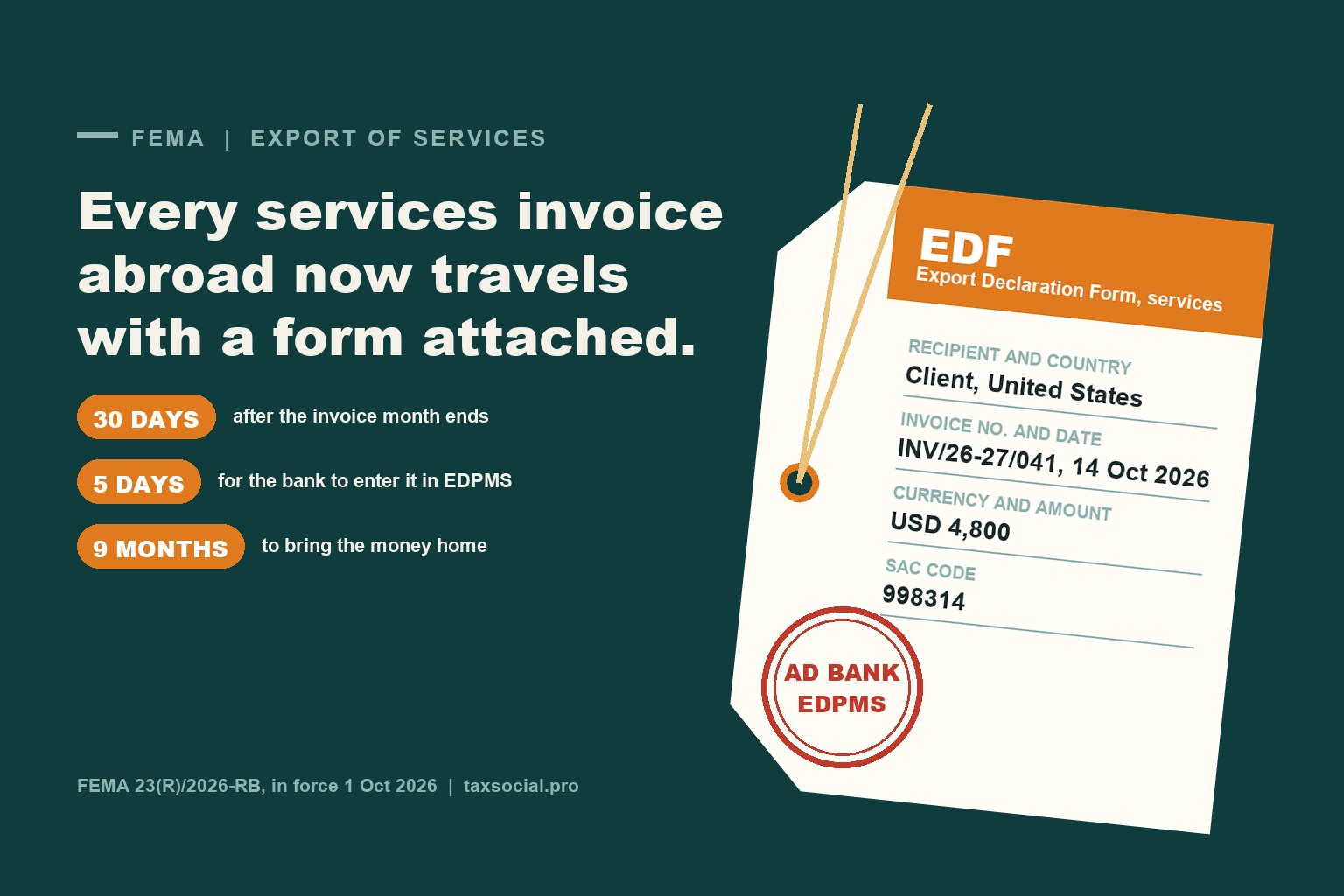

Since 1 October 2026, exporting services comes with a FEMA declaration. Until 30 September, most services could be exported without filing anything: only software had a form (SOFTEX). The Foreign Exchange Management (Export and Import of Goods and Services) Regulations, 2026 change that. "An exporter of services", with no carve-out for size, must give a declaration in the Export Declaration Form (EDF) to its authorised dealer bank within 30 days from the end of the month in which the invoice was raised, although exporters of services other than software may instead file it on or before the date the payment arrives. One EDF can cover all of a month's invoices. The bank records it in RBI's export monitoring system (EDPMS) within five working days, and the money must come in within nine months of the invoice date, or twelve if the invoice is in rupees. On the 30-day rule, an invoice raised in October 2026 needs its EDF by 30 November 2026.
1. The instruments, and the dates that matter
- The Regulations: Notification No. FEMA 23(R)/2026-RB dated 13 January 2026, published in the Gazette on 15 January 2026. Regulation 1(2): "These regulations shall come into force from October 01, 2026." They replace the 2015 Export Regulations (FEMA 23(R)/2015-RB) "except in respect of things done or omitted to be done before such supersession".
- The amendment: Notification No. FEMA 23(R)/(1)/2026-RB dated 22 September 2026, published on 24 September 2026, also in force from 1 October. It changed the realisation period, as explained in section 6.
- The bank's instructions: A.P. (DIR Series) Circular No. 20 dated 16 January 2026, also from 1 October 2026. It withdraws the Master Directions on export and on import of goods and services and a long list of older circulars, including the ones that governed SOFTEX.
The power behind all of this is Section 7(3) of FEMA, which has always required "every exporter of services" to furnish a declaration "in such form and in such manner as may be specified". What is new is that RBI has now specified a form for all services, not only for software.
2. Who has to file
Regulation 3(2) applies to "an exporter of services". It sets no threshold and makes no exception for individuals. The Explanation to Regulation 2(1)(f) adds that "'services' shall also include 'software'". On the plain words, that covers a freelance developer billing a US client, a consultancy with a UK retainer, a SaaS business invoicing overseas subscribers, a design studio, and a group's captive service centre billing its parent. The Regulations do not list any of these by name. They do not need to, because the obligation attaches to the act of exporting a service, not to the kind of business that does it.
Two things the Regulations do not do. They do not carry over the old list of exports that needed no declaration, and they do not set any value below which a services EDF is unnecessary. The ₹10 lakh figure that appears in the Regulations (section 6 below) is about closing entries once the money arrives. It is not a threshold for filing.
3. When: thirty days after the end of the invoice month
Regulation 3(2) in full:
"An exporter of services shall furnish to the specified authority, a declaration in EDF specifying the amount representing the full export value of services, within 30 days from the end of month in which invoice for services has been raised, provided that: (a) the exporter of services who has exported services to one or more recipients in a month, may submit a single EDF for all such exports; (b) the exporter of services other than software, may submit an EDF on or before the date of receipt of payment; (c) the Authorised Dealer may, on a request from the exporter citing reasons for delay, extend the period for submission of the EDF after satisfying itself about the reasonableness of the request."
- The clock runs from the invoice month, not from payment. October invoices: EDF by 30 November. November invoices: by 30 December.
- One EDF a month is enough. Proviso (a) lets you put every recipient and every invoice of a month on a single form.
- Proviso (b) gives non-software exporters a second deadline. An exporter of services "other than software, may submit an EDF on or before the date of receipt of payment". Read as a proviso to the 30-day rule, it lets such an exporter file as late as the day the money arrives, even if that falls after the 30-day window. It does not say what happens if payment never arrives, and how banks will apply it is not yet settled. Filing within the 30 days keeps you safe on any reading, and is what we would do until your bank's SOP or an RBI clarification says otherwise. Software exporters do not have this option.
- Late is not fatal if the bank agrees. Under proviso (c) the bank can extend the period on a reasoned request. The Regulations do not say the request must come before the period ends, but asking early is the easier conversation.
4. Where: your bank, unless you are in an SEZ or STPI
Regulation 2(1)(f) names the "specified authority" that receives the EDF:
| Exporter | Services other than software | Software |
|---|---|---|
| In the Domestic Tariff Area | Authorised Dealer (your bank) | Authorised Dealer, or Software Technology Parks of India (STPI) |
| In an SEZ | Development Commissioner of the SEZ | Development Commissioner of the SEZ |
Where the EDF goes to anyone other than the bank, Regulation 3(3) requires that authority to forward the authenticated form to the bank. Either way, the bank enters it: Regulation 18(1)(b) requires the AD to "enter details of EDF of service (of its customers) in EDPMS within five working days of receipt of EDF from an exporter". EDPMS, the Export Data Processing and Monitoring System, is the system RBI already uses to track export receivables for goods. Services exporters are now in it too.
The Regulations do not prescribe a portal or an upload format. Regulation 19 requires each bank to put in place an internal policy and SOP for export transactions, covering documents, timelines and charges, and to publish the main features on its website. How you actually submit the form, whether online banking, a trade portal or a branch, is therefore your bank's call. Check its published SOP.
5. What the form asks for
The EDF is a single form for goods and services, set out in the Annex to the Regulations. For a services exporter the parts that matter are:
- General information: type of export (Goods/Service), mode of delivery (there is an "Internet" option), AD code, IE Code, GSTIN, PAN, the exporter's and the AD's names and addresses, mode of realisation, and any third party paying on the client's behalf.
- Part 2B, services to multiple recipients: a table with one row per invoice. It asks for the recipient's name, address and country, the invoice number, date, currency and amount, the net realisable value, the contract number and date if any, a description of the services, and the SAC code.
- Part 4, the exporter's declaration: that the particulars are true, and an undertaking to deliver "the foreign exchange / Indian Rupees representing the full value" to the named bank "on or before" a date, within the realisation period.
- Part 5: certification by the specified authority (Customs, SEZ, AD or STPI).
The header has a field for the IE Code. Many small services exporters have never needed an Importer-Exporter Code. The Regulations do not say whether the field is mandatory for them, so ask your bank before assuming you can leave it blank.
The two forms are different, but the facts underneath them are the same. The invoice numbers, dates and values in Part 2B should reconcile with the exports you report in GSTR-1, and the SAC codes with your tax invoices. Prepare both from the same register so they cannot drift apart.
6. The nine-month clock, and what happens if it runs out
Regulation 5(1) as amended:
- Nine months from the date of invoice for services.
- Twelve months "where the export of goods and services is invoiced or/and settled in Indian Rupees".
- The bank may extend the period "on request by an exporter citing reasons for the delay".
Check which version you are reading. The Regulations as notified in January said fifteen and eighteen months. The September amendment substituted nine and twelve before the Regulations came into force. Commentary written between January and September, and some written since, still quotes fifteen months. That was never the operative figure.
If the money does not come in:
- Reduction or write-off. Under Regulation 6 the bank may allow under-realisation or non-realisation on a reasoned request. Where the export value is up to ₹10 lakh per invoice, the bank may allow it "based on a declaration from the exporter".
- Closure on declaration. Under the proviso to Regulation 4(2), an EDPMS entry for an invoice of up to ₹10 lakh "may be closed based on a declaration from the exporter" that payment has been realised, in full or otherwise. The declaration can be given quarterly for bulk closure.
- Set-off. Under Regulation 7 the bank may allow export receivables to be set off against import payables to the same overseas party or its group, within the realisation period.
- Persistent non-realisation. Under Regulation 13, if proceeds remain unrealised "for a period beyond one year from the due date of realisation or extended period", the exporter "shall undertake further exports only against receipt of full advance or an irrevocable Letter of Credit". For a services business, that is a severe commercial restriction.
Advances have one extra rule. Where you receive an advance for an export, Regulation 10(1) requires the advance and any later realisation to go through the same bank, unless you tell both banks of a change.
7. What happened to SOFTEX
Under the 2015 Regulations, software exported other than in physical form was declared on Form SOFTEX, certified by the designated official of the Ministry of Information Technology at an STPI, a Free Trade Zone or an SEZ. The 2026 Annex has one form, the EDF, for goods, services and software, and Circular No. 20 withdraws the circulars that governed SOFTEX. Neither instrument says in so many words that "SOFTEX is discontinued". The result is the same, though: from 1 October a software exporter files an EDF. STPI keeps a role, as one of the authorities that can receive and certify it.
Software still has one difference. Proviso (b) to Regulation 3(2), the "on or before the date of receipt of payment" option, is only for "services other than software". A software exporter works to the 30-day deadline without it.
8. Invoices raised before 1 October
The Regulations have no transitional clause for services invoices dated before 1 October 2026. What they have is the general saving clause ("things done or omitted to be done before such supersession"), a proviso keeping exporters already on RBI's Caution List on 30 September 2026 under their existing orders, and Regulation 20, which lets banks deal with pre-1 October transactions that used to need RBI's approval.
Some commentaries say September invoices stay under the old framework. That is a reasonable reading, since under the 2015 Regulations no declaration was due for most services when those invoices were raised. But it is an inference, not something the text says. If you have large September invoices outstanding, confirm your bank's position in writing.
9. The GST connection
The EDF is a FEMA document, not a GST one, but the two sets of rules meet in two places.
- Export status depends partly on the money. Section 2(6) of the IGST Act has five conditions, all of which must be met: an Indian supplier, a recipient outside India, a place of supply outside India, the payment condition, and no merely-distinct-establishment relationship. The payment condition, clause (iv), requires that "the payment for such service has been received by the supplier of service in convertible foreign exchange or in Indian rupees wherever permitted by the Reserve Bank of India". Your bank's realisation record proves that one condition, for GST as well as FEMA. It does not prove the other four.
- The LUT clock is longer than the FEMA clock. If you export under a Letter of Undertaking, Rule 96A(1)(b) of the CGST Rules makes you liable to pay the tax, with interest, fifteen days after "one year, or the period as allowed under the Foreign Exchange Management Act, 1999 ... including any extension of such period as permitted by the Reserve Bank of India, whichever is later", from the invoice date, or any further period the Commissioner allows. With FEMA now at nine months and no extension, the GST liability arises one year and fifteen days after the invoice. That means an unpaid invoice can be in breach of FEMA for three and a half months before GST is affected. Don't read the GST comfort as FEMA comfort.
One more GST change from this year is relevant here. Since 30 March 2026, intermediary services supplied to overseas clients can qualify as exports, as we covered in May. A business newly treating those receipts as exports is also, from 1 October, newly filing EDFs for them.
10. If you do not file
The Regulations themselves are silent on consequences. FEMA supplies them. Section 13(1) makes anyone who contravenes "any rule, regulation, notification, direction or order" liable, on adjudication, to a penalty "up to thrice the sum involved in such contravention where such amount is quantifiable, or up to two lakh rupees where the amount is not quantifiable", plus up to ₹5,000 a day for a continuing contravention. A missed EDF is a contravention of Regulation 3(2), and FEMA contraventions can be compounded.
There is one protection for exporters in the Regulations. Regulation 19(3) says a bank "shall not levy any charges or penalty on its constituent ... for any regulatory delay/violation by the constituent". Your bank can extend the time, chase you for the form and report you, but it cannot fine you for being late.
11. A checklist for a small services exporter
- Tell your bank you export services and ask for its EDF process under its published SOP: channel, format, and whether it needs an IE Code.
- Diary the 30th day after each month-end for that month's EDF. October 2026 invoices are due by 30 November 2026. The payment-date alternative exists for non-software services, but filing within 30 days is safe on any reading.
- Build the EDF from your export invoice register, the same register that feeds GSTR-1, with the SAC code on every line.
- If a client pays an advance, route the advance and the balance through the same bank, or tell both banks if you switch.
- Track each invoice against nine months (twelve if invoiced in rupees), and ask for an extension in good time.
- Use the ₹10 lakh declaration route to close small invoices, quarterly if that suits you.
- Keep the bank's realisation advice: it is your evidence for GST export status and for FEMA alike.
- Software exporters: EDF replaces SOFTEX, and proviso (b) is not available to you.
Freelancers who file under the presumptive scheme will find this fits alongside the rest of our freelancer tax guide.
Sources
- Foreign Exchange Management (Export and Import of Goods and Services) Regulations, 2026, Notification No. FEMA 23(R)/2026-RB dated 13 January 2026, as amended by Notification No. FEMA 23(R)/(1)/2026-RB dated 22 September 2026, including the Export Declaration Form in the Annex.
- RBI, A.P. (DIR Series) Circular No. 20 dated 16 January 2026, "Export and Import of Goods and Services".
- Foreign Exchange Management (Export of Goods & Services) Regulations, 2015 (superseded from 1 October 2026), Regulation 3.
- Foreign Exchange Management Act, 1999: Sections 7(3) and 13(1).
- Integrated Goods and Services Tax Act, 2017: Section 2(6). CGST Rules, 2017: Rule 96A.
This article states the position as at 4 October 2026, three days after the Regulations came into force. RBI may clarify the open points, and each bank's SOP governs the mechanics. Confirm with your bank and on your own facts before relying on it.



Comments (0)
No comments yet. Be the first to comment!