
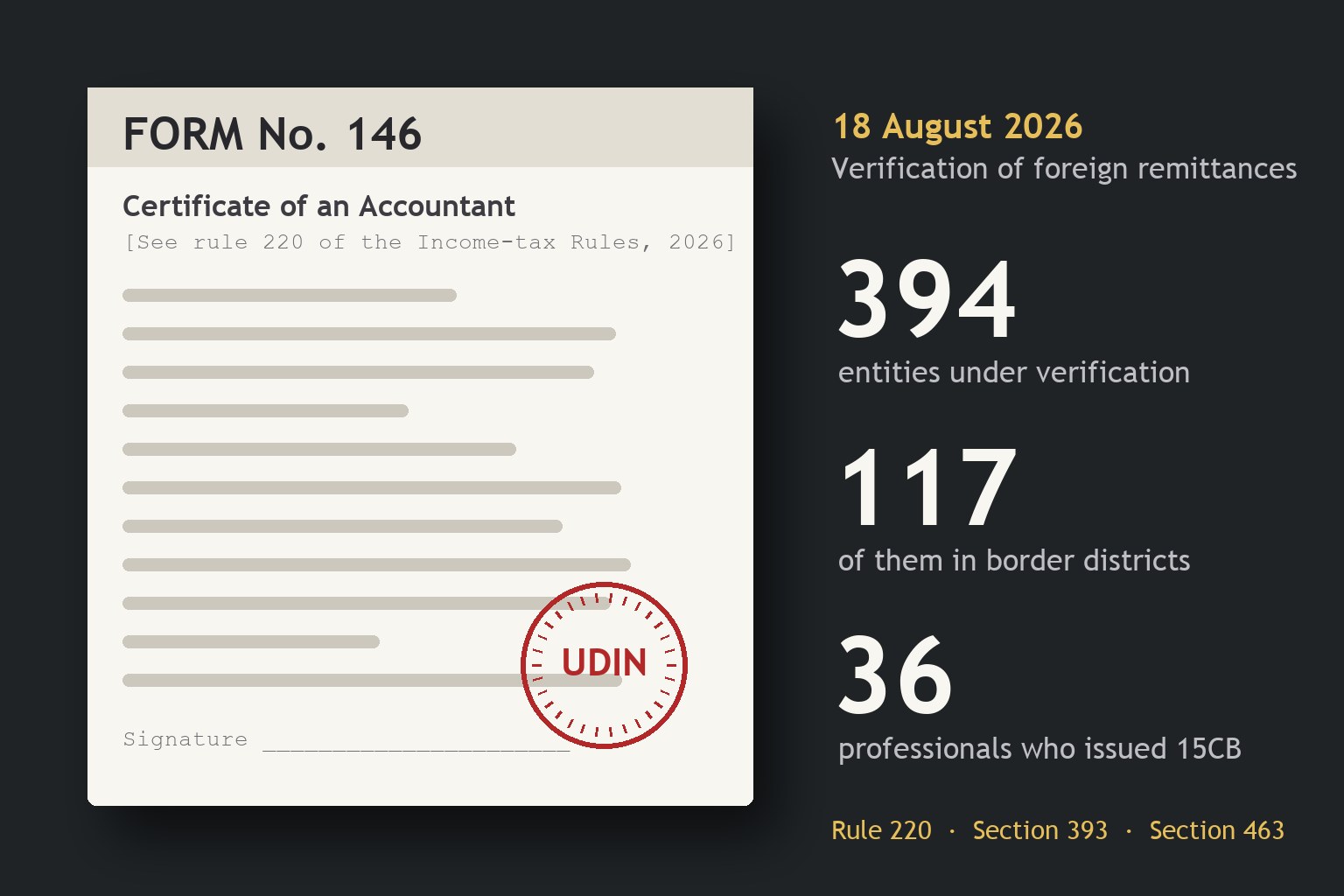

TL;DR. On 18 August 2026 the Income Tax Department began verifying about 394 entities that sent large sums abroad over three years while filing no returns or tiny ones, and 36 professionals who signed a disproportionate share of the Form 15CB certificates behind those remittances. The certificate is called Form 146 now, under Rule 220 of the Income-tax Rules, 2026, and the penalty for signing an incorrect one is section 463 of the Income-tax Act, 2025. The five things the department checked are the five things a Form 146 working paper file should be able to answer. This piece lays out the rule, the certificate, and that file.
1. What the department said on 18 August
The press release on the department's site is short. Read as a list, it says the department:
- analysed data on outward foreign remittances over the last three years, together with ground intelligence, and identified entities that remitted large amounts of foreign exchange while having little or no business activity;
- found that many were non-filers, or reported turnovers that bore no relation to the money sent;
- found on verification that several were not operating from the addresses they had declared;
- found the stated purposes, such as freight, import of software and consultancy services, did not match the financial information the entities themselves had submitted;
- found that a large number of the Form 15CB certificates behind the remittances had been issued by a relatively small group of professionals;
- traced the pattern back to an earlier search on fictitious charitable trusts that were providing accommodation entries against bogus donations; and
- launched a verification exercise covering about 394 entities, 117 of them in districts adjoining the land border, and 36 professionals.
The release also states the standard it will hold the professionals to. An accountant certifying a remittance under Rule 37BB was required to determine its taxability in accordance with the books of account and other documents, and to exercise due care, diligence and professional judgment. The exercise is described as ongoing.
Two words matter. It is a verification, not an assessment. And the certificates in question were Form 15CB under the 1962 Rules, because the remittances pre-date 1 April 2026. For anything remitted since then, the same certificate is Form 146. The diligence standard did not move with the form number.
2. Rule 220: which part of Form 145, and when Form 146 is needed
Rule 220 of the Income-tax Rules, 2026 replaced Rule 37BB. It applies to a person responsible for paying to a non-resident, not being a company, or to a foreign company. The structure is:
| Sum being paid | Form 145 | Certificate needed |
|---|---|---|
| Chargeable under the Act; the payment, or the aggregate of such payments in the tax year, does not exceed Rs 5,00,000 | Part A | None |
| Chargeable; exceeds Rs 5,00,000; a certificate or order has been obtained from the Assessing Officer under section 395(1) or (2) | Part B | The AO's certificate |
| Chargeable; exceeds Rs 5,00,000; no AO certificate | Part C | Form 146 from an accountant as defined in section 515(3)(b) |
| Not chargeable under the Act | Part D | None |
Where Part B has been furnished, Part C is not required for the same payment. Form 145 is furnished electronically, under digital signature or otherwise, in the format the Director General of Income-tax (Systems) specifies, and is then given to the authorised dealer before the money leaves. The AD can be required by an income-tax authority to produce its copy, and under sub-rule (6) the AD files a quarterly statement of all remittances, exempt ones included, in Form 147 within fifteen days of the quarter end. An IFSC Unit files Form 148. That quarterly statement is a standing data feed on every outward remittance, which is worth remembering when the release speaks of "analysis of data on outward foreign remittances".
The three exemptions in sub-rule (3)
No Form 145 is required for a sum that is not chargeable under the Act where:
- the remittance is made by an individual and does not require prior RBI approval under section 5 of FEMA read with Schedule III of the Current Account Transaction Rules, which is the Liberalised Remittance Scheme case;
- the remittance is made by a Unit of an International Financial Services Centre; or
- the remittance falls in the specified list of 33 purpose codes.
The list is worth reading against the purposes the department flagged. It includes advance payment against imports (S0101), payment towards import on settlement of invoice (S0102), business travel (S0301), travel for education (S0305), personal gifts and donations (S1302), and Indian investment abroad in equity, debt and real estate (S0001 to S0005). It does not include a general freight code: the only freight-adjacent entry is S0602, freight insurance on imports and exports, and S0202 and S0208 cover operating expenses of Indian shipping and airline companies abroad. It does not include consultancy or any other services code. The test is the purpose code, not the label on the invoice. A remittance that is not chargeable and fits a listed code, such as settlement of an import invoice for goods under S0102, needs no Form 145 at all. A remittance that fits no listed code needs one: Part D if it is not chargeable, Part A, B or C if it is. Freight paid to a foreign carrier, a software licence fee that is not an import of goods, and consultancy fees fall in that second group, and those were the three purposes the release named.
3. What section 393 does, and what the certificate is for
Section 393 of the Income-tax Act, 2025 is the deduction-at-source section, and payments to non-residents of sums chargeable under the Act sit in its table. The chargeability question is answered by sections 5 and 9 of the Act, which is why the department's Form 146 FAQs describe the form as the certificate in which the chartered accountant examines and certifies the remittance with regard to chargeability under sections 5 and 9, along with the provisions of the applicable Double Taxation Avoidance Agreement. Form 146 exists so that a professional, not the remitter, has answered that question before the bank releases the money.
Who can sign it: a chartered accountant registered on the e-filing portal who has been assigned Part C of Form 145 by the remitter. It is filed under digital signature only. The department's FAQs on the form add the portal mechanics: a Form 146 can be withdrawn within seven days of submission, cannot be edited after submission, and once consumed against a Form 145 Part C cannot be reused; if the remitter withdraws the Part C, the linked Form 146 moves to withdrawn status. Those are portal rules rather than anything in Rule 220, and the FAQs are where to check them. One certificate, one remittance.
4. What the accountant actually certifies
The certificate is not a signature on a bank form. It carries, in the accountant's name and under a UDIN:
- The remitter: name, PAN, TAN, status and residential status.
- The remittee: name, country, tax identification number in that country, and whether a tax residency certificate has been obtained.
- The remittance: currency, amount, the bank through which it goes, proposed date, the RBI purpose code, and the nature of the payment.
- Taxability under the Act: whether the sum is chargeable under sections 5 and 9, under which head, and whether tax is to be grossed up because the payer bears it.
- Treaty position: whether the remittee is entitled to treaty benefit, the article relied on, whether the remittee has a permanent establishment in India, and the rate that follows.
- Specific heads: for capital gains, the dates of acquisition and sale and the consideration; for business income, the PE position; for royalty and fees for technical services, the characterisation and the rate.
- The deduction: the rate, the amount of tax to be deducted, and the amount to be remitted after it.
- The accountant: name, membership number, firm registration number and the UDIN.
Every one of those is a statement of fact or of law that the accountant has verified or formed. That is what section 463 attaches to.
5. The two penalties, and who pays which
On the accountant, section 463. An accountant, merchant banker or registered valuer who furnishes incorrect information in any report or certificate under the Act or the Rules is liable to a penalty of Rs 10,000, payable in respect of each incorrect report or certificate, on the direction of the Assessing Officer, the Joint Commissioner (Appeals) or the Commissioner (Appeals) where the inaccuracy is found in the course of proceedings. This is the successor to section 271J of the 1961 Act and the department's own FAQs cite it against Form 146. Thirty-six professionals who signed a large number of certificates should read the words "each such certificate" carefully.
On the remitter, section 462. Where a person required to furnish the information under section 397(3)(d) fails to furnish it, or furnishes inaccurate information, the Assessing Officer may impose a penalty of Rs 1,00,000. The amount is fixed, not a ceiling; the discretion is whether to impose it. That is separate from the consequences of not deducting tax that was deductible under section 393: the remitter can be treated as in default for the tax, with interest, and can lose the deduction for the expense.
Beyond the Act. A chartered accountant who certifies without the examination the certificate implies is exposed under the Chartered Accountants Act's disciplinary machinery independently of any penalty under the Income-tax Act. The release's reference to "professional judgment" is not decorative.
6. The diligence file: the release, turned into a checklist
Neither Rule 220 nor Form 146 prescribes a file. The form requires the accountant to have examined the agreement, where there is one, and the documents and books needed to determine the nature of the remittance and the tax to be deducted; the treaty fields, including the residency certificate, arise only where treaty relief is claimed. Everything beyond that is a matter of professional judgment, and the department has now told us what its own judgment looks for. Set its five findings against a working paper file and the mapping is one-to-one.
| What the department checked | What a prudent working paper file shows, before signing |
|---|---|
| Was the remitter a filer, and did its turnover fit the remittance? | The remitter's PAN and TAN, its last filed return and the turnover in it, its GST registration and turnover where applicable, and a note on how a business of that size comes to be paying this amount abroad. A Rs 3 crore remittance from an entity reporting Rs 40 lakh of turnover is a question, not a fact to be certified around. |
| Was it operating from the declared address? | Evidence the business exists where it says it does: the GST registration certificate, a lease or ownership document, an office visit note where the engagement is new. The accountant is certifying a payer's tax position; knowing the payer is real is prior to that. |
| Did the stated purpose match the financials? | The contract or purchase order, the invoice, and evidence the service was rendered or the goods moved: deliverables and correspondence for consultancy, licence terms and download or delivery records for software, bills of lading or airway bills and the shipping line's invoice for freight. The purpose code on Form 145 has to be the one the documents support. |
| Was the treaty rate justified? | The remittee's tax residency certificate for the period, its self-declaration on beneficial ownership and on having no PE in India, and the article of the treaty relied on. Software and consultancy are exactly where royalty and fees for technical services characterisation is contested; the file should say which reading the accountant took and why. |
| Were the certificates concentrated in a few hands? | Volume is not misconduct, but volume without engagement letters, working papers and UDINs generated for each certificate is. Each Form 146 should have its own working paper file, and the UDIN generated for it, on the date it was signed. |
A remitter that keeps this file has answered the verification before it arrives. An accountant who insists on it before signing has made an incorrect certificate, and therefore section 463, far less likely.
7. If you are one of the 394, or one of the 36
Remitter. A verification notice asks for the documents behind the remittances. Produce the file described above, for each remittance, with the Form 145 acknowledgements and the Form 146 certificates matched to the AD bank's records. Where a payment went out on a Part D declaration, be ready to show why it was not chargeable. Where tax was deducted at a treaty rate, be ready to show the residency certificate and the no-PE declaration that were on file on the date of remittance, not obtained afterwards. If a remittance turns out to have been chargeable and undeducted, the exposure is the tax, interest and the section 462 penalty, and it is better computed by you than by the officer.
Accountant. Pull the working paper for each certificate named. The question the officer will ask is the one the release framed: what did you examine, and what judgment did you form on chargeability and on the treaty rate. Section 463 is triggered by incorrect information in the certificate, not by thin working papers as such; but a certificate signed on an invoice alone, with no view on characterisation and a treaty rate applied without a residency certificate, is how incorrect information gets into a certificate. Where a client supplied documents that later proved false, the working papers are what separate a professional who was deceived from one who did not look.
8. The wider point
Form 15CB was often treated, by remitters and by some professionals, as a bank formality priced by the certificate. The department has now said in writing that it reads the certificate as a professional's determination of taxability, that it can see who signs how many, and that it will verify the entities behind them down to the address. Under the 2026 Rules the form is 146, the rule is 220 and the penalty is section 463, but the substance is the one the release describes: determine taxability from the books and the documents, and exercise due care, diligence and professional judgment. Price the work accordingly.
Sources
- Press release dated 18 August 2026, "Income Tax Department undertakes verification of suspicious foreign remittances", linked from the incometaxindia.gov.in home page.
- Rule 220 of the Income-tax Rules, 2026, "Furnishing of information for payment to a non-resident, not being a company, or to a foreign company", read in full on incometaxindia.gov.in on 3 September 2026, including the specified list in sub-rule (3).
- Income-tax Act, 2025: section 393 (deduction of tax at source), section 462 (penalty for failure to furnish information or furnishing inaccurate information in respect of payments to a non-resident), section 463 (penalty for furnishing incorrect information in reports or certificates), section 515(3)(b) (definition of accountant), and sections 5 and 9 (scope of total income; income deemed to accrue or arise in India).
- Department FAQs on Form 145 and Form 146, as republished by authorised dealer banks.
- Rule 37BB of the Income-tax Rules, 1962, the provision that governed the remittances under verification.
This article states the law as on 3 September 2026 and describes a press release, not a notice issued to any particular person. Whether a given remittance was chargeable, and at what rate, depends on the contract, the recipient's residence and the treaty, and is a question for the professional who signs the certificate on those documents. Nothing here is advice on a specific remittance.



Comments (0)
No comments yet. Be the first to comment!