
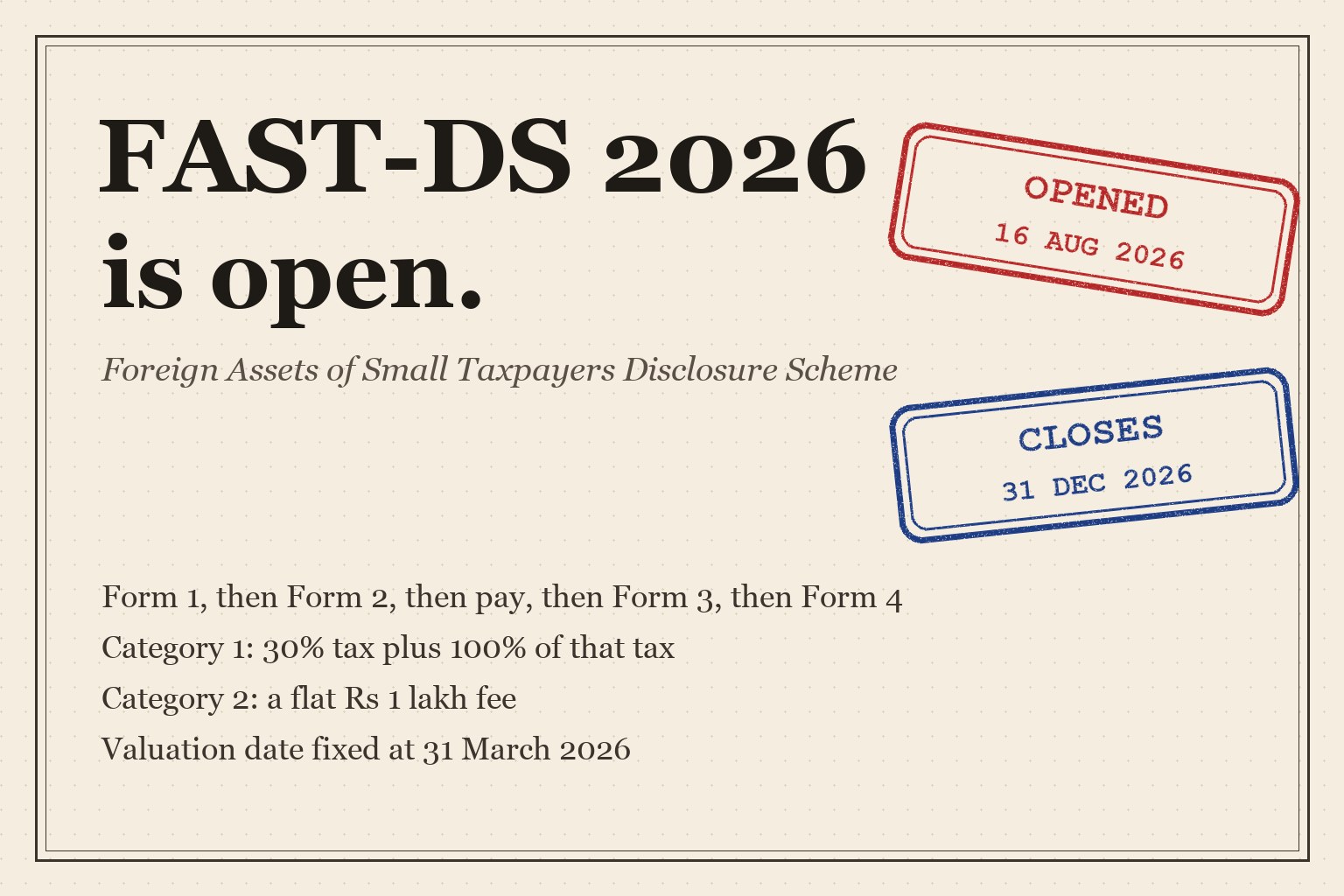

TL;DR. The scheme we wrote about in April as "enacted but not commenced" is now running. The Rules were notified on 14 August 2026, the window opened on 16 August, and the last date for a declaration in Form 1 is 31 December 2026. Two things decide whether you can use it at all: which of the two rows of the section 133 Table you fall in, and what your foreign asset is worth under the Rules as on 31 March 2026. The second is where people go wrong, because a bank account is valued on everything ever deposited into it, not on the balance.
1. Status as on 3 September 2026
| Item | Position |
|---|---|
| Statute | Chapter IV of the Finance Act, 2026, sections 130 to 144: the Foreign Assets of Small Taxpayers Disclosure Scheme, 2026 |
| Commencement | 16 August 2026 |
| Rules | Foreign Assets of Small Taxpayers - Disclosure Scheme Rules, 2026, Notification No. 114/2026, G.S.R. 732(E) dated 14 August 2026 |
| Last date for Form 1 | 31 December 2026 |
| Valuation date | 31 March 2026, fixed by the Rules for every asset regardless of when it was acquired |
| Guidance | CBDT FAQs on the Scheme, linked from the incometaxindia.gov.in home page |
| Forms | Form 1 (declaration), Form 2 (order stating the amount), Form 3 (intimation of payment), Form 4 (order certifying payment) |
If you are reading this after 31 December 2026, check whether the last date was extended before you rely on anything below. The last date is whatever the Central Government notifies (section 131(1)(g)), so an extension would come as a notification, not as an amendment to the Act.
2. What changed between April and August
The Finance Act, 2026 enacted the Scheme with a commencement clause that said it would start "on such date as the Central Government may, by notification in the Official Gazette, appoint" (section 130(2)). Nothing could be filed until that notification came. On 14 August 2026 the Government notified both the commencement and the Rules that make the Scheme workable: the valuation method for each kind of asset, the four forms, the manner of payment, and the electronic verification the Act requires before an amount is communicated. The CBDT published a set of FAQs alongside.
Our April piece described the Bill. This one describes the working scheme. Where the two differ, this one is current.
3. Who can declare, and for what
Section 131(1)(a) defines the "assessee" who can use the Scheme in two limbs:
- a person who was resident in India under section 6 of the Income-tax Act, 1961 in the previous year; or
- a person who is now a non-resident or not ordinarily resident but who was resident in India either in the previous year to which the undisclosed foreign income relates, or in the previous year in which the undisclosed foreign asset was acquired.
So a person who left India in 2023 and is a non-resident today can still declare a foreign account that was funded while they were resident in 2019. The CBDT FAQs say the same thing in plainer words. What matters is residential status in the year of the default, not today.
Section 132 then lists the three defaults a declaration can cure, for "any previous year":
- the person failed to furnish a return under section 139 of the 1961 Act;
- the person furnished a return but failed to disclose the asset or income in it, before the Scheme commenced; or
- the asset or income has escaped assessment within the meaning of section 147 of the 1961 Act.
The Scheme is drafted in Income-tax Act, 1961 language even though that Act was replaced on 1 April 2026, because every default it cures happened in a year governed by the 1961 Act. Section 131(2) imports undefined words from the 1961 Act, the Black Money Act and the Income-tax Act, 2025, in that order.
4. The section 133 Table, and the arithmetic behind "60%"
Section 133 is a two-row table. Which row you are in depends on one question: can you explain the source of the money that bought the asset?
Row 1: undisclosed foreign asset, or undisclosed foreign income
An "undisclosed asset located outside India" is defined in section 131(1)(j) as a foreign asset (including a financial interest in any entity) held in your name or of which you are the beneficial owner, where you have no explanation for the source of the investment, or the explanation is, in the Assessing Officer's opinion, unsatisfactory. "Undisclosed foreign income" (section 131(1)(k)) is income from a source outside India that was chargeable in India but was never offered to tax.
The amount payable is the aggregate of three figures:
- tax at 30% of the value of the undisclosed asset as on 31 March 2026;
- tax at 30% of the undisclosed foreign income; and
- an amount equal to 100% of the tax in (i) and (ii).
The condition: the aggregate value of the undisclosed asset and the undisclosed foreign income "does not exceed one crore rupees".
The net effect is 60% of the base, which is the number everyone quotes. But note how the statute gets there. The extra amount is framed as 100% of the tax, not as a second 30% of the value. Our April piece described it as "a further 30%"; the arithmetic is identical, the drafting is not, and Form 2 will show it as tax plus an equal additional amount.
Row 2: an asset you can explain, but never put in Schedule FA
Row 2 covers a foreign asset that was acquired either (a) from income that accrued or arose outside India while you were a non-resident and that you did not declare in the relevant Schedule of the return on becoming resident, or (b) from income that was offered to tax in India, but the asset itself was never declared in the relevant Schedule. The amount payable is a fee of one lakh rupees, on condition that the value of the asset does not exceed five crore rupees.
This is the row for the returning NRI's overseas retirement account, the employee's vested RSUs that were taxed as salary but never appeared in Schedule FA, and the account opened during a work posting abroad and simply forgotten. The tax was paid, or was never due. The default is a reporting one, and the Scheme prices it accordingly.
The ceilings are tested on value under the Rules, not on your bank statement
Both ceilings are tested on the "value of the asset", which section 131(1)(l) defines as fair market value determined in the manner prescribed, and both are aggregate tests. Rule 5(1) requires the Form 1 to be made so that the aggregate value of undisclosed income and undisclosed assets declared under row 1 does not exceed Rs 1 crore, and the aggregate value of assets declared under row 2 does not exceed Rs 5 crore. Three row 2 assets of Rs 2 crore each cannot be declared, and declaring two of them to fit under the line is not an option the Rules offer. That takes us to valuation, the part of this Scheme that decides eligibility before anything else does.
5. Valuation: 31 March 2026, and the bank-account rule
The Rules fix a single valuation date, 31 March 2026, for every asset still held on that date, whether it was bought in 2012 or in February 2026. The general rule for an asset is the higher of its cost of acquisition and the price it would ordinarily fetch if sold in the open market on the valuation date. A valuation report from a Government-recognised valuer in the country where the asset is located can support the market figure; where no market valuation is carried out, the indexed cost of acquisition is treated as the fair market value. The Rules carry separate methods for bullion and jewellery, quoted and unquoted shares and securities, immovable property, artistic work, an interest in a partnership firm, and a residual head for anything else.
An asset other than a bank account that was sold before 31 March 2026 is not valued at market on that date at all. Rule 3(2) values it at the higher of its cost of acquisition and the sale price; where it was transferred for no consideration or inadequate consideration, at the higher of cost and its fair market value on the date of transfer. A foreign flat sold in 2022 is therefore still declarable, on the price it fetched.
The rule that surprises people is the one for a bank account. Its value is not the balance on 31 March 2026. Under Rule 3(1)(e) it is the sum of all deposits made into the account from the date it was opened up to the valuation date, and a deposit made out of the proceeds of a withdrawal from the same account is left out. The one exception is an account that was already declared under Chapter VI of the Black Money Act in 2015 and taxed on that basis: for that account only deposits since the earlier declaration count. This is the same logic the Black Money Act valuation rules have used since 2015, and it is deliberate: money that passed through the account and was spent is still money that was never explained.
Rule 3(3) then allows reinvestment tracing: where withdrawals from one account, or the sale proceeds of one asset, were used to acquire another foreign asset, the value of the first is reduced by the amount reinvested, so the same money is not counted twice. Foreign currency values are converted at the RBI reference rate on 31 March 2026, with other currencies converted through the US dollar. For assets other than bank accounts, a variance of up to 20% between the declared value and the value later determined does not by itself invalidate the declaration.
A worked example
Rohan opened an account abroad in 2017 during a two-year posting, funded it from salary that was taxable in India in a year he was resident but never reported, and left it dormant after 2020. The balance on 31 March 2026 is Rs 22 lakh at the RBI reference rate. His bank statements since 2017 show total credits of Rs 95 lakh, of which Rs 8 lakh are re-deposits of amounts he had withdrawn and put back.
| Step | Rs |
|---|---|
| Aggregate deposits since opening | 95,00,000 |
| Less: re-deposits of earlier withdrawals | (8,00,000) |
| Value of the account under the Rules | 87,00,000 |
| Row 1 test: does 87 lakh exceed 1 crore? | No, eligible |
| Tax at 30% | 26,10,000 |
| Additional amount, 100% of the tax | 26,10,000 |
| Amount payable | 52,20,000 |
Rohan's instinct was that he owed 60% of Rs 22 lakh, or Rs 13.2 lakh. He owes Rs 52.2 lakh, against an account with Rs 22 lakh in it. Had total deposits been Rs 1.05 crore net of re-deposits, he would have been outside row 1 altogether and the Scheme would not have been available for that account at all. Run the deposit arithmetic before anything else.
Change one fact: if Rohan had been a non-resident throughout the years the account was funded, and only failed to report it in Schedule FA after returning, he is in row 2. The value of the account is the same Rs 87 lakh, the ceiling is Rs 5 crore, and the amount payable is Rs 1 lakh.
6. The four-form clock
Section 135 sets a sequence with dates counted from the end of a month, and the Rules give each step a form.
| Step | Form | Who | Time limit |
|---|---|---|---|
| Declaration, filed electronically with valuation reports and evidence of how the asset was acquired or the income earned. Several assets can go in one form. | Form 1 | Declarant | On or before 31 December 2026 |
| Electronic verification that the declarant is eligible and the declaration follows the Scheme (section 134(2)), then an order stating the amount payable | Form 2 | Prescribed authority | Within one month from the end of the month in which Form 1 was filed |
| Payment | Challan | Declarant | Within two months from the end of the month in which Form 2 was received |
| Late payment | Declarant | A further period not exceeding two months, with simple interest at 1% for every month or part of a month | |
| Intimation of payment with proof | Form 3 | Declarant | Within the extended period |
| Order certifying payment, conclusive as to what it states (section 135(6)) | Form 4 | Prescribed authority | Within one month from the end of the month in which Form 3 was received |
Put dates on it. A Form 1 filed on 20 December 2026 should draw a Form 2 by 31 January 2027. If the order is received in January, payment is due by 31 March 2027, and the extended period with interest runs to 31 May 2027. A Form 1 filed on 30 November 2026 pulls every date forward by a month. The FAQs say plainly that the benefit of the Scheme ceases for a declaration that is not paid within the four months; section 135 counts those months from the end of the month in which the Form 2 order is received, and that is the date to diarise.
Two sections make that outcome expensive. Section 136 excludes the declared income or investment from your total income under the 1961 Act and the Black Money Act only if payment is made within the extended period. Section 138 says nothing paid under section 135 is refundable. Pay late and you are outside the Scheme with your money still inside it.
The Rules allow payment in instalments within the period, and the FAQs confirm multiple assets or types of income can be declared in a single Form 1. Filing on the last day is legal and unwise: section 134(2) requires electronic verification that you are an eligible assessee and that the declaration matches the Scheme, and the evidence of acquisition has to be attached, not promised.
7. What a valid declaration gives you, and what it does not
Given. Section 139: immunity from any further tax or penalty, and from prosecution, under the Black Money Act, in respect of the income or asset declared, for the previous year ending 31 March 2026 or any earlier previous year. Section 136: the declared income or investment is not included in total income for any assessment year under the 1961 Act or the Black Money Act. Section 141: where an assessment under either Act is pending on the same income or asset, the Assessing Officer must take the declaration into account when finalising it.
Not given.
- Anything under the Prevention of Money-laundering Act. Section 140(a) removes from the Scheme any income or asset that represents, directly or indirectly, proceeds of crime in respect of which PMLA proceedings have been initiated or are pending. The immunity in section 139 is expressly under the Black Money Act and nothing else.
- A second bite at a closed year. Section 140(b) excludes any income or asset relating to an assessment year for which Black Money Act assessment proceedings have already been completed.
- Rectification or relief. Section 137: in respect of the declared income or asset, and the amount paid on it, you cannot seek rectification or revision of any assessment under the 1961 Act or the Black Money Act, and you cannot claim any set-off or relief in any appeal, reference or other proceeding on such an assessment.
- Immunity for what you did not declare. The protection is "in respect of income or asset so declared". A second account left out of Form 1 is exactly where it was before.
- Protection if a material particular is false. Section 134(3) deems the declaration invalid if any material particular is found false "at any stage", or if any condition of the Scheme is violated. The 20% valuation variance for non-bank assets is the only cushion the Rules give.
- A FEMA answer. The Scheme says nothing about the Foreign Exchange Management Act. Whether the asset was acquired in compliance with it is a separate question with a separate regulator.
One related provision worth separating from the Scheme: the Finance Act, 2026 also amended the Black Money Act so that prosecution does not lie where the aggregate value of undisclosed foreign assets other than immovable property is within Rs 20 lakh. That is a change to the parent Act, not part of FAST-DS, and it does not remove the tax and penalty exposure the Scheme is designed to settle.
8. Six decisions to make before Form 1
- Which row. If you can evidence that the asset came from income taxed in India, or from foreign income earned while you were a non-resident, you are in row 2 at Rs 1 lakh. If you cannot, you are in row 1 at 60%. The difference on the Rohan example is Rs 51.2 lakh, so the evidence is worth assembling properly.
- Aggregate before you conclude you qualify. Row 1 tests the aggregate of all undisclosed assets and income; row 2 tests the aggregate of all the assets declared under it (Rule 5(1)). Value every item under the Rules first. One account with cumulative deposits above the ceiling takes the whole row 1 declaration off the table.
- Trace the reinvestments. Money that moved from a savings account into a brokerage account is counted once, but only if you can show the movement. Get the statements for every year since each account was opened.
- Check section 140 first. A completed Black Money Act assessment on that year, or a PMLA proceeding on that money, closes the door before you open it.
- Fix the calendar backwards from your cash. The 60% figure is due in full within two months from the end of the month of the Form 2 order, and 1% a month buys at most two more. File Form 1 when you know how you will pay, not when you know you should.
- Keep reporting the asset going forward. The Scheme settles the past. If you are resident in India, other than not ordinarily resident, in tax year 2026-27, a foreign asset you still hold on 31 March 2027 belongs in the foreign-asset schedule of that year's return under the Income-tax Act, 2025. A non-resident or not-ordinarily-resident declarant does not pick up that obligation by declaring.
Sources
- Finance Act, 2026, Chapter IV, sections 130 to 144, read section by section on incometaxindia.gov.in on 3 September 2026.
- Foreign Assets of Small Taxpayers - Disclosure Scheme Rules, 2026, Notification No. 114/2026, G.S.R. 732(E) dated 14 August 2026, in force from 16 August 2026.
- CBDT FAQs on the Foreign Assets of Small Taxpayers Disclosure Scheme, 2026, linked from the department's home page.
- Black Money (Undisclosed Foreign Income and Assets) and Imposition of Tax Act, 2015, and the valuation rules under it, for the bank-account method the Scheme Rules follow.
This article states the Scheme as notified on 14 August 2026 and read on 3 September 2026. The valuation rules are summarised, not reproduced; the amount payable on any real set of facts turns on the exact method the Rules prescribe for that asset class and on evidence of source that only you can assemble. It is not advice on your facts. Given that the amounts under row 1 are large and non-refundable, and that a false material particular invalidates the whole declaration, have the valuation and the row classification checked by a practising professional before Form 1 is filed.




Comments (0)
No comments yet. Be the first to comment!