

Updated 17 September 2026. This page was first published on the morning of 15 September, when no MDR had been fixed. On the evening of 15 September the Ministry of Finance and NPCI announced the framework. Section 4 now sets out what was decided; the rest of the page — the notification, the statute behind it, and who pays what — is unchanged.
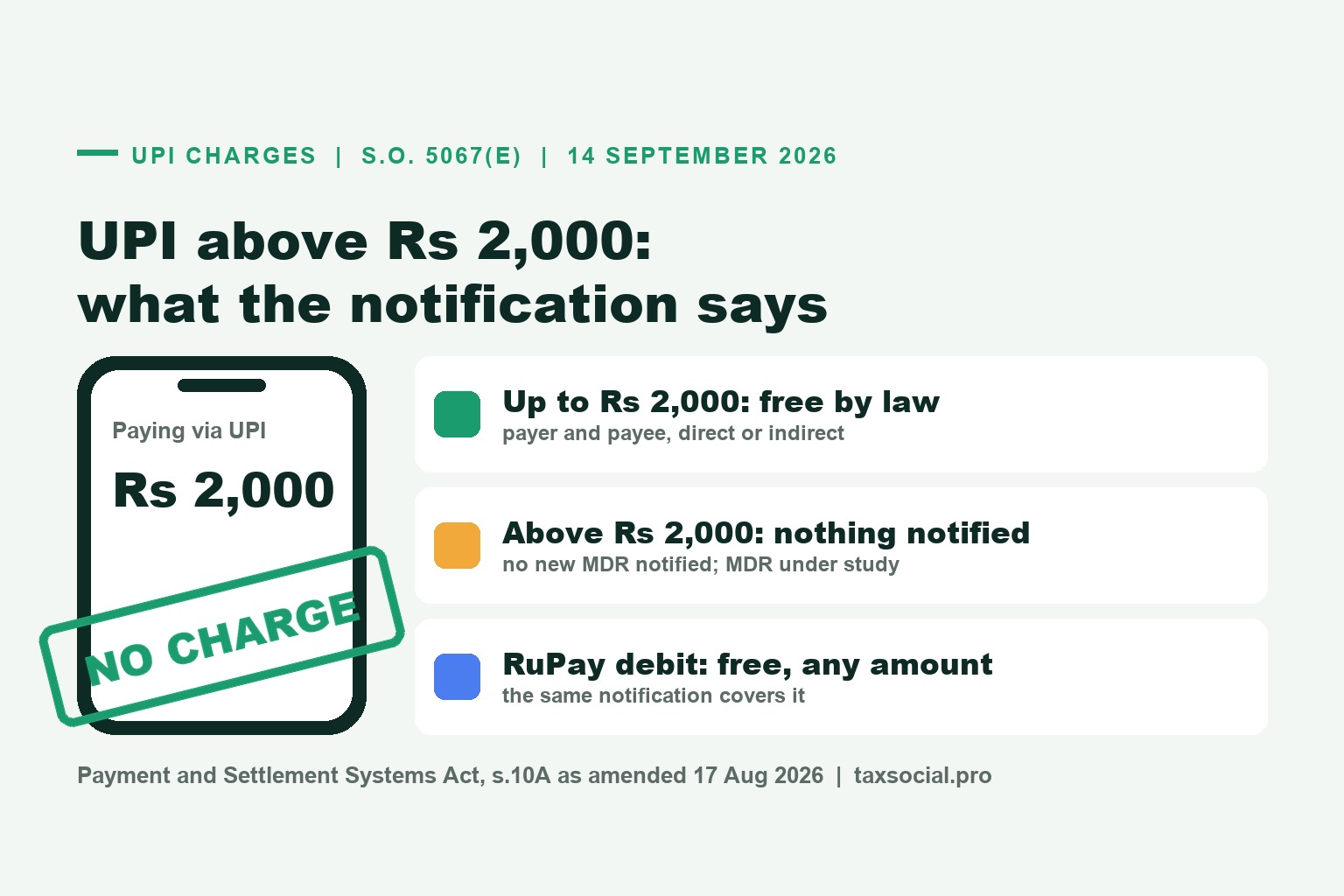
A customer still pays nothing for a UPI payment of any amount. From 15 October 2026 the merchant pays 0.4% on payments above Rs 2,000. On 14 September 2026 the Department of Financial Services notified, under Section 10A of the Payment and Settlement Systems Act, 2007, two electronic modes on which no bank or system provider may impose any charge, directly or indirectly, on the person paying or the person receiving: debit cards powered by RuPay, and UPI transactions up to Rs 2,000. That is the whole of Notification S.O. 5067(E), and it is a floor, not a charge. The next evening the government and NPCI filled in what sits above that floor: a merchant discount rate of 0.4% on person-to-merchant payments above Rs 2,000, capped at Rs 300 from Rs 75,000 upwards, flat Rs 5 in several essential sectors, nil for small merchants receiving up to Rs 1 lakh a month, and nil on every person-to-person transfer at any amount. It is payable by the merchant to its bank, and merchants are not permitted to pass it on. What changed in the law underneath is that Section 10A was amended in August so the zero-charge protection now covers whatever the Central Government notifies, rather than everything prescribed under a section of the repealed Income-tax Act, 1961. The rumour was about the gap that amendment created. The notification is about the floor it kept. What the fee costs a merchant, and how it is taxed, is set out separately.
1. What the notification says
Notification S.O. 5067(E), Ministry of Finance, Department of Financial Services, dated 14 September 2026, is issued under Section 10A of the Payment and Settlement Systems Act, 2007. It does two things. First, it specifies the electronic modes of payment for the purposes of that section: a debit card powered by RuPay, and Unified Payments Interface transactions up to Rs 2,000. Second, it restates the consequence the section attaches to them: no bank or system provider shall impose, whether directly or indirectly, any charge upon a person making or receiving a payment by using those modes.
Read it for what it covers and for what it does not. It covers the payer and the payee, so a merchant receiving Rs 1,800 by UPI cannot be charged for it any more than the customer can. It covers indirect charges, so a bank or system provider cannot relabel its charge as a convenience or processing fee. It binds banks and system providers; whether a merchant’s own separately imposed fee is barred depends on the RBI’s instructions for the instrument and on the merchant’s acquiring terms, not on this notification alone. It covers RuPay debit cards with no amount limit. And it stops at Rs 2,000 for UPI. Above that figure the notification is silent, and silence in a notification is not a charge.
2. Why a notification was needed at all
Since 1 November 2019, Section 10A has said that no bank or system provider may impose any charge, directly or indirectly, on a person making or receiving a payment “by using the electronic modes of payment prescribed under section 269SU of the Income-tax Act, 1961”. Section 269SU obliged businesses with turnover above Rs 50 crore to offer prescribed electronic modes, and Rule 119AA, from 1 January 2020, prescribed three: a RuPay debit card, BHIM-UPI, and a BHIM-UPI QR code. That chain is the legal basis of what everyone calls “zero MDR”. Merchant discount rate, or MDR, is the fee an acquiring bank charges a merchant for accepting a digital payment; for RuPay debit and UPI it has been nil since January 2020 because Section 10A forbade it.
The reference went stale on 1 April 2026. The Income-tax Act, 2025 replaced the 1961 Act, and Section 269SU became Section 187 of the new Act with Rule 133 of the Income-tax Rules, 2026 in place of Rule 119AA. Section 10A still named the old section. Whether that left a gap is arguable: the 2025 Act saves earlier rules and notifications where they are consistent with its own provisions, and the General Clauses Act ordinarily reads a reference to a repealed-and-re-enacted provision as a reference to the new one. Parliament did not leave it to argument. The Taxation and Other Laws (Amendment) Act, 2026, passed by the Lok Sabha on 6 August, returned by the Rajya Sabha on 10 August and assented to on 17 August 2026 as Act 21 of 2026, rewrote the cross-reference in its second section. For the words “the electronic modes of payment prescribed under section 269SU of the Income-tax Act, 1961” it substituted “one or more electronic modes of payment as the Central Government may, by notification, specify”, with effect from the date the Act was published in the Gazette. The Statement of Objects gives the reason in one line: to remove the reference to a provision of the Income-tax Act.
So from 17 August 2026 the section reads: no bank or system provider shall impose, whether directly or indirectly, any charge upon a person making or receiving a payment by using one or more electronic modes of payment as the Central Government may, by notification, specify. From 17 August until 14 September the amended section needed a fresh notification to identify any protected mode. The 14 September notification is that specification. It is not the start of charging; it is the restatement, in narrower words, of the zero-charge rule that had been hanging on a repealed section.
3. The words that matter: “one or more” and “up to Rs 2,000”
The old section protected every mode Rule 119AA prescribed, at any amount. The new section protects whatever is notified, and the notification protects UPI only up to Rs 2,000. That is the difference the rumour was built on, and it is a real difference. Before August, a charge on a Rs 5,000 UPI payment was unlawful. Today it is not forbidden by Section 10A — and from 15 October 2026 a charge does sit there, on the merchant's side of the transaction.
The Finance Minister said as much when the Bill went through the Rajya Sabha on 10 August 2026: the provision does not impose any tax or transaction charge on UPI users; it is an enabling provision; no MDR framework had at that point been finalised; and any framework, when it came, would apply only to merchant transactions above a threshold, at nominal rates. The framework announced five weeks later is on those terms. The government’s own note on the UPI incentive scheme says the same thing from the other side: the point of zero MDR was to bring small merchants onto digital rails, and the incentive scheme reimburses banks for the cost of small-ticket transactions because merchants are not charged for them.
4. The 0.4 per cent MDR: what was decided on 15 September
When this page first went up on the morning of 15 September, the 0.4 per cent figure was reporting rather than rule. That evening it stopped being so. A Ministry of Finance release and a 42-question FAQ from NPCI, both dated 15 September 2026, set out the framework. It takes effect on 15 October 2026.
| Transaction | MDR payable by the merchant |
|---|---|
| Any person-to-person transfer, any amount | Nil |
| Merchant payment up to Rs 2,000 | Nil |
| Merchant payment above Rs 2,000 | 0.4 per cent of the whole amount |
| Merchant payment of Rs 75,000 or more | Rs 300, capped |
| Railways, telecom, insurance, fuel, agricultural inputs, utilities — above Rs 2,000 | Flat Rs 5 |
| Mutual funds, securities, stockbrokers and dealers — above Rs 2,000 | 0.02 per cent, capped at Rs 300 |
| Small merchants receiving up to Rs 1 lakh a month (the P2PM category) | Nil |
| UPI Mandates and AutoPay — SIPs, subscriptions, standing instructions | No prescribed MDR |
Three things about it follow the structure of the law as this page described it, and one is worth spelling out. The charge falls on the merchant, not on the customer: MDR is by definition the acquirer’s charge to the merchant, the government has said in terms that it is neither a tax nor a charge collected by the Government or NPCI, and NPCI’s FAQ says merchants who have been onboarded cannot pass it on. It does not touch UPI payments of Rs 2,000 or less, or RuPay debit cards, because the 14 September notification still protects those. And it attracts GST at 18 per cent as a financial service, so 0.4 per cent billed exclusive of GST is an outlay of 0.472 per cent of the transaction; a GST-registered merchant making taxable supplies may be able to take input tax credit on the GST part, subject to the usual conditions.
The government’s own framing of the size of it: roughly 96 per cent of merchant transactions are unaffected, because they are either below Rs 2,000 or received by small merchants in the zero-MDR tier, and person-to-person transfers — about 70 per cent of total UPI transaction value — sit outside the framework altogether. Note also where the rates come from. They are not in a gazette notification. Section 10A cannot fix a rate; it can only forbid a charge. The rates were settled by the UPI and Services Steering Committee headed by NPCI and published by NPCI, which is also how any revision will arrive.
A separate article works through what this costs a merchant — the cap arithmetic, the input tax credit position, the TDS question, what it does to turnover and to presumptive income, and the monthly limit that moves a small merchant out of the zero-MDR tier.
5. Where charges already exist, and who pays them
Two corners of UPI have carried merchant-side charges for years, and they are the source of most “UPI is charged” screenshots.
Wallets on UPI. Since 1 April 2023, under an NPCI circular of 24 March 2023, a merchant payment above Rs 2,000 made from a prepaid instrument (a wallet loaded with money, as opposed to a bank account) attracts an interchange of up to 1.1 per cent, depending on the merchant category. At or below Rs 2,000 there is none. The interchange is paid on the merchant side; NPCI said at the time, and it remains the case, that the customer pays nothing.
RuPay credit cards on UPI. NPCI’s operating circular of 4 October 2022, which linked RuPay credit cards to UPI, set nil MDR, meaning no interchange and no app-provider or PSP charge, for transactions up to and including Rs 2,000 in its Small Offline Merchant category. Above that, the circular applied the existing RuPay interchange, again on the merchant side; current merchant pricing is whatever the NPCI and bank schedules now say. A customer paying with a RuPay credit card through a UPI app pays the card issuer’s terms, not a UPI fee.
The 14 September notification protects “UPI transactions upto Rs. 2,000” without distinguishing how the payment is funded, so up to that figure it reaches wallet-funded and credit-card-funded UPI too. Above Rs 2,000 it is silent, and it does not itself alter the wallet and RuPay-credit-card pricing rules that already apply there. Both are worth knowing about, because the “Rs 2,000” figure in them is the same figure the government has now written into law for ordinary UPI, and it is not a coincidence: it is the line the payments system has used for “small ticket” since 2022.
6. The obligation on the other side: Section 187
The zero-charge rule has always had a twin. Section 269SU of the 1961 Act, now Section 187 of the Income-tax Act, 2025, obliges every person carrying on business or profession whose sales, turnover or gross receipts exceeded Rs 50 crore in the preceding tax year to provide the facility to accept payment through the prescribed electronic modes, in addition to any other electronic modes offered. Rule 133 of the 2026 Rules prescribes four: a RuPay debit card; BHIM-UPI; a BHIM-UPI QR code; and, new this year, full-KYC central bank digital currency wallets. Under the 1961 Act the penalty for not offering the prescribed modes was Rs 5,000 for every day the failure continued, under Section 271DB; Section 452 of the 2025 Act carries the same daily penalty.
That obligation is why large retailers, hospitals, schools and utilities must show a UPI QR code at the till. It is separate from Section 10A: the Income-tax Act says you must accept these modes; the Payment and Settlement Systems Act says nobody may charge for them. The August amendment cut the second statute’s reliance on the first, and the two lists already differ: Rule 133 includes CBDC wallets and puts no amount limit on UPI, while the Section 10A notification names only RuPay debit and UPI up to Rs 2,000. A business above Rs 50 crore must accept all four Rule 133 modes; for RuPay debit and for UPI up to Rs 2,000, no bank or system provider may charge it for doing so.
7. Myth against notification
| What is circulating | What the position is as at 17 September 2026 |
|---|---|
| “UPI will start costing customers money” | It will not. The charge announced on 15 September falls on the merchant. Customers pay the posted price, with no transaction fee, platform fee or monthly cap on free usage. |
| “The government has imposed a tax on UPI” | MDR is neither a tax nor a charge collected by the Government or NPCI. It is a fee within the payments industry, shared among banks, payment service providers and app providers. |
| “Sending money to a friend above Rs 2,000 will cost money” | No. Person-to-person transfers are free at any amount, including self-transfers between your own accounts. |
| “RuPay debit cards will now be charged above Rs 2,000” | The Rs 2,000 limit applies to UPI only. RuPay debit cards are protected by the notification at any amount. |
| “The 0.4 per cent applies only to the part above Rs 2,000” | It applies to the whole amount. NPCI’s worked example puts the fee on a Rs 3,000 payment at Rs 12, not at Rs 4. |
| “Small shops will now be charged” | Not while they stay in the P2PM tier, which means UPI receipts up to Rs 1 lakh a month. Receipts above that for three consecutive months move a merchant into the charged category. |
| “Merchants can add a UPI surcharge to the bill” | No. NPCI’s FAQ says onboarded merchants cannot pass MDR to customers, and banks have been advised to ensure they do not. For RuPay debit cards the RBI’s MDR directions say the same. A merchant may set its prices; it may not add a UPI line to the invoice. |
8. What to watch
The second of the three documents this section originally watched for has now arrived, in the form of an NPCI publication rather than a circular in the gazette. Two remain open. A further notification under Section 10A could add or remove a protected mode or move the Rs 2,000 line, in either direction. And no RBI direction has been written that binds merchants directly on UPI surcharging: the prohibition reaches the merchant through the acquiring contract and NPCI’s rules, where for debit cards the RBI’s own MDR directions do the work. Beyond that, three things are live. The All India Petroleum Dealers Association is seeking a full exemption for fuel, and oil ministry officials met the association on 17 September. The concessional treatment announced for educational institutions has no published figure attached to it. And the small-merchant fund — an amount equivalent to 5 per cent of MDR collections — is to be worked out with the Reserve Bank within three months, which is after the framework starts. Meanwhile an ordinary UPI payment still costs the payer nothing at any amount, a UPI payment of Rs 2,000 or less costs the merchant nothing, the wallet and RuPay-credit-card regimes above Rs 2,000 continue as they were, and the Union Budget 2026-27 provides Rs 2,000 crore for the RuPay debit and low-value BHIM-UPI incentive scheme that reimburses banks for small-ticket transactions.
FAQ
Will I be charged for a UPI payment above Rs 2,000? Not as a customer, ever — not on a person-to-person transfer and not on a payment to a shop. From 15 October 2026 the merchant pays 0.4 per cent on merchant payments above Rs 2,000, capped at Rs 300, and is not permitted to pass it on to you.
What does the notification cover? Debit cards powered by RuPay at any amount, and UPI transactions up to Rs 2,000. No bank or system provider may charge the payer or the payee, directly or indirectly.
Why was it issued now? Because the August 2026 amendment to Section 10A replaced the old reference to Section 269SU of the repealed 1961 Act with “modes the Central Government may notify”. Without a notification the section protected nothing.
What is MDR? The fee an acquiring bank charges a merchant for accepting a digital payment. It is a merchant cost, not a deduction from the customer.
Is the 0.4 per cent figure real? Yes, since the evening of 15 September 2026. It applies to merchant payments above Rs 2,000 from 15 October 2026, on the whole amount, capped at Rs 300 from Rs 75,000 upwards, with flat Rs 5 in several essential sectors and 0.02 per cent for capital markets. It is a merchant cost.
Do wallets and credit cards on UPI pay charges? On the merchant side, yes, above Rs 2,000: up to 1.1 per cent interchange for wallet payments since April 2023, and RuPay interchange for credit-card payments outside the small-merchant exemption since 2022. The customer does not pay.
Which businesses must accept UPI? Every business or profession with turnover or receipts above Rs 50 crore in the preceding tax year, under Section 187 of the Income-tax Act, 2025 and Rule 133: RuPay debit card, BHIM-UPI, BHIM-UPI QR and full-KYC CBDC wallets, on pain of a Rs 5,000-a-day penalty under Section 452.
Can a shop add a UPI fee to my bill? No. NPCI’s FAQ says onboarded merchants cannot pass MDR charges to customers and that the framework ensures consumers pay only the posted price; banks have been advised to enforce it, and for RuPay debit cards the RBI’s MDR directions already do. A merchant is free to set its prices; it is not free to add a UPI charge to the invoice.
Sources
- Payment and Settlement Systems Act, 2007, s.10A, as inserted with effect from 1 November 2019 and as amended by the Taxation and Other Laws (Amendment) Act, 2026 (Act 21 of 2026, assented 17 August 2026), s.2; the Bill’s Statement of Objects and Reasons, para (a), and Annexure.
- Ministry of Finance, Department of Financial Services, Notification S.O. 5067(E) dated 14 September 2026, F. No. 01/05/2025-DP-DFS, Gazette of India Extraordinary Part II Section 3(ii) No. 4877.
- Rajya Sabha proceedings of 10 August 2026 on the Taxation and Other Laws (Amendment) Bill, 2026 (Finance Minister’s reply), as reported.
- Income-tax Act, 1961, ss.269SU and 271DB; Income-tax Rules, 1962, Rule 119AA (Notification 105/2019); Income-tax Act, 2025, ss.187, 452 and 536; Income-tax Rules, 2026, Rule 133 (as notified 20 March 2026).
- PIB release of 19 March 2025 on the incentive scheme for promotion of low-value BHIM-UPI transactions (P2M), FY 2024-25; Union Budget 2026-27 allocation as reported on 1 February 2026.
- NPCI circular of 24 March 2023 on interchange for PPI-on-UPI merchant transactions; NPCI operating circular NPCI/2022-23/RuPay/019 dated 4 October 2022 on RuPay credit cards linked to UPI.
- Reserve Bank of India, direction on merchant discount rate for debit card transactions (December 2017) and the Payment Aggregator framework (March 2020).
- Press Information Bureau, Ministry of Finance, Release ID 2310586, 15 September 2026, “UPI Continues to Remain Free for Peer to Peer Transactions and 96% of Merchant Transactions”.
- National Payments Corporation of India, “Merchant Discount Rate (MDR) on Select UPI (P2M) Transactions — Frequently Asked Questions”, 15 September 2026.
- Reports of 14-17 September 2026 on the framework and the representations against it (Inc42, Business Today, Business Standard, The Federal).



Comments (0)
No comments yet. Be the first to comment!