
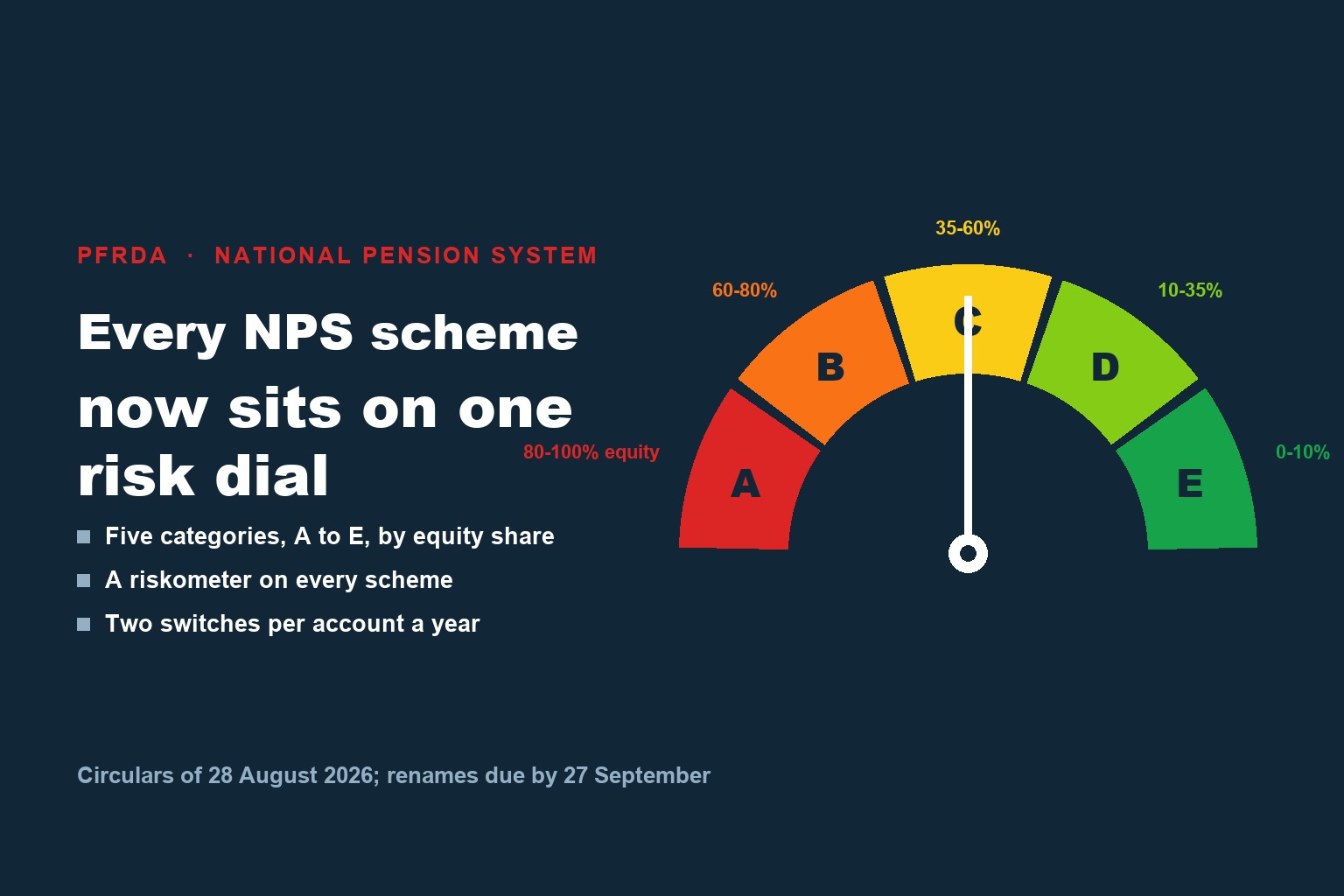

TL;DR: On 28 August 2026 the Pension Fund Regulatory and Development Authority issued two circulars that change how every National Pension System scheme is named, grouped and shown to you. Circular PFRDA/2026/47/REG-PF/10 sorts all NPS investment options into five types, grades the schemes launched by pension funds into five risk categories, A to E, by how much equity they are allowed to hold, puts a riskometer on every scheme, fixes a naming format and a single selection journey across all platforms, and limits you to two scheme or fund changes per account a year. Circular PFRDA/2026/48/REG-PF/11 gives pension funds 30 days to rename their existing MSF schemes, and to bring any whose equity mandate spans more than one category into a single category, and 45 days to merge, subsume or restructure the schemes in any category where a fund has more than two. Nothing is required of you. But the scheme you hold may carry a new name by the end of September, the category letter on it tells you something about its risk that the old name did not, and the change-versus-merge distinction decides whether your original account conditions continue or the target scheme’s conditions apply. This article goes through the circulars clause by clause and ends with what to check.
1. Where this comes from
Until October 2025 a non-government NPS subscriber chose between three things: a lifecycle fund whose equity share fell with age, an “active choice” split across the equity, corporate-bond and government-securities schemes of one pension fund, and nothing else. The circular of 16 September 2025 opened a Multiple Scheme Framework from 1 October 2025, under which pension funds could design their own schemes for particular groups and a subscriber could hold several of them under one PRAN. Those became known as MSF schemes, and everything that existed before was labelled a “Common Scheme”.
Eleven months on, the Authority has decided the result needed a common grammar. The August circular says its purpose is to “facilitate informed investment decisions by subscribers, promote comparability of schemes offered by different Pension Funds and prescribe uniform requirements relating to scheme naming, subscriber journeys, disclosures and implementation”. The second circular says, in terms, that from 28 August 2026 “the distinction between Common Schemes and Multiple Scheme Framework (MSF) Schemes shall stand discontinued”. The September 2025 circular, the January 2022 circular on changing pension fund and the October 2025 circular that renamed the lifecycle funds are all superseded. The framework circular is issued under section 14 of the PFRDA Act, 2013, and its provisions do not apply to accounts tagged to the Government sector; the second circular operationalises it for pension funds, the CRAs and the NPS Trust.
2. The five types of scheme
Paragraph 1.1 of circular 47 puts every NPS option into one of five types, and requires every subscriber-facing platform to use the same grouping.
| Type | What it is | Equity ceiling |
|---|---|---|
| Lifecycle-based schemes | The four existing lifecycle variants. The split between equity (E), corporate bonds (C) and government securities (G) is adjusted automatically by age under the matrix approved by PFRDA. | 50 per cent for Life Cycle Aggressive (35E/55Y), falling to 35 per cent by 55; 75 per cent for Life Cycle 75 High (15E/55Y) until 35, then down to 15 per cent by 55; 50 per cent for Life Cycle 50 Moderate (10E/55Y) until 35, then 10 per cent by 55; 25 per cent for Life Cycle 25 Low (5E/55Y) until 35, then 5 per cent by 55. |
| Active Choice | You set the allocation across E, C and G yourself. | 75 per cent in equity under Tier I, 100 per cent under Tier II; corporate bonds and government securities can each go to 100 per cent. |
| NPS Sanchay | A composite scheme for the informal sector, following the investment pattern that applies to the Government sector under NPS. | Equity 25 per cent, corporate bonds 45 per cent, government securities 65 per cent, short-term debt 10 per cent, asset-backed and miscellaneous 5 per cent, as maximums. |
| MSF schemes | Schemes designed by a pension fund and approved by the Authority. Every scheme launched under the Multiple Scheme Framework so far is now in this box. | Depends on the category the scheme is placed in, A to E, in section 3. |
| 4A schemes | Curated or thematic schemes introduced under Regulation 4A of the Exit Regulations: NPS Vatsalya, NPS Swasthya, NPS MSME. Allocation, charges and terms follow their own guidelines. | As per the respective scheme. |
Two things follow for an existing subscriber. If you are in a lifecycle fund or on active choice, your scheme has not changed; it has been given a type label and, on active choice and lifecycle, the platforms must now show returns, charges, risk information, AUM and benchmark separately for each underlying asset class. If you bought into a pension fund’s own scheme after October 2025, it is now an MSF scheme, and the next section is about you.
3. MSF schemes: the A-to-E grades
Paragraph 2.4 is the heart of the circular. Every MSF scheme must sit in exactly one of five categories, decided by the equity exposure its mandate allows.
| Code | Category | Equity mandate |
|---|---|---|
| A | Aggressive Growth, Very High Risk | 80 to 100 per cent |
| B | High Growth, High Risk | 60 to 80 per cent |
| C | Balanced Growth, Medium Risk | 35 to 60 per cent |
| D | Conservative | 10 to 35 per cent |
| E | Debt (government and corporate bonds) | 0 to 10 per cent |
“Every MSF Scheme shall have an equity exposure mandate corresponding to any one category.” A scheme whose mandate straddled two bands under the 2025 rules, say 50 to 90 per cent, cannot stay that way: circular 48 requires it to be “modified, restructured or reclassified so as to conform to a single prescribed MSF Category” within 30 days. A pension fund may offer up to two schemes in each category under each Tier. Where it has more than two in one category today, it has 45 days to merge, subsume or restructure them, after informing the subscribers and following the winding-up process.
The code goes into the name. Paragraph 3.2 fixes the format as abbreviation of the pension fund’s name + “NPS” + the category code + the scheme name, with “Tier 2” at the end for Tier II schemes. The circular’s own illustrations are “XYZ NPS A Retirement Scheme” and “XYZ NPS E Retirement Scheme Tier 2”. Existing MSF schemes must be renamed to this pattern within 30 days of 28 August, so by 27 September 2026. Pension funds must also “prominently disclose the relative equity exposure hierarchy, with Category A representing the highest and Category E the lowest equity exposure”. The one-letter code is the point: a subscriber comparing two schemes across two pension funds no longer has to read two mandates to know which carries more equity.
Note what the grade measures. It is the mandate, the ceiling and floor the scheme is allowed to run at, not the allocation on any given day. A Category B scheme may hold 61 per cent equity or 79 per cent; both are within mandate. The riskometer, next, is meant to capture the rest.
4. The riskometer and the comparison table
Circular 48 says, in paragraph 4(f), “Every Scheme shall display a Risk-o-meter in the format specified by the Authority.” The 2025 framework already asked pension funds to show one; the difference now is that the format is to be prescribed centrally so that the dial on one fund’s scheme means the same as the dial on another’s. The circular does not itself set that format out. Until the standard format is issued and adopted, a riskometer on a platform is the fund’s own presentation, and a comparison across funds is safer made on the category letter and the mandate than on the dial.
The comparison table is prescribed already. Paragraph 4.1 fixes the order in which every platform, including the CRA portals and other onboarding channels, must walk you through a choice: first the type of scheme, then the category of MSF scheme, the lifecycle fund, or the asset allocation on active choice, and only then the pension fund. Before you pick a fund, the platform must lay out every scheme of that category from every pension fund side by side with, at minimum:
- scheme name and pension fund name;
- date of launch;
- historical returns, and the benchmark with comparative benchmark returns;
- applicable charges;
- the riskometer;
- assets under management as on the last day of the previous month.
Each MSF scheme must also have an NPS Scheme Essentials Document in the format at Annexure A of circular 48: objective, target segment, asset-allocation pattern, risk level, benchmark, vesting period, charges and fees, risk management, taxation, winding-up provisions and subscriber communication. That one page is where an MSF scheme’s own terms live, and it is the document to read before the marketing page.
One carve-out to know about: paragraph 4.2 lets a platform owned by a Point of Presence show, for onboarding, only the schemes of the pension funds associated with that PoP. A bank’s or distributor’s app is therefore not obliged to show you the whole market. The CRA portals are.
5. What you can hold, and how often you can change
Paragraph 5 sets the operating rules, and they are worth reading precisely because they are where a subscriber can trip.
- One lifecycle or active-choice scheme at a time. Under one PRAN you may hold only one of the two, not both (para 5.2).
- Several MSF schemes at once. You may hold investments in more than one MSF scheme simultaneously (para 5.3), and a PRAN can carry multiple accounts, each with one scheme.
- Two requests a year. A subscriber may submit at most two requests per account per financial year to change the pension fund, the investment scheme, or both. A single request that changes both counts as one (para 5.4).
- Changing scheme does not reset the clock. Moving from one scheme to another among the MSF, lifecycle, active and Sanchay types “shall not affect the vesting period or any other applicable conditions governing the Account, which shall continue to be reckoned from the original date of opening of the Account” (para 5.5).
- Merging changes the terms. Paragraph 6 lets a subscriber with more than one scheme merge one into another, the target. From then on the merged money is governed by the target scheme’s vesting, charges, partial-withdrawal and other conditions.
- Corporate accounts are narrower. Where the account is held through an employer, a change of scheme is allowed only to the extent the circular of 7 November 2025 on corporate accounts permits (para 5.6).
The circular’s own illustration of change versus merge is the one to remember. A subscriber opens Scheme A on 1 April 2026 with a 15-year vesting period and changes to Scheme B on 1 April 2029: vesting still runs from 1 April 2026 and the original account’s conditions, including its limit of four partial withdrawals, continue. If instead the Scheme A investment is merged into Scheme B on 1 April 2029, the merged money is thereafter governed by Scheme B’s conditions, “including its vesting period, withdrawal provisions and other applicable limits”. The word on the form matters.
6. Charges
Annexure A of circular 47 sets out what a subscriber pays under every type of scheme other than the 4A schemes.
| Charge | Rate |
|---|---|
| Point of Presence plus investment management fee, if you came through a PoP | 0.24 to 0.32 per cent a year of assets under management, depending on the pension fund |
| The same, for a direct subscriber | 0.04 to 0.12 per cent a year of AUM |
| Central Recordkeeping Agency | Rs 100 to Rs 500 |
| NPS Trust fee | 0.003 per cent a year of AUM |
| Custodian | 0.00000000177 per cent a year of assets under custody |
GST and other taxes come on top. The annexure points to the separate PoP-charges circular of the same date and the investment-management-fee circular of 6 March 2026 for the detail; those, not this table, are the operative documents if a charge on your statement looks wrong. What the annexure makes visible is the gap between the PoP route and the direct route: on the published ranges, somewhere between 0.12 and 0.28 percentage points a year, every year, on the whole corpus.
7. If a scheme you hold is wound up
The 45-day merge requirement means some MSF schemes will close this autumn. Circular 48, paragraph 4(j), fixes what happens: subscribers of a scheme being wound up must be given the choice of any other scheme, and “those subscribers who do not exercise their choice, would be migrated to the Life Cycle 50 – Moderate (10E/55Y) Scheme of the same Pension Fund under Tier I”. That default is a lifecycle fund with a 50 per cent equity ceiling that tapers to 10 per cent by 55. If you were in a Category A scheme because you wanted 90 per cent equity, silence puts you somewhere quite different. Answer the letter.
8. What to do this month
- Nothing is compulsory. Neither circular asks a subscriber to submit anything.
- Expect a rename. If you hold a pension fund’s own scheme, its name should change to the “XYZ NPS <code> <name>” pattern by 27 September. The letter in the new name is its equity grade; check it is the grade you meant to buy.
- If you hold an MSF scheme, read its Scheme Essentials Document once it is posted. Vesting, partial-withdrawal limits and charges are on that page.
- Budget your two changes. A pension-fund switch and a scheme switch in the same request is one; two separate requests are two, and that is the year’s allowance for that account.
- Do not merge when you mean to change. A change keeps your original account’s conditions, vesting date included; a merge puts the merged money under the target scheme’s.
- If you get a winding-up notice, reply. The default is Life Cycle 50 Moderate under Tier I of the same fund.
- Government-sector accounts are outside all of this. Corporate-model accounts are inside it but with the narrower switching rules of the November 2025 circular.
Whether the NPS is the right home for your retirement money against PPF and equity funds is a separate question; our comparison of the three under the new regime takes that up. And if you are past 60 and the question is income rather than accumulation, the Senior Citizens’ Savings Scheme guide is the companion piece. Neither August circular prescribes a tax treatment or changes any tax rule; the MSF Scheme Essentials Document has a taxation row, and that is where an MSF scheme’s own tax note will sit.
FAQ
Do I have to do anything? No. The circulars bind pension funds, CRAs and platforms. A subscriber only needs to act if a scheme they hold is wound up, and then only to choose where the money goes.
My scheme’s name has changed. Has the scheme changed? Not necessarily. A rename to the new format is required by 27 September. A change of mandate is required only if the old mandate straddled two categories; the fund must tell you if so.
What does the letter mean? The equity mandate: A is 80 to 100 per cent, B 60 to 80, C 35 to 60, D 10 to 35, E 0 to 10.
Can I hold an active-choice account and an MSF scheme together? Yes. The one-at-a-time rule is between lifecycle and active choice; MSF schemes can be held alongside either, and several at once.
How many times can I switch? Two requests per account per financial year, covering pension fund, scheme, or both.
Does switching restart my 15-year vesting? A change does not. After a merge, the merged investment is governed by the target scheme’s vesting, withdrawal and other conditions.
Is the riskometer live? The requirement is; the format is the one the Authority specifies, and the circular does not itself set it out.
I am a government employee. Accounts tagged to the Government sector are outside both circulars.
Sources
- PFRDA circular PFRDA/2026/47/REG-PF/10 dated 28 August 2026, “Standardised framework for classification and presentation of Schemes under the NPS”, with Annexure A (charges) and Annexure B (circulars superseded).
- PFRDA circular PFRDA/2026/48/REG-PF/11 dated 28 August 2026, “Operationalising the framework for classification and presentation of Schemes under the NPS”, with Annexure A (NPS Scheme Essentials Document).
- PFRDA circular PFRDA/2025/09/REG-PF/01 dated 16 September 2025, “Introduction of Multiple Scheme Framework (MSF) for Non-Government Sector Subscribers under NPS” (superseded), for the background.
- PFRDA Act, 2013, section 14.
Written as at 8 September 2026 from the two circulars as published on pfrda.org.in. The 30-day and 45-day deadlines are counted from 28 August 2026. Scheme-level terms are in each scheme’s Essentials Document; check that document and your CRA statement before acting on anything here.

Comments (0)
No comments yet. Be the first to comment!