
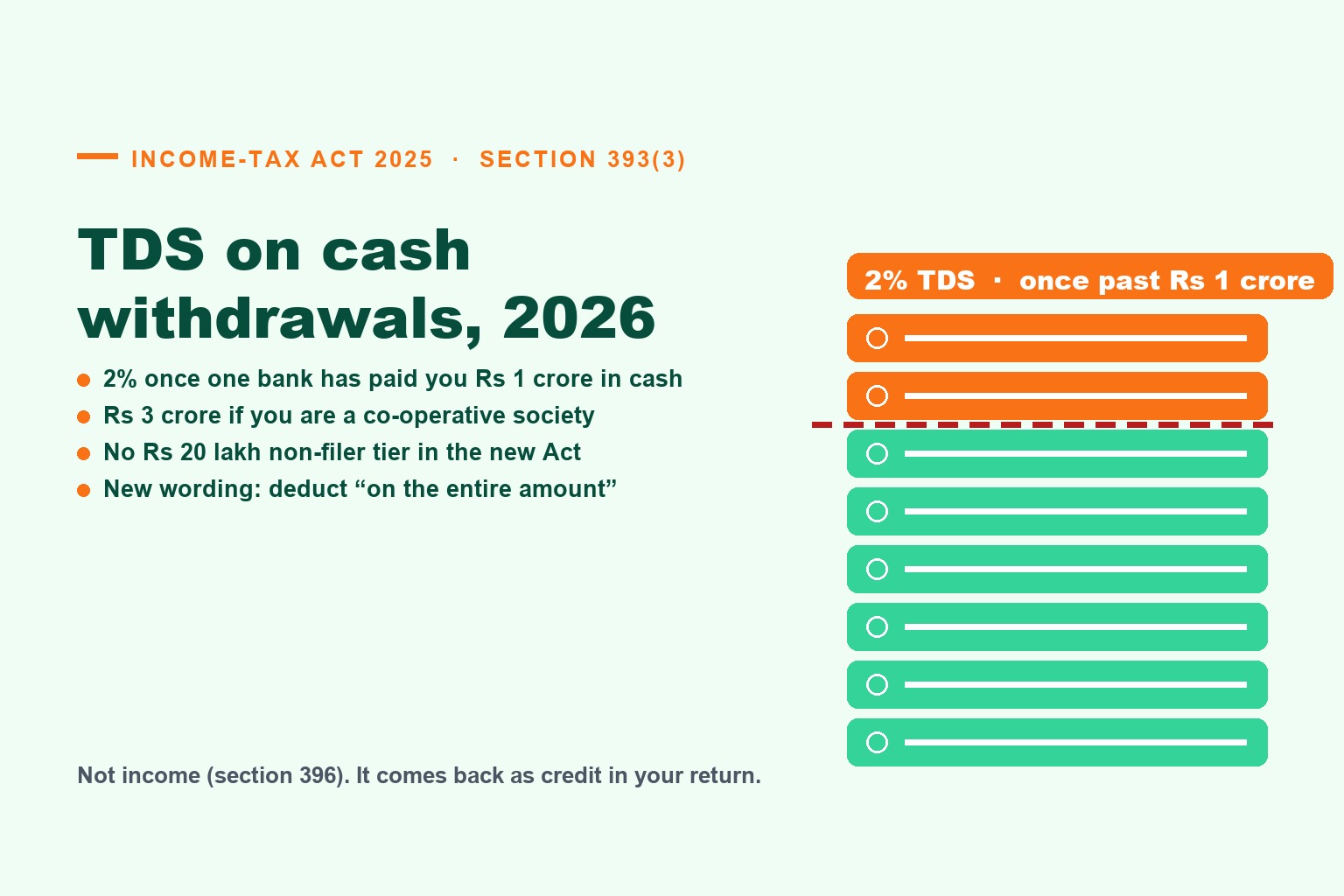

TL;DR: Since 1 April 2026, tax deducted at source on cash withdrawals is governed by section 393(3) of the Income-tax Act, 2025 (Table, serial number 5), not section 194N of the 1961 Act. The bank, co-operative bank or post office deducts 2% once the cash it has paid you from all your accounts with it crosses Rs 1 crore in the tax year, or Rs 3 crore if you are a co-operative society. Two things changed on 1 April that a lot of bank FAQs, and the most-read articles on the subject, have not caught up with. First, the non-filer tier is not in the new Act: the old rule that a person who had not filed returns for three years was taxed from Rs 20 lakh, at 5% above Rs 1 crore, has no counterpart in section 393. Second, the new section says the deduction is "on the entire amount" once the threshold is crossed, where section 194N charged 2% of the sum in excess of Rs 1 crore. Whether banks are applying that literally is the question to ask before you plan a large withdrawal. The tax is not a cost: it comes back as credit in your return, and the Act itself says it is not income.
1. Where the rule now lives
The 2025 Act folds the non-salary TDS provisions into one section, 393, with tables (salary is section 392). Cash withdrawals sit in sub-section (3), the table headed "For payments to any person". The row reads:
"5. Any sum, paid in cash, from one or more accounts maintained by any person (herein referred as recipient). [Payer:] Any person, being, (a) a banking company; (b) a co-operative society engaged in carrying on the business of banking; or (c) a post office. Rate: 2%. Threshold limit: (a) three crore rupees in case of recipient being, a co-operative society; or (b) one crore rupees in case of recipient being person other than a co-operative society."
And the opening words of sub-section (3), which tell the bank how to apply that row:
"(3) Where any income or sum of the nature specified in column B of the Table below, is credited or paid by the person specified in column C during the tax year, to any person, the person responsible for making payment of such income or sum, shall deduct income-tax, (a) on the entire amount of such income or sum, where the amount or aggregate of amounts exceed the threshold limit specified in column D ...; (b) at the rate specified in column D; (c) at the time of payment thereof in cash or by way of a cheque or a draft or by any other mode, or as specified therein; and (d) subject to the provisions of sub-sections (4), (5), (6), (8) and (9)."
Three practical points follow from the text alone. The threshold is counted per bank, not per PAN: the row speaks of "one or more accounts maintained by any person" with the payer named in column C. Two banks each paying you Rs 90 lakh in cash deduct nothing. The threshold is an aggregate for the tax year, across savings, current and any other accounts you hold with that bank, and ATM withdrawals count because they are cash paid from your account. And the deduction happens at the time of payment, so the bank cannot reach back into money it paid you in April when your aggregate crosses the line in October; what it does with the October withdrawal is the question in section 4.
2. What did not change
The rate (2%), the Rs 1 crore threshold, the Rs 3 crore threshold for co-operative societies (added to section 194N by the Finance Act, 2023 and carried into the new row), and the list of payers are the same. So are the exempt recipients. Sub-section (4) of section 393, Table serial number 18, says no tax is deducted on cash paid to:
- the Government;
- any banking company or co-operative society engaged in banking, or a post office;
- a business correspondent of a bank or co-operative bank, working under the Reserve Bank of India's guidelines;
- a white label ATM operator of a bank or co-operative bank, working under an RBI authorisation.
That is the list from the third proviso to section 194N. What the new row does not carry is the old fourth proviso, under which the Central Government could notify further exempt recipients "in consultation with the Reserve Bank of India". Three such notifications exist: cash replenishment agencies and franchise agents of white label ATM operators (Notification 68/2019), commission agents and traders operating under an Agricultural Produce Market Committee (Notification 70/2019), and RBI-licensed authorised dealers, full-fledged money changers and their franchise agents (Notification 80/2019). They survive the change of Act: section 536(2)(j) of the 2025 Act keeps notifications issued under the 1961 Act in force so far as they are not inconsistent with the corresponding new provisions, and the Board's transition FAQs say the same. So a cash replenishment agency, an APMC commission agent or a money changer that meets the conditions of its notification is still exempt; what changed is only that the bank now has to trace the exemption through the transition clause rather than a proviso. If you are in one of those trades, get the bank's written confirmation before the season's first large withdrawal.
3. What changed, part one: the non-filer tier is not in the new Act
From 1 July 2020, section 194N carried a first proviso for people who had not filed returns. In the words of the 1961 Act:
"Provided that in case of a recipient who has not filed the returns of income for all of the three assessment years relevant to the three previous years, for which the time limit of file return of income under sub-section (1) of section 139 has expired, immediately preceding the previous year in which the payment of the sum is made to him, the provision of this section shall apply with the modification that (i) the sum shall be the amount or the aggregate of amounts, as the case may be, in cash exceeding twenty lakh rupees during the previous year; and (ii) the deduction shall be (a) an amount equal to two per cent of the sum where the amount or aggregate of amounts, as the case may be, being paid in cash exceeds twenty lakh rupees during the previous year but does not exceed one crore rupees; or (b) an amount equal to five per cent of the sum where the amount or aggregate of amounts, as the case may be, being paid in cash exceeds one crore rupees during the previous year."
Banks built a portal check around this: before paying out cash they queried the department's "ITR filing compliance check" utility, and the 2%/5% and Rs 20 lakh figures appeared on every bank's TDS page. Section 393(3) of the 2025 Act has one row for cash withdrawals, with one rate and two thresholds, and no proviso about returns. We searched the section for any note attached to serial number 5: there is none (the three notes under that table concern lottery winnings, online games and lottery commission). The Finance Act, 2026 amended section 393 in four places, none of them this row. The separate "higher rate for non-filers" provision of the 1961 Act, section 206AB, never applied to cash withdrawals and was in any case omitted from 1 April 2025.
So for tax year 2026-27, a person who has never filed a return and withdraws Rs 50 lakh in cash from one bank faces no TDS under this row. That is a real change, and it is the one most of the high-traffic explainers get wrong: the page CAClubIndia has served four lakh times still lists the Rs 20 lakh / 5% tier as the 2026 rule. The one non-filer-adjacent rule that survives is the PAN rule: section 397(2) says that if you do not furnish a valid PAN to the deductor, tax is deducted at the higher of the section's rate, the rate in force, or 20%. A bank that has no PAN on file for the account can therefore deduct 20% of a withdrawal above the threshold instead of 2%.
Two cautions. Not filing when you are required to has its own consequences, and large cash movements leave their own footprint: the bank's annual statement of financial transactions reports cash withdrawals of Rs 50 lakh or more in a year from current accounts, and cash deposits above the set limits, whether or not any tax was deducted. The absence of TDS is not the absence of a record. And if the department believes the new row has dropped something Parliament intended to keep, the fix is a notification or an amendment; we have seen neither as of 14 September 2026, and this section will be updated the day one appears.
4. What changed, part two: "entire amount", or the excess?
Section 194N as it stood on 31 March 2026 told the bank to "deduct an amount equal to two per cent of such sum", where "such sum" was the cash "exceeding one crore rupees during the previous year". Banks read that as the excess: withdraw Rs 1.2 crore in a year and the deduction was 2% of Rs 20 lakh, or Rs 40,000. Section 393(3)(a) says the deduction is "on the entire amount of such income or sum, where the amount or aggregate of amounts exceed the threshold limit". Read literally, once your aggregate crosses Rs 1 crore, 2% applies to the whole Rs 1.2 crore: Rs 2,40,000.
There are two reasons to take the literal reading seriously. The 2025 Act uses the "entire amount" formula deliberately: sub-section (1), which covers payments to residents, opens with the same words, and it is the ordinary TDS rule (cross a threshold on rent or professional fees and tax applies to the whole, not the excess). And where Parliament wanted the excess, it said so in a note: for TDS on purchase of goods, Note 1(b) to serial number 8(ii) of the resident table reads "The tax shall be deducted on the sum exceeding fifty lakh rupees". There is no such note under serial number 5 of the any-person table.
There are also two reasons the practical outcome may be narrower than the arithmetic above. The deduction is made "at the time of payment"; a bank cannot deduct from cash it has already handed over. So the earliest it can act is the withdrawal that takes your aggregate past the threshold, and the natural bank-side reading of "entire amount" is that the whole of that withdrawal, and every later one, is taxed at 2%, rather than only the slice above Rs 1 crore. On our Rs 1.2 crore example, if the crossing withdrawal was Rs 30 lakh (taking you from Rs 90 lakh to Rs 1.2 crore), the bank deducts 2% of Rs 30 lakh, Rs 60,000, rather than 2% of the Rs 20 lakh excess. The second reason is that practitioner trackers are split: some describe the 2026 position as "entire amount", others as "only on the amount exceeding", and at least one says the department's own statement formats still capture the excess. We have not found a Board circular settling it. Until one appears, the safe planning assumption is the wider one, and the thing to check is the certificate your bank issues for the quarter: it shows the amount on which tax was deducted.
If you are close to the line, the arithmetic argues for splitting the crossing withdrawal: take the aggregate to exactly Rs 1 crore, then withdraw the rest separately, so the "entire amount" of the taxed withdrawal is only what you actually needed above the threshold. None of this changes what you ultimately pay, because of section 6 below; it changes how much cash the bank holds back on the day.
5. Why Form 15G or 15H does not stop it
The self-declaration that stops TDS on interest (the old Forms 15G and 15H) is now sub-section (6) of section 393, and it works only for the provisions it lists: accumulated provident-fund balance, insurance commission, rent, units, interest, life-insurance payouts and dividends. Cash withdrawals under sub-section (3) are not on the list, so a declaration that your income is below the taxable limit does not stop the deduction. A senior citizen with no taxable income who withdraws Rs 1.1 crore in cash to buy a flat will have tax deducted and will recover it through a return. That was the position under section 194N too; the new Act simply makes the list explicit.
6. It is not income, and it comes back
TDS on a withdrawal is unusual: the money you took out is your own, not income. The Act says so. Section 396 deems every sum deducted under the chapter to be "income received", "except tax paid under section 392(2)(a) and tax deducted as per section 393(3) (Table: Sl. No. 5)". So the Rs 60,000 the bank held back is not added to your income; it appears in your annual information statement as tax paid on your behalf, and you claim it as credit against your tax for the year, with the balance refunded. Under the 1961 rules, credit for this particular deduction was given in the year of deduction rather than the year the "income" was assessable, because there is no income to match it to; the 2026 Rules carry the same logic, and the entry will sit against tax year 2026-27 in your statement.
Practically: reconcile the bank's certificate for the quarter against your annual information statement before you file; if the bank has deducted on a larger base than you expected, the credit is correspondingly larger, so do not leave it unclaimed. A business with heavy cash payroll (construction, agri-trading, transport) can see lakhs held back over a year; that is working capital gone until the refund, which is the real cost of the provision.
7. A worked year
| Date (tax year 2026-27) | Cash withdrawn from Bank A | Aggregate with Bank A | TDS on the literal reading of section 393(3) | What the excess-only reading would give |
|---|---|---|---|---|
| April to August | Rs 90 lakh, in many withdrawals | Rs 90 lakh | Nil (threshold not crossed) | Nil |
| 12 September | Rs 30 lakh | Rs 1.20 crore | 2% of Rs 30 lakh = Rs 60,000 (the withdrawal that crosses) | 2% of Rs 20 lakh = Rs 40,000 |
| 20 November | Rs 10 lakh | Rs 1.30 crore | 2% of Rs 10 lakh = Rs 20,000 | Rs 20,000 |
| Same year, Bank B | Rs 95 lakh | Rs 95 lakh (separate payer) | Nil | Nil |
Same person, no return filed for three years: under the 1961 Act the September withdrawal alone would have carried 5% on the amount above Rs 1 crore and 2% from Rs 20 lakh upward; under the 2025 Act the figures are the ones in the table. A co-operative society in the same position deducts nothing until Rs 3 crore.
8. Five things to do before a large cash withdrawal this year
- Ask the bank which reading it applies, in writing, and keep the reply. The cost of being wrong is cash-flow, not tax, but for a Rs 30 lakh withdrawal it is the difference between Rs 20,000 and Rs 60,000 held back on the day.
- Make sure the PAN is on the account, and on every account you hold with that bank. Section 397(2) turns 2% into 20% if it is not.
- Count across all your accounts with that bank, including ATM withdrawals and cash paid against a bearer cheque. Count separately for each bank.
- If you are a business correspondent, ATM operator, cash replenishment agency, APMC agent or money changer, get the bank's confirmation of your exempt status (the new row, or the 2019 notification carried forward by section 536(2)(j)) before, not after, the deduction.
- Reconcile the certificate to your annual information statement and claim the credit. It is your money.
Two related pages: the rules on receiving cash have not moved with the withdrawal rule, and the Rs 2 lakh cap on cash receipts (the old section 269ST, now in the 2025 Act) is covered in our note on e-rupee, UPI and the section 269ST grey zone; and how a TDS entry shows up, and how to fix one that is wrong, is in Form 26AS vs AIS vs TIS.
Sources
- Income-tax Act, 2025: section 393(3) and its Table (serial number 5); section 393(4) Table serial number 18 (exempt recipients); section 393(6) Table (declarations for no deduction); Note 1(b) to section 393(1) Table serial number 8(ii); section 396 (tax deducted is income received, with the exception for section 393(3) serial number 5); section 397(2) (PAN not furnished). Read on incometaxindia.gov.in on 14 September 2026.
- Income-tax Act, 1961, section 194N as substituted by the Finance Act, 2020 with effect from 1 July 2020: first proviso (non-filers), third proviso (exempt recipients), fourth proviso (notified recipients); Finance Act, 2023 (Rs 3 crore threshold for co-operative societies).
- Notifications 68/2019 (18 September 2019), 70/2019 (20 September 2019) and 80/2019 (15 October 2019) issued under the then clause (v) of the proviso to section 194N; CBDT Circular 14/2020 (20 July 2020) confirming they continued after the 2020 substitution; section 536(2)(j) of the Income-tax Act, 2025 and the CBDT's FAQs on transition, under which notifications made under the 1961 Act continue so far as not inconsistent with the new Act.
- Income-tax Rules, 2026, the statement of financial transactions table (cash withdrawals of Rs 50 lakh or more from current accounts).
- Finance Act, 2026 (Act 4 of 2026), section 84 (amendments to section 393), read to confirm that serial number 5 of section 393(3) was not touched.
This article states the law as it stood on 14 September 2026 and notes where bank practice is unsettled. Section 4 describes a question of reading on which a Board clarification may follow; the day one does, this page will be updated and dated. It is general information, not advice on your withdrawal; a bank's deduction is corrected through the return, not at the counter.


Comments (0)
No comments yet. Be the first to comment!