
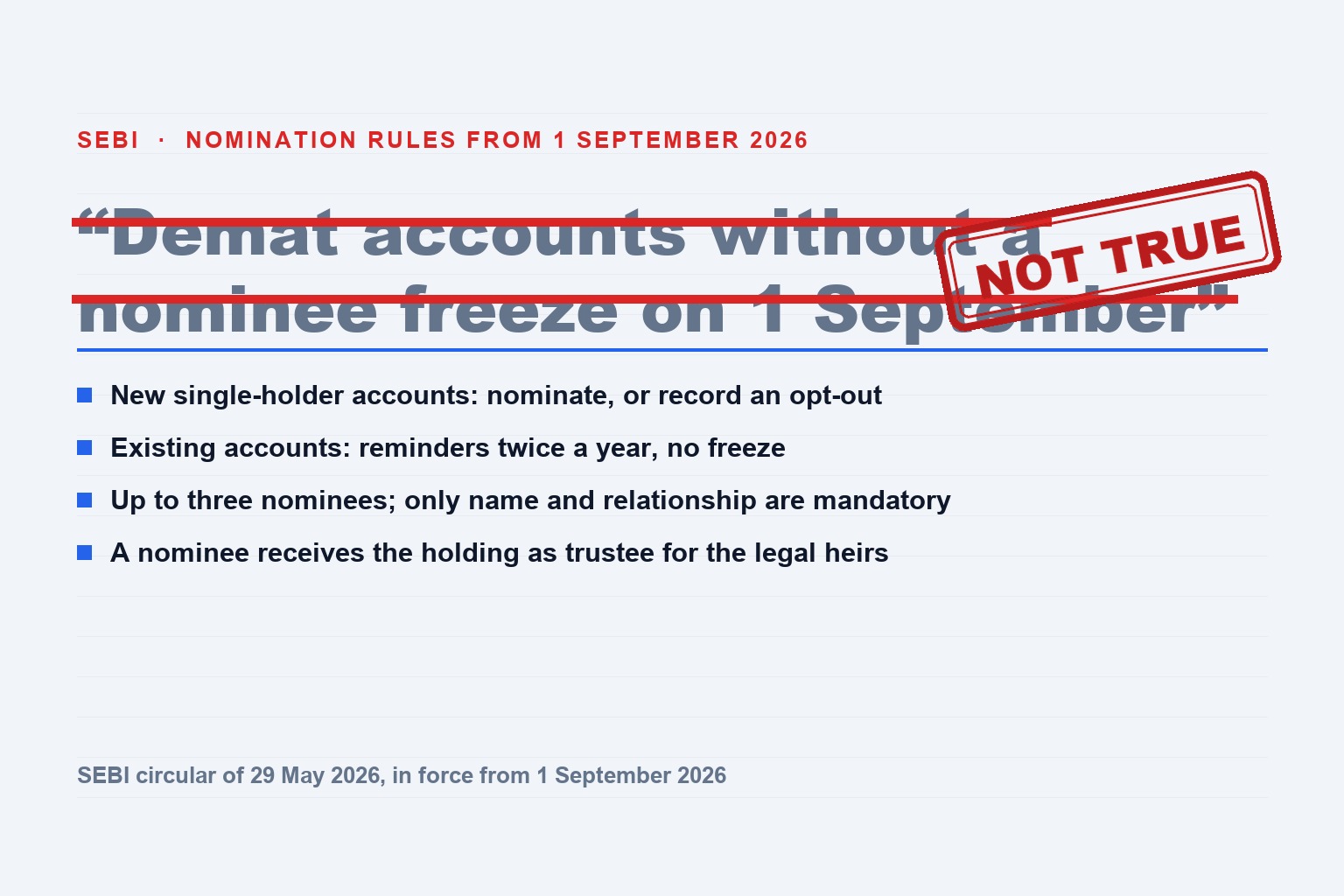

TL;DR: The message doing the rounds says demat accounts without a nominee were frozen on 1 September 2026. They were not, and no SEBI circular says they will be. What did happen on 1 September is that SEBI’s circular of 29 May 2026 came into force. It requires every new single-holder demat account or mutual-fund folio to carry either a nomination or an opt-out declaration, signed on paper or agreed to on screen; leaves nomination optional for joint holdings; caps nominees at three; cuts the mandatory information to the nominee’s name and relationship (plus date of birth if the nominee is a minor); drops the witness for a signed form; and tells depository participants and fund registrars to remind everyone who has not nominated, twice a year by SMS and e-mail and once a day by pop-up. Existing accounts are covered by the reminders and by nothing harsher. The freeze that people remember was set for 30 June 2024 and was withdrawn by SEBI on 10 June 2024, before it ever took effect. The rest of this article goes through the circular clause by clause, explains what a nominee actually receives, and says who should still act this month.
1. Where the freeze story comes from
It is not invented; it is out of date. Through 2022 and 2023 SEBI ran a series of deadlines by which existing investors had to record a “choice of nomination”, either naming someone or opting out, failing which demat accounts and mutual-fund folios were to be frozen for debits. The last of those deadlines was 30 June 2024, set by the circular of 27 December 2023. Then, on 10 June 2024, SEBI issued circular SEBI/HO/MIRSD/POD-1/P/CIR/2024/81, whose first operative line for existing investors reads: “Non-submission of ‘choice of nomination’ shall not result in freezing of Demat Accounts as well as Mutual Fund Folios.” Dividends and redemptions that listed companies had withheld for want of a nomination were to be released. From that day the sanction for an existing investor has been a reminder, not a freeze.
The 29 May 2026 circular supersedes that June 2024 circular along with seventeen others going back to 2002, and it does not reinstate freezing. Its only provision for an account without a nomination is paragraph 10.2, which is about messages and pop-ups. So the rumour attaches a 2023 sanction to a 2026 date on which a different, gentler rule started.
2. What the 29 May 2026 circular actually requires
The circular is SEBI/HO/OIAE/OIAE_IAD-3/P/CIR/2026/12676, addressed to asset management companies and their registrars, the depositories and depository participants. It follows a consultation paper of March 2026 and, in SEBI’s words, was issued after “representations from stakeholders raising certain operational challenges” with the January 2025 rules. Paragraph 13 brings it into effect on 1 September 2026.
| Point | The rule | Where |
|---|---|---|
| New single-holder accounts and folios | For every single account or folio opened on or after 1 September 2026, “the investor shall mandatorily provide nomination, unless declaration form for ‘opt-out’ is submitted”. | 4.1 |
| Joint accounts and folios | Nomination is optional. Providing or changing a nominee needs the consent of all joint holders, whatever the mode of operation. | 4.2, 4.3 |
| How many nominees | Up to three. | 5.1 |
| Mandatory details | Name of the nominee and the nature of the relationship. Date of birth, if the nominee is a minor. | 7(a) |
| Optional details | Mobile number, e-mail, percentage share, a KYC identifier, and the guardian’s details for a minor. The form must let you fill all, some or none of these. | 7(b), 7(c) |
| No percentage given | Equal shares. Any odd lot after the division goes to the first nominee on the form. | 7(b) |
| Online nomination | Validated by a digital signature certificate, an Aadhaar-based or other recognised e-sign, or two-factor authentication where one factor is an OTP sent to the registered mobile number and e-mail. | 6.2 |
| Paper nomination | Wet signature; no witness needed. A thumb impression instead of a signature needs two witnesses, with their names and addresses on the form. | 6.2 |
| Opting out | Sign the declaration at Annexure B, or choose “opt out” online and agree to the same declaration on screen. | 8 |
| Changing your mind | Nominations can be given, changed or cancelled any number of times, with an acknowledgement each time. | 9.1, 9.3 |
| Your statement | It will print either the nominees’ names or a Yes/No on whether a nomination exists, as you choose on the form. | 10.1 |
| Accounts without a nomination, old or new, including opt-outs | An e-mail and SMS nudge twice a year, and a pop-up on the benefits of nomination on the first log-in of the day. Nothing is sent to those who have nominated. | 10.2 |
| Existing accounts | The same clauses apply “mutatis mutandis”: the new forms and process are available to you, and the reminders apply to you if you have no nominee. | 9.2, 11 |
Read paragraph 4.1 carefully, because it is the one the rumour misquotes. The mandate is attached to the opening of a single-holder account or folio on or after 1 September. It is a condition of onboarding, enforced by the depository participant or the fund not opening the account until you have either filled in the nomination or recorded the opt-out, on the Annexure B form or by agreeing to the same declaration on screen. It is not a condition attached to accounts that already exist, and paragraph 10.2 is what applies to those.
3. What changed against the January 2025 rules
The circular this one replaces, dated 10 January 2025, had gone the other way: more nominees and more compulsory information. Three of its features are gone.
- Ten nominees never arrived; the cap is three. The 2025 circular contemplated up to ten nominees, but that clause was placed in the third phase of implementation, deferred to 15 December 2025 and then, on 11 December 2025, deferred “to a further date to be notified separately”. It was never brought into force. The 2026 form has three columns, and three is the rule.
- Identifiers and contact details are no longer compulsory. The 2025 rules, in force for this part from 8 August 2025, required for each nominee one identifier (PAN, driving-licence number or the last four digits of Aadhaar, or a passport number for an NRI, OCI or PIO) and full contact details, residential address included. The 2026 rule reduces the mandatory set to name and relationship, and moves the identifier, mobile and e-mail into the optional block. The form still offers the fields, with a note that the DP or registrar “will be able to reach out to your nominee if you provide the contact details”, which is the practical reason to fill them.
- Witnesses. The 2025 form had already dispensed with a witness for a signed form; the 2026 circular restates that in the body of the rule and keeps two witnesses only where a thumb impression is used.
Two things from the 2025 circular are simply not carried into the 2026 one. The first is the rule that a power-of-attorney holder cannot nominate on the investor’s behalf; the 2026 circular is silent on it. The second, which matters more, is transmission. The 2025 circular had said that a nominee claiming the holdings needed only a self-attested death certificate, their own KYC and, where a pledge existed, the lender’s discharge, and that no affidavit, indemnity or notarisation could be demanded. The 2026 circular is about how a nomination is recorded, not how a claim is paid, and it supersedes the 2025 circular in full. Transmission now has its own rulebook: SEBI’s circular of 23 July 2026 on the simplification and standardisation of the framework for transmission of securities, in force 30 days from issue. Where a nomination exists, it asks the nominee for a transmission request form, the client master list of the nominee’s own demat account, a verifiable death certificate (a QR-coded certificate now counts) and the security certificate or statement of account where applicable. It repeats that the nominee receives the assets as trustee for the legal heirs, and it does not apply at all where there are competing claims, which go to court. If you are the one making a claim, work from your DP’s or fund’s form under that framework.
4. What a nominee actually gets
This is the part of the subject that no form fixes, and the reason to nominate carefully rather than casually. A nominee is the person the depository or the fund is entitled to hand the holdings to on your death, so that it is discharged. A nominee is not, by that fact, the owner. The Supreme Court settled the point for company shares in Shakti Yezdani v. Jayanand Jayant Salgaonkar (2023 INSC 1076, decided 14 December 2023): nomination under the Companies Act does not create a third mode of succession alongside a will and intestate succession, and the nominee holds the securities for the benefit of the legal heirs. SEBI’s January 2025 circular wrote the same rule into the securities-market process, requiring the nominee to receive the assets “as trustee on behalf of legal heir(s)”, and its nomination form opened with a declaration to that effect.
The 2026 circular’s own opt-out declaration describes nomination in exactly those terms. The investor who opts out signs that they understand nomination “helps in faster and smoother transmission of my securities to my legal heir(s)”, that without it the heirs “may require the submission of certain additional legal or court-issued documents which may delay the process”, and that if no claim is made for a prolonged period the holdings “may be treated as unclaimed assets and they may be transferred to” the Investor Education and Protection Fund Authority. That is the honest summary of what nomination does: it decides who can collect, quickly and without a succession certificate. Who keeps is decided by your will, or by the succession law that applies to you if there is none.
Three consequences for the form.
- If the person you want to inherit is also your only heir, or your will leaves the holdings to them, naming them as nominee makes collection simple and there is no conflict.
- If you name someone who is not an heir, a friend, a sibling, a charity’s trustee, they will receive the holdings and hold them for whoever the will or the succession rules say. Naming them does not give them the money; a will would.
- If you name three people with percentages, you are directing how the DP or fund distributes at transmission, not how the estate is finally divided. If the shares you want them to keep differ from what the will says, the will governs and the nominees owe each other adjustments.
The nomination circular says nothing about income tax, and nothing in it changes who is taxed on the holdings after a death. That turns on the estate, the succession position and what is later sold or earned; take tax advice before inherited holdings are sold or a return is filed on them.
5. Who should still act this month
- Opening a new demat account or a first folio with a fund house, in your sole name: you will be asked for a nominee or an opt-out at onboarding, and the account will not open without one. Decide before you start the form. Systematic investment plans that create a new folio at a new fund house from 1 September fall under this.
- Existing single-holder account with no nominee: no sanction. You will get the twice-yearly message and the daily pop-up until you provide a nomination; opting out records your choice but does not stop the reminders, because paragraph 10.2 covers opt-outs too. A nomination can be given online, validated by e-sign or by an OTP sent to your registered mobile and e-mail; an online opt-out means agreeing to the Annexure B declaration on screen. If you have been putting it off because the old form wanted your nominee’s address and PAN, it no longer does.
- Existing account with a nomination: nothing to do, and you should receive no reminders. It is worth checking the statement: the circular lets you choose whether it prints the nominee’s name or just “Yes”.
- Joint holders: nomination stays optional. If you add one, every holder signs. If one holder dies, the holding passes to the survivors under SEBI’s transmission framework; the 2026 circular does not say in terms whether the account, now single-held, must then nominate or opt out, so ask your DP or fund what it will require.
- Heard that ten nominees were allowed? They were contemplated by the 2025 circular, but that provision was deferred and never came into force, so there should be no nomination of more than three persons on file. If a DP or fund did record one, the 2026 circular does not address it; ask in writing whether a fresh three-person form is needed.
- Anyone with a will: read the nomination and the will together. They should name the same people in the same shares, or at least not contradict each other.
This circular covers demat accounts and mutual-fund folios. Bank deposits, PPF and other small-savings accounts, EPF and insurance policies each have their own nomination rules and forms, and none of them changed on 1 September.
FAQ
Was my demat account frozen on 1 September 2026? No. Freezing for want of a nomination was withdrawn by SEBI on 10 June 2024 and the 2026 circular does not bring it back.
What did start on 1 September? Mandatory nomination-or-opt-out for new single-holder demat accounts and folios, the three-nominee cap, the shorter mandatory details, and the twice-yearly reminders for anyone without a nominee.
Do I have to give my nominee’s PAN or Aadhaar? No. Name and relationship are mandatory; date of birth if the nominee is a minor. Identifiers and contact details are optional.
Do I need a witness? Not for a signed paper form. Two witnesses if you use a thumb impression instead of a signature. Online, the OTP or e-sign is the validation.
Can I opt out? Yes, by signing the Annexure B declaration or agreeing to it on screen. You will still receive the reminders.
Can I name my minor child? Yes. Give the date of birth; the guardian’s details are optional.
Does the nominee become the owner? No. The nominee collects the holdings and holds them for the legal heirs; the will or succession law decides ownership.
I have a joint account with my spouse. Must we nominate? No, it is optional. If you do, both of you sign.
Sources
- SEBI circular SEBI/HO/OIAE/OIAE_IAD-3/P/CIR/2026/12676 dated 29 May 2026, “Ease of doing investments – Modified Norms for Nomination in Demat Accounts and Mutual Fund Folios”, paragraphs 4 to 15, Annexure A (nomination form) and Annexure B (opt-out declaration).
- SEBI circular SEBI/HO/OIAE/OIAE_IAD-3/P/ON/2025/01650 dated 10 January 2025, “Revise and Revamp Nomination Facilities in the Indian Securities Market” (superseded), paragraphs 2.4, 3.1, 3.2, 3.3 and 3.7.
- SEBI circulars SEBI/HO/OIAE/OIAE_IAD-3/P/ON/2025/0027 dated 28 February 2025 (phasing), SEBI/HO/OIAE/OIAE_IAD-3/P/CIR/2025/110 dated 30 July 2025 and HO/42/36/12(4)2025-OIAE-IAD3 dated 11 December 2025 (deferments of Phase III) (all superseded).
- SEBI circular HO/38/13/11(14)2026-MIRSD-POD/I/17111/2026 dated 23 July 2026, “Ease of Doing Investment and Ease of Doing Business – Simplification and standardisation of the framework for transmission of securities”, paragraphs 1.3, 2.1(d), 4.1.1 and 4.1.2 of the Annexure.
- SEBI circular SEBI/HO/MIRSD/POD-1/P/CIR/2024/81 dated 10 June 2024, “Ease of Doing Investments – Non-submission of ‘Choice of Nomination’” (superseded), paragraphs 1 and 3.1.
- Shakti Yezdani v. Jayanand Jayant Salgaonkar, 2023 INSC 1076, Supreme Court of India, 14 December 2023.
Written as at 8 September 2026 from the circulars as published on sebi.gov.in. Transmission procedure is set by SEBI’s circular of 23 July 2026 and your DP’s or fund’s forms under it; succession questions turn on your personal law and your will, on which take advice from a lawyer.


Comments (0)
No comments yet. Be the first to comment!