
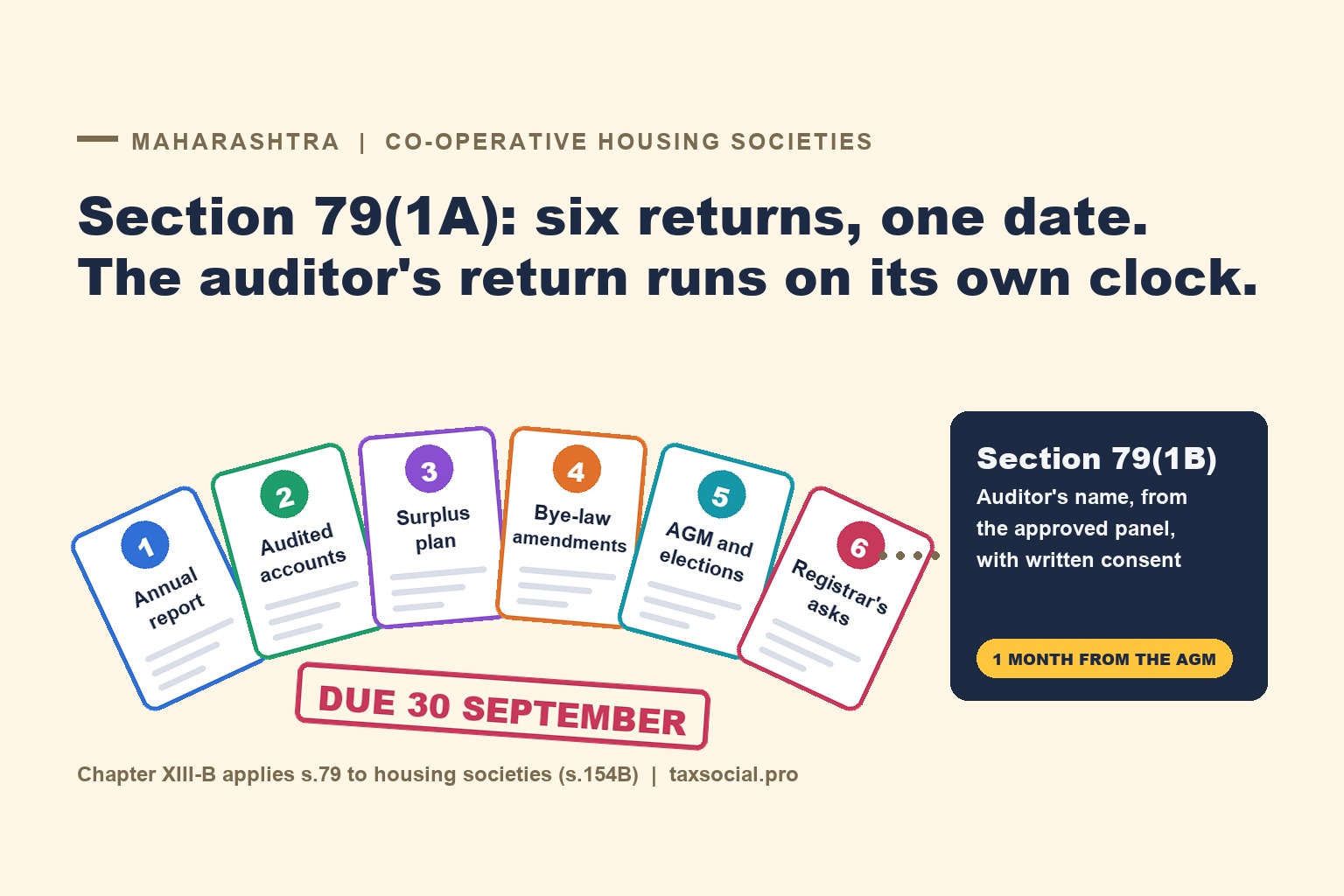

Every co-operative housing society in Maharashtra files six returns with the Registrar within six months of the close of its financial year. For a society whose year ends on 31 March, that is 30 September, the same outer date as the AGM. The six are listed in section 79(1A) of the Maharashtra Co-operative Societies Act, 1960: the annual report, the audited accounts, the surplus plan approved by the general body, bye-law amendments, a declaration on the AGM and elections, and anything else the Registrar asks for. A seventh return, under section 79(1B), gives the name of the auditor appointed at the AGM from the government-approved panel, with the auditor's written consent. It is due within one month of the AGM. These sections still govern housing societies after the 2019 housing chapter, because section 154B(1) applies them expressly. Posters on this topic usually say the consequence is "action under section 79(2)". The real exposure is wider. The Registrar can file the returns himself and recover the cost from the society. The committee members responsible can be made to pay that cost, plus up to Rs 100 a day, into the society's funds. And once a member is held responsible under section 79, section 154B-23 takes away their committee seat and bars them from standing again for five years.
1. The six returns in section 79(1A)
Section 79(1A) was inserted in 2013 by Maharashtra Act 16 of 2013 and has not been amended since. It says every society "shall file returns within six months of the close of every financial year to which such accounts relate, to the Registrar or to the person authorised by him", and lists what the returns must contain:
| Clause | What the Act says | What it means in practice |
|---|---|---|
| (a) | annual report of its activities | The committee's report on the year: repairs, major decisions, member matters, anything material. |
| (b) | its audited statement of accounts | The audited balance sheet and income and expenditure account. For a society “not carrying on business for profit”, which is ordinarily the case for a housing society, Explanation II to section 75(2) requires an audited income and expenditure account in place of a profit and loss account. |
| (c) | plans for disposal of surplus funds as approved by the general body | The general body must have approved the plan before it is filed. In the ordinary course that approval is taken at the AGM, although the Act does not say it has to be the AGM. |
| (d) | list of amendments to the by-laws of the society, if any | Only amendments made during the year. If there were none, say so. |
| (e) | declaration regarding date of holding of its general body meeting and conduct of elections when due | The AGM date, and, if the committee's term ended during the year, whether the election was held. |
| (f) | any other information required by the Registrar in pursuance of any of the provisions of this Act | Whatever the Registrar has called for under the Act. Most years there is nothing extra. |
Most of these overlap with what the committee places before the AGM. Section 75(2) lists the annual report, the surplus plan, bye-law amendments and the election declaration (along with other items such as the audit report, the rectification report and next year's budget), and section 75(4) places the audited accounts for adoption. In practice, the return is largely built from the AGM papers. Section 79 does not, however, make the other five items conditional on the AGM. Only the surplus plan needs general-body approval before it is filed.
2. The deadline: why it is 30 September, and why it lands on the same day as the AGM
The Act does not mention "30 September" anywhere. It says six months from the close of the financial year. For the usual 31 March year end, that makes the FY 2025-26 returns due by 30 September 2026.
Section 75(1) sets two related deadlines for every society:
- the accounts must be audited within four months of the year end, which is 31 July for a March year end; and
- the AGM must be called within six months, which is 30 September.
The section 79(1A) returns are therefore due on the same outer date as the AGM. Most societies take the general body's approval of the surplus plan at the AGM, so a society holding its AGM on the last permitted day is left with that day to file. Do not wait for the AGM to file the items that do not need its approval. And do not treat the AGM as the end of the season, because the return is still due.
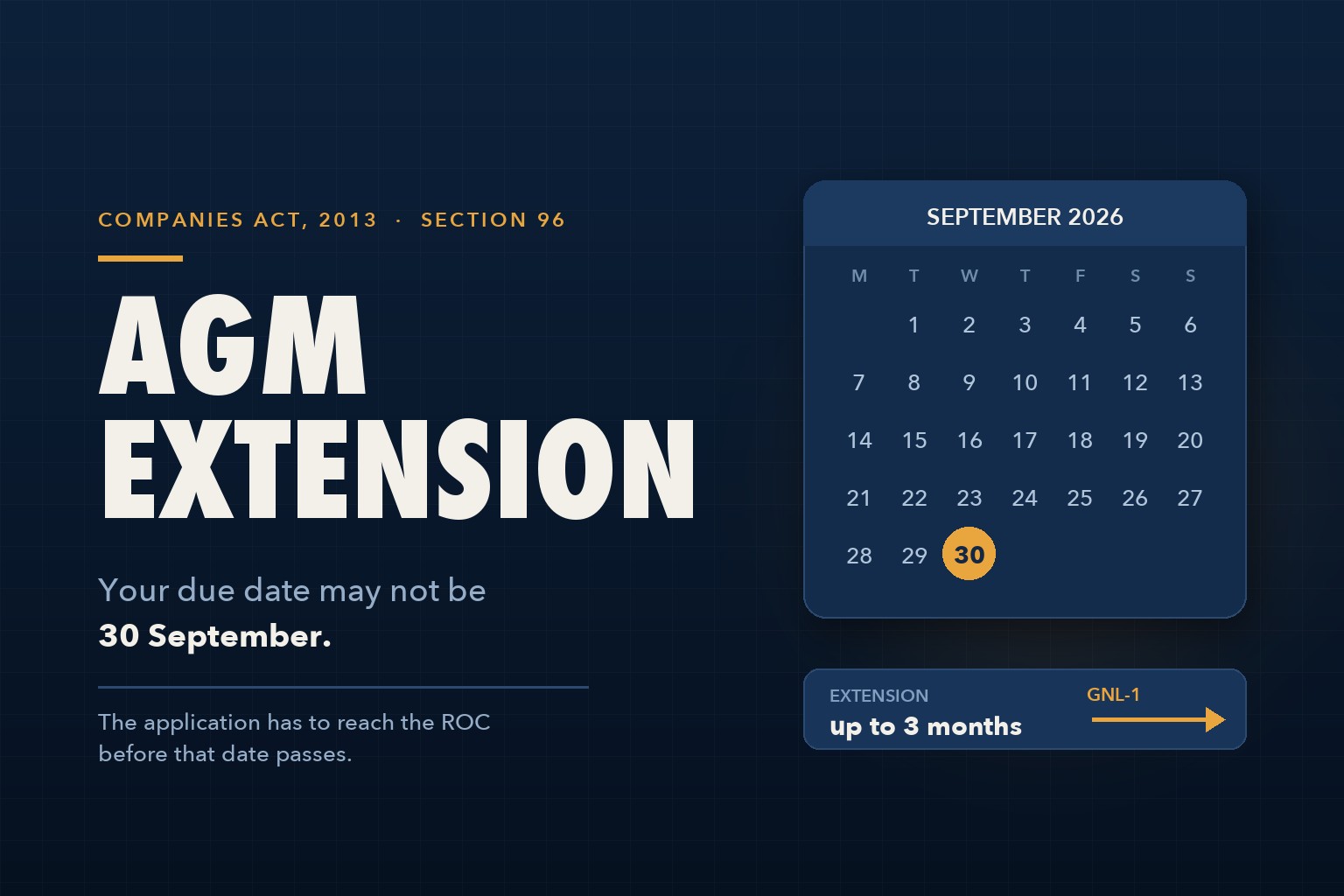
Can the Registrar extend it? Only in a limited case. Since 2022, the first proviso to section 75(1) lets the Registrar extend the audit and AGM period by up to three months, by a general or special order. The power is limited to "exceptional circumstances such as infectious diseases, pandemic, flood, heavy rains, droughts or earthquake". It is not a routine extension that any society can apply for. Unless your Registrar has issued such an order for your area, the six-month limit applies. (The longer 9- and 12-month periods in the second proviso applied only to FY 2019-20 and 2020-21.)
3. The seventh return: the auditor, under section 79(1B)
Section 79(1B) says every society "shall also file a return regarding the name of the auditor or auditing firm from a panel approved by a State Government in this behalf, appointed in the general body meeting together with his written consent, within a period of one month from the date of annual general body meeting."
Section 75(2A) sets out the same duty from the appointment side. It says:
- the AGM appoints the auditor for the current financial year, from the State Government's approved panel;
- the name and the auditor's written consent are filed with the Registrar within thirty days of the AGM; and
- the same auditor cannot be appointed for more than three consecutive years by the same society.
Section 79(1B) says "one month" and section 75(2A) says "thirty days". To comply with both, file within thirty days of the AGM. For an AGM held on 30 September 2026, that is by 30 October 2026.
For housing societies, an "auditor" means a person or firm on the panel approved by the State Government under section 81(1) (section 154B-1(4)). The panel can include chartered accountants, cost accountants, certified auditors and government auditors. Do not skip this return: under the first proviso to section 81(1)(a), if the society has failed to intimate and file the return under section 75(2A) and section 79(1B), the Registrar may, by an order recording his reasons in writing, cause the society's accounts to be audited by an auditor from the approved panel.
4. "We are a housing society, doesn't Chapter XIII-B replace all this?"
No. In 2019 a separate chapter for co-operative housing societies, Chapter XIII-B (sections 154B to 154B-31), was added by Maharashtra Act 23 of 2019. Many committees assume it replaced the general provisions. It did not, for returns.
Section 154B(1) lists the general provisions that "shall apply mutatis mutandis to the housing societies". The list expressly includes section 75, sub-sections (1), (1-1A), (1A), (1B), (2), (3) and (4) of section 79, sections 81 to 89A, and sections 145 to 148A, which include the offences, the punishments and the rules on prosecution. Chapter XIII-B has no returns section of its own. For housing societies, section 79 is still the law on returns, applied through section 154B(1).
The housing rules notified in 2026 (Chapter XI-B of the Maharashtra Co-operative Societies Rules, rules 106C-1 to 106C-14) do not change this either. Rule 106C-13 says the AGM "shall be held every year as per the provisions of section 75 of the Act". They do not prescribe any separate returns form.
5. Where the returns are filed
The Department of Co-operation runs an online society returns module, which is described on its portal, mahasahakar.maharashtra.gov.in. The department says returns were traditionally filed on paper, that the platform is meant to be used by all co-operative societies to furnish their returns, and that it is free to use. The page describes "basically 6 mandatory returns", but its list has seven entries:
- annual activity returns;
- audited statements of accounts: balance sheet;
- audited statements of accounts: profit and loss statement;
- plan for surplus distribution;
- list of amendments to bye-laws;
- date of holding the AGM and election;
- name of the auditor and the consent return.
The department's list splits the accounts into two entries and folds the section 79(1B) return into the same module.
Two things we could not confirm from an official source. The first is a form number for these returns. The Act and the 2026 housing rules prescribe none. The second is a circular making online filing the only permitted mode. If your Registrar's office still accepts a paper filing, keep the stamped acknowledgement. If you file online, keep the portal acknowledgement. Either way, the acknowledgement is your proof of the date you filed.
6. What actually happens if the returns are not filed
Posters on this topic usually say non-compliance "can lead to action by the Registrar under section 79(2), including penalties". That is incomplete. Section 79(2) is not a penalty provision. The consequences are spread over five provisions, and the fourth below is the one committee members are least aware of.
(i) The Registrar files the returns himself, at the society's cost: section 79(2)
If a society does not take an action the Act requires, including filing returns, within the time allowed, the Registrar may take that action himself or through a person he authorises, "at the expense of the society". That expense is recoverable from the society "as if it were an arrear of land revenue".
(ii) The responsible officers repay it, plus up to Rs 100 a day: section 79(3)
Once the Registrar has acted under section 79(2), he may call on the officers he considers responsible for the failure. After giving them a hearing, he may require them:
- to pay the society the expenses it has incurred because of their failure; and
- to pay into the society's assets a sum of up to Rs 100 for each day until his directions are carried out.
Both amounts are payable by the officers personally. Neither goes to the government.
(iii) Fines on conviction: sections 146 and 147
Failing to file is also an offence. The relevant clauses are:
- Section 146(g): a society, officer or member that "wilfully makes a false return or fails to furnish a return under section 75 or 79". Punishable with a fine of up to Rs 5,000 under section 147(g).
- Section 146(i): for a society with a working capital of Rs 50,000 or more, a committee, officer or member that fails "without any reasonable excuse" to send a return or comply with orders made under section 79. Punishable with a fine of up to Rs 5,000.
- Section 146(f): failure to comply with section 75(2), (2A), (3) or (4). This clause covers the auditor-appointment return. Punishable with a fine of up to Rs 5,000.
- Section 146(k): wilfully making a false return. This is more serious: imprisonment up to one year, a fine up to Rs 10,000, or both.
These fines are imposed only on conviction. Under section 148(1), no court below a Metropolitan Magistrate or a Judicial Magistrate First Class can try the offence. Under section 148(3), no prosecution can be started without the Registrar's previous sanction. The steps under sections 79(2) and (3), by contrast, are the Registrar's own, and need no court.
(iv) Losing the committee seat for five years: section 154B-23
This consequence applies only to housing societies, and posters on this topic do not mention it. Under section 154B-23(1)(iii), no person is eligible to be a committee member "if he has been held responsible under section 79". Under section 154B-23(2), a sitting member who becomes disqualified this way "shall cease to be a Member of Committee and his seat shall thereupon be deemed to be vacant". Under section 154B-23(3), a member removed under clause (iii) cannot be re-elected, co-opted or nominated to the committee for five years.
The trigger is being held responsible under section 79, which in practice means a finding against the officer after the hearing under section 79(3). One unfiled return does not remove the whole committee automatically. It does mean a Registrar's finding under section 79 affects the individual committee members, not only the society.
(v) AGM and auditor defaults: section 75(5)
The AGM deadline and the auditor-appointment return carry a separate risk. If the AGM is not called within the period in section 75(1), or section 75(2), (2A), (3) or (4) is not complied with, the Registrar may, after a show-cause opportunity:
- declare the officer or committee member whose duty it was, and who failed "without reasonable excuse", disqualified for up to five years; and
- if that person is a paid servant of the society, impose a penalty of up to Rs 5,000.
So a society that misses the AGM and the returns together can face action under section 75(5) and section 79 at the same time.
A change that is proposed, not in force. The Co-operation Department has published proposed amendments to this Act under the Jan Vishwas decriminalisation exercise, for objections. They would replace the court fine for failing to furnish a return under section 75 or 79 with a penalty of up to Rs 10,000, imposed by an adjudicating officer. Do not confuse this with the Maharashtra Jan Vishwas (Amendment of Provisions) Act, 2025 (Mah. Act LVI of 2025), which was enacted on 31 December 2025: that Act does not amend the Co-operative Societies Act. As at 29 September 2026 we have not found the co-operative amendments enacted, so the court-fine route described above is still the law.
7. What the poster gets right, and what it leaves out
| Poster claim | Position under the Act |
|---|---|
| Six returns under section 79(1A) | Correct. The six items match clauses (a) to (f) almost word for word. |
| Due within 6 months of the close of the financial year | Correct. 30 September for a 31 March year end. The Act states it as six months, not as a calendar date. |
| Section 79(1B): auditor's name from the approved panel, with written consent, within 1 month of the AGM | Correct. Section 75(2A) says thirty days, so file within thirty days. |
| Applies to co-operative housing societies | Correct, through section 154B(1). The 2019 housing chapter applies section 79 expressly; it has no returns section of its own. |
| "Action by the Registrar under section 79(2) including penalties" | Imprecise. Section 79(2) is the Registrar filing at the society's expense. The money payable by officers is in section 79(3). The fines are in sections 146 and 147, on conviction and only with the Registrar's sanction. It also leaves out the five-year committee disqualification under section 154B-23. |
8. A checklist for the committee this week
- Check the audit is complete. The audited accounts are item (b), and the audit was due by 31 July. If the audit is still pending, the return cannot be complete, and the AGM cannot adopt the accounts either.
- Hold the AGM by 30 September, unless your Registrar has issued an exceptional-circumstances order under the first proviso to section 75(1). Make sure the AGM approves the surplus plan, because item (c) must be "as approved by the general body".
- Appoint the auditor at the same AGM from the approved panel. Check that this is not the auditor's fourth consecutive year with the society.
- File the six section 79(1A) returns by 30 September. Where there is nothing to report under a head, such as no bye-law amendments, state that rather than leaving it blank.
- File the auditor return (name and signed consent) within thirty days of the AGM.
- Keep the acknowledgements. If the Registrar later acts under section 79, the date on the acknowledgement is your evidence that the society filed on time.
FAQ
Our AGM is on 30 September. Can we file the returns in October?
Not without being late. Section 79(1A) counts six months from the close of the financial year, not from the AGM. Only the auditor return under section 79(1B) runs from the AGM date.
Does a small housing society, with fewer than 250 members, have lighter return obligations?
No. The 250-member threshold in the Act concerns how committee elections are conducted. It does not reduce the section 79(1A) returns.
Can we reappoint the same auditor every year?
Not indefinitely. The proviso to section 75(2A) bars the same society's AGM from appointing the same auditor for more than three consecutive years.
Is the Rs 100 a day a fine paid to the government?
No. Under section 79(3) it is paid by the responsible officers into the society's own assets, after a hearing, and only once the Registrar has acted under section 79(2). The fines of up to Rs 5,000 are separate. They are imposed by a magistrate, on conviction, under section 147.
Our committee changed mid-year. Who is responsible?
Section 79(3) reaches the officer or officers the Registrar "considers to be responsible" for the failure, after hearing them. The Act does not name a particular office-holder, so the Registrar decides this on the facts. Make sure the handover papers record who is handling the returns.
Sources
- Maharashtra Co-operative Societies Act, 1960, consolidated text on India Code (text as on 6 June 2025): sections 75(1) and provisos, 75(2), (2A), (4), (5); 79(1), (1-1A), (1A), (1B), (2), (3), (4); 81(1)(a) and first proviso; 146(f), (g), (i), (k); 147; 148(1) and (3); 154B(1) and (2); 154B-1(4); 154B-23.
- Maharashtra Act 16 of 2013 (inserted sections 79(1A) and (1B) and 75(2A)); Maharashtra Act 23 of 2019 (inserted Chapter XIII-B); Maharashtra Act 28 of 2022 (exceptional-circumstances proviso to section 75(1); section 79(1) and (1-1A)).
- Maharashtra Co-operative Societies (Amendment) Rules, 2026, Chapter XI-B, rule 106C-13 (Co-operation Commissionerate).
- Department of Co-operation, Maharashtra: "Online Society Returns Modules", mahasahakar.maharashtra.gov.in.
- Co-operation Department: proposed draft amendments to the Maharashtra Co-operative Societies Act, 1960 under the Jan Vishwas exercise (published for objections); Maharashtra Jan Vishwas (Amendment of Provisions) Act, 2025, Mah. Act LVI of 2025, Maharashtra Government Gazette of 31 December 2025.
This article states the position under the Maharashtra Co-operative Societies Act, 1960 as at 29 September 2026, for a housing society with a 31 March year end. India Code's consolidated text runs to 6 June 2025. We checked for later amending Acts affecting these sections and found none enacted, but a later amendment or a Registrar's order for your area would change the dates. Nothing here is advice on your society's facts. Check with your Registrar's office or your society's auditor.



Comments (0)
No comments yet. Be the first to comment!