
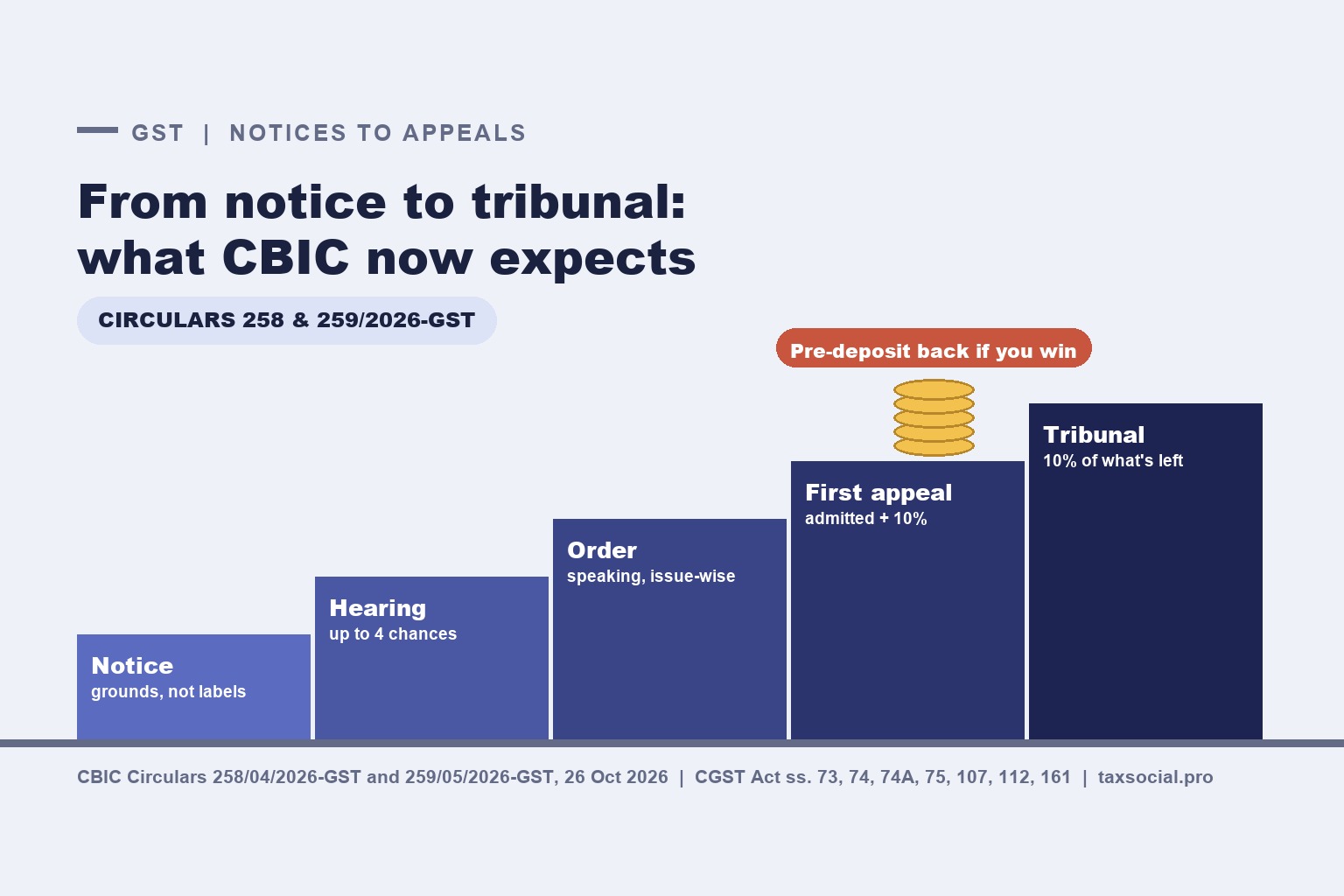

CBIC has issued two circulars on GST disputes, both dated 26 October 2026. Circular No. 258/04/2026-GST is an 18-page set of guidelines for officers. It covers how to draft a show cause notice (SCN) and an adjudication order, when fraud, wilful misstatement or suppression can be alleged, how to run personal hearings, the limits of rectification, and how first appeals should be handled. Circular No. 259/05/2026-GST answers six questions on the pre-deposit for an appeal. The tribunal's 10% is worked out on what the first appellate order leaves in dispute. A pre-deposit is refundable after a win even if the department plans to appeal, unless the order is stayed. Interest on the refund runs from the date of each payment. Circular 258 is addressed to officers, but it doubles as a checklist for anyone replying to a notice or drafting an appeal. One caveat: its paragraph 17 says the guidelines are illustrative and must not be cited by officers in notices or orders.
1. Why two circulars
Paragraph 1.2 of Circular 258 is unusually frank about why it was needed. Orders passed by adjudicating and appellate authorities have been "vague, non-speaking", or have failed to consider what the noticee or appellant said. The result has been "avoidable litigation and remand or reversal" further up. Circular 259 records that "varying interpretations" of the pre-deposit provisions had increased litigation. Both were issued under section 168(1) of the CGST Act, so they bind central tax officers.
2. Before the notice
Rule 142(1A) lets the officer send Part A of FORM GST DRC-01A, a pre-SCN intimation of the tax found payable under section 73, 74 or 74A. It remains optional. The circular asks officers to send it "wherever feasible", because it gives the taxpayer a chance to explain or pay before formal proceedings begin (para 2). If one comes, answer it properly. It is the cheapest point at which to settle a mistake.
3. What a show cause notice should contain
Paragraph 4 sets out the structure:
- Who and what period: name, GSTIN, trade name, registration status, principal place of business, jurisdiction, and the tax periods. Where there are several noticees, each one's particulars are to be given separately. The notice should say how the case arose: assessment, audit, return scrutiny or enforcement. The circular cites the Telangana High Court in Nice Enterprises: a notice that only reproduces statutory provisions without grounds or factual particulars violates natural justice.
- Facts and evidence, discussed objectively and in neutral language such as "it appears that". Words like "determined" are to be avoided, because a notice asks for an explanation and is not a verdict.
- The provisions said to be contravened, each linked to the act or omission alleged. Unrelated sections are not to be piled in, and where there are several noticees the role of each is to be spelt out.
- A statement of charges. The circular cites the Supreme Court in G.R. Infra Project Ltd. v. State of Madhya Pradesh (19 August 2026): what is needed to sustain a notice or order must be in it. A deficiency in the SCN, including non-application of mind, cannot be cured later.
- Quantification, with the basis, split financial year by financial year where the notice covers several years. Interest can be demanded "as applicable", since it depends on the date of payment.
- A closing paragraph naming the adjudicating authority, the reply deadline and the consequences of not replying.
The summary must go up on the portal in DRC-01 (DRC-02 for a statement), and service must follow section 169 (para 9). Officers are asked not to issue notices at the last minute before the time limit, so that there is time to reply and to adjudicate (para 8).
4. Fraud, wilful misstatement and suppression
This is the part of Circular 258 most likely to change outcomes. Section 74(1), and section 74A(5)(ii) for 2024-25 onwards, apply only where tax was evaded through fraud, wilful misstatement or suppression of facts. The circular tells officers:
- The notice itself must set out the specific allegations, facts and material behind that charge. Reproducing the words "fraud, wilful misstatement or suppression" is not enough (para 5.1, quoting G.R. Infra).
- All three require an intention to evade tax. An omission is not suppression unless it is deliberate. Facts known to both sides cannot be "suppressed". An incorrect statement is not a wilful misstatement unless it was made knowing it to be false (para 5.2). The circular cites the Andhra Pradesh High Court in Sriba Nirman Company, which it says the Supreme Court has affirmed.
- These provisions cannot be invoked merely because tax was not paid. They are not to be used in a scrutiny case just because a discrepancy was found. They need material evidence of the conduct, set out in the notice (para 5.3).
- Once a first notice on a set of facts has invoked fraud or suppression, a second notice on the same facts and grounds for a later period generally cannot invoke them again, unless there are new and independent grounds. Later statements should go under section 73 or 74A(5)(i) (para 5.5).
- A notice that mixes a fraud demand and a non-fraud demand must split them, with separate reasons and separate figures. That includes section 74A notices for 2024-25 onwards, where both kinds share one 42-month time limit (para 6).
- If the evidence of intent is not there, the adjudicating authority must say so and confine the demand to section 73 or 74A(5)(i) (para 13).
Why it matters: for periods up to 2023-24, sections 73 and 74 give the fraud route a longer time limit and a heavier penalty, equal to the tax subject to the reduced amounts for early payment. From 2024-25, section 74A has one time limit, but the penalty still differs between the two limbs. A reply that shows the notice gives no material for the inference of intent is now aligned with CBIC's own instruction.
5. Parallel proceedings, hearings and the order
One authority at a time. Section 6 bars a central officer from starting proceedings on a subject matter a State officer has already taken up, and the State Acts say the same in reverse. The circular asks officers to follow the guidelines in paragraph 97 of the Supreme Court's judgment in Armour Security (India) Ltd. (para 7).
Personal hearings (para 10.1):
- A hearing is due under section 75(4) on a written request, or whenever an adverse decision is contemplated.
- Section 75(5) allows no more than three adjournments, so a noticee gets at most four hearing opportunities. Refusing an adjournment within that limit needs reasons in writing.
- Authorised representatives under section 116 are to be heard.
- Virtual hearings are encouraged.
- A record is kept of every hearing, and the order is preferably passed within a month of the hearing.
- If the officer is transferred mid-way, the successor must give a fresh hearing. An officer who has already heard the case should try to pass the order before handing over charge.
The order (para 11) must be a speaking order:
- Every submission answered. Each submission made in DRC-06 or at the hearing must be dealt with and accepted, partly accepted or rejected with reasons. "Reply has been considered" is not enough.
- Every judgment answered. Each judgment the noticee cites must be discussed, with reasons if it is held not to apply.
- Nothing beyond the notice. Under section 75(7) the order cannot exceed the amount in the notice or rest on grounds not in it. A new issue needs a new notice.
- AI is checked by a person. Where AI tools are used, a human must check the result, because the officer remains responsible for the order (para 11.7.1).
- Clear figures. Tax, interest and penalty are to be shown issue by issue, year by year, and under CGST, SGST, IGST and UTGST separately, preferably in a table. Wherever possible, interest is quantified up to the date of the order and stated to run until payment; section 75(9) makes interest payable even if the order does not mention it. Anything already paid is to be adjusted and the balance stated.
- Reasoned penalty. A penalty needs reasons, with the discipline of section 126, and is not to be imposed mechanically (para 11.10).
- Summary on the portal. The summary of the order goes up in DRC-07.
6. Rectification is not a second chance
Section 161 lets the authority that issued an order correct an error apparent on the face of the record. Paragraph 14 confines it tightly:
- Only the issuing authority can rectify; a senior officer cannot do it under section 5(2).
- The error must be obvious, not one that needs "a long-drawn process of reasoning" (the circular cites Arun Dev Upadhyaya).
- It cannot be used to correct errors of law or to re-weigh facts.
- Apply within three months of the order. Rectification must be done within six months, except for a purely clerical or arithmetical slip.
Requests are to be disposed of quickly in DRC-08. If your complaint is that the officer got the law or the facts wrong, appeal. Do not let the three-month appeal period run out while a rectification application waits.
7. First appeals
- No rejection on merits at the door. The preliminary check under rule 108 covers particulars, limitation, form, pre-deposit and documents. Merits are for the hearing, not a ground to reject at registration (para 15.1).
- Limitation is decided first. The period is three months from communication of the order, plus one more month on sufficient cause under section 107(4). The circular says an appeal beyond that cannot be decided on merits "even in cases where a prima facie case is discernible" (para 15.2). Diarise the date.
- Withdrawal is by APL-01/03W under rule 109C. After the final acknowledgement in APL-02 it needs the Appellate Authority's approval, to be decided within seven days.
- Hearing dates on the portal. Hearing dates are to be communicated on the portal, and the order is to record each hearing, who appeared and what was said.
- Additional grounds and evidence. An additional ground (section 107(10)) can be allowed where the omission was not wilful or unreasonable. A new factual issue needing fresh investigation should not ordinarily be entertained. Additional evidence is admitted only on the rule 112 grounds, after the adjudicating authority has had a chance to rebut it.
- Decided within a year where possible. Appeals are to be decided within a year of filing where possible, leaving out any period of a stay by a court or the Tribunal (section 107(13)). Cross-appeals by you and the department against the same order are to be heard together and decided by one order.
The rules on hearings, orders and fraud findings (paras 10, 11 and 13) apply to appellate authorities as well (para 16).
8. Pre-deposit: the six answers in Circular 259
| Question | Answer |
|---|---|
| What is the "admitted amount" and what is "tax in dispute"? | The admitted amount is the part of the tax, interest, fine, fee and penalty in the order that you accept and do not appeal against. It must be paid in full. The rest is in dispute, and the pre-deposit is 10% of the tax in dispute. You make the split when filing, in Table 14 of APL-01 (Table 20 of APL-05 before the Tribunal). |
| How much for the Tribunal if the first appeal changed the demand? | 10% of the tax in dispute as confirmed by the Appellate Authority and still disputed. This is in addition to what was paid for the first appeal. |
| Does a favourable order have to say "refund the pre-deposit"? | No. Where the order makes any pre-deposit refundable, claim it in FORM GST RFD-01 under "on account of order". The order need not say so expressly. |
| You won, but the department may appeal. Refund? | Yes. The refund is not to be denied because the department intends to appeal or has appealed. It can be held back only if the order is stayed by the Tribunal or a court. |
| From when does interest run on the refund? | Section 115 already gives interest, at the rate under section 56, "from the date of payment of the amount" till the date of refund. Where you paid at both levels, the circular says each payment counts from its own date. |
| The Tribunal remands the case. Refund? | On a full remand, the pre-deposit is refundable within the prescribed time. On a partial remand, the department first recovers or adjusts the demand confirmed against you, with interest, and refunds the balance. |
The statutory percentages and the monetary caps in sections 107(6) and 112(8) are unchanged by the circular. The 57th GST Council has recommended a separate cap for penalty-only orders and a standalone interest provision in section 115 for pre-deposit refunds, which our ICAI article explains is about the interest rate, since section 56 has two. Both need the Act to be amended first. Our 57th Council article on penalties and prosecution covers them.
9. How to use Circular 258
Paragraph 17 says the guidelines are "illustrative" and "non-exhaustive" and "must not be cited by proper officers in show cause notices, final or appellate orders". That stops officers quoting the guidelines in their own notices and orders. It does not say how a court will judge a notice, and it does not stop you referring to the circular. A reply or appeal is stronger, though, when it rests on the statute and the judgments the circular itself relies on: G.R. Infra, Sriba Nirman, Nice Enterprises, Armour Security and Saheli Leasing. Point to the circular to show that CBIC itself expects the same thing.
Practical checklist when a notice arrives:
- Note the date of service and the reply date. Ask in writing for a personal hearing.
- Check whether the notice gives specific material for any fraud or suppression charge, or only the words.
- Check that the demand is split by year and by tax head, and that a mixed notice separates the fraud and non-fraud parts.
- Check whether an SGST or UTGST officer has already initiated proceedings on the same subject matter (section 6).
- Answer every allegation in DRC-06 and file every judgment you rely on, so that an order that ignores them is open to challenge.
- When the order comes, decide what you accept and what you dispute before you file the appeal. That split fixes the pre-deposit.
These are two of eight GST circulars CBIC issued on 26 October 2026. Exporters with old rule 96(10) demands should read our article on Circular 264, which takes many of those appeals off the table.
Sources: CBIC Circular No. 258/04/2026-GST, 26 October 2026 (attached), paragraphs 1 to 18; CBIC Circular No. 259/05/2026-GST, 26 October 2026, paragraphs 1 to 4 and the table of six issues; judgments as cited and described in Circular 258; Recommendations of the 57th Meeting of the GST Council, PIB, 8 October 2026, as covered in our articles of 8 and 9 October 2026.



Comments (0)
No comments yet. Be the first to comment!