
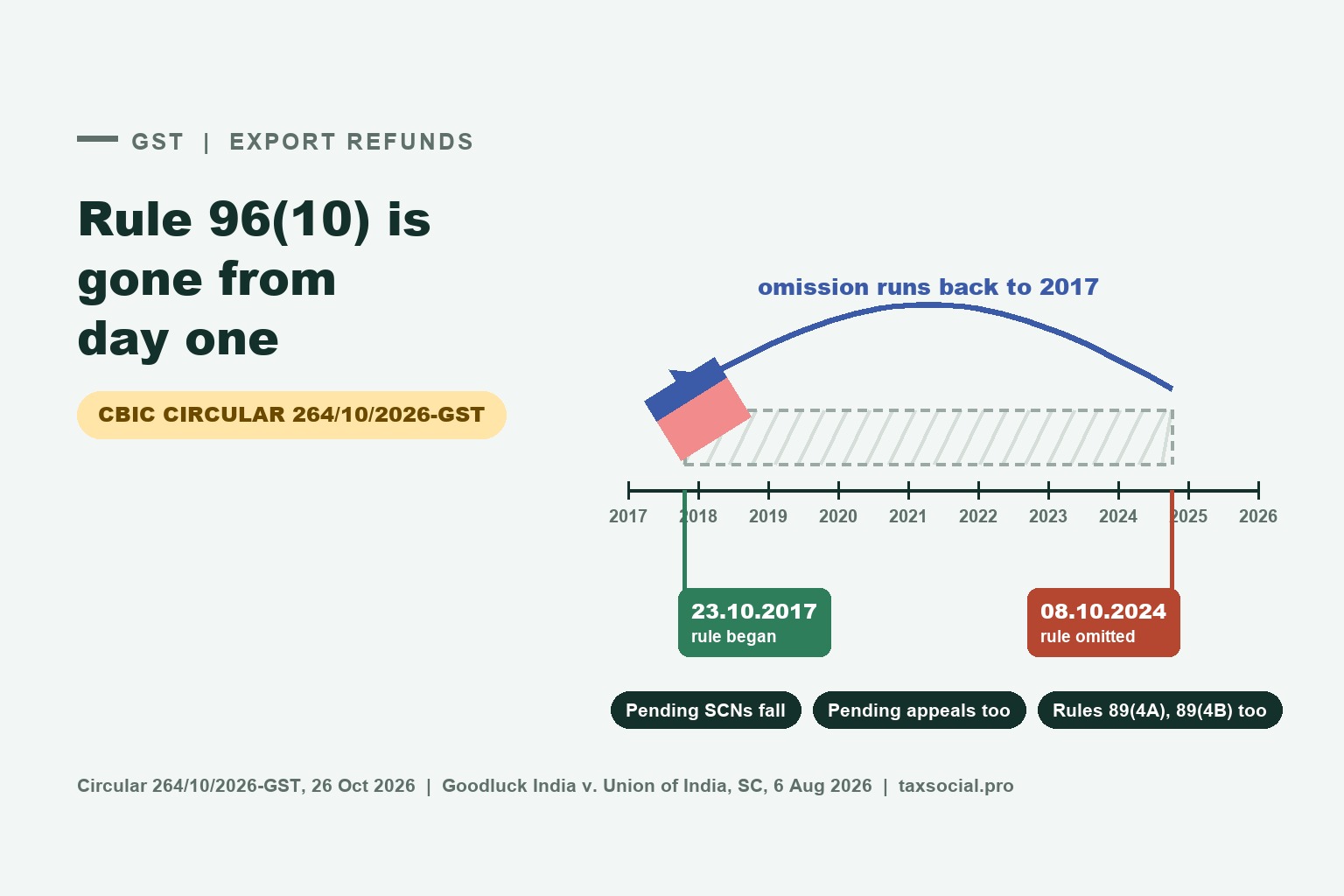

CBIC has told its officers to treat the omission of rule 96(10) of the CGST Rules as effective from 23 October 2017, the date the rule began, and to deal with pending rule 96(10) proceedings in line with the Supreme Court's judgment in Goodluck India Limited v. Union of India (6 August 2026). That judgment held that a rule omitted without a saving clause takes with it every proceeding pending on the date of omission. Circular No. 264/10/2026-GST, dated 26 October 2026, applies the same treatment to rules 89(4A) and 89(4B), which were omitted by the same notification. For an exporter with a rule 96(10) show cause notice, demand or appeal still open, that ground no longer stands. The circular does not say what happens to cases that were already closed, or to money paid back without any proceeding. Those questions remain open.
1. What the circular says
The circular is short: two pages, eight paragraphs. The operative part is paragraph 6:
- In view of the Supreme Court's decision, "the said omission of rule 96(10) of the CGST Rules will be effective retrospectively from 23.10.2017".
- Field formations are to deal with pending proceedings on rule 96(10) "in accordance with the said judgment".
- The same treatment applies, mutatis mutandis, to the omission of rules 89(4A) and 89(4B).
Paragraph 4 records the holding as CBIC reads it: in the absence of any saving or sunset clause, the omission of rule 96(10) "applies to all proceedings pending as on the date of omission". Paragraph 5 records the reasoning. The Court relied on the Constitution Bench in Kolhapur Canesugar Works Ltd. v. Union of India (2000) 2 SCC 536: section 6 of the General Clauses Act, 1897, which keeps pending proceedings alive when a law is repealed, does not apply when a rule is omitted. Pending proceedings survive only if an express provision or a legal device in the statute or rules preserves them, and Notification 20/2024-Central Tax had neither.
The circular was issued under section 168(1) of the CGST Act, so it binds the department's officers. The Supreme Court's judgment binds everyone, whatever the circular says.
2. What rule 96(10) did
An exporter of goods has two routes. It can export under a letter of undertaking (LUT) without paying IGST, then claim a refund of unused input tax credit under rule 89. Or it can pay IGST on the export and get that IGST refunded under rule 96, with the shipping bill treated as the refund application. Rule 96(10) closed the second route to exporters who had taken certain input-side concessions. As substituted from 9 October 2018 by Notification 54/2018-Central Tax, a person claiming refund of IGST paid on exports "should not have":
- (a) received supplies on which the benefit of Notification 48/2017-Central Tax (deemed exports, such as supplies against an Advance Authorisation or to an EOU), except so far as it relates to capital goods received against the EPCG scheme, or Notifications 40/2017-Central Tax (Rate) or 41/2017-Integrated Tax (Rate) (the concessional rate, 0.1% in all, on supplies to merchant exporters) had been availed; or
- (b) availed Notification 78/2017-Customs or 79/2017-Customs (IGST exemption on imports by EOUs and under Advance Authorisation or EPCG), again except for capital goods under EPCG.
An Explanation inserted by Notification 16/2020-Central Tax, with effect from 23 October 2017, softened limb (b). The benefit was not treated as availed where the exporter paid IGST and compensation cess on the imported inputs or capital goods and claimed exemption from basic customs duty only.
The aim, the circular says in paragraph 3, was to stop a double benefit: tax-free inputs and then a refund of IGST on the export of goods made from them. In practice it produced years of show cause notices asking exporters to repay IGST refunds already granted, with interest and penalty, often years after the shipments.
Rules 89(4A) and 89(4B) were the matching provisions on the LUT route. Rule 89(4A) dealt with an exporter that had received deemed-export supplies under Notification 48/2017-Central Tax: refund was allowed of the credit on its other inputs and input services. Rule 89(4B), as substituted in October 2018, dealt with inputs received under the merchant-export rate notifications or imported under Notifications 78/2017 or 79/2017-Customs. Claims under these sub-rules were kept out of the normal rule 89(4) formula, both the credit and the matching turnover. Notification 20/2024 omitted both sub-rules and the cross-references to them in rule 89(4) and 89(5). It also removed the reference to rule 96(10) from rule 86(4B)(b), the provision under which an exporter that repays such a refund through FORM GST DRC-03, from the electronic cash ledger and with interest and any penalty, gets an equal amount re-credited to its electronic credit ledger by an order in FORM GST PMT-03A.
3. How we got here
| Date | Event |
|---|---|
| 23 October 2017 | Rule 96(10) takes effect (the circular calls this the date "from which it was brought into effect") |
| 9 October 2018 | Rule 96(10) substituted by Notification 54/2018-Central Tax in the form above; rule 89(4B) substituted the same day |
| 23 March 2020 | Notification 16/2020-Central Tax inserts the basic-customs-duty-only Explanation, with effect from 23 October 2017 |
| 9 September 2024 | 54th GST Council meeting recommends omitting rule 96(10) prospectively, because of the difficulty exporters faced (circular, para 3) |
| 8 October 2024 | Notification 20/2024-Central Tax omits rule 96(10) and rules 89(4A) and 89(4B), with no saving clause |
| 13 June 2025 | Gujarat High Court, Addwrap Packaging Pvt. Ltd. v. Union of India: the omission applies to all proceedings and cases pending on 8 October 2024. The rule 96(10) show cause notices and orders before the court are quashed. |
| 6 August 2026 | Supreme Court, Goodluck India Limited & Anr. v. Union of India & Ors., SLP (Civil) No. 24550 of 2025 and connected matters: the omission applies to all proceedings pending on the date of omission |
| 8 October 2026 | 57th GST Council meeting recommends a circular clarifying that the omission is effective from 23 October 2017 |
| 26 October 2026 | Circular No. 264/10/2026-GST issued |
4. What "retrospectively from 23.10.2017" does and does not mean
The courts described this a little differently from the circular. The Gujarat High Court said rule 96(10) "would stand omitted prospectively but applicable to pending proceedings/cases where final adjudication has not taken place". The circular says the omission "will be effective retrospectively from 23.10.2017". For a case still open, both lead to the same result: the rule cannot be the basis for a demand or a refund rejection.
The circular's wording also has a consequence for the department. If the rule is treated as having gone from the day it began, an officer has nothing on which to start a fresh rule 96(10) proceeding for any old period. Even without the circular, Kolhapur Canesugar says no new proceedings can be started under an omitted rule that has no saving clause.
What the circular does not do:
- It does not amend the rules. No notification giving Notification 20/2024 retrospective effect has been issued. The instrument is a circular following a Supreme Court judgment. When we covered the 57th Council meeting we said it was open whether a circular alone or an amending notification would follow. A circular it is.
- It does not deal with closed cases. It speaks of "pending proceedings". It says nothing about an order that became final because no appeal was filed, or about an appeal decided finally against the exporter before 8 October 2024.
- It does not deal with voluntary repayments. Many exporters paid back IGST refunds through DRC-03 after an audit objection or a letter, without any notice or order being issued. The circular does not say whether that money can now be claimed back.
- It does not touch other grounds. Many notices combine rule 96(10) with other allegations, for example that the pre-import condition of an Advance Authorisation was breached, or that the export value was misdeclared. Only the rule 96(10) ground falls. Everything else in the notice still has to be answered on its own merits.
5. Where you stand, case by case
| Your situation | What the circular and judgment mean | What to do |
|---|---|---|
| Show cause notice on rule 96(10), not yet decided | The proceeding cannot continue on that ground | File a written submission with the circular and the judgment and ask for the notice to be dropped to that extent |
| Order confirming a rule 96(10) demand, appeal pending (Appellate Authority, GSTAT or High Court) | A pending appeal is a pending proceeding. The Gujarat High Court treated writ petitions against such orders the same way. | Place the circular on record and ask for the appeal to be allowed on that ground. Once the order is set aside, claim the pre-deposit back in FORM GST RFD-01 under "on account of order". Circular 259/05/2026-GST says that refund is not to be withheld merely because the department plans to appeal, unless the order is stayed. |
| IGST refund rejected or withheld on rule 96(10), with a reply, appeal or writ still pending | The rejection cannot stand on that ground | Ask for the claim to be processed under rule 96 without the rule 96(10) restriction |
| LUT refund cut down under rules 89(4A) or 89(4B), still pending | The circular applies the same treatment mutatis mutandis | Rework the claim under rule 89(4) as it now stands, without the carve-outs. Do the arithmetic first: for some exporters the special sub-rules gave more, not less. |
| Order became final before 8 October 2024 (no appeal, or appeal finally lost) | Not addressed. The circular and the judgment, as the circular records it, speak only of proceedings pending on the date of omission. | Take advice before spending on litigation. Any remedy depends on facts outside the circular. |
| Repaid the refund through DRC-03 with no notice or order | Not addressed | Whether a refund claim lies, and when the two-year limit under section 54 starts to run, is unsettled. Keep the payment records and take advice early rather than late. |
Where the interest and penalty in a notice arise only from the rule 96(10) demand, they should fall with it. Amounts resting on any other ground in the same notice have to be dealt with on their own.
6. Why it took a circular
The GST Council's recommendation in September 2024 was to omit the rule prospectively, and Notification 20/2024 said nothing about pending cases. Officers therefore kept pursuing old notices, and High Courts were asked to decide the point. The notification carried no saving clause, and the Supreme Court held that in those circumstances the omission reached every proceeding pending on 8 October 2024. Once that was settled, officers needed an instruction to stop. Paragraph 2 of the circular says doubts were being raised "by the tax officers as well as taxpayers". Paragraph 7 asks for trade notices to publicise it.
Circular 264 is one of eight GST circulars CBIC issued on 26 October 2026. One of the others, on pre-deposits for appeals, matters to anyone whose rule 96(10) appeal is now going to succeed. We are covering the rest separately.
Sources: CBIC Circular No. 264/10/2026-GST, 26 October 2026 (attached); rule 96(10) as substituted by Notification 54/2018-Central Tax, the Explanation inserted by Notification 16/2020-Central Tax, and paragraphs 6, 9 and 10 of Notification 20/2024-Central Tax, as reproduced in Gujarat High Court, Addwrap Packaging Pvt. Ltd. v. Union of India, R/SCA No. 22519 of 2019, 13 June 2025, paras 18-24, 130 and 203-208; Supreme Court, Goodluck India Limited & Anr. v. Union of India & Ors., SLP (Civil) No. 24550 of 2025, 6 August 2026, as recorded in the circular.



Comments (0)
No comments yet. Be the first to comment!