
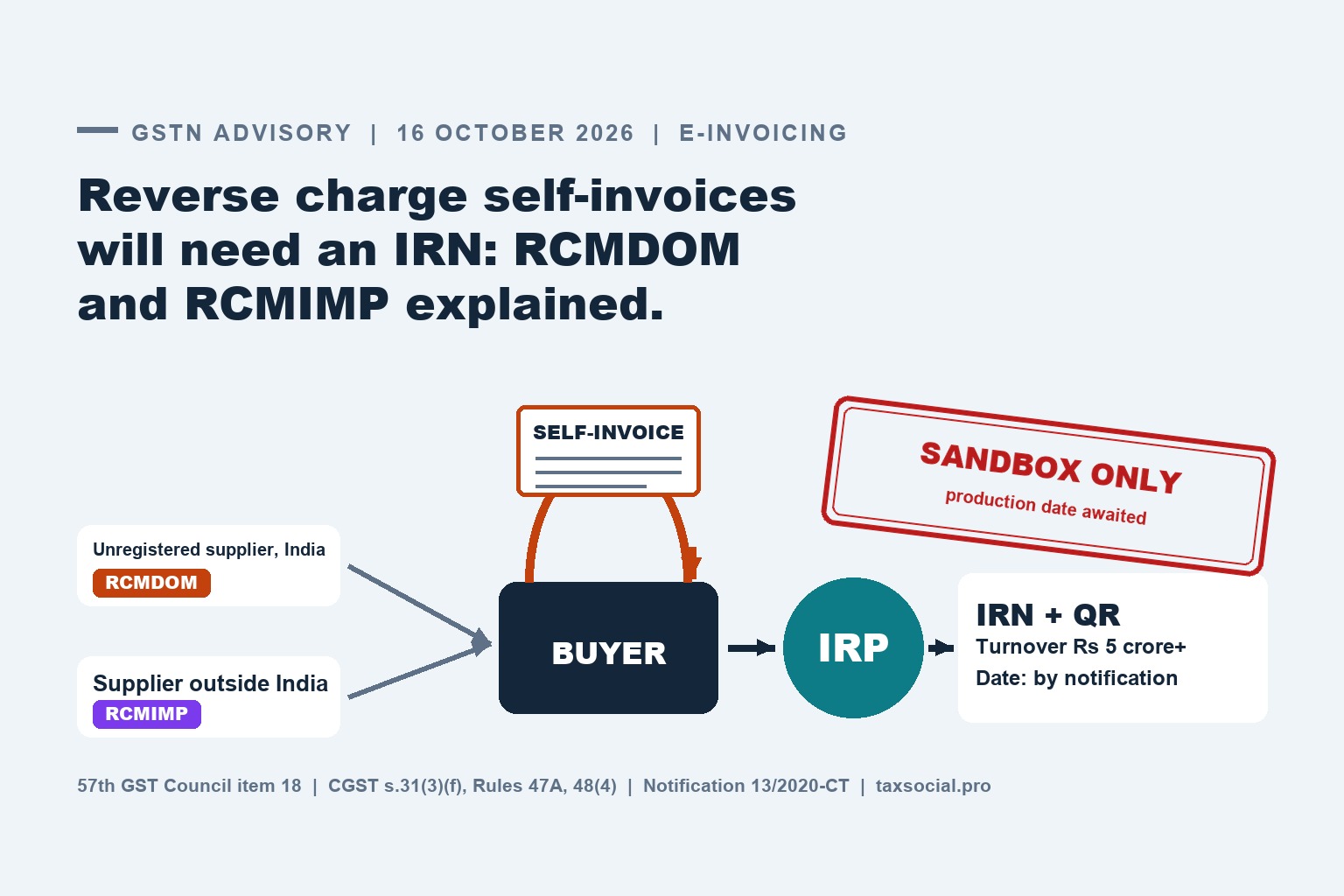

GSTN has announced that e-invoicing is coming to reverse charge self-invoices. In an advisory dated 16 October 2026, it introduced two new supply types on the Invoice Registration Portals (IRPs): RCMDOM, for self-invoices on purchases from unregistered suppliers in India where the buyer pays GST under reverse charge, and RCMIMP, for self-invoices on import of services. A business inside e-invoicing (today, turnover above Rs 5 crore) will have to obtain an Invoice Reference Number (IRN) for these self-invoices, much as it already does for its sales invoices. It is not mandatory yet. The facility is live only in the sandbox, the test version of each IRP. The law still has to be changed by notification, and GSTN says the production date "would be communicated in due time". Here is what the advisory says, which purchases it catches, the questions it leaves open, and what to do while the notification is awaited. The advisory is attached to this article.
Where this comes from
The 57th GST Council meeting on 8 October 2026 recommended, in item 18 of its release, "extending e-invoicing to domestic supplies received from an unregistered person where the tax is payable under reverse charge mechanism, as well as to the import of services, for taxpayers having aggregate annual turnover of Rs. 5 crore and above". We listed it in our full list of the 57th Council's decisions as one that needs only a notification under Rule 48, not an amendment to the Act. The GSTN advisory of 16 October is the systems side of that recommendation: the IRPs are being changed so that the portal can accept these documents when the notification comes.
What the GSTN advisory says
- Two new supply types join the existing e-invoice schema. RCMDOM covers recipient-generated self-invoices for specified domestic supplies received from unregistered persons, where the registered recipient pays tax under reverse charge. RCMIMP covers recipient-generated self-invoices for import of services from suppliers outside India.
- Who it is for: registered taxpayers with an aggregate annual turnover (AATO) of Rs 5 crore and above, which the advisory calls "the current eligibility threshold for e-Invoicing". It adds that scope, applicability and effective date "would be governed by the applicable notifications".
- The recipient reports, not the supplier. Today an e-invoice is reported by the registered supplier. Under the change, an "eligible and active" registered recipient will report its own self-invoice through an authorised IRP, choosing RCMDOM or RCMIMP, and get an IRN once the particulars pass validation.
- Sandbox only, on all six IRPs. NIC IRP-1 and IRP-2, Cygnet (IRP-3), Clear (IRP-4), EY (IRP-5) and IRIS (IRP-6) have the change in their sandboxes. Validations and error codes will be the same across all six, following NIC IRP-1's technical specifications.
- Still to come: a detailed release note from NIC IRP-1 (specifications, business validations, validation codes), a GSTN and IRP webinar, and the production date.
Why a notification is still needed
The self-invoice itself is not new. Section 31(3)(f) of the CGST Act already requires a registered person who pays tax under Section 9(3) or 9(4) to issue an invoice for goods or services received from a supplier who is not registered. Since 1 November 2024 that must be done "within the period as may be prescribed", and Rule 47A prescribes thirty days from the date of receipt of the supply. Our reverse charge guide covers this in detail.
What is new is the IRN. E-invoicing rests on Rule 48(4) of the CGST Rules, under which the Government notifies the class of registered persons who must prepare invoices after obtaining an IRN. The notification in force, Notification 13/2020-Central Tax as amended, covers persons whose aggregate turnover in any financial year from 2017-18 onwards exceeds Rs 5 crore. It applies to invoices "in respect of supply of goods or services or both to a registered person or for Exports". That wording was written for the supplier's own sales invoice. A self-invoice is issued by the buyer for a purchase, and the advisory itself says the existing framework is for invoices "ordinarily reported by registered suppliers". In our reading, the self-invoice falls outside that wording, which is why the new requirement needs a notification of its own or an amendment to Notification 13/2020. Until that is issued, nobody is required to put an IRN on a self-invoice.
Which purchases RCMDOM catches
RCMDOM is about the unregistered supplier. Reverse charge alone is not enough. Some common cases, assuming the buyer is above the threshold:
- Commercial rent paid to an unregistered landlord. The buyer pays 18 per cent under reverse charge and issues a self-invoice every month. Under the change, each one needs an IRN.
- Legal fees to an unregistered advocate or firm, and sitting fees or other payments to a director for services as a director, where the director is not registered. (Reverse charge applies to a director's services either way; RCMDOM is only for the unregistered director.)
- Goods on the reverse charge list bought from unregistered sellers, such as metal scrap.
- Purchases by a real estate promoter from unregistered suppliers, where tax is payable under Section 9(4).
What RCMDOM does not catch:
- Reverse charge supplies from a registered supplier, for example a registered goods transport agency or advocates' firm. The supplier issues the tax invoice, marked as reverse charge, and the buyer issues no self-invoice. Whether that invoice carries an IRN depends on the supplier's own e-invoicing status, not the buyer's.
- E-commerce operators paying tax under Section 9(5). That liability is not reverse charge as Section 2(98) defines it.
- Ordinary purchases from unregistered persons that are not on a reverse charge list. No tax is payable on them, so no self-invoice is needed.
Which purchases RCMIMP catches
Section 5(3) of the IGST Act, read with the reverse charge notification issued under it, makes the recipient in India liable to pay IGST on most services received from a supplier outside India; online services supplied to non-business consumers are the main exception. Where the recipient is a registered person liable under reverse charge and the overseas supplier is not registered in India, the self-invoice requirement applies (the IGST Act applies Section 31 of the CGST Act through Section 20), and that self-invoice is what RCMIMP is for. Typical cases are software subscriptions bought by a business from foreign companies, overseas consultancy and legal fees, foreign advertising, and management fees charged by a group company abroad. Import of goods is not part of this change. IGST on imported goods is paid at customs against the bill of entry, which stays the document for them.
Five questions the advisory leaves open
- "Rs 5 crore and above" or "exceeds Rs 5 crore"? The Council and GSTN both say "and above". Notification 13/2020 says "exceeds". A business at exactly Rs 5 crore sits on the line, and the notification's wording will settle it.
- Which year's turnover? The current test is any financial year from 2017-18 onwards. Once a business crosses the threshold in any year, it stays in e-invoicing even if turnover later falls. If the new notification uses the same test, many smaller businesses whose turnover crossed Rs 5 crore once will be in.
- Will the existing exclusions carry over? Banks, NBFCs and insurers (Rule 54(2)), goods transport agencies, passenger transport operators, multiplexes, SEZ units, government departments and local authorities are outside e-invoicing for their sales. The advisory says nothing about their purchases. This matters most for banks and financial institutions, which pay reverse charge on a large volume of imported services.
- Will the IRP's 30-day limit apply? Since 1 April 2025 the IRPs refuse to accept an invoice from a business with turnover of Rs 10 crore and above if it is reported more than thirty days after its date. A self-invoice already has its own thirty days under Rule 47A. If both apply, a self-invoice issued late may also be one the IRP will not accept.
- How will the IRN data feed the returns? The advisory does not say. The same Council meeting recommended a new Rule 86D, an "Electronic Statement of tax paid on Reverse charge basis and input tax credit claimed". We expect the self-invoice IRNs to feed that statement, but that is our reading, not something GSTN has said.
Why it will matter once notified
Rule 48(5) says that an invoice issued by a person to whom Rule 48(4) applies, in any other manner, "shall not be treated as an invoice". If the new notification brings self-invoices under Rule 48(4) in the same way, a self-invoice without an IRN would not count as an invoice at all. That is where the cost lies. Rule 36(1)(b) allows input tax credit on a Section 31(3)(f) self-invoice, subject to payment of the tax. If the self-invoice is not a valid document, the reverse charge tax paid in cash may have no valid document behind the credit. The penalty exposure will depend on how the notification is drafted and how the default is treated, but a blocked credit on a year of rent or software subscriptions could easily cost more than any penalty. (The advisory does not deal with either point.)
There is also a practical benefit. Self-invoices are where reverse charge compliance most often fails: they are issued late, numbered outside any series, or not issued at all. An IRN on each one leaves a dated record on the portal, which should make the thirty-day rule and the time of supply easier to prove, and easier for the department to check.
What to do now
- Do not generate production IRNs on self-invoices yet. The facility is in the sandbox only. Keep issuing self-invoices within thirty days of receiving the supply, as Rule 47A already requires.
- List your reverse charge purchases and mark each supplier as registered, unregistered or overseas. RCMDOM will be for the reverse charge purchases from unregistered suppliers in India, and RCMIMP for imported services on which you pay tax under reverse charge.
- Check your self-invoice numbering. Rule 46 requires a consecutive serial number, unique for the financial year, and the IRP is likely to validate the document number as it does for sales invoices (the NIC release note will confirm). Most businesses keep a separate series for self-invoices so they never clash with sales invoice numbers.
- Ask your ERP vendor, GSP or ASP whether they have started testing RCMDOM and RCMIMP in the sandbox, and when. The advisory asks them to prepare now.
- Watch for three documents: the NIC IRP-1 release note, the Rule 48(4) notification with its effective date, and the webinar notice. Check the official e-invoice portal, einvoice.gst.gov.in.
For the e-invoicing rules as they stand today, including the existing exclusions and the 30-day reporting limit, see our e-invoicing explainer.
Sources
- GSTN advisory, "Introduction of e-Invoicing Facility for Recipient Generated Self Invoices under Reverse Charge Mechanism for Domestic Supplies from Unregistered Persons (RCMDOM) and Import of Services (RCMIMP)", 16 October 2026, GST portal (attached).
- Press Information Bureau, "Recommendations of the 57th Meeting of the GST Council", 8 October 2026, items 5.1 and 18.
- Central Goods and Services Tax Act, 2017: Sections 2(98), 9(3), 9(4), 9(5) and 31(3)(f). Integrated Goods and Services Tax Act, 2017: Sections 5(3) and 20, and Notification 10/2017-Integrated Tax (Rate).
- CGST Rules, 2017: Rules 36(1)(b), 46, 47A, 48(4) and 48(5), and 54(2) to (4A).
- Notification 13/2020-Central Tax dated 21 March 2020, as amended up to Notification 10/2023-Central Tax.
Status as of 16 October 2026: no notification has been issued; the change is available only in the IRP sandboxes.



Comments (0)
No comments yet. Be the first to comment!