

CBIC has issued guidelines written for people applying for GST registration, not only for the officers processing them. Circular No. 257/03/2026-GST, dated 26 October 2026, runs to 38 pages with six annexures. Wrong or inadequate details of the principal place of business are, in CBIC's words, one of the major reasons for queries and rejections, and the circular deals with them in detail. It lists the documents for each kind of premises: owned, inherited, rented with or without an agreement, borrowed from family, and co-working. It gives ready formats for a consent letter, a no-rent-agreement undertaking and an inheritance affidavit. It also tells officers what they may not ask for: a Udyam certificate, a residential address in the same city or State, or proof that a home is fit for business. Officers may not judge whether an electricity connection is domestic or commercial either. The timelines in rules 9, 9A and 14A are unchanged. It also points applicants to a complaint route to the Chief Commissioner or Commissioner. The 57th GST Council had recommended a circular of this kind on 8 October.
1. What the circular is
CBIC had already issued Instruction No. 03/2025-GST on 17 April 2025, telling officers how to process registration applications. Circular 257 is the applicant's side of the same exercise. Paragraph 1.2 sets out why it is needed. CBIC's analysis of rejections and queries found the same faults again and again: missing or illegible documents and inconsistent details. These were concentrated in four places: identity of the applicant, proof of the principal place of business (PPoB), constitution of the business, and the authorised signatory.
The circular has six parts at the back:
- Annexure I: 51 FAQs.
- Annexure II: a checklist of documents by constitution (proprietorship, firm or LLP, HUF, company, society or trust, government department, PSU, local authority).
- Annexure III: the list of documents accepted as proof of the PPoB.
- Annexure IV: an affidavit format where the premises belonged to a deceased ancestor.
- Annexure V: an undertaking format where there is no rent agreement.
- Annexure VI: a consent letter format.
It also contains instructions to officers. The circular is issued under section 168(1) of the CGST Act and addressed to central tax formations. It does not itself say how it applies to State tax officers, and a registration application may be allotted to either administration. If yours sits with the State, check whether your State has issued a matching circular or trade notice, and use the State's grievance channel if needed.
2. Proof of premises: which document for which premises
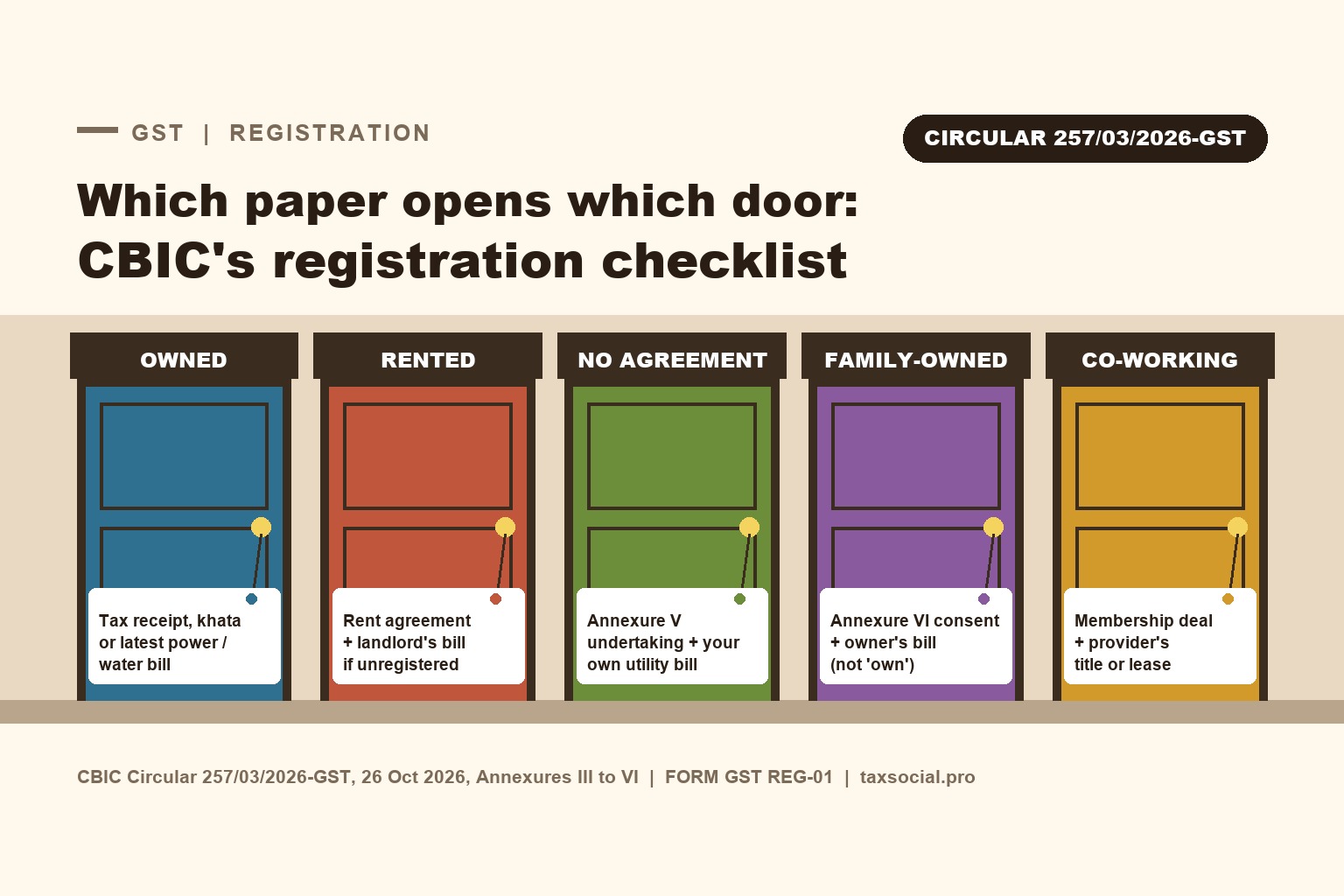
Paragraph 3.7.1 calls wrong or inadequate PPoB details "one of the major reasons" for rejections and queries. The rules for each case:
| Premises | Upload |
|---|---|
| Owned, in the applicant's own name | Any one of: latest property tax receipt, municipal khata, a document certifying property identification, latest electricity bill or latest water bill, in the applicant's name and with the full address |
| Owned by a deceased ancestor, nothing in the applicant's name | Affidavit in Annexure IV, death certificate, and one of the documents above in the ancestor's or the applicant's name |
| Rented, agreement registered | The registered rent or lease agreement. Where State law makes registration compulsory (by use or by term), it must be the registered one. |
| Rented, agreement not required to be registered | The agreement plus one of the "owned" documents in the landlord's name. If the electricity or water bill is in the tenant's own name, that bill with the agreement will do instead. |
| Rented, no agreement at all | Undertaking in Annexure V, plus a premises document. Paragraph 3.8.3(b) and FAQ 25 describe the latest electricity or water bill in the tenant's name; Annexure III allows any one of the "owned" documents in the name of the applicant or the owner. |
| Owned by a spouse, parent, sibling, partner or director, used with consent | Consent letter in Annexure VI signed by the owner (all co-owners, if jointly owned) plus one "owned" document in the owner's name |
| Co-working space | Membership agreement showing the period and the suite, cabin or desk allotted, plus the provider's ownership document, or the provider's registered lease from the owner |
| SEZ unit or developer | Letter of Approval or Letter of Permission from the Development Commissioner, with validity |
Points in the circular that will save a query:
- "Own" means your own name. A house in a parent's, spouse's or partner's name is not "own" premises for the applicant. Paragraph 3.8.2.1 says to choose "Consent", "Rented/Leased" or "Shared" instead. Selecting "Own" with a father's electricity bill is a classic rejection.
- Jointly owned property (FAQ 37): a co-owner applying needs no NOC from the others. If the bills are in only one co-owner's name, upload a document that shows both as owners.
- Shared meter in the landlord's name (FAQ 34): with a registered agreement, the agreement alone is enough. With an unregistered one, add a landlord document.
- Not accepted: a post office box or courier address (FAQ 32), photographs of the applicant or landlord at the premises (FAQ 35), and a Udyam certificate as address proof (FAQ 36).
- Not required: telecom towers and bank ATMs, being unmanned, need not be declared as a PPoB or additional place (para 3.9).
- Several branches in one building (FAQ 33): one registration with one PPoB and the rest as additional places, or separate registrations. Either way, each place needs its own proof.
- The address must be exact, down to the shop, flat or plot number, with the right PIN code. Use the portal's map pin for latitude and longitude. A khasra number or a locality on its own is the kind of open address that draws a query or a negative physical verification report (para 3.7.2). The address on the form must match the document.
Some States also require electricity connection details for the PPoB: the name of the board or unit and the consumer number. The circular names Maharashtra, Rajasthan, Odisha, Andhra Pradesh, Assam and Madhya Pradesh.
3. The rest of the form
- Legal name exactly as on the PAN (and the MCA certificate for a company). For a proprietorship, the proprietor's name. Use the e-mail and mobile number linked to the PAN where there are any.
- Photographs of the proprietor, partners (up to ten), Karta, managing director or authorised person, managing trustee and so on. Each must be an individual recent colour photograph of the full face, not a group photograph and not a crop of a PAN, Aadhaar, driving licence or passport (para 3.4.3).
- DIN is mandatory for company directors and LLP designated partners.
- Authorised signatories: up to ten, each with an authorisation letter from the proprietor, partners, board or committee. FAQ 50 advises at least two, so that the application is not stuck if one is unavailable for e-sign, DSC or Aadhaar verification.
- Bank account: not mandatory at the application stage. Rule 10A requires it within 30 days of the grant of registration or before the first GSTR-1 or IFF, whichever is earlier. The circular advises giving it upfront where available. The account must be in the applicant's name and opened on its PAN.
- Reason for registration and options: select the right reason (threshold, voluntary, inter-State supply, reverse charge and so on). Tick composition, casual taxable person or Rule 14A only if you mean it.
- Previously suspended or cancelled on the same PAN: before applying again, file every pending return for the old registration, including the final return in GSTR-10 where applicable, and clear the liability (para 4).
4. What officers may ask, and what they may not
Under paragraph 5.4 a query in FORM GST REG-03 is to be raised "only" in three cases:
- a document is incomplete or illegible;
- the address does not match the document, or the document does not look like valid proof of address;
- the address is incomplete or vague.
For the second case, paragraph 5.4(ii) says the officer may seek additional documents "as per the list of documents in Annexure-IV". Annexure IV is the inheritance affidavit format. The list of address documents is Annexure III, which is probably what is meant.
Paragraphs 5.4.1 and 6 then list what officers have been doing and must stop:
- asking why the residential address of the applicant, managing director or signatory is in a different city or State (FAQ 30 confirms you need no residential address where you register);
- asking for a Udyam certificate;
- objecting that the declared activity cannot be carried on from the premises, or treating residential premises as unfit for business;
- classifying an electricity connection as domestic or commercial, or scrutinising the bill amount;
- seeking documents beyond the prescribed list, or communicating outside REG-03;
- rejecting outright for a mismatch that a REG-03 query could have cured.
Checks on a utility bill or property tax receipt are limited to the applicant's name and the address. On a rent agreement the officer checks mainly that it is valid, that it names both the applicant and the lessor, and that it gives the exact address.
5. Timelines
| Stage | Time limit |
|---|---|
| Rule 14A (small suppliers passing on output tax of up to Rs 2.5 lakh a month to registered buyers) or rule 9A (system-identified low-risk applicants) | Granted by the system within 3 working days |
| Aadhaar opted for and authenticated, no physical verification | Officer to decide within 7 working days of the application |
| Aadhaar not opted for or failed, or the system flags the application for physical verification, or the officer orders it with approval | Within 30 days, after physical verification under rule 25 |
| Query in REG-03 | Within 7 working days of the application (30 days where physical verification applies) |
| Your reply in REG-04 | Within 7 working days of receiving the query. If you miss it, the application can be rejected (FAQ 15). |
| Officer's decision after the reply | Approve within 7 working days, or reject with reasons in REG-05 within 7 working days |
| Physical verification report (REG-30) | To be uploaded at least 5 days before the 30 days run out, with GPS-tagged photographs |
| No action within the time limit | Registration is deemed approved (rule 9(5); para 5.7, FAQ 17) |
If you did not opt for Aadhaar authentication, or the portal routes you to biometric authentication, the application is complete only after you visit a GST Suvidha Kendra for a photograph and verification of the original documents (para 5.2). The circular therefore advises opting for Aadhaar authentication.
A caution on biometrics. The circular describes rule 8(4A) as written: biometric authentication at a Facilitation Centre for Aadhaar opt-ins the system flags on risk parameters. It does not mention the Delhi High Court's interim direction of 8 September 2026 in Neha v. Union of India. That direction told "all the authorities across the country" not to allow any GST registration without biometric Aadhaar authentication. Our article on that order has the details. The direction was interim and the case has been listed again since. Before advising a client, check the latest order in the case and the current GSTN advisory, and look at what the portal actually asks for when the application is filed. Build a possible Kendra visit into your timeline.
6. Rule 14A, rejection and grievances
- Leaving Rule 14A (para 6.1, FAQ 10): file FORM GST REG-32 with the documents required for REG-01, after filing all returns due and at least one return under the scheme. It is processed like a fresh regular application. Our Rule 14A article covers the scheme.
- Rejected: FAQ 18 says to correct the deficiencies named in the REG-05 order and apply afresh. An appeal under section 107 also lies against a rejection. For most applicants a corrected fresh application is quicker.
- Delay or unwarranted queries (para 8): complain to the jurisdictional Chief Commissioner of Central Tax or Commissioner of State Tax, on the special e-mail address each Zone or State has identified for this. The circular does not list the addresses. Look for them in the trade notice your Zone or State issues.
- Everything happens on the portal. Apart from physical verification and the Kendra visit, there is no face-to-face step, and all communication comes through the common portal (para 7). Watch the portal, not just e-mail.
Applying from a State where you already hold a GSTIN on the same PAN? Our article on REG-01 auto-population explains what the portal now pre-fills. Circular 257 is one of eight GST circulars CBIC issued on 26 October 2026, and we are covering the others separately.
Sources: CBIC Circular No. 257/03/2026-GST, 26 October 2026 (attached), paragraphs 1 to 8, Annexure I (FAQs 1 to 51) and Annexures II to VI; CBIC Instruction No. 03/2025-GST, 17 April 2025, as referred to in the circular; Recommendations of the 57th Meeting of the GST Council, PIB, 8 October 2026; Delhi High Court, Neha v. Union of India, W.P.(C) 12210/2026, order of 8 September 2026, as reported in our article of that date.


Comments (0)
No comments yet. Be the first to comment!