
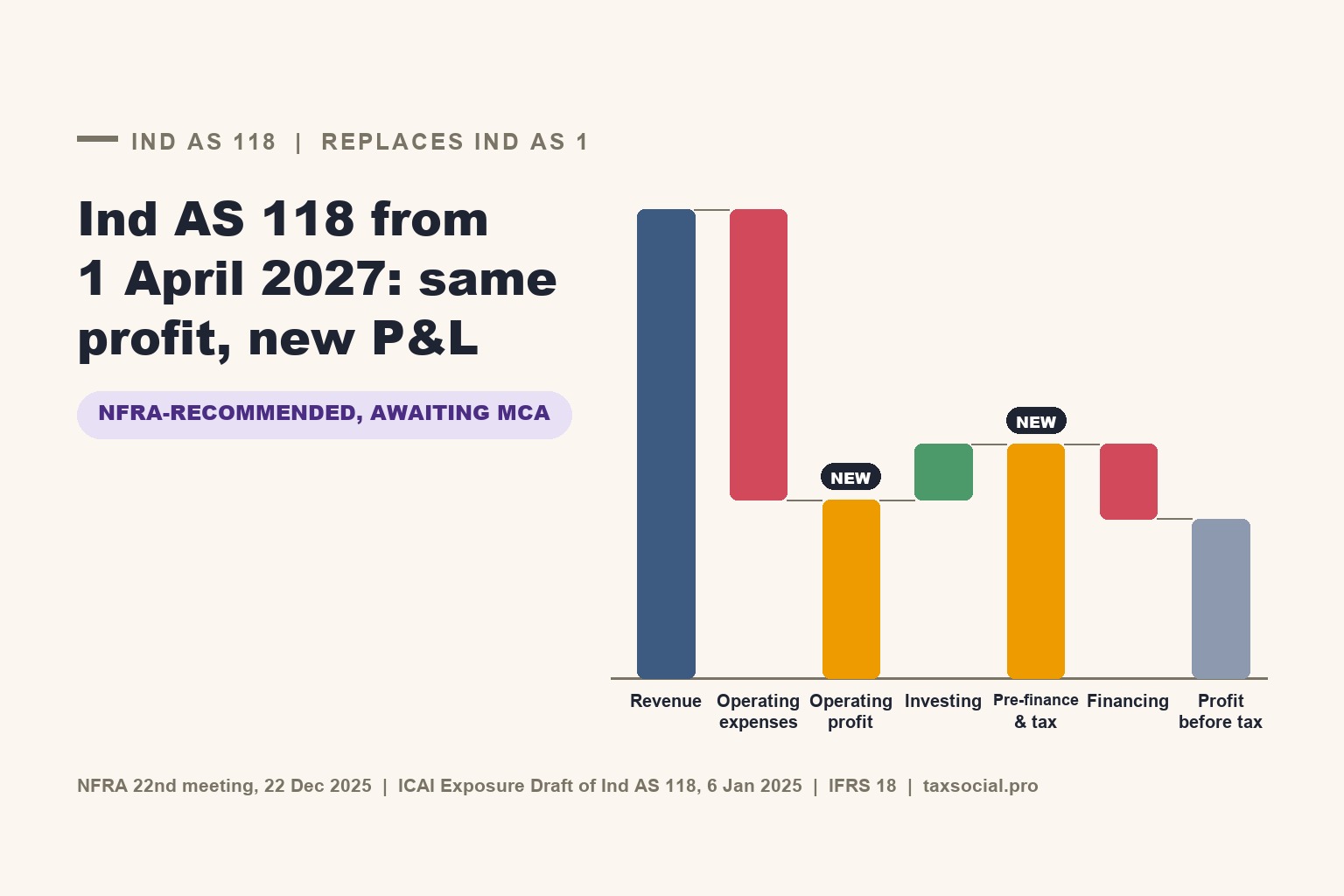

Ind AS 118, Presentation and Disclosure in Financial Statements, is proposed to replace Ind AS 1 for annual reporting periods beginning on or after 1 April 2027, but it is not law yet. The National Financial Reporting Authority (NFRA) recommended it to the Central Government at its meeting of 22 December 2025. It becomes binding only when the Ministry of Corporate Affairs notifies it under section 133 of the Companies Act, 2013. MCA's latest Ind AS amendment, G.S.R. 725(E) of 12 August 2026, did not include it, and we have found no later notification as of 26 October 2026. Ind AS 118 does not change how much profit a company makes. It changes how the statement of profit and loss is laid out: five categories, two new required subtotals including operating profit, an option to present expenses by function, and a single note on the "adjusted" profit measures companies quote to investors. If it is notified as recommended, comparatives must be restated, so the year shown alongside the first Ind AS 118 year will be FY 2026-27, the year already running.
1. Where it stands
| Step | Date | What happened |
|---|---|---|
| IASB issues IFRS 18 | April 2024 | Effective globally for periods beginning on or after 1 January 2027 |
| ICAI exposure draft of Ind AS 118 | 6 January 2025 | Comments until 6 April 2025; proposed effective date 1 April 2027 |
| ICAI proposal to NFRA | August 2025 | As recorded in NFRA's minutes |
| NFRA recommends it to the Central Government | 22 December 2025 | Effective for annual periods beginning on or after 1 April 2027; early adoption from 1 January 2027 recommended for companies with a calendar-year accounting period |
| MCA notification | Pending | Needed under section 133 before the standard binds anyone |
NFRA changed only one thing in ICAI's proposal: the effective date. For companies that prepare financial statements on a January-December year, mostly Indian subsidiaries of foreign groups, NFRA recommended that MCA permit early adoption for periods beginning on or after 1 January 2027, so they are not out of step with a parent applying IFRS 18. That option exists only if MCA notifies it. NFRA also asked MCA to consider changes to Schedule III of the Companies Act, and SEBI to consider changes to its circulars and formats. SEBI has said it will review its reporting formats.
The final text could still differ from the exposure draft. What follows is based on the exposure draft and on NFRA's record of the meeting.
2. Who it applies to
Companies that prepare financial statements under Ind AS, that is, under the Companies (Indian Accounting Standards) Rules, 2015. Companies that follow the Accounting Standards (AS) under the Companies (Accounting Standards) Rules, 2021 are not affected, and neither are non-corporate entities. If your company or your client files under AS, nothing here changes your statements.
3. Profit does not change; the layout does
ICAI's exposure draft is explicit: Ind AS 118 "will not affect how companies measure financial performance, it will affect how companies present and disclose financial performance". Revenue, expenses and profit before tax stay the same. What changes is how they are grouped. (One narrow exception: on first application, an entity eligible under paragraph 18 of Ind AS 28 may switch an associate or joint venture from the equity method to fair value through profit or loss, retrospectively, and that can change amounts.)
Five categories
Every item of income and expense in profit or loss goes into one of five categories:
- Operating: the default. Everything not classified elsewhere, including unusual or volatile items.
- Investing: income and expenses from assets that generate returns separately from the main business, such as rent from investment property and dividends; income and expenses from cash and cash equivalents; and income and expenses from associates and joint ventures, such as the share of their profit.
- Financing: income and expenses on liabilities raised purely for finance, such as bank loans and bonds, plus interest expense on other liabilities, such as lease liabilities and pension liabilities.
- Income taxes: income tax expense or income under Ind AS 12.
- Discontinued operations: under Ind AS 105.
Every entity must assess whether it has a specified main business activity: investing in particular types of assets, or providing financing to customers. Banks and insurers are the standard's examples, and many NBFCs will be in the same position, but it is an entity-by-entity assessment, not a sector label. Where the activity exists, income and expenses that most companies would put in investing or financing go into operating, because for that entity they are the operating result.
Two new subtotals
Operating profit or loss, and profit or loss before financing and income taxes (with exceptions for some entities with specified main business activities). Today Schedule III's statement of profit and loss has no operating profit line, so each company and each analyst computes "EBIT" or "operating profit" its own way.
An illustration
A manufacturing company, not a financier, with these figures (Rs crore):
| Today (Ind AS 1 / Schedule III) | Ind AS 118 (by nature) | ||
|---|---|---|---|
| Revenue from operations | 1,000 | Revenue | 1,000 |
| Other income (interest on deposits 20, dividends 10) | 30 | Materials, employee benefits, depreciation, other expenses | (850) |
| Total income | 1,030 | Operating profit | 150 |
| Materials, employee benefits, depreciation, other expenses | (850) | Investing: interest on deposits, dividends | 30 |
| Finance costs (bank loan 40, lease interest 10) | (50) | Profit before financing and income taxes | 180 |
| Financing: bank loan interest, lease interest | (50) | ||
| Profit before tax | 130 | Profit before tax | 130 |
Same profit before tax; a different story on the way down. The "other income" block, which today mixes interest, dividends, scrap sales and export incentives, has to be split by category. Income from the business itself, such as scrap sales, moves into operating; income from investments moves into investing.
Expenses by nature, by function, or both
This is the change that is new for India, not just under IFRS. Ind AS 1 today requires expenses to be analysed by nature (materials, employee benefits, depreciation and so on), although IAS 1 allows nature or function. Ind AS 118 follows IFRS 18 and lets a company present operating expenses by nature, function (cost of sales, distribution, administration) or a mix.
It is not a free choice. The company must pick the presentation that gives "the most useful structured summary" of its expenses, considering what drives its profitability, how it is managed and reports internally, standard industry practice, and whether allocating an expense to a function would be arbitrary (paragraph B80). Arbitrary allocations must stay by nature.
A company that presents by function must also disclose, in the notes, the amounts of depreciation, amortisation, employee benefits, impairment losses and inventory write-downs included in each function line. At the NFRA meeting, SEBI accepted the B80 factors as enough for comparability, provided companies disclose the basis on which they chose. One member expected most Indian companies to stay with nature, as most still use the indirect method for cash flows when given a choice.
Other changes
- Grouping: items are aggregated on shared characteristics and disaggregated on characteristics they do not share, and grouping must not obscure material information. The label "other" is allowed only when no more informative label can be found.
- Cash flow statement (Ind AS 7): the indirect method is to start from operating profit, rather than the profit before tax most Indian companies start from today.
- EPS (Ind AS 33): additional per-share figures are allowed only on a total or subtotal identified in Ind AS 118, or on an MPM.
- Ind AS 8 is to be renamed "Basis of Preparation of Financial Statements" and to receive many of the accounting-policy requirements now in Ind AS 1. NFRA's minutes mention consequential amendments to 32 standards.
- Ind AS 118 keeps the single statement of profit and loss (no separate statement of comprehensive income), unlike IFRS 18's two-statement option.
4. Management-defined performance measures (MPMs)
An MPM is a subtotal of income and expenses that a company uses in public communications outside the financial statements, such as management commentary, press releases and investor presentations, to communicate management's view of an aspect of the performance of the company as a whole, and that is neither one of the subtotals listed in paragraph 118 nor a total or subtotal Ind AS specifically requires. A subtotal used in public communications is presumed to communicate management's view; the company can rebut that only with reasonable and supportable information (paragraphs 119 and 120). "Adjusted PAT" or "EBITDA before exceptional items" quoted in an investor deck are typical examples. Oral statements, call transcripts and social media posts are not counted.
Every MPM goes into a single note in the audited financial statements, with:
- what it measures and why management thinks it is useful, and how it is calculated;
- a reconciliation to the most directly comparable Ind AS subtotal, with the income tax effect and the effect on non-controlling interests of each reconciling item, and a description of how the tax effect was determined;
- a statement that it is management's view and not necessarily comparable with similarly named measures of other companies;
- explanations, and restated comparatives where practicable, whenever an MPM is added, dropped or recalculated, or the method for its tax effects changes.
Some subtotals are excluded from the definition (paragraph 118), including gross profit and operating profit before depreciation, amortisation and Ind AS 36 impairments. So an EBITDA built exactly from the new operating profit line needs no MPM note. An EBITDA computed the way many Indian companies do today, for example by excluding other income or adding back particular items, may not match that definition. It will then generally be presumed to be an MPM, with the full disclosure, unless the company can rebut the presumption under paragraph 120. Free cash flow and non-financial ratios are not MPMs, because they are not subtotals of income and expenses.
Because the note sits inside the financial statements, these numbers come within the scope of the audit.
5. What companies may need to change
The post that is circulating is right about where the work lies. In practical terms:
- Chart of accounts and ERP: each ledger needs to map to a category (operating, investing, financing). If the company moves to function-wise presentation, costs need cost-centre or function tags, and the nature-wise amounts of depreciation, employee benefits, impairment and inventory write-downs must still be extractable for each function line.
- Restated comparatives start now. As proposed, the standard applies retrospectively (Appendix C of the exposure draft). The first annual statements under it, for FY 2027-28, must present FY 2026-27 restated, with a reconciliation of each profit or loss line item from the Ind AS 1 amounts to the restated amounts. FY 2026-27 is already under way, so data captured this year should already carry the new classifications.
- Interim reporting in the first year: as proposed, condensed interim statements under Ind AS 34 must use the new headings and subtotals and show line-by-line reconciliations for the comparative periods. Listed companies' quarterly results follow SEBI's formats, which SEBI has said it will review.
- Expense allocation: a company choosing function-wise presentation needs a documented, consistent allocation method that does not become arbitrary. That is a judgement auditors will test.
- Controls over MPMs: numbers that used to live only in the investor deck now need the same controls as audited figures: definitions, calculation, reconciliation, tax effect and consistency over time.
- Contracts and incentives: Ind AS 118 does not rewrite any contract. But loan covenants, earn-outs, bonus plans and ESOP performance conditions that refer to "EBITDA", "EBIT" or "operating profit" as reported may produce a different number once the reported line is defined by the standard. Read the definitions now, and renegotiate or fix the reference before the first Ind AS 118 year if needed.
- Schedule III and AOC-4 XBRL: today's Schedule III Division II formats list expenses by nature and have no operating profit line. NFRA has asked MCA to consider changes, and the AOC-4 XBRL taxonomy is likely to need changes too. Until MCA acts, watch for how the format and the standard will be reconciled.
6. What to do before notification
- Do a gap assessment on the FY 2025-26 financial statements: classify each P&L line into the five categories, work out operating profit, and list every "adjusted" measure used in investor communication.
- Decide nature vs function using the B80 factors, and document the reasons. That record is what you will show the auditor and, for listed companies, the basis SEBI asked to see disclosed.
- Configure the ERP for FY 2026-27 data, so the restated comparative year does not have to be rebuilt by hand.
- Review covenants and incentive definitions that rely on reported profit lines.
- Calendar-year subsidiaries of foreign groups: plan for 1 January 2027 if the early-adoption route is notified as NFRA recommended. The group parent will already be on IFRS 18 from that date.
- Watch for the MCA notification, Schedule III amendments and SEBI's revised result formats. We will update this article when they issue.
For companies outside Ind AS, the formats that matter are different; see our article on the ICAI Guidance Note on financial statements of non-corporate entities and the ROC form changes for FY 2025-26.
Sources: Record note of the 22nd meeting of the National Financial Reporting Authority, 22 December 2025 (nfra.gov.in, attached), in particular paragraphs 5, 6, 21, 22 and 29; ICAI Accounting Standards Board, Exposure Draft of Ind AS 118, Presentation and Disclosure in Financial Statements, 6 January 2025 (icai.org), including paragraphs 117 to 125, B80 to B82, Appendix C and Appendix 1; Companies (Indian Accounting Standards) Amendment Rules, 2026, G.S.R. 725(E), 12 August 2026; IFRS 18, IASB, April 2024.

Comments (0)
No comments yet. Be the first to comment!