
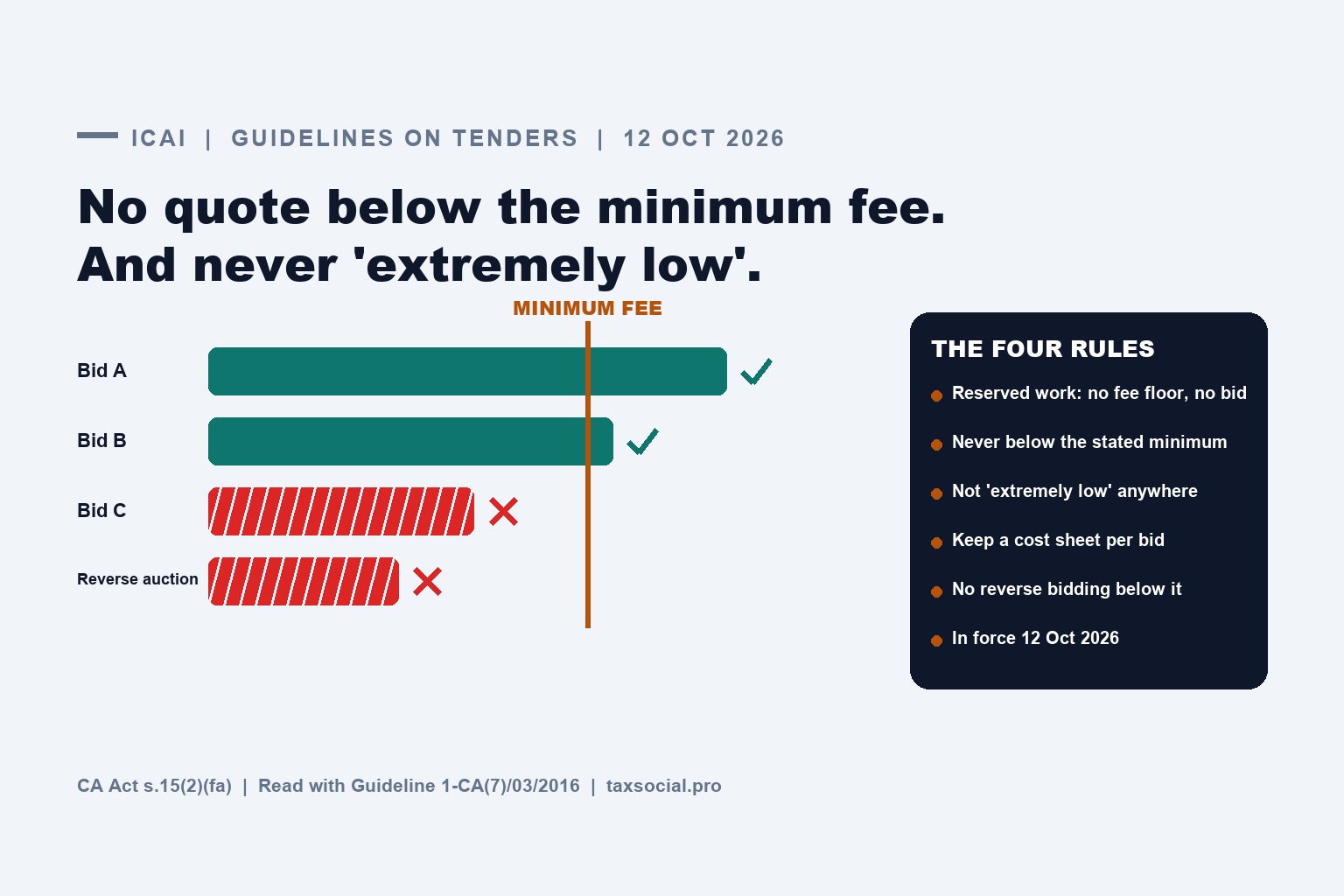

On 12 October 2026 the Council of ICAI issued fresh "Guidelines for members in practice for responding to the tenders issued by various organizations for availing professional services", under section 15(2)(fa) of the Chartered Accountants Act, 1949, which empowers the Council "to issue guidelines for the purpose of carrying out the objects of this Act", with immediate effect. Four rules:
- No response to a tender for services exclusively reserved for chartered accountants by a statute unless the tender prescribes a minimum fee. Where it does, you cannot quote below it.
- Fees must not be "extremely low" in any tender, reserved services or not.
- A cost sheet must be kept for every bid, and ICAI may call for it.
- Reverse bidding below the minimum fee is not permitted.
The first rule is not new: it has been in place since 2016, and ICAI has taken members to its Disciplinary Committee over it. What is new is that the "not extremely low" rule now reaches every tender. The guidelines are attached to this article.
1. The text, rule by rule
The guidelines are a single page, signed by the Secretary, CA. (Dr.) Jai Kumar Batra, dated 12 October 2026.
- (i) Name and commencement: in force "with immediate effect". The guidelines say nothing about bids submitted before 12 October.
- (ii) Reserved services: "A member of the Institute in practice shall not respond to any tender document, by whatever name called, which does not prescribe any minimum fees for availing the professional services which are exclusively reserved for chartered accountants under any statute." Where the minimum fee is prescribed, a member may respond, and "the fee quoted ... shall not be less than the minimum fees, prescribed in the tender document".
- (iii) No extremely low fees anywhere: fees "should not be extremely low whether or not the tender is issued in the area of services exclusively reserved for chartered accountants and it shall be commensurate with the size, value, volume, manpower requirement and nature of work".
- (iv) Cost sheet: "In all cases where the member responds to the tender document, a cost sheet shall be maintained incorporating details of the estimated costs to be incurred therein having regard to number of persons involved, hours to be spent, etc. The Institute may call for any such documents".
And five explanations:
- "Minimum Fee" includes "'estimated fee' or 'professional fee' or 'average fee' by whatever name called".
- For services not exclusively reserved for CAs by statute, a member may respond whether or not a minimum fee is prescribed, and whether or not only CAs are invited.
- The guidelines do not apply where quotations are called from members or firms "through individual letters".
- "Responding to reverse bidding option provided by the tenderer below minimum fee is not permitted."
- They are to be read with the earlier Guideline No. 1-CA(7)/03/2016 dated 7 April 2016.
2. What was already the rule
The 2016 guideline (No. 1-CA(7)/03/2016, published in the Gazette on 7 April 2016) is a single paragraph. A member in practice "shall not respond to any tender issued by an organization or user of professional services in areas of services which are exclusively reserved for chartered accountants, such as audit and attestation services", except "where minimum fee of the assignment is prescribed in the tender document itself or where the areas are open to other professionals along with the Chartered Accountants". The Code of Ethics (Volume II, para 2.14.1.6(iv)) adds that the fee quoted "shall not be less than the minimum fee mentioned in the tender" and that "non-adherence to these Guidelines could lead to disciplinary action as this is a Council decision". ICAI's Tender Monitoring Directorate watches tenders, refers cases, and has told members that cost sheets should be kept.
So the core of guideline (ii) was already binding on members. What 2026 adds:
| Point | Before 12 October 2026 | From 12 October 2026 |
|---|---|---|
| Reserved services, no minimum fee in the tender | Do not respond | Do not respond (unchanged) |
| Reserved services, minimum fee prescribed | Do not quote below it (Code of Ethics) | Do not quote below it, now in the guideline itself |
| Non-reserved services | Free to respond | Free to respond, but the fee must not be "extremely low" and must be commensurate with the work |
| Cost sheet | Not in the 2016 guideline; urged by the Tender Monitoring Directorate | Expressly required for every tender response; ICAI may call for it |
| Reverse auctions | Not expressly addressed | Bidding below the minimum fee in a reverse auction expressly barred |
| Individual quotation letters | Not addressed | Expressly outside the guidelines |
3. The question that decides most cases: is the service "exclusively reserved by statute"?
The minimum-fee rule bites only on services a statute reserves for chartered accountants: the statutory audit under the Companies Act, the tax audit under the Income-tax Act, and audits that a State or local statute reserves for CAs. ICAI's 2016 FAQs said so, and its Disciplinary Committee has read "statute" to include a local statute.
A case heard finally on 25 January 2026, with the order dated 10 February 2026, shows how much turns on it. A Surat firm quoted Rs 1.475 lakh on a GeM tender for "financial audit services" of a District Rural Development Agency in Gujarat, against an "estimated bid value" of Rs 2.10 lakh. The Director (Discipline) found it prima facie guilty. The Committee then held the member not guilty. The DRDA was a society under the Societies Registration Act, and the Gujarat amendment and the Ministry's DRDA guidelines let its accounts be audited by a chartered accountant or such other persons as the State Government may authorise. So the audit was not exclusively reserved for CAs, and the minimum-fee restriction did not apply.
Two lessons follow. Check the statute behind the assignment, not the tender's description of it. And under the 2026 guidelines, even where the service turns out not to be reserved, guideline (iii) now asks whether the fee was extremely low.
4. GeM tenders and "estimated bid value"
Many government tenders, including those on the GeM portal, state an "estimated bid value" instead of a "minimum fee". Explanation 1 now says "Minimum Fee" includes "estimated fee ... by whatever name called". Read with explanation 4 on reverse bidding, the safe course for a reserved service is to treat the estimated value as a floor and not quote below it. Whether an "estimated bid value" on GeM is an "estimated fee" in every case is not spelt out. Until ICAI clarifies, quoting below it on a reserved assignment invites a question from the Tender Monitoring Directorate.
5. What "extremely low" means
The guidelines give no number. The test is that the fee should be "commensurate with the size, value, volume, manpower requirement and nature of work". The guideline asks for the cost sheet to show estimated costs "having regard to number of persons involved, hours to be spent, etc." In our view, that is how you show the fee was commensurate, and a fee below your own estimated cost would be hard to defend; the guideline itself does not set a below-cost rule.
For context, ICAI has published recommended minimum professional fees, with a calculator, for different classes of cities and services. The tender guidelines do not make those numbers binding, but they are the obvious reference if ICAI asks whether a fee was extremely low.
6. What happens if you breach them
Contravening "any guidelines issued by the Council" is professional misconduct under Item (1) of Part II of the Second Schedule to the Chartered Accountants Act (professional misconduct in relation to members generally). The Director (Discipline) forms a prima facie opinion, and a Second Schedule matter found prima facie made out goes to the Disciplinary Committee under section 21B, where the outcomes range from a reprimand and fine to removal of the name from the register for a period.
7. Checklist before you bid
- Is the service exclusively reserved for CAs by a statute (central, State or local)? Check the statute, not the tender title.
- If reserved: is a minimum fee, estimated fee or average fee stated? If not, do not respond. If yes, do not quote below it, including in a reverse auction.
- Whether reserved or not: prepare a cost sheet with team, hours and estimated cost, and make sure the fee is commensurate with it.
- Keep the cost sheet with the bid papers. ICAI may call for it, and it is your evidence if a complaint follows.
- A quotation asked for by an individual letter is outside these guidelines, but the Code of Ethics still applies.
Source: "Guidelines on Tenders", The Institute of Chartered Accountants of India, 12 October 2026 (resource.cdn.icai.org, attached); ICAI Guideline No. 1-CA(7)/03/2016 dated 7 April 2016 as quoted in ICAI Disciplinary Committee orders; Code of Ethics, Volume II, para 2.14.1.6(iv); ICAI Disciplinary Committee order in PPR/MISC/TMD/76/2024-DD/28/INF/2024/DC/2160/2025 (final hearing 25 January 2026); Chartered Accountants Act, 1949, section 15(2)(fa) and Second Schedule, Part II, Item (1).



Comments (0)
No comments yet. Be the first to comment!