
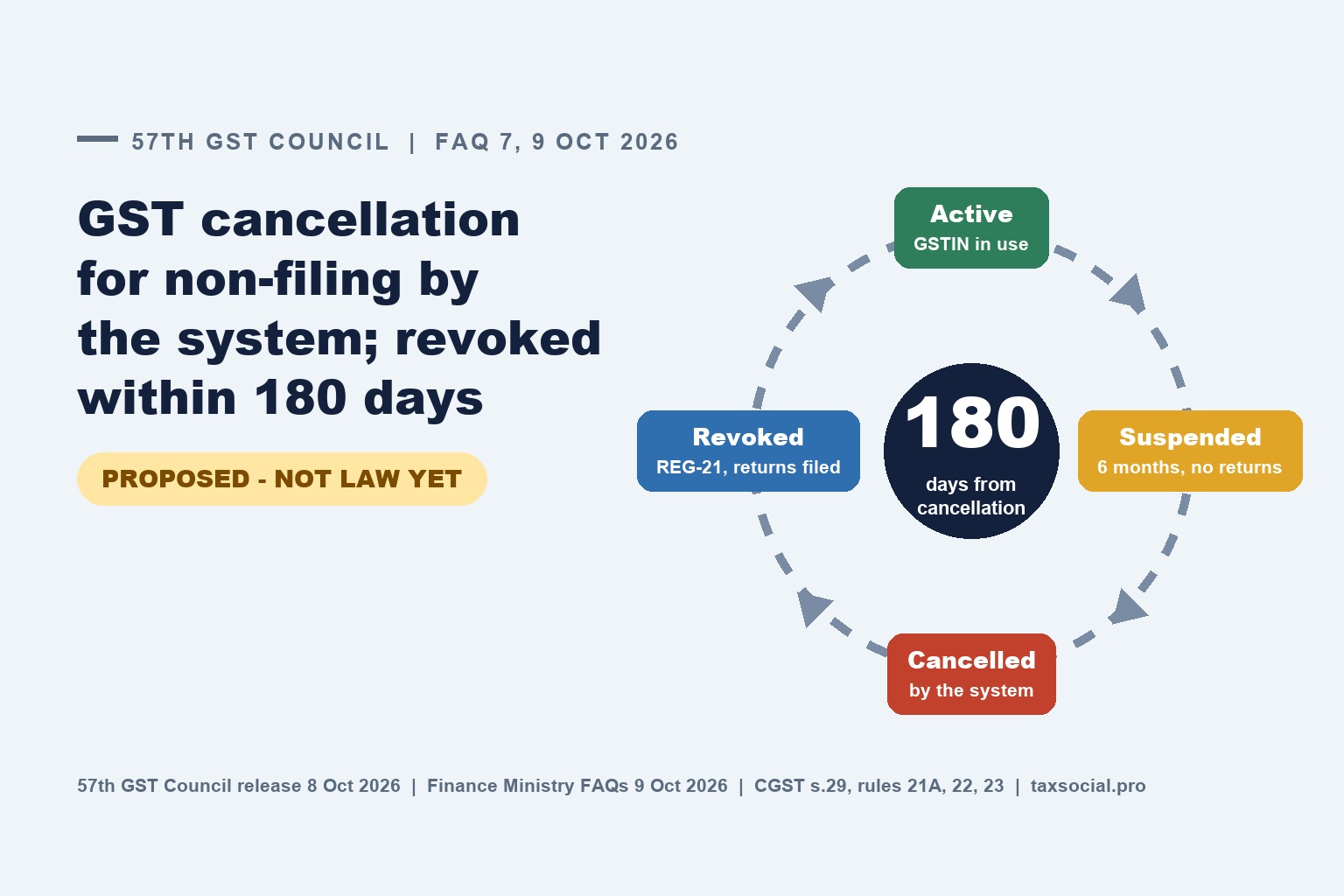

This is not law yet. Posts are going round saying GST cancellation for non-filing "is now system-driven" and that you "now get a clear 180-day window" for system revocation. That is what the 57th GST Council recommended on 8 October 2026, and what the Finance Ministry's FAQ of 9 October describes. Nothing has been notified. As of 26 October 2026, CBIC's list of new notifications and circulars has nothing on it after the Council meeting, the CGST Rules still have no rule 23A, and section 29 of the CGST Act still says an officer cannot cancel your registration without hearing you. Today an officer still cancels, and an application to revoke a cancellation is still due within 90 days of service of the order, extendable by up to 180 days more. Below: what is coming, what it would mean for a business that has fallen behind on returns, and what to do under the law as it stands.
1. What was announced
Item 3.1.2 of the Council's press release recommends amending rules 21A and 22 of the CGST Rules and inserting a new rule 23A, "to provide for a mechanism of system based cancellation and revocation of registration based on non-compliance and subsequent compliance of the defaults of non-filing return or non-furnishing of the details of the bank account, within specified time period."
The Finance Ministry's FAQs on cancellation of registration, posted on PIB the next day, explain it in FAQ 7. Where the system has suspended a registration for non-filing of returns for six consecutive months, or for not furnishing bank account details under rule 10A, "section 29 is being amended to provide for registration to be cancelled by the system, without intervention of officer". And if the taxpayer then cures the default and applies for revocation in FORM GST REG-21 within 180 days of the date of cancellation, the system will revoke the cancellation.
So two defaults are covered: returns not filed, and bank account details not furnished. The FAQ's example is six consecutive months of non-filing, which is today's trigger for monthly filers under rule 21(h). For quarterly filers, rule 21(i) uses two tax periods; the release speaks of "non-filing return" without separating the two.
We covered all eight cancellation FAQs, including automatic acceptance of cancellation applications, in our article on the Finance Ministry FAQs. This piece is only about the non-filer: the business that stops filing, gets cancelled, and wants its GSTIN back.
2. Why it is not law yet
The Act has to change first. Section 29(2) lets the proper officer cancel registration for non-filing, and its first proviso says: "the proper officer shall not cancel the registration without giving the person an opportunity of being heard." A system cannot give a hearing, which is why the FAQ says section 29 "is being amended". That needs Parliament. Earlier changes to sections 29 and 30 came through Finance Acts (2020, 2022, 2023 and 2024), so a Finance Bill is the usual route, but no date has been announced.
The rules have to change too. Amendments to rules 21A and 22 and the new rule 23A need a CBIC notification. None has been issued. The CGST Rules on CBIC's tax information portal still show rules 21A, 22 and 23 in their existing form, and there is no rule 23A.
The Council itself says so. Its release ends: the recommendations "would be given effect through the relevant circulars/ notifications/ law amendments which alone shall have the force of law."
3. Today and what is proposed, side by side
| Law today | Proposed (not yet in force) | |
|---|---|---|
| Who cancels | The proper officer (section 29(2), rule 22) | The system, "without intervention of officer" |
| Before cancellation | Show cause notice in REG-17; reply in REG-18 within seven working days of service | Not yet set out. FAQ 7's question assumes cancellation follows if returns are not filed within one month of suspension; the answer does not confirm that period, and the Council says only "within specified time period" |
| Date cancellation takes effect | A date the officer decides, which can be retrospective (section 29(2), rule 22(3)) | Not stated |
| Time to apply for revocation | 90 days from service of the cancellation order (rule 23(1)) | 180 days from the date of cancellation |
| Extension | Up to 180 days more, on sufficient cause, by the Commissioner or an authorised officer not below Additional or Joint Commissioner | Not stated |
| Who decides revocation | The officer: revokes in REG-22 within 30 days, or rejects in REG-05 after a REG-23 notice and your REG-24 reply | The system, once the default is cured |
| What you must do first | If cancelled for non-filing: file the pending returns and pay the tax due on them with interest, penalty and late fee (rule 23(1)). In every case: Aadhaar authentication, or the alternative documents where no Aadhaar number has been assigned (rule 10B) | "Compliance of the said non-compliances": file the returns, or furnish the bank details. The new rule will set the detail |
4. What it would mean for you
The warning comes earlier, and there may be no one to explain to
Today the main lifeline for a non-filer is in rule 22(4). If you get a REG-17 notice for non-filing and, instead of replying, you "furnish all the pending returns and make full payment of the tax dues along with applicable interest and late fee", the officer must drop the proceedings and pass an order in REG-20. An officer is in the loop, and in practice a reply explaining illness, closure or a dispute can be read.
Under the proposal there is no officer in the loop. If the FAQ's one-month reading is what the rule ends up saying, the suspension becomes the real last warning: cure the default within the set period, or the registration goes. Treat any suspension notice as urgent, and keep the e-mail address and mobile number on your registration current, because that is where the notice will reach you.
Revocation becomes a matter of compliance, not discretion
Today an officer can reject a revocation application, after a REG-23 notice. Under the proposal, a taxpayer who cures the default and files REG-21 within 180 days gets the registration back by the system. For a genuine business that fell behind, that is the real gain: a predictable outcome, without having to persuade anyone.
The 180 days are not necessarily longer than today
Today's period is 90 days, plus up to 180 more if an officer agrees: up to 270 days in all, but the extra 180 are discretionary. The proposed 180 days look fixed. Two details matter:
- The clock runs from the date of cancellation, not from service. Today the 90 days start when the order is served on you. Under the proposal the period runs from the date of cancellation whether or not you have seen it.
- Nothing is said about day 181. The FAQ does not say whether an extension, or an application to an officer, will still be possible after the 180 days, or what route you will have instead. Wait for the rule before relying on anything beyond 180 days.
Questions the announcement leaves open
- The date the cancellation takes effect. Today an officer can cancel from a past date, and the third proviso to rule 23(1) then makes you file returns from that effective date. The FAQ does not say from which date a system cancellation will run.
- Section 30. Section 30(1) gives the right to apply for revocation to a person "whose registration is cancelled by the proper officer on his own motion", and section 30(2) has the officer decide it. A system cancellation and a system revocation do not obviously fit that wording. The FAQ mentions only section 29 being amended; expect the amendment or the new rule 23A to deal with it.
- Quarterly filers. Whether the system route applies after two missed quarters, as rule 21(i) does today, is not stated.
What does not change
- Your old liability survives. Section 29(3): cancellation does not affect your liability for tax and other dues for any period before cancellation, whether determined before or after it.
- The section 29(5) amount is still payable on cancellation: the credit on inputs and capital goods held in stock on the day before cancellation, or the output tax on them, whichever is higher.
- Suspension still stops you trading normally. Under rule 21A(3), while suspended you must not issue a tax invoice or charge tax, so your buyers cannot take credit on what you sell in that period. Under rule 21A(3A) no refund is granted during a suspension by the officer or under rule 21A(2A).
- The three-year bar on old returns. Section 39(11) says a return cannot be filed after three years from its due date, unless the Government allows it by a notification on the Council's recommendation. Where the cancellation was for non-filing, revocation needs the pending returns filed first. Inside a 180-day window this will rarely bite, but a business that lets cancellation drift for years can reach a point where the oldest returns can no longer be filed at all.
Bank account details: the same route
The second default is rule 10A: bank account details must be furnished within 30 days of the grant of registration, or before filing GSTR-1 or the IFF, whichever is earlier. Today rule 21A(2A)(b) already lets the system suspend for this, with an intimation in REG-31 asking you to explain within 30 days, and the suspension is deemed revoked once you comply, if the registration has not already been cancelled. The proposal extends that to system cancellation and system revocation.
5. What to do now, under the law as it stands
- Behind on returns but not yet cancelled: file the pending GSTR-3B and GSTR-1 now, and pay the tax with interest and late fee. If a REG-17 notice has come, doing exactly this makes the officer drop the proceedings under rule 22(4). The reply period is seven working days from service.
- Already cancelled by an officer: you have 90 days from service of the cancellation order to file REG-21, not 180. If the cancellation was for non-filing, first file the pending returns and pay the tax due on them with interest, penalty and late fee. Complete Aadhaar authentication under rule 10B (a person with no Aadhaar number gives the enrolment slip and one of the identity documents that rule lists). Past 90 days, the extension of up to 180 days is available only on sufficient cause, granted by the Commissioner or an officer authorised by him. Once revoked, file the returns for the gap period within 30 days of the revocation order.
- Do not wait on the new rule. Someone who believes the system now gives 180 days and files on day 120 may find the 90-day limit already gone, with the extension at an officer's discretion.
- Bank details: if you have a REG-31 intimation for rule 10A, add the bank account on the portal; the suspension is deemed revoked on compliance if the registration has not been cancelled.
- Late fee: the waiver of late fee on a GSTR-3B filed within the month is also only a recommendation; see our late fee waiver article.
6. What to watch for
- An amendment to section 29 of the CGST Act (and, we expect, section 30) in a Finance Bill or a CGST amendment Bill, and the notification bringing it into force.
- A CBIC notification amending rules 21A and 22 and inserting rule 23A. It will settle the open questions above: the period after suspension, the effective date of cancellation, and what happens after 180 days.
- A GSTN advisory when the portal starts cancelling and revoking by itself.
We will update this article when any of these issues. The rest of the meeting is in our 57th GST Council roundup.
Sources: Recommendations of the 57th Meeting of the GST Council, PIB, 8 October 2026 (Release ID 2320934), item 3.1.2 and closing note; "Frequently Asked Questions (FAQs) on cancellation of GST registration", Ministry of Finance, PIB, 9 October 2026 (FAQ ID 160399), FAQ 7; CGST Act sections 29, 30 and 39(11) and CGST Rules 10A, 10B, 21, 21A, 22 and 23 as on CBIC's tax information portal, read 26 October 2026; CBIC's list of new GST notifications and circulars, checked 26 October 2026.


Comments (0)
No comments yet. Be the first to comment!