
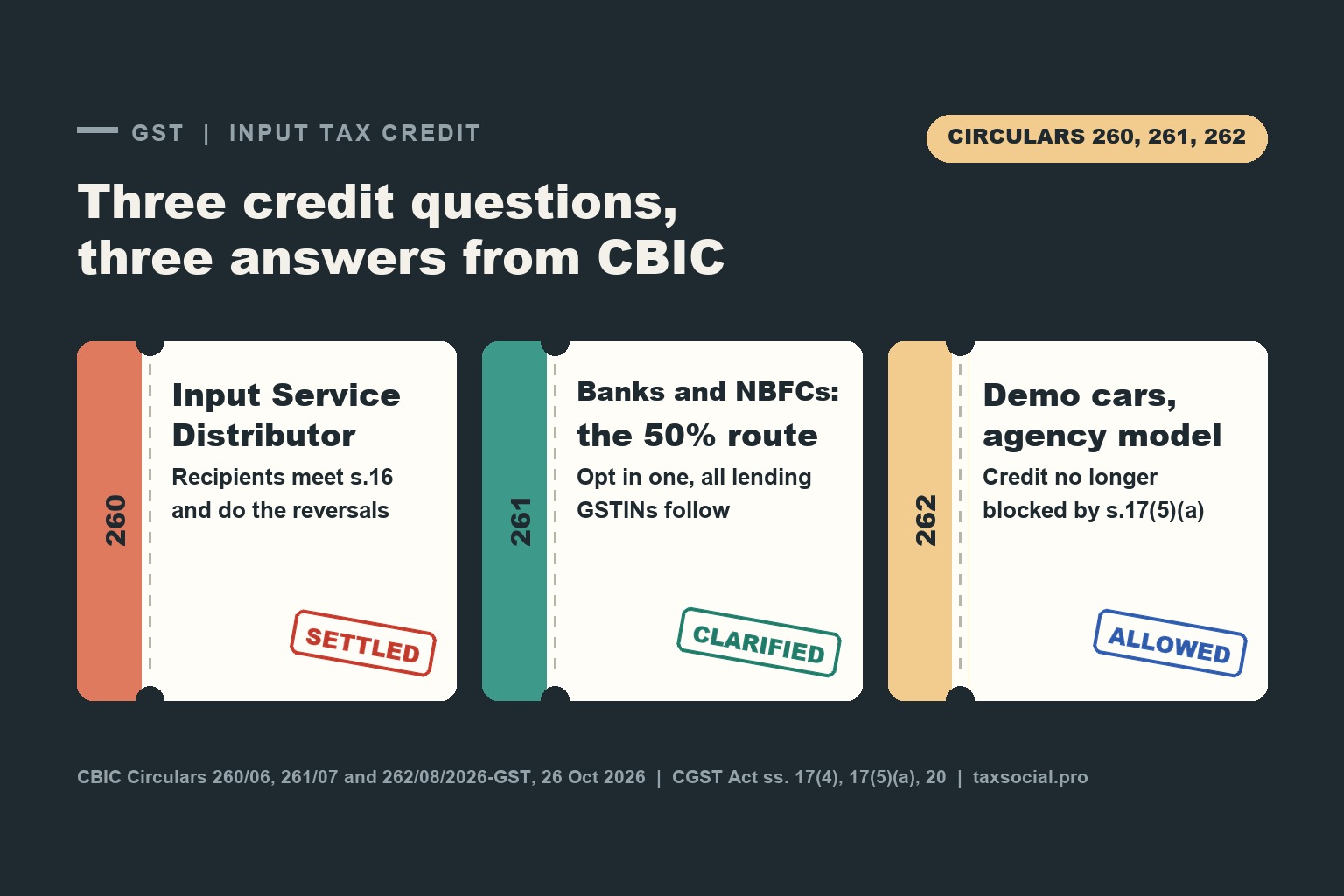

Three of the eight GST circulars CBIC issued on 26 October 2026 settle input tax credit questions that have produced years of audit objections.
- Circular No. 260/06/2026-GST, Input Service Distributors (ISD): each registration that receives input service invoices for or on behalf of other units, where the credit has to be distributed under section 20, needs its own ISD registration. The units receiving the credit, not the ISD, must meet the section 16 conditions and make the reversals. The rule 54(1A) cross-charge that moves reverse charge credit to the ISD is neither turnover nor Net ITC.
- Circular No. 261/07/2026-GST, banks, financial institutions and NBFCs: only registrations that take deposits or give loans can choose the 50% credit option in section 17(4). If one of them chooses it, all of them must. The credit is laid out step by step for GSTR-3B, with and without the Invoice Management System.
- Circular No. 262/08/2026-GST, car dealers: CBIC has withdrawn its own 2024 view and now accepts that credit on demo vehicles is not blocked by section 17(5)(a) for a dealer working under the dealer-agency model. The ordinary conditions for credit still apply.
1. Input Service Distributors: Circular 260
An ISD is an office that receives invoices for input services, including services taxed under reverse charge, for or on behalf of distinct persons (other registrations on the same PAN), and distributes the credit under section 20. The circular answers seven questions.
Who needs an ISD registration
A business with separate registrations for different verticals or places of business in the same State has a distinct person for each registration (sections 25(2) and 25(4)). The circular finds no bar on more than one ISD registration in a State. It says each registrant that receives input service invoices for or on behalf of distinct persons must take an ISD registration. Under rule 39(1), credit can go only to the distinct persons to whom it is attributable.
Who must meet the conditions, and who reverses
- The recipients of credit must satisfy the conditions in sections 16 and 17 and the rules: possession of the invoice, receipt of the service, tax actually paid by the supplier, and so on. The ISD's job is to distribute in the manner section 20 lays down.
- Reversals belong to the recipients. The ISD distributes the entire credit available to it to the recipients to whom it is attributable. Reversals under section 17(1) or 17(2) (with rules 42 and 43), or under section 17(4) (with rule 38), are made by the recipients.
- If distribution goes wrong, the ISD faces a penalty under section 122(1)(ix): Rs 10,000 or the tax evaded or credit distributed irregularly, whichever is higher. Any excess credit is recovered from the recipients, with interest, under section 21 read with section 73, 74 or 74A.
What "available for distribution in a month" means
Rule 39(1)(a) requires credit available for distribution in a month to be distributed in the same month and reported in GSTR-6. The circular reads "available" practically. Once invoices reach the ISD's GSTR-6A, the credit becomes available for distribution only when the ISD has ascertained that it is prima facie eligible. It must then be distributed in the month of that ascertainment, split into eligible and ineligible credit as rule 39(1)(g) requires. The ISD does not avail credit itself. But it is the one holding the invoices for centrally procured services, so it is best placed to make the first eligibility call.
The rule 54(1A) cross-charge
Where a regular registration on the same PAN and in the same State as the ISD has paid reverse charge tax on input services attributable to one or more distinct persons, it can issue an invoice, credit note or debit note to the ISD under rule 54(1A) to pass that credit across for distribution. The circular calls this "merely a credit transferring mechanism" and draws three conclusions:
- The value on that document is not turnover in the State of the issuing registration under section 2(112), even though it may have to be declared in its GSTR-1 to reach the ISD. So it is left out of the turnover ratio used to distribute ISD credit, and out of "adjusted total turnover" for a refund under section 54(3) and rule 89.
- The credit transferred is not Net ITC of the issuing registration for the refund formulae in rules 89(4) and 89(5).
- The issuing registration makes no reversal under section 17(1), 17(2) or 17(4) on that credit. It passes the whole amount to the ISD. The recipients reverse, and the issuing registration may itself be one of them.
The first two answers matter most to exporters and inverted-duty refund claimants that also act as the same-State conduit for the ISD. Including the cross-charge would have inflated their turnover or their Net ITC.
2. Banks, financial institutions and NBFCs: Circular 261
Section 17(4) gives a banking company or financial institution, including an NBFC, that supplies services by way of accepting deposits or extending loans or advances an option. Instead of splitting credit between taxable and exempt supplies under section 17(2), it can avail 50% of the eligible credit on inputs, input services and capital goods every month and let the rest lapse. Under the first proviso, once the option is exercised it cannot be withdrawn for the rest of that financial year. Under the second proviso, the 50% restriction does not apply to tax on supplies from another registered person with the same PAN.
Who can opt, and who must
- A registration of such an entity that does not accept deposits or give loans or advances, for example one engaged only in bullion trading, can neither opt for section 17(4) nor be made to follow it.
- A registration that does accept deposits or lend, even if it supplies other services too, may opt.
- If one such registration opts, every registration of that entity that accepts deposits or lends must follow section 17(4). The option cannot be taken State by State.
The same-PAN relaxation
The second proviso applies only to supplies received from another same-PAN registration that has also opted for section 17(4). Credit on supplies from a same-PAN registration outside the option, such as the bullion desk above, falls within the 50% restriction.
How to report in GSTR-3B
Circular 170/02/2022-GST already set out the general GSTR-3B reporting. For an entity on the 50% route, Circular 261 adds the following.
Without IMS. Take the credit auto-populated from GSTR-2B (other than reverse charge credit) plus the reverse charge credit claimed. Find what is eligible under section 16, then:
- Reverse permanently, in Table 4(B)(1), credit on inputs and input services used for non-business purposes and credit attributable to section 17(5) items.
- Avail in full the credit on supplies from same-PAN registrations covered by the second proviso.
- Avail 50% of what remains, and reverse the other 50% permanently in Table 4(B)(1) of the same return.
Credit not yet eligible because a section 16 condition is unmet is reversed temporarily in Table 4(B)(2). When the condition is met, it is reclaimed in Table 4(A)(5) of a later return, shown in Table 4(D)(1), and put through the same three steps. The reclaim must come within the section 16(4) time limit.
With IMS. This applies once the IMS amendments to the CGST Rules are notified, and also to cases where IMS was already in use before that. Keep pending on IMS any invoice whose credit is not yet eligible, so that it stays out of GSTR-2B. Accepted and deemed-accepted documents flow into GSTR-2B and GSTR-3B. That amount, plus reverse charge credit, goes through the same three steps.
Past periods. Officers are told not to take an adverse view of a different reporting method used earlier, "as long as the amount of ITC availed" under section 17(4) is consistent with these principles. A presentation difference in GSTR-3B is not, by itself, a ground for a demand. A difference in the amount still is.
3. Demo vehicles under the dealer-agency model: Circular 262
Section 17(5)(a) blocks credit on motor vehicles for transporting persons with a seating capacity of up to 13 (including the driver). The exceptions include vehicles used for making a taxable "further supply of such motor vehicles". In September 2024, Circular 231/25/2024-GST allowed a dealer credit on demo vehicles used to promote its own sales. But paragraph 4.6 denied it where the dealer only acts as an agent of the manufacturer, which sells to the customer directly (the dealer-agency model). The dealer there was said not to be making a further supply of motor vehicles on its own account.
Circular 262 withdraws paragraph 4.6. It reasons that:
- demo vehicles serve the same purpose in both models, letting a buyer drive before buying;
- in both they are bought from the manufacturer on tax invoices, usually capitalised, held for a mandatory period and then sold with tax paid;
- the Central Motor Vehicles Rules treat them alike;
- the phrase "such motor vehicles" in section 17(5)(a)(A), rather than "said motor vehicle", covers vehicles used to further the supply of similar vehicles, not only the vehicle itself.
Denying credit to one model was "discriminatory". Credit on demo vehicles is therefore not blocked under section 17(5)(a) for a dealer in the agency model.
What still applies, from Circular 231 and the Act:
- Capitalised demo vehicles are capital goods. If you claim income-tax depreciation on the GST component, section 16(3) denies the credit on that component.
- Selling the demo vehicle later attracts tax on the sale, and section 18(6) applies to capital goods on which credit was taken.
- Time limits. The circular does not extend the section 16(4) time limit. Credit on a demo vehicle invoiced in 2025-26 that was not claimed because of paragraph 4.6 can still be taken in a return filed by 30 November 2026, or by the date the 2025-26 annual return is filed if that is earlier. That holds only if the other section 16 conditions are met (the invoice in GSTR-2B, receipt, tax paid by the supplier) and no depreciation has been claimed on the GST component. For earlier years, the time limit has generally passed. A dealer facing a demand or appeal over credit already taken under the agency model should rely on the withdrawal in that proceeding. Our section 16 and 30 November article covers the time limit.
4. What to do now
| You are | Check |
|---|---|
| A group with several registrations in a State and central procurement | Whether each registration that receives common input service invoices has its own ISD registration; that recipient units, not the ISD, are reversing; and that rule 54(1A) cross-charge values are out of your turnover and Net ITC in refund claims |
| A bank, NBFC or financial institution on the 50% route | That every lending or deposit-taking registration follows it, that non-lending registrations do not, that the same-PAN full credit is taken only from opted registrations, and that the GSTR-3B tables match the circular going forward |
| A car dealer under the agency model | Whether any 2025-26 demo vehicle credit is still claimable before the earlier of 30 November 2026 and filing the 2025-26 annual return, with all section 16 conditions met and no depreciation on the GST component; and any pending notice or appeal based on paragraph 4.6 |
The other circulars from the same day cover notices, orders and pre-deposits, registration applications and the rule 96(10) omission.
Sources: CBIC Circular No. 260/06/2026-GST, Circular No. 261/07/2026-GST and Circular No. 262/08/2026-GST, all dated 26 October 2026 (Circular 262 attached); Circular No. 231/25/2024-GST, 10 September 2024; Circular No. 170/02/2022-GST, 6 July 2022, as referred to in Circular 261; CGST Act sections 2(61), 16, 17, 20, 21, 25 and 122(1)(ix) and CGST Rules 38, 39 and 54(1A) as quoted in the circulars.



Comments (0)
No comments yet. Be the first to comment!