

Correction, 14 October 2026. This article has been rewritten. The version published on 12 April 2026 described Rule 14A as a power of the department to restrict a registration it suspects. That was wrong. Rule 14A is an optional scheme the taxpayer chooses at registration, and the Rs 2.5 lakh figure the earlier version called a "system-driven indicator" is written into the rule itself. We regret the error.
Rule 14A of the CGST Rules is the simplified GST registration scheme, in force since 1 November 2025. An applicant who expects output tax on supplies to registered buyers of no more than Rs 2.5 lakh a month can tick "Yes" for it in REG-01 and, after Aadhaar authentication, get registration within three working days.
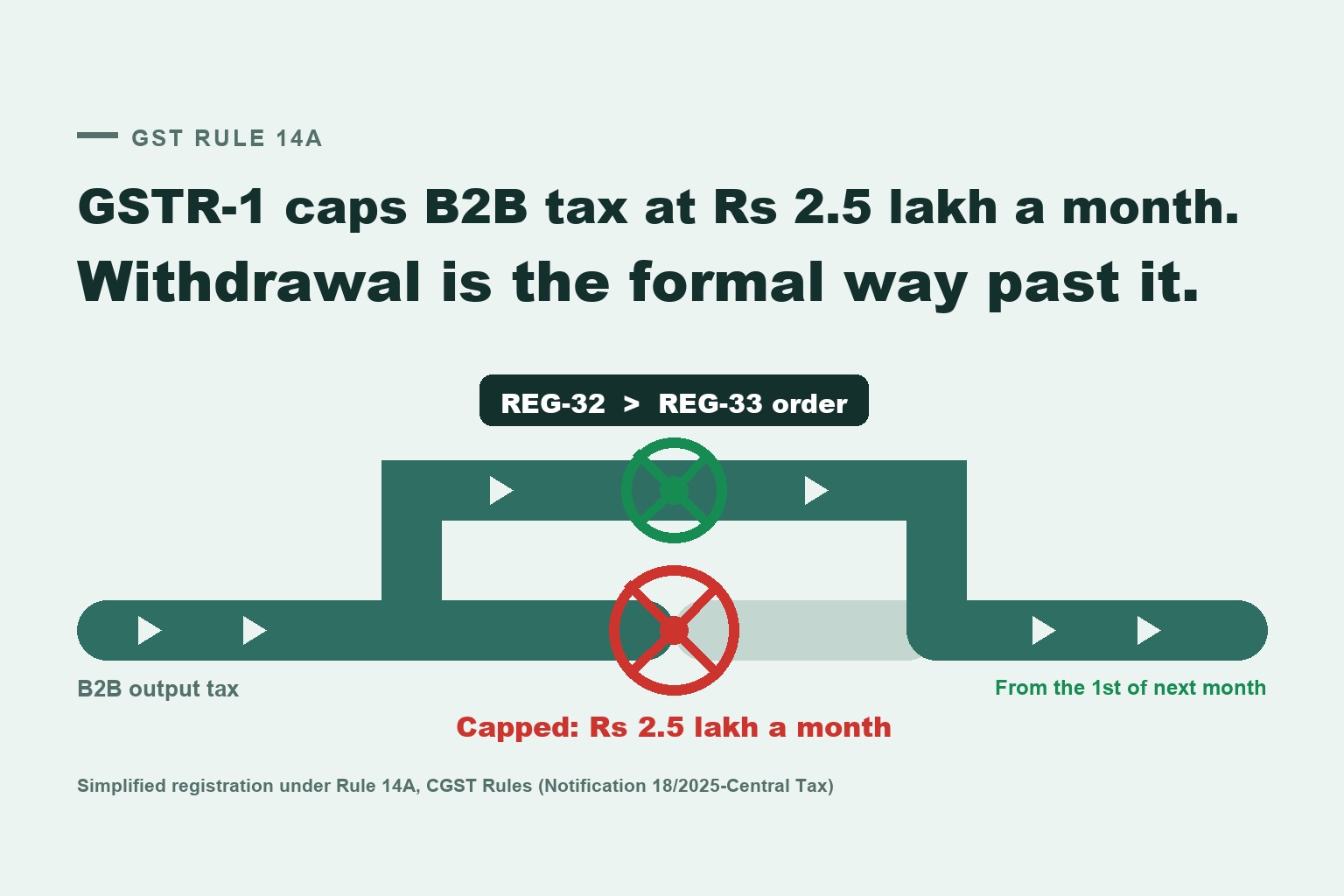
- The cap is the condition you accepted. Until an officer allows you to leave the scheme, you cannot report more than Rs 2.5 lakh a month of output tax on B2B supplies. That is the "GSTR-1 restriction" people run into.
- The way out is withdrawal: file FORM GST REG-32 (online since 21 February 2026). The officer verifies it under Rule 9 and either allows it in REG-33 or rejects it in REG-05.
- Withdrawal only helps from the next month. After the REG-33 order you can report above the cap from the first day of the month after the order, and you cannot go back and amend earlier months above it.
- So plan ahead. If your B2B sales are about to grow, apply to withdraw before you cross the cap, not after.
1. What Rule 14A actually is
Rule 14A was inserted into the CGST Rules by Notification No. 18/2025-Central Tax dated 31 October 2025, in force from 1 November 2025. Its heading says what it is for: an "option for taxpayers having monthly output tax liability below threshold limit". The key parts:
- Who can opt in (sub-rule 1). Anyone applying for registration under Rule 8 who determines that their total output tax on supplies of goods or services made to registered persons will not exceed Rs 2.5 lakh a month. The figure counts central tax, State or Union territory tax, integrated tax and compensation cess together. Supplies to consumers and other unregistered buyers do not count towards it.
- Aadhaar is compulsory (sub-rule 2). Without Aadhaar authentication you cannot get a Rule 14A registration, except for persons notified under section 25(6D). REG-01 instruction 8A requires OTP-based Aadhaar authentication for anyone opting in.
- Fast grant (sub-rule 4). On successful Aadhaar authentication, the portal grants registration electronically within three working days of the application.
- One per State (sub-rule 3). A person registered under Rule 14A in a State or Union territory cannot get another Rule 14A registration there on the same PAN. An ordinary registration under Rule 8 is still open.
You opt in yourself, at serial 4.1 of Part-B of REG-01, and you sign a declaration (4.1.1) that the business "shall abide by the conditions and restrictions" that come with it. No officer imposes Rule 14A on anyone.
2. Why GSTR-1 will not take more than Rs 2.5 lakh
The restriction is in sub-rule (11). A Rule 14A registrant becomes able to furnish output tax on supplies to registered persons above Rs 2.5 lakh only after receiving an order allowing withdrawal, and only "from the first day of succeeding month in which the said order has been issued". GSTN's advisory of 21 February 2026 says the same. Until then, the cap applies every month.
So if you are registered under Rule 14A and your B2B sales grow past the cap, you will not be able to report the excess. There is no switch for the officer to "remove a restriction". The only route past the cap is to leave the scheme.
Two consequences follow, and both are written into the rule:
- No retrospective relief. Sub-rule (12): after the withdrawal order, you cannot amend what you reported for earlier months so as to exceed the cap. If the order is issued on 20 October, you can report above Rs 2.5 lakh from 1 November. October and earlier stay capped.
- Your buyers feel it first. A registered buyer's credit depends on your GSTR-1. If B2B supplies made in a capped month cannot be reported, the buyer does not see that credit for that month.
The rules do not say how a supply made above the cap before the order should be reported. If you are already in that position, take advice on the specific facts before filing. Do not move B2B invoices into the B2C tables to get around the cap: that is a misreport, and it denies your buyer the credit anyway.
3. Leaving the scheme: REG-32, step by step
Sub-rules (5) to (10) and FORM GST REG-32 set out the procedure. GSTN switched on the online facility on 21 February 2026. Before that there was no way to file the form on the portal, which is why many people in early 2026 found themselves stuck at the cap.
- Check you are eligible. You can file REG-32 only if you have filed:
- returns for at least one tax period (the rule required three months for applications filed before 1 April 2026), and
- every return due from the effective date of registration up to the date of the application.
- Update your registration first. If anything you gave in REG-01 has changed, get it amended under Rule 19 before applying (sub-rule 6). No amendment application may be pending when you file REG-32.
- File the form. On the portal: Services > Registration > Application for Withdrawal from Rule 14A. The link appears only if you are an active Rule 14A registrant. The option field is set to "No", and you give a reason. The form offers "output tax liability in respect of supply made to registered person exceeds two lakh fifty thousand rupees per month", or "Other".
- Authenticate Aadhaar. The Primary Authorised Signatory and one Promoter or Partner must authenticate. Depending on the portal's risk check, that is OTP-based or biometric. Biometric authentication comes with a photograph and verification of the original documents uploaded with REG-01 (sub-rule 7). The ARN (application reference number) is generated only after authentication.
- Watch the two 15-day windows in GSTN's advisory. A draft must be submitted within 15 days of creation, and Aadhaar or biometric authentication completed within 15 days of submission. Otherwise no ARN is generated.
- Officer verification. The application is verified under Rule 9 (sub-rule 9), the same way as a new registration application. Ordinarily the officer must act within seven working days. Where physical verification of your place of business applies, the limit is thirty days. The officer may ask for clarification in REG-03, and you reply in REG-04 within seven working days.
- The order. The officer allows the withdrawal in REG-33 or rejects it in REG-05 (sub-rule 10). The REG-33 order says the amended registration certificate is on your dashboard.
While REG-32 is pending you cannot file any amendment application, core or non-core, or an application to cancel your registration. Settle anything you need to change before you apply.
Deemed approval, with one exception. The application is verified under Rule 9, and sub-rule (13) switches off Rule 9(5)'s deemed approval in one case only. Read together, that means that if the officer does not act within the Rule 9 time limits, the application can be deemed approved under Rule 9(5). The exception: if the officer starts cancellation proceedings after you file and they are still pending, the application must be rejected, and deemed approval does not apply.
4. Who should opt in, and who should not
Rule 14A suits a business that sells mostly to consumers, or sells to registered buyers on a small scale with no plans to grow that side soon. It gets you registered in days instead of waiting on an officer.
It is a poor choice if:
- your B2B sales could cross Rs 2.5 lakh of tax in any month in the next year or so. At an 18% rate, that is roughly Rs 13.9 lakh of taxable B2B sales in a month. At 5% it is Rs 50 lakh.
- you expect a large one-off order. The cap is monthly, so a single month can breach it.
- you plan to sell through e-commerce warehouses in other States. The proposed Rule 14B scheme for e-commerce sellers needs a home-State registration that is not under Rule 14A. The Finance Ministry's FAQ 7 says a Rule 14A registrant must first withdraw through REG-32. See our article on the Rule 14B FAQs.
If you already hold a Rule 14A registration in a State and need a second registration there on the same PAN, Rule 14A(3) rules out a second Rule 14A registration. It does not bar an ordinary one, but an ordinary second registration still has to meet its own conditions under section 25(2) and Rule 11, such as a separate place of business. Our REG-01 auto-population article covers that trap.
5. If you are not under Rule 14A: the other reasons GSTR-1 gets blocked
If your GSTIN was not registered under Rule 14A, a blocked GSTR-1 has a different cause. Rule 59(6) stops you furnishing GSTR-1, or using the invoice furnishing facility, where:
- you have not filed GSTR-3B for the preceding month, or for the preceding tax period if you file quarterly (clauses a and b);
- you have received an intimation under Rule 88C, about tax in GSTR-1 exceeding tax paid in GSTR-3B, and have neither paid nor replied. GSTR-1 or IFF for the following tax periods stays blocked until you do (clause d);
- you have received an intimation under Rule 88D, about credit in GSTR-3B exceeding what GSTR-2B supports, and have neither paid nor replied. Again, the block is on later tax periods until you do (clause e);
- you have not given bank account details as Rule 10A requires (clause f).
Each of these clears once you do what the rule asks. None of them involves REG-32, which is only for leaving Rule 14A.
6. What the 57th GST Council proposed for Rule 14A registrants
On 8 October 2026 the Council recommended two changes that touch this scheme. Neither is law until they are notified.
- Amendments. Changes to registration particulars would be accepted automatically on the portal, except a change of principal place of business. For Rule 14A registrants, even that would be automatic.
- Cancellation. This proposal is for all registered persons, not only Rule 14A registrants. In a first phase, cancellation on your own application would be accepted automatically, once all returns are filed and dues paid, only for two groups: those who never passed on credit above Rs 2.5 lakh in any month, and those who did but filed the final return (GSTR-10) in time. A Rule 14A registrant who stayed within the cap falls in the first group. A second phase would extend automatic acceptance to all applications. This needs amendments to the Act and the rules.
The recommendations as published say nothing about the REG-32 withdrawal procedure. The full list is in our 57th Council roundup.
Checklist
- Check your registration certificate or REG-01 to see whether you opted for Rule 14A.
- Track your monthly output tax on B2B supplies against Rs 2.5 lakh, including compensation cess.
- If you will cross the cap, file all pending returns, finish any amendment, then file REG-32 well before the month you expect to cross.
- Keep the Aadhaar holders available. Authentication may be biometric, at a facilitation centre.
- Remember the order works from the first of the following month, not from the day it is issued.
Sources: Notification No. 18/2025-Central Tax, G.S.R. 805(E), 31 October 2025 (Rule 14A, FORM GST REG-01 Part-B serial 4.1, FORM GST REG-32 and its instructions, FORM GST REG-33); GSTN advisories "Advisory for Simplified GST Registration Scheme" (1 November 2025) and "Facility for Withdrawal from Rule 14A" (21 February 2026); CGST Rules 9 and 59(6); Recommendations of the 57th Meeting of the GST Council, PIB, 8 October 2026.


Comments (0)
No comments yet. Be the first to comment!