
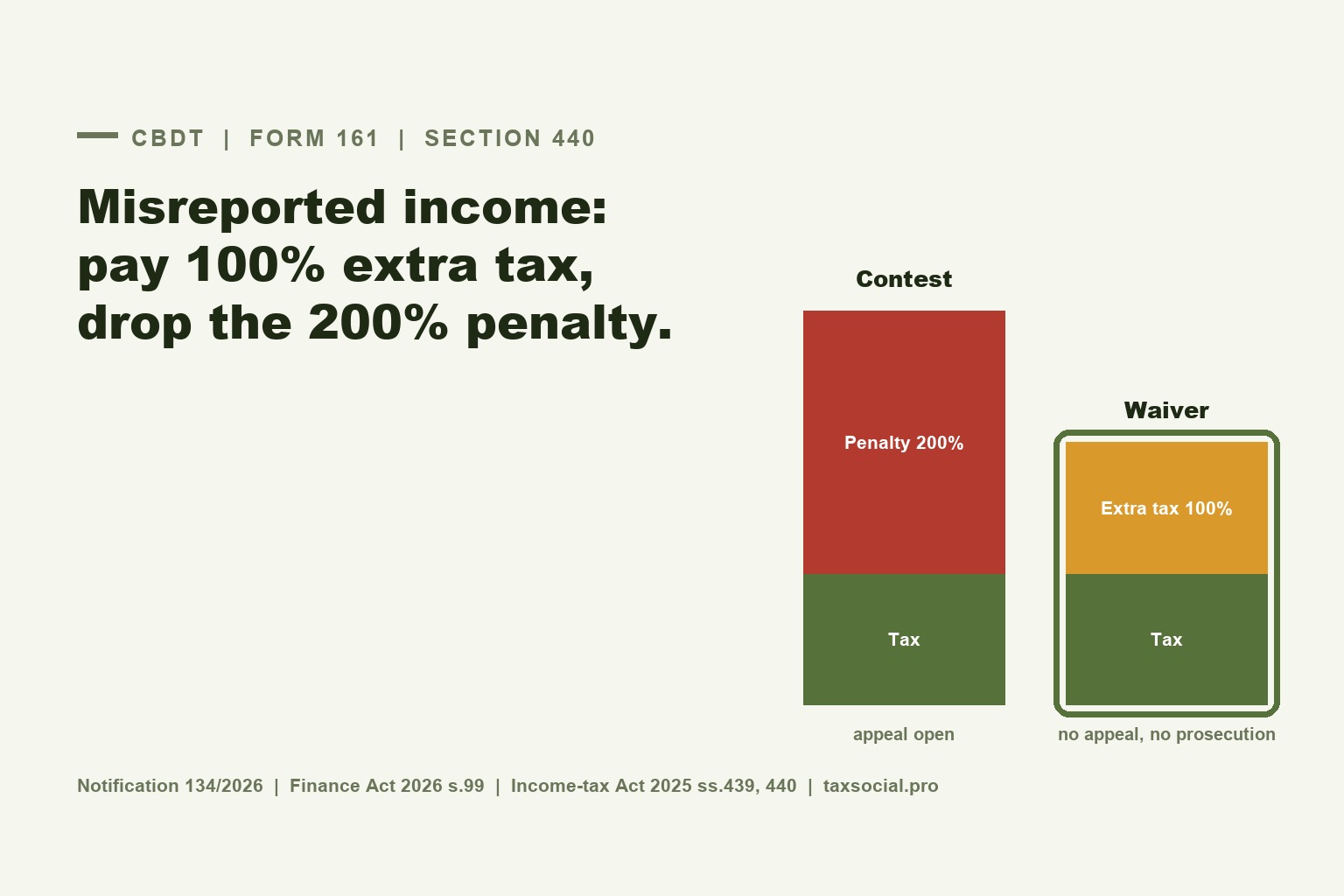

On 8 October 2026 the CBDT notified a new Form 161 (Notification No. 134/2026, the Income-tax (Sixth Amendment) Rules, 2026) for applying to waive the penalty under section 440(2) of the Income-tax Act, 2025. The form matters because section 440 is no longer the old section 270AA. The Finance Act, 2026 rewrote it from 1 April 2026. Waiver is now available even where income was misreported, which the old law and the original 2025 Act both refused, but at a price: the assessee must pay additional income-tax of 100% of the tax on the under-reported income (misreporting cases in section 439(11)(a) to (f)), or 120% for unexplained income caught by the new clause (g), in lieu of the penalty. All tax, interest and additional tax must be paid within the demand notice period, no appeal can be filed, and the application must be made within a month of the end of the month in which the order is received. The new form has fields for exactly these amounts.
1. What the notification does
Notification No. 134/2026, G.S.R. 871(E), dated 8 October 2026, issued under sections 533 and 440 of the Act, in force on publication in the Gazette:
- Rule 231: after "imposition", the words "or waiver" are inserted. The rule was framed in March 2026 for an application to "grant immunity from imposition of penalty under section 439". Now it covers waiver too.
- Form No. 161 is substituted, titled "Application for seeking waiver of penalty under section 440(2) of the Income-tax Act, 2025".
The rules had been out of step with the Act for six months. The Income-tax Rules, 2026 were notified on 20 March 2026 against the text of section 440 as originally enacted. The Finance Act, 2026 substituted section 440(1) to (4) with effect from 1 April 2026, the same day the Act and the Rules came into force. The new form closes that gap.
2. Section 440 before and after the Finance Act, 2026
| Section 440 as enacted (2025) | Section 440 as substituted by the Finance Act, 2026 (from 1 April 2026) | |
|---|---|---|
| Heading | Immunity from imposition of penalty, etc. | Waiver of penalty and immunity from prosecution |
| What you get | Immunity from penalty under section 439 and from prosecution under sections 478 and 479 | Waiver of penalty levied under section 439, and immunity from prosecution under sections 478 and 479 |
| Under-reporting (not misreporting) | Pay tax and interest within the demand period; no appeal against the order | Pay tax and interest within the demand period; no appeal against the order or the levy of penalty; operates on a penalty already levied |
| Misreporting, section 439(11)(a) to (f) | No immunity (section 440(4)) | Available if, in addition, additional income-tax of 100% of the tax on under-reported income is paid within the demand period |
| Unexplained income, section 439(11)(g) (new) | Not a misreporting case; separate penalty of 10% of the tax payable under section 195(1)(i), under section 443 | Available on additional income-tax of 120% of the tax on under-reported income |
| Bar | Misreporting cases | Any proceeding initiated under Chapter XXII (offences and prosecution) |
| Time to apply | Within one month from the end of the month in which the order is received | |
Section 440(5) to (8) were not touched. The Assessing Officer must decide within three months from the end of the month the application is received. A rejection needs a hearing first. The order is final. And once the application is accepted, no appeal or revision lies against the assessment order.
3. What "misreporting" covers
Section 439(10) sets the penalty for misreporting at 200% of the tax on under-reported income, against 50% for plain under-reporting under section 439(9). Section 439(11) lists the misreporting cases:
- (a) misrepresentation or suppression of facts;
- (b) failure to record investments in the books;
- (c) claim of expenditure not substantiated by any evidence;
- (d) a false entry in the books;
- (e) failure to record a receipt with a bearing on total income;
- (f) failure to report an international transaction or specified domestic transaction under Chapter X;
- (g) inserted by the Finance Act, 2026: "income referred to in section 195(1)(b)".
So the waiver trades a 200% penalty for 100% (or 120%) additional tax, paid upfront, with no appeal.
4. Clause (g): unexplained income, and why 120%
Section 195(1)(b) covers income under sections 102 to 106 (unexplained credits, investments, assets such as money, bullion and jewellery, expenditure, and amounts borrowed or repaid on a hundi: the old sections 68 to 69D) that the Assessing Officer determines and that was not shown in the return. The Finance Act, 2026 changed three things together:
- the tax rate on such income in section 195(1) was cut from 60% to 30%;
- section 443, the separate penalty of 10% of the tax on such income (which displaced the section 439 penalty), was omitted;
- such income, where determined by the AO, became a misreporting case under section 439(11)(g), so the 200% penalty applies, or waiver on 120% additional tax.
At base rates only, the cost of an unexplained addition settled through the waiver works out the same as before: 30% tax plus 120% of 30% is 66% of the income, which is what 60% tax plus a penalty of 10% of that tax came to. This is not an all-in figure: the Finance Act, 2026 levies a 25% surcharge on income taxed under section 195(1)(i), and cess applies, so the actual amounts are higher. What changed is the route. The rate is lower, but the alternative to paying is now a 200% penalty and possible prosecution, not a 10% penalty. Unexplained income disclosed in the return under section 195(1)(a) is not under-reported, so none of this applies to it.
5. The new Form 161, field by field
- Part A: name, PAN, address, mobile and email.
- Part B: tax year; the section under which the order was passed; its DIN; date of the order; date of service; due date for payment in the notice of demand; income assessed; under-reported income split into (A) in consequence of misreporting, (i) under section 439(11)(a) to (f) and (ii) under section 439(11)(g), and (B) not in consequence of misreporting.
- Items 13 to 16: tax and interest on assessed income; tax on the under-reported income at items 12(A)(i) and (ii) under section 439(12); additional income-tax in lieu of penalty at 100% of the first and 120% of the second; and the total payable for the waiver.
- Item 17: challan details (BSR code, date, serial number, amount) of what has been paid.
- Verification: a declaration that no appeal has been filed against the order, and an undertaking that none will be filed before the period in section 440(5) runs out.
Note 3 says the total must be paid within the due date in the notice of demand. Note 4 says some fields will be pre-filled.
6. A worked example
An assessment adds Rs 10 lakh of unsubstantiated expenditure (section 439(11)(c)) for an individual taxed at 30% on the margin. Ignoring surcharge and cess and interest for simplicity:
| Contest, and lose | Apply for waiver | |
|---|---|---|
| Tax on under-reported income | Rs 3,00,000 | Rs 3,00,000 |
| Penalty (200%) / additional income-tax (100%) | Rs 6,00,000 | Rs 3,00,000 |
| Prosecution exposure | Remains | Immunity from initiation of proceedings under sections 478 and 479 (if no Chapter XXII proceeding has already begun) |
| Appeal | Available | Given up |
If the addition is weak, appeal. If it is sound, the waiver halves the penalty cost and closes the matter. Watch two separate deadlines: everything must be paid by the due date in the notice of demand, and Form 161 itself must be filed within one month from the end of the month in which the order was received. Depending on the dates, the application deadline can come first.
7. Points to watch
- "Levied". The new section 440 speaks of waiving a penalty "levied". From 1 April 2027, under section 471(4) as inserted by the same Finance Act, the section 439 penalty is to be part of the assessment or reassessment order itself. Until then, penalty orders may follow assessments separately; how the waiver works where the penalty has not yet been levied when the demand falls due is a practical question the form does not answer.
- Mixed additions. An order may contain plain under-reporting and misreporting together. The form handles this by splitting under-reported income into its parts, and the additional tax applies only to the misreporting parts.
- Chapter XXII (offences and prosecution). If any proceeding under that chapter has already been initiated, no waiver or immunity can be granted.
- Interest. Interest is not waived; it is part of the amount payable at item 13.
Source: Notification No. 134/2026, G.S.R. 871(E), 8 October 2026 (Income-tax (Sixth Amendment) Rules, 2026), from incometaxindia.gov.in; Income-tax Act, 2025 (30 of 2025), sections 195, 439, 440 and 443 as enacted (Gazette); Finance Act, 2026, sections 1(2), 55, 98, 99, 100 and 107 (Gazette); Income-tax Rules, 2026, rule 231 as notified on 20 March 2026.






Comments (0)
No comments yet. Be the first to comment!