
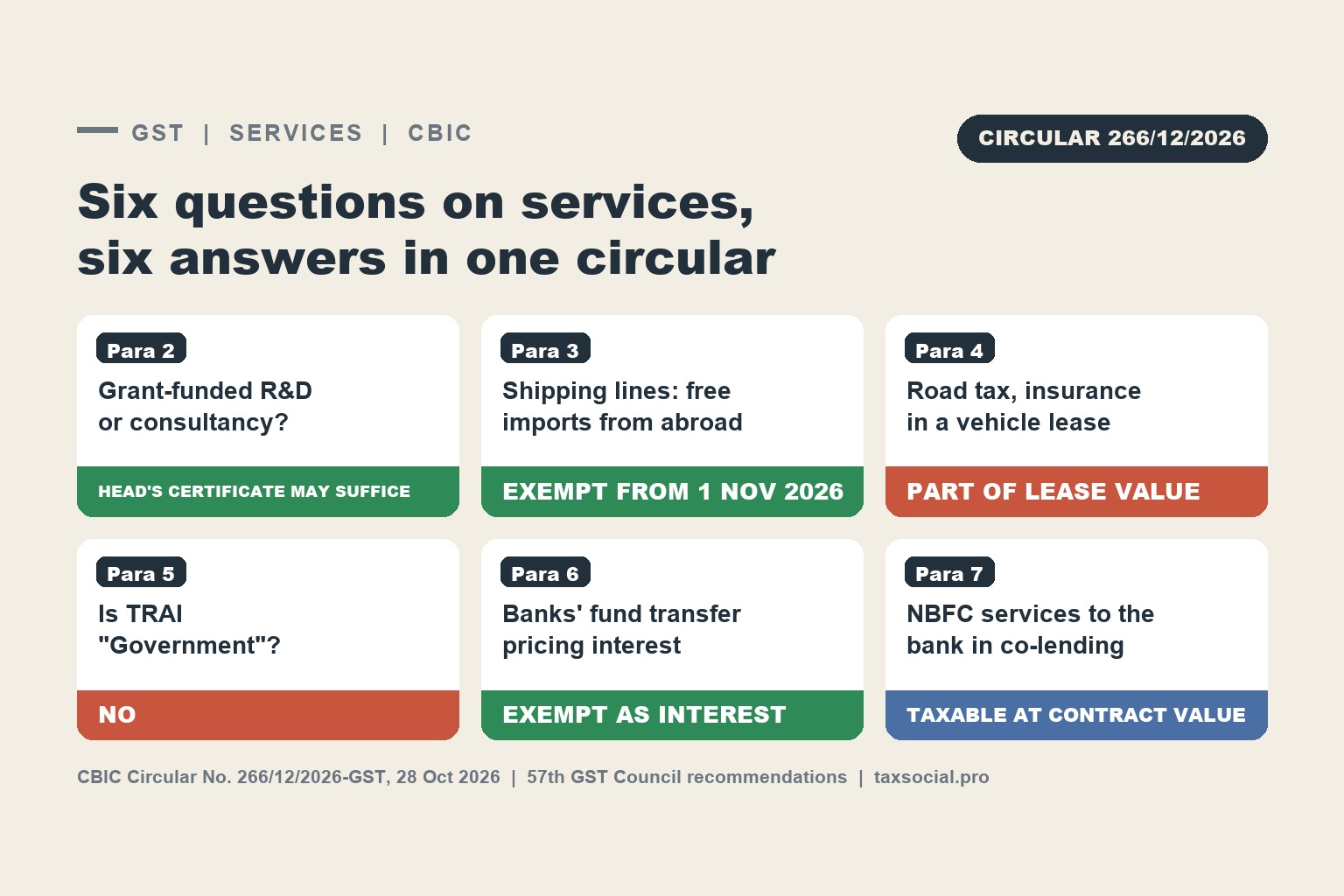

CBIC has settled six GST questions on services in one circular. Circular No. 266/12/2026-GST, dated 28 October 2026, implements clarifications the 57th GST Council recommended on 8 October. In brief:
- Grant-funded R&D: a certificate from the head of the institution that the work is research and development, not consultancy, "may suffice" for the exemption.
- Foreign shipping lines: services an Indian establishment receives free from a related person abroad are exempt from 1 November 2026, and the past period is regularised "as is where is".
- Vehicle leasing: road tax, registration, insurance and FASTag charges recovered from the lessee are part of the leasing value and taxed at the leasing rate.
- TRAI: it is not "Government" under the CGST Act.
- Banks' fund transfer pricing: the notional interest is "interest" for the exemption, so the demands raised on it should fall away.
- NBFC co-lending: the services an NBFC renders to the bank are taxable, valued at what the agreement says.
Two of the six favour the taxpayer outright, two settle disputes against the industry's reading, and two are about who sits where in the law.
1. What the circular is
A circular under section 168(1) of the CGST Act tells officers how to read the law so that it is applied the same way everywhere. It binds the department's officers. It does not bind a taxpayer, an appellate authority or a court, and it cannot change the Act or a notification. Where a circular clarifies what the law always meant, it is generally applied to past periods as well. Where it says something new, the change has to come through a notification.
Circular 266 has both kinds. The shipping exemption is a notification (Notification No. 07/2026-Integrated Tax (Rate), 27 October 2026, effective 1 November 2026); the circular only records it and regularises the past. The other five items are clarifications of existing law. A companion, Circular 265/11/2026-GST of the same date, deals with goods: sublimation paper, toys, the margin scheme for used cars and seaweed-based bio-stimulants.
2. The six items at a glance
| Item | The question | CBIC's answer | Who gains |
|---|---|---|---|
| R&D v consultancy (para 2) | How to tell exempt grant-funded R&D from taxable consultancy | Certificate by the head of the institution may suffice | Universities, research bodies |
| Foreign shipping lines (para 3) | GST on free services from a related person abroad | Exempt from 1 Nov 2026; 1 Jul 2017 to 31 Oct 2026 regularised "as is where is" | Shipping lines' Indian establishments |
| Vehicle leasing (para 4) | Are road tax, insurance, FASTag recoveries outside the leasing value? | No. Part of the composite leasing supply | The department |
| TRAI (para 5) | Is TRAI "Government"? | No | The department |
| Fund transfer pricing (para 6) | GST on notional interest between bank branches | Covered by "interest", so exempt | Banks |
| NBFC co-lending (para 7) | Are the NBFC's services to the bank taxable? | Yes, at the value in the agreement | The department, with certainty on value |
3. Research and development, or consultancy?
The background. Since 10 October 2024, entry 44A of Notification No. 12/2017-Central Tax (Rate) exempts research and development services provided by a Government Entity, or by a research association, university, college or other institution notified under section 35(1)(ii) or (iii) of the Income-tax Act, 1961, where the consideration comes as grants. When it recommended that exemption, the 54th Council also asked for the line between R&D and consultancy to be clarified.
The problem. Neither "research", "research and development" nor "consultancy" is defined in the CGST Act, the rules, the notifications or the explanatory notes to the services classification. A sponsored project that tests a material, develops a process or studies a market can look like either. The exemption is lost if the work is consultancy.
The answer. Para 2.3: a certificate from the head of the government entity, research association, university, college or institution, certifying that the activity "is in the nature of research & development and not in the nature of consultancy", "may suffice" for claiming the exemption.
What it does and does not do.
- It does not define R&D. It moves the judgment to the head of the institution, who has to sign for it.
- "May suffice" is not "shall be conclusive". The certificate is evidence in support of the exemption, and it should normally be enough. It creates no legal presumption, and an officer who has evidence that the work is consultancy can still examine the classification and the other conditions of entry 44A.
- The other conditions of entry 44A still apply. The supplier must be one of the listed kinds, and the consideration must be in the form of grants. A fee for a commissioned study is not a grant, whatever the certificate says.
- Institutions should issue the certificate project by project, keep the grant sanction letter with it, and make sure the certificate describes the work actually done.
Entry 44A still refers to section 35 of the Income-tax Act, 1961. The 1961 Act was replaced by the Income-tax Act, 2025 from 1 April 2026, but the notification has not been amended to follow the renumbering. Institutions notified under the old section 35 should keep the notification under which they were approved.
4. Foreign shipping lines: exempt from 1 November, past regularised
The background. A foreign shipping line typically operates in India through an Indian establishment (a branch or liaison set-up registered for GST). The head office or a related company abroad provides it with services such as IT systems, documentation and management, often without charging. Under paragraph 4 of Schedule I to the CGST Act, an import of services from a related person or from one's own establishment outside India, in the course or furtherance of business, is a supply even without consideration, and tax is payable on it under reverse charge. Valuing services that were never billed has been a long-running source of notices.
The change. The 57th Council recommended exempting this import of services. It has been done by Notification No. 07/2026-Integrated Tax (Rate), dated 27 October 2026, from 1 November 2026 (an import of services is an inter-State supply, so the exemption is under the IGST Act).
The past. Para 3.3 regularises the payment of GST on these imports for 1 July 2017 to 31 October 2026 on an "as is where is" basis. In the Council's past use of the phrase, it means what was paid is not refunded and what was not paid is not demanded. So a shipping line that paid tax under reverse charge does not get it back, and one that did not pay should not be pursued for it. The circular does not spell this out, so anyone with a pending notice on this issue should cite para 3.3 in reply and ask for the proceedings to be dropped.
What is not covered. Only imports by an Indian establishment of a foreign shipping company, from a related person or its own establishment outside India, without consideration. Where the Indian establishment pays for the services, or where the business is not a shipping company, the ordinary rules still apply.
5. Motor vehicle leasing: the recoveries are part of the lease
The question. In a vehicle lease, the lessor buys the vehicle in its own name and stays the owner. It registers the vehicle, pays road tax, insures it and buys the FASTag, and recovers these costs from the lessee, often as separate lines on the invoice. Lessors have argued that these are reimbursements outside the value of their service, or that registration charges and road tax are statutory levies collected as a pure agent.
The answer. Para 4.4: recovery of such statutory and ancillary expenses "form part of the value of the composite supply of the leasing service" and is taxed at the rate that applies to leasing the vehicle. CBIC's reasoning (para 4.3): the lessor incurs these costs for a vehicle it owns, and they are incidental to and closely connected with the leasing service.
What it means.
- The pure agent route under rule 33 is hard to argue here. A pure agent incurs a cost on behalf of the recipient and does not use the goods or services for its own account. A lessor paying road tax and insurance on its own vehicle is paying its own costs as owner.
- Section 15(2)(c) already includes in value "incidental expenses ... charged by the supplier to the recipient". The circular applies that to leasing.
- Lessors that have kept these recoveries outside the taxable value should expect the past to be questioned. The clarification reads as a statement of existing law, so it is not limited to supplies after 28 October 2026. Review open periods, and check whether the tax can still be recovered from lessees under the lease terms.
- Lessees registered for GST should check their eligibility for credit on the higher invoiced tax under section 17(5), which blocks credit on most motor vehicles and on leasing of them, subject to its exceptions.
6. TRAI is not "Government"
The Telecom Regulatory Authority of India asked to be treated as "Government", on the ground that it is a statutory authority set up under the TRAI Act, 1997 to perform regulatory functions, and is largely funded by Government grants.
Para 5.3 says no. "Government" under section 2(53) of the CGST Act means the Central Government. CBIC's sectoral FAQs on government services already say that a statutory body, corporation or authority created by Parliament or a State Legislature is a juridical entity distinct from the Government, and that regulatory bodies and autonomous entities are not "Government".
Why it matters. Several exemptions and reverse-charge entries turn on services being supplied to or by "the Central Government, State Government, Union territory or local authority". Those entries do not apply to TRAI as "Government". The circular does not decide whether TRAI is a "Governmental Authority" or a "Government Entity", which are separately defined terms used in some entries; that turns on the definitions and the facts. The same reasoning applies to other statutory regulators.
7. Banks' fund transfer pricing: notional interest is "interest"
The background. Under fund transfer pricing (FTP), a bank's head office notionally pools the deposits raised by deposit-mobilising branches and allocates them to lending branches at an internal price linked to the product or tenure. It is an internal performance measure. In some cases officers raised demands on this notional amount, treating it as a financial service supplied by the head office to branches in other States, because branches registered in different States are "distinct persons" under section 25(4).
The answer. Para 6.4: the notional amount or interest recorded in the books against making a loan or advance under FTP "is covered by the definition of 'interest'" for the exemption under Notification No. 12/2017-Central Tax (Rate). That notification exempts services of extending deposits, loans or advances so far as the consideration is interest or discount, and defines interest as interest payable in any manner in respect of moneys borrowed or debt incurred.
What it means.
- Demands raised on FTP notional interest should be dropped. Banks with pending notices or appeals on the issue should rely on para 6.4.
- The clarification treats FTP as an exempt supply rather than as no supply at all. Where a bank holds one registration in a State, its branches in that State are one person, so nothing moves between distinct persons. Between registrations, usually in different States, it does, and an exempt supply has a consequence: credit attributable to it has to be reversed. A bank that has opted for the 50% route under section 17(4) does not do that working; a bank that has not should check its rule 42 working. (On the section 17(4) option, see our article on Circulars 260 to 262.)
- Only the notional interest is covered. Any separate internal charge for services, such as centralised processing, is not interest.
8. NBFC co-lending: the NBFC's services to the bank are taxable
The background. In co-lending, a bank and an NBFC lend jointly to a borrower in a pre-agreed proportion, combining the bank's cheaper funds with the NBFC's reach. The borrower pays a blended rate. The NBFC is usually the one dealing with the borrower: it sources the customer, does the KYC, appraises and underwrites the loan, services and monitors it, and collects repayments.
The answer. Para 7.4: these "lending services" provided by an NBFC to a bank under a co-lending arrangement "are taxable under GST", and their value "shall be the value specified in the contractual agreement entered into between the NBFC and the bank". CBIC relies on the RBI (Commercial Banks – Transfer and Distribution of Credit Risk) Directions, 2025, which recognise that the NBFC provides lending services to the bank in a co-lending arrangement, and which require the participating regulated entities to decide objective criteria for the fees for those services.
What it means.
- Interest stays exempt. Each lender's share of interest from the borrower is consideration for extending a loan, and remains exempt. What is taxable is the NBFC's service to the bank.
- Value is what the contract says. The tax is computed on the fee in the agreement. That forecloses an officer recomputing a value from interest spreads, and equally makes the agreement the document that will be examined. Agreements that are silent on the fee, or bury it in an interest-sharing formula, should be looked at again.
- Who pays. The NBFC charges GST to the bank on a forward-charge basis. The bank's credit on it is subject to section 17(4) if the bank uses the 50% option.
- The past. This is framed as a clarification, so NBFCs that have not charged tax on such fees should review their exposure for open periods.
9. What to do
- Universities and research institutions: put a project-wise R&D certificate, signed by the head of the institution, on file with each grant.
- Foreign shipping lines: stop paying reverse charge on free services from related persons abroad from 1 November 2026, and cite para 3.3 against any notice for the past.
- Vehicle lessors: include road tax, registration, insurance and FASTag recoveries in the taxable value from now, and review past periods.
- Banks: cite para 6.4 in any FTP proceedings.
- NBFCs and banks in co-lending: check the agreements state the service fee, and charge GST on it.
The rest of the 57th Council's decisions, and which of them still need a change in the law, are in our 57th GST Council roundup.
Sources: CBIC Circular No. 266/12/2026-GST, 28 October 2026 (attached), paragraphs 2 to 7; CBIC Circular No. 265/11/2026-GST, 28 October 2026; Notification No. 07/2026-Integrated Tax (Rate), 27 October 2026, as cited in Circular 266; Notification No. 12/2017-Central Tax (Rate), entries 27 and 44A and the definition of "interest"; CGST Act sections 2(53), 15, 17, 25(4) and 168 and Schedule I paragraph 4; CGST Rules rule 33; Recommendations of the 57th Meeting of the GST Council, PIB, 8 October 2026.



Comments (0)
No comments yet. Be the first to comment!