
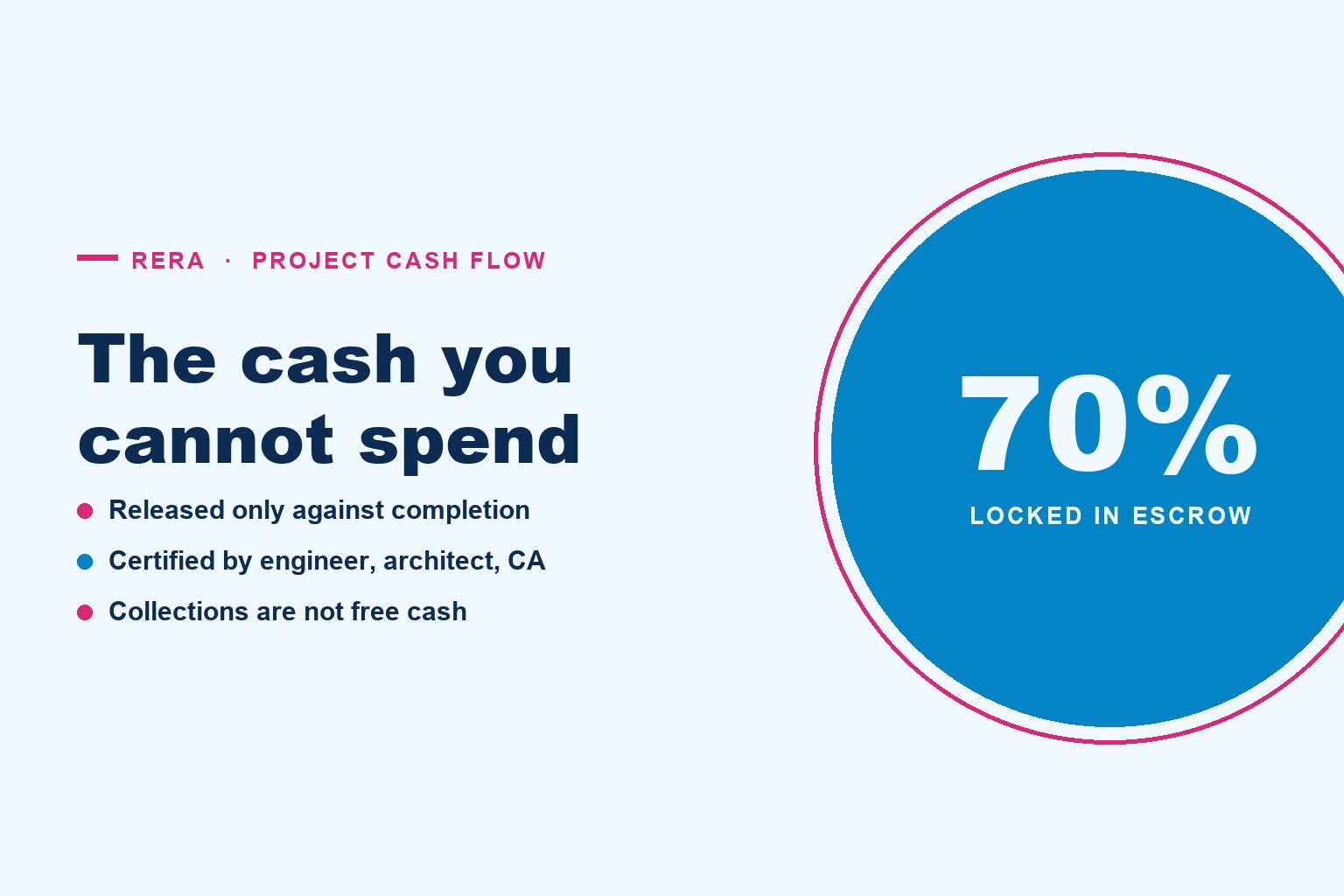

TL;DR: Most real-estate project models fail for the same reason: they are profit-and-loss forecasts with a construction schedule bolted on. A project model has to be a constrained cash-flow model, because three rules decide what the developer can actually spend and when. First, seventy per cent of everything collected from buyers is locked in a separate account under Section 4(2)(l)(D) of RERA, and comes out only against a certificate signed by an engineer, an architect and a chartered accountant. Second, residential developers sit in a GST scheme with no input tax credit, so every rupee of GST on cement, steel and works contracts is project cost, not a credit. Third, under Ind AS 115 the revenue does not arrive when the money does — for most Indian residential contracts it lands at possession, years after the cash, though that is a conclusion you have to reach on your own contract rather than assume. Build for those three and the model will survive the lender's appraisal and the auditor's questions. Ignore them and it will show a healthy project running out of money.
1. Why the standard model breaks here
The generic three-statement model assumes cash is fungible: money in the bank is money you can spend. In a RERA-registered project that assumption is simply false, and it is false by statute rather than by convention.
It also assumes revenue and cash roughly track each other. In Indian residential real estate they diverge by years. A demand-linked payment plan may have collected eighty per cent of the sale value by the time the slabs are done, while the accounting revenue for those same units is still zero.
And it treats indirect tax as a wash — collected from the customer, paid to the government, netted against credits. Under the concessional residential scheme there are no credits to net.
Fix those three and most of the rest is ordinary discipline. Get them wrong and the model is not conservative or aggressive; it is describing a different business.
2. Model the project, not the company
The modelling unit is the RERA-registered project or phase, because that is the unit the escrow attaches to. A developer running four towers registered as three phases has three separate escrow accounts, three separate completion percentages and three separate certification trails. Consolidating them into one company-level model hides precisely the problem you are modelling: cash trapped in Phase 2 cannot fund Phase 3, however healthy the group looks.
Build one tab per registered project, then consolidate. Keep the escrow balance as a distinct line, never merged into "cash and bank".
3. The collection line
Start with the sales side, because everything downstream is a function of it:
- Inventory — units by type, carpet area, and the RERA-declared saleable area.
- Booking curve — units sold per month. This is the single most sensitive assumption in the model and deserves an explicit scenario, not a straight line.
- Price realisation — base rate plus floor rise, PLC, parking and amenity charges, net of the discount actually given rather than the one in the price list.
- Payment plan — construction-linked, possession-linked or flexi. This converts bookings into collections, and the lag between the two is where optimistic models quietly cheat.
- Collection efficiency — demands raised versus money received. Assume 100% and the model is fiction; a realistic haircut and an ageing assumption belong here.
The output of this block is a monthly collections figure. Not bookings. Not revenue. Collections.
4. The 70% escrow, and what it does to your cash
This is the constraint that makes the model a real-estate model. Section 4(2)(l)(D) of the Real Estate (Regulation and Development) Act, 2016 requires the promoter to declare that seventy per cent of the amounts realised for the project from allottees will be deposited in a separate account in a scheduled bank, to cover the cost of construction and the land cost, and used only for that purpose.
Three provisos then govern how the money comes back out, and each one is a modelling input:
- Proportionality. The promoter may withdraw from the separate account to cover the cost of the project in proportion to the percentage of completion of the project. Not in proportion to costs incurred. Not on demand.
- Tri-partite certification. The withdrawal may be made only after it is certified by an engineer, an architect and a chartered accountant in practice that the withdrawal is in proportion to the percentage of completion. Three professionals, all three required.
- Annual audit. The promoter must get the accounts audited within six months after the end of every financial year by a chartered accountant in practice, and produce a certified statement of accounts.
What this means in the model
Free cash available to the promoter in any month is not collections. It is:
the 30% that falls outside the statutory deposit requirement
+ certified withdrawals from the escrow (capped by percentage of completion)
− project costs paid
Note what that 30% is and is not. Section 4(2)(l)(D) restricts the seventy per cent; it does not declare the balance free of every claim. State RERA rules, the financing documents, the lender's waterfall and the project's own contracts can all bite on it. Treat it as "outside the statutory deposit requirement", model any further restriction that actually applies, and do not assume it is spendable by default.
Take a simple month. Collections Rs 10 crore. Rs 7 crore goes into the escrow, Rs 3 crore falls outside the deposit requirement. If the project is 40% complete and cumulative certified withdrawals to date are already at that ceiling, the escrow contributes nothing this month regardless of the Rs 7 crore sitting in it. The developer's spendable cash is Rs 3 crore against a construction bill that may be several times that.
This is the structural squeeze of a fast-selling, slow-building project, and it is invisible in any model that treats collections as cash. In the model it means you need two separate balances — escrow and free cash — with the escrow released only against the certified-completion ceiling. A monthly line for "cumulative withdrawal entitlement less cumulative withdrawals" is the single most useful cell in the whole workbook.
Two practical notes, and the first one is where models most often go wrong.
Do not assume you know how "percentage of completion" is measured here. The Act says withdrawal must be in proportion to the percentage of completion; it does not prescribe how that percentage is computed. That is left to the rules made by the State authority, and States differ. Some prescribe a cost-incurred-to-estimated-total-cost formula, which looks like the accounting measure but is computed on the project cost estimate filed with the authority rather than on your books. Others work off certified physical progress. The forms, the certificate formats and the upload-and-release process also vary. Model the formula and the release process in the rules of the State your project is registered in — and read them, rather than assuming either the physical measure or your financial-reporting figure.
Second, the certification cycle has a lag: engineer and architect measurement, then CA verification, then bank release. Model the lag; a project can be technically entitled to a withdrawal it will not see for six weeks.
5. Construction cost, and the GST scheme with no credit
Residential construction sits in a concessional GST scheme in force from 1 April 2019: broadly 1% for affordable housing and 5% for other residential apartments, in both cases without input tax credit, with one-third of the total consideration deemed to be the value of land. The scheme carries a condition on the proportion of inputs and input services to be procured from registered suppliers, with a reverse-charge consequence on any shortfall.
Verify the rate applicable to your project category and the current procurement condition against the CBIC notifications before you model them. Rates and conditions have moved more than once, and a project model built on last year's rate is a wrong model. But the structural point below does not depend on the rate at all, and it is the one that matters for modelling.
The consequence: input GST is cost
Because the scheme is without ITC, GST charged by your contractors and suppliers never comes back. It is not a balance-sheet item that unwinds. It is construction cost, and it must be modelled inside the cost line rather than in a separate tax schedule.
That single fact has consequences most models miss:
- Rate changes on inputs hit project cost directly. When GST 2.0 took effect on 22 September 2025 — removing the 12% slab and moving cement from 28% to 18% — a developer under the no-credit scheme did not gain a credit. The cost of cement fell. That belongs in the model as a cost input, and it is a real change to the cost line of any project procuring after that date.
- Registered versus unregistered procurement is a modelled decision, not a procurement detail. The scheme's procurement condition and its reverse-charge consequence mean the mix has a cash cost. Model it.
- Works contract versus material-plus-labour changes the number. Two commercially identical arrangements can carry different GST, and with no credit to absorb the difference it lands on the project.
The cost block itself should be built bottom-up — land, approvals and premiums, construction by activity, infrastructure and amenities, marketing and brokerage, finance cost, and a contingency you actually intend to use — and phased on the construction schedule rather than spread evenly. Peak funding requirement is a function of phasing, not of total cost, and a model that spreads costs evenly will understate the peak every time.
6. Land, and the joint development case
An outright land purchase is easy to model: a large early outflow, usually the reason the project needs debt at all.
A joint development agreement is not. The developer pays little or nothing up front and instead gives the landowner a share of the built area or of revenue. In the model this shows up as a reduction in saleable inventory or a revenue share outflow — not as land cost — and getting that classification wrong distorts every per-square-foot metric downstream.
On the tax side, a JDA with an individual or HUF landowner carries a deferral: the landowner's capital gains are chargeable in the year the completion certificate is issued, rather than in the year the agreement is signed — subject to the condition that the landowner does not transfer their share before that date. This is the landowner's tax position, not the developer's, but it drives negotiation and sometimes the structure of the area split, so a developer's model should carry it as an assumption note.
One caution on section numbers. The Income-tax Act, 2025 commenced on 1 April 2026 and renumbered the statute. The familiar 1961-Act references for the JDA deferral, for the stamp-duty-value floor on transfers of land and buildings held as stock-in-trade, and for the notional rent charge on unsold completed inventory are no longer the operative citations. The mechanisms survive; the numbers do not. Map each to the current section before you put a citation in a document that leaves your desk.
7. Debt, and interest during construction
Construction finance is drawn against progress and repaid out of collections, usually through an escrow mechanism the lender controls. Three things belong in the model:
- Drawdown schedule — tied to the cost curve, subject to the promoter contribution being brought in first, which is how most sanctions are worded.
- Interest during construction. Under Ind AS 23, borrowing costs directly attributable to a qualifying asset are capitalised rather than expensed — but only while the capitalisation conditions hold. Capitalisation must be suspended during extended periods in which active development is suspended, and ceases when substantially all the activities necessary to prepare the asset for its intended use or sale are complete. That distinction is the whole point in a delay scenario, and it cuts both ways: a delay in which work continues capitalises interest and raises total project cost, while a stalled project stops capitalising and takes the interest straight to the profit and loss account. Model the two cases separately — a model that capitalises interest through a stoppage overstates the asset and understates the loss.
- Repayment waterfall — the order in which collections go to escrow, to the lender, to costs and to the promoter. Model the actual waterfall in the sanction letter, not a simplified version of it.
8. Revenue recognition is not collection
Under Ind AS 115, revenue is recognised when control of the asset transfers to the customer — and that can be over time or at a point in time. The test is in paragraph 35. Revenue goes over time only if one of three conditions is met, and for a residential project the one that matters is the third: the entity's performance creates an asset with no alternative use to the entity and the entity has an enforceable right to payment for performance completed to date.
That second limb is where most Indian builder-buyer agreements fail, which is why residential revenue commonly lands at a point in time, on handover. But that is a conclusion about a particular set of contracts, not a rule of Indian accounting — the ICAI has expressly cautioned against reading Ind AS 115 as requiring real-estate revenue to be recognised only on completion or possession. The answer turns on the agreement, on the applicable State law and RERA rules, and on the enforceability of the payment right in practice.
What that means for the model: do not hard-code the recognition pattern. Establish which way paragraph 35 falls for your contract form, document the reasoning, and build the accounting view on that. A model that assumes possession-based recognition for a project whose contracts satisfy paragraph 35(c) will misstate every reported margin and every profit-based covenant test in it.
So the model needs two views of the same project:
- the cash view, which is what determines whether the project survives; and
- the accounting view, which is what the financial statements, the covenants and the tax computation run off.
Costs accumulate as inventory or contract cost while collections sit as an advance from customers, and both unwind at possession. The result is a profit-and-loss account that looks empty for three years and then reports the entire project margin in one period. If your covenant package contains a profit-based test, that lumpiness is a live risk and belongs in the covenant schedule, not in a footnote.
9. What the lender actually tests
When the model goes into a bank as part of the project report and CMA data, a credit officer will look at a short list. Build these as explicit outputs rather than leaving them to be derived:
| Metric | What it asks | Where models go wrong |
|---|---|---|
| Cost to complete vs balance receivables | Can the unsold and unrealised inventory fund what is left to build? | Counting escrow cash as available when the completion ceiling blocks it |
| DSCR | Does cash flow cover interest and principal in each period? | Computed on annual averages, hiding a quarter where it falls below 1 |
| Peak funding requirement | What is the deepest the project goes into deficit, and when? | Costs spread evenly instead of phased, which flattens the trough |
| Promoter contribution | Has the promoter's share gone in, and up front? | Modelled as a plug that arrives exactly when needed |
| Project IRR vs equity IRR | Does the project work, and does the equity work after debt? | Only one of the two is presented — usually the flattering one |
| Break-even — both kinds | Economic: what net realisation must be sold to recover total project cost? Cash: when does the collection curve cover the funding requirement? | Only one of the two is presented, so a project that is profitable on paper but cannot be funded through its trough looks fine |
Sensitivity is not optional
A single-scenario model is an opinion. Run at least these four, each independently and then in a downside combination:
- Sales velocity down 25% and 40% — the assumption that breaks projects most often.
- Price realisation down 5% and 10%.
- Construction cost up 10%, with the IDC effect flowing through rather than held constant.
- Completion delay of six and twelve months, carrying both the IDC compounding and the escrow-release delay.
The output that matters is not the IRR in each case. It is the date and depth of the worst cash position, and whether the project can be funded through it.
10. A build checklist
- One tab per RERA-registered project or phase. Consolidate afterwards, never before.
- Separate the escrow balance from free cash. Never net them.
- Carry a running "withdrawal entitlement less withdrawals taken" line, driven by the completion formula your State RERA rules actually prescribe — read them rather than assuming.
- Model the certification and bank-release lag, not just the entitlement.
- Put input GST inside construction cost, because under the no-credit scheme that is what it is.
- Verify the current GST rate and procurement condition for your project category before locking the cost line.
- Capitalise only eligible borrowing costs, only while the Ind AS 23 conditions hold; suspend on an extended stoppage and cease at substantial completion.
- Establish where paragraph 35 of Ind AS 115 falls for your contract form before you fix the recognition pattern. Keep a cash view and an accounting view, and reconcile them.
- Present project IRR and equity IRR together, and both break-evens — economic and cash.
- Map every income-tax reference to the Income-tax Act, 2025 numbering before it leaves your desk.
Sources and further reading
- State RERA rules and regulations — made under the Act by each State authority. They prescribe how the percentage of completion is computed for withdrawal purposes, the certificate formats, and the release process, and they differ between States. Always work from the rules of the State the project is registered in.
- Real Estate (Regulation and Development) Act, 2016 — Section 4(2)(l)(D) and its three provisos: the seventy per cent separate account, withdrawal in proportion to the percentage of completion, certification by an engineer, an architect and a chartered accountant in practice, and audit of accounts within six months of the financial year end by a chartered accountant in practice.
- GST on residential construction — the concessional scheme in force from 1 April 2019 under Notification 03/2019-Central Tax (Rate) and the corresponding State notifications: 1% for affordable and 5% for other residential apartments, without input tax credit, with one-third of consideration deemed to be land value, and a condition on procurement from registered suppliers. Confirm current rates and conditions on the CBIC portal.
- GST 2.0, effective 22 September 2025 — slab restructuring, including cement moving from 28% to 18%. Relevant to a developer under the no-credit scheme as a change in input cost.
- Ind AS 115, Revenue from Contracts with Customers — transfer of control, and the paragraph 35 test for over-time recognition (no alternative use plus an enforceable right to payment for performance completed to date). See also the ICAI educational material and the ICAI clarification cautioning against a blanket completion-or-possession rule for real estate.
- Ind AS 23, Borrowing Costs — capitalisation of directly attributable borrowing costs on a qualifying asset, suspension during extended periods of suspended active development, and cessation when substantially all preparatory activities are complete.
- Income-tax Act, 2025 — in force from 1 April 2026. All income-tax provisions relevant to real estate have been renumbered; map before citing.
This article states the position as at 30 August 2026 and is written for professionals building or reviewing project models. GST rates and conditions, RERA rules made by individual State authorities, and accounting requirements all change; every figure that enters a model should be verified against the current notification or standard before it is relied on. Nothing here is advice on a specific project, and a project model is not a substitute for an appraisal by the lender or an opinion from the professionals certifying under Section 4(2)(l)(D).


Comments (0)
No comments yet. Be the first to comment!