
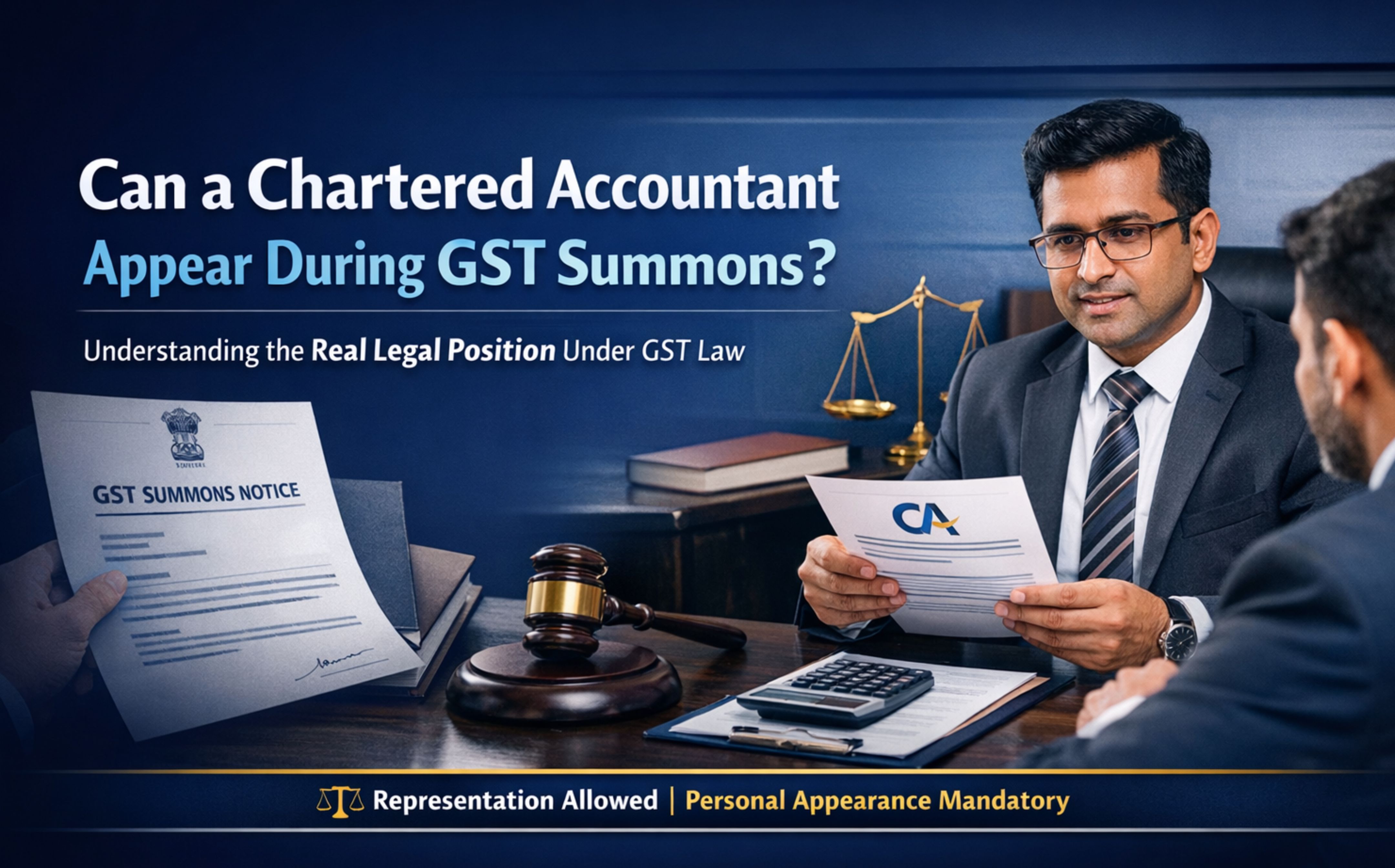

The Question Every GST Practitioner Faces
A summons lands on your client's desk under Section 70 of the CGST Act. The client panics, calls you, and asks the obvious question: "Can you just go instead of me?" The honest answer is neither a clean yes nor a clean no. The statute permits representative appearance, but the discretion to allow it rests with the officer, and the nature of what the officer wants to ask matters as much as the letter of the law.
The Statutory Framework: Section 70 of the CGST Act
Section 70 of the Central Goods and Services Tax Act, 2017 arms the proper officer with powers analogous to a civil court under the Code of Civil Procedure, 1908. Under Section 70(1), an officer may summon any person whose attendance is considered necessary either to give evidence or to produce a document or any other thing in an inquiry.
The critical provision for the present discussion is Section 70(1A), inserted by the Finance Act, 2023. It reads, in substance, that every person summoned "shall be bound to attend, either in person or by an authorised representative, as such officer may direct." The drafting is deliberate. The phrase "as such officer may direct" places the discretion squarely in the hands of the investigating authority, not the taxpayer.
In other words, a person who is summoned does not have an automatic, unconditional right to send a representative. The officer can insist on personal attendance if the facts demand it.
Who Qualifies as an "Authorised Representative"?
The expression "authorised representative" is defined under Section 116 of the CGST Act read with Rule 84 of the CGST Rules. The category includes:
- A relative or a regular employee of the person concerned
- An advocate entitled to practise in any court in India
- A Chartered Accountant, Cost Accountant, or Company Secretary holding a certificate of practice
- A retired officer of the Commercial Tax Department or the Central Board of Indirect Taxes and Customs, subject to the cooling-off and other conditions prescribed
- A GST Practitioner enrolled under Section 48
So a practising CA is unquestionably within the list of persons who can act as an authorised representative under the statute. The question is never whether the CA is qualified. The question is whether the officer, in the exercise of discretion under Section 70(1A), will permit appearance by the CA in place of the summoned person.
The Crucial Distinction: Evidence vs. Documents
The answer turns on what the officer wants from the summoned person. Section 70(1) contemplates two distinct objects of a summons: giving evidence, and producing documents or other things. The two stand on very different footings when it comes to representative appearance.
Where the Summons Seeks Documents or Records
If the summons is primarily for production of books of account, invoices, e-way bills, ledgers, GSTR filings, or similar documentary material, a CA can practically and lawfully comply on the client's behalf. The officer is seeking records, not personal testimony, and the representative can deliver, explain, and certify those records.
Where the Summons Seeks Personal Evidence
If the summons is directed at the taxpayer's personal knowledge of facts — how a particular purchase was arranged, who approved a payment, why a supplier was chosen, how stock moved between locations, who generated the e-way bill, what was discussed in a meeting — substitution by a CA is, in practice, not available. The bar is not a statutory prohibition: Section 70(1A) contains no express provision barring a representative from appearing even where a statement is to be recorded. The bar operates at two levels. First, the officer, in the exercise of discretion under Section 70(1A), will almost invariably insist on the personal presence of the person whose knowledge is sought. Second, even if representative appearance were permitted, a CA's statement about facts he did not personally witness is, in substance, hearsay — it has no probative value in a subsequent show cause under Section 74 or prosecution under Section 132, and may well invite an adverse inference against the taxpayer.
The practical consequence is settled. A CA may accompany the client, sit through the statement recording under Section 70 read with Section 136 of the CGST Act, and assist with document references. But the statement recorded on oath must come from the person who actually has personal knowledge of the facts. The CA's role at that moment is that of an adviser in the room, not a substitute witness.
When a CA is Summoned in His Own Capacity
A separate situation arises when the CA is himself the addressee of the summons — for example, where the officer wants to examine him as the auditor of the taxpayer, as the statutory auditor under the Companies Act, 2013, or as the person who issued a GST reconciliation statement. In that case the CA appears in his own capacity and is bound to attend personally. He cannot send another representative in his place, subject again to the officer's discretion under Section 70(1A).
It is also important to remember that the legal privilege attaching to communications between an advocate and client under Section 126 of the Indian Evidence Act, 1872 (now Section 132 of the Bharatiya Sakshya Adhiniyam, 2023) does not extend to Chartered Accountants. A CA summoned under Section 70 cannot refuse to disclose client communications on the ground of professional privilege. This is a meaningful practical difference between engaging a CA and engaging an advocate at the investigation stage.
Exemptions from Personal Appearance
The CGST Act does not itself carve out exemptions from personal appearance in summons proceedings, but Section 70(1) borrows the civil court analogy, and officers generally follow the protections contained in Sections 132 and 133 of the Code of Civil Procedure, 1908. These provisions exempt certain classes — including women who by custom do not appear in public and specified high-ranking public officers — from being compelled to attend a court in person. Where the exemption applies, the investigation may be advanced through written responses or by examining the person at their residence.
Age, illness, or disability are not per se grounds of exemption under the CGST Act, but officers routinely accommodate genuine medical or mobility constraints on a case-by-case basis, provided the taxpayer establishes the difficulty on record.
Judicial Guidance on Section 70 Summons
Several High Courts have, over the last three years, examined the contours of Section 70 summons and the scope of representative appearance. The consistent theme in the reported decisions is twofold. First, the summons power under Section 70 is a serious statutory power and compliance is mandatory — failure to attend can attract prosecution under Section 174 of the Indian Penal Code, 1860 (now Section 210 of the Bharatiya Nyaya Sanhita, 2023). Second, the officer's discretion under Section 70(1A) is not unfettered; it must be exercised reasonably and the insistence on personal presence should be tied to the nature of the inquiry.
Where summons have been issued repeatedly, at unreasonable frequencies, or with the apparent object of pressuring the taxpayer rather than advancing a genuine inquiry, writ courts have intervened. At the same time, courts have uniformly declined to treat Section 70 summons as optional or as an invitation that can be deflected by sending a CA in place of the summoned person.
Practical Guidance for CAs Handling a GST Summons
- Read the summons carefully. Identify whether it is issued to the taxpayer or to the CA himself, whether it calls for production of documents, recording of a statement, or both, and the section under which it has been issued.
- Check jurisdiction and form. A valid summons under Section 70 must be in writing, must bear the signature and designation of the proper officer, and must be issued in Form GST INS-01 or the equivalent format used by the officer's jurisdiction.
- Prepare the client. Where personal appearance is required, brief the client on the transactions likely to be discussed, the documents on record, and the importance of answering truthfully. A statement recorded under Section 70 read with Section 136 is admissible in evidence in subsequent proceedings.
- Accompany, do not substitute. Attend with the client where factual testimony is to be recorded. Assist with document references and ensure that the statement accurately captures what the client says. Request a copy of the statement at the close of the proceedings.
- Seek representative appearance where appropriate. If the summons is purely for production of records, a written request may be made to the officer seeking permission for the CA to appear with the records on behalf of the taxpayer. Do not assume the permission; obtain it in writing.
- Respect the timeline. If additional time is needed to assemble records or for a genuine reason preventing attendance, file an adjournment request in advance, with supporting documents, rather than simply not turning up.
- Protect the client from self-incrimination. The protection under Article 20(3) of the Constitution does not strictly apply to pre-prosecution statements under Section 70, but the client should be advised carefully where the line of questioning is moving towards admission of wilful evasion under Section 132 of the CGST Act.
Consequences of Non-Appearance
A person who without reasonable cause fails to comply with a summons issued under Section 70 commits an offence. Beyond the invocation of Section 174 IPC (Section 210 BNS), the department may proceed to draw adverse inferences, pass best-judgment orders, and in serious cases initiate arrest under Section 69 of the CGST Act where the alleged evasion crosses the thresholds in Section 132. Treating a summons casually is therefore never an option, whether the client appears in person or through a representative.
Conclusion
A Chartered Accountant is a recognised authorised representative under the CGST Act and can very much play a central role in the defence of a taxpayer facing GST summons proceedings. What is effectively closed to the CA is the ability to stand in for the client where the officer wants to record the client's personal knowledge of the facts of the case — not because Section 70(1A) expressly bars it, but because the officer's discretion under that sub-section will almost always be exercised to require personal attendance for statement recording, and because a representative's statement on facts outside his own knowledge has no evidentiary value. The role of the CA at the investigation stage is therefore best understood as that of an adviser and companion — preparing the client, safeguarding procedural rights, handling documentary compliance, and ensuring that the officer's discretion under Section 70(1A) is exercised within the four corners of the law.





Comments (0)
No comments yet. Be the first to comment!