
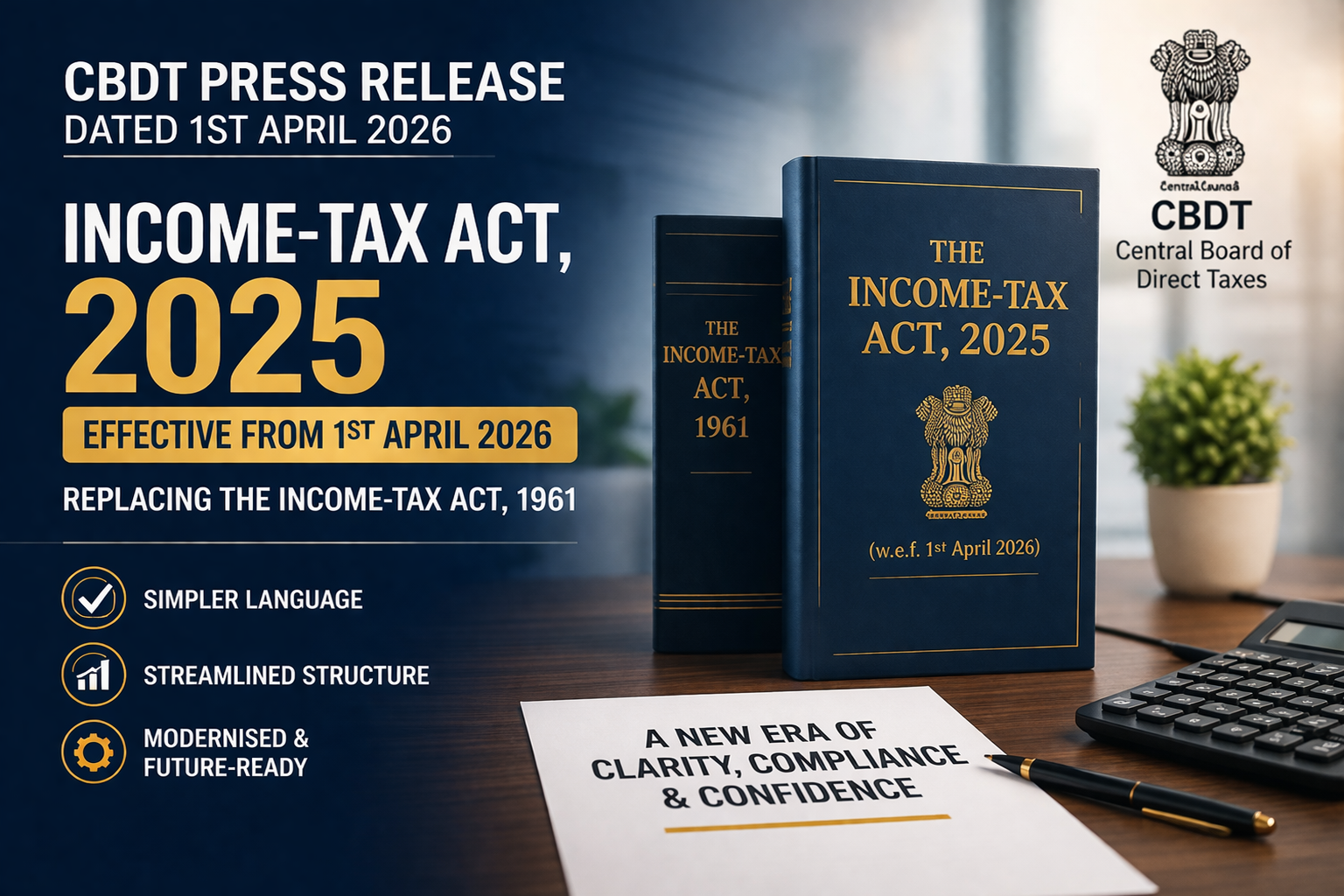
The Central Board of Direct Taxes (CBDT), through its Press Release dated 1st April 2026, has officially notified that the Income-tax Act, 2025 has come into force from 1st April 2026, replacing the earlier Income-tax Act, 1961. This marks a significant shift in India’s direct tax framework.
Key Highlights of the New Law
| Replacement of Old Law: | The Income-tax Act, 1961 is now replaced by the Income-tax Act, 2025. |
| Simplified Language: | The new Act uses clearer and more concise wording for better understanding. |
|
Streamlined Structure: |
Sections have been reorganised logically to improve navigation and interpretation. |
|
Focus on Modernisation: |
The law aims to align with current business practices and reduce ambiguity in compliance. |
Impact for Chartered Accountants and Tax Professionals
- Easier interpretation and advisory due to simplified provisions
- Reduced litigation scope over complex language
- Need to update internal knowledge, systems, and client communication
- Transitional challenges in mapping old sections to new provisions
Reliable Sources
- CBDT Press Release dated 01.04.2026
- Ministry of Finance notifications on Income-tax Act, 2025
- Official publications on Central Board of Direct Taxes
Conclusion
The implementation of the Income-tax Act, 2025 is a major reform aimed at improving clarity and efficiency in tax compliance. Chartered accountants and tax professionals should proactively adapt to the new framework to guide clients effectively.
Comments (0)
No comments yet. Be the first to comment!